# 1 position
Berk Trade and Business School - Plumbing Technology/Plumber.
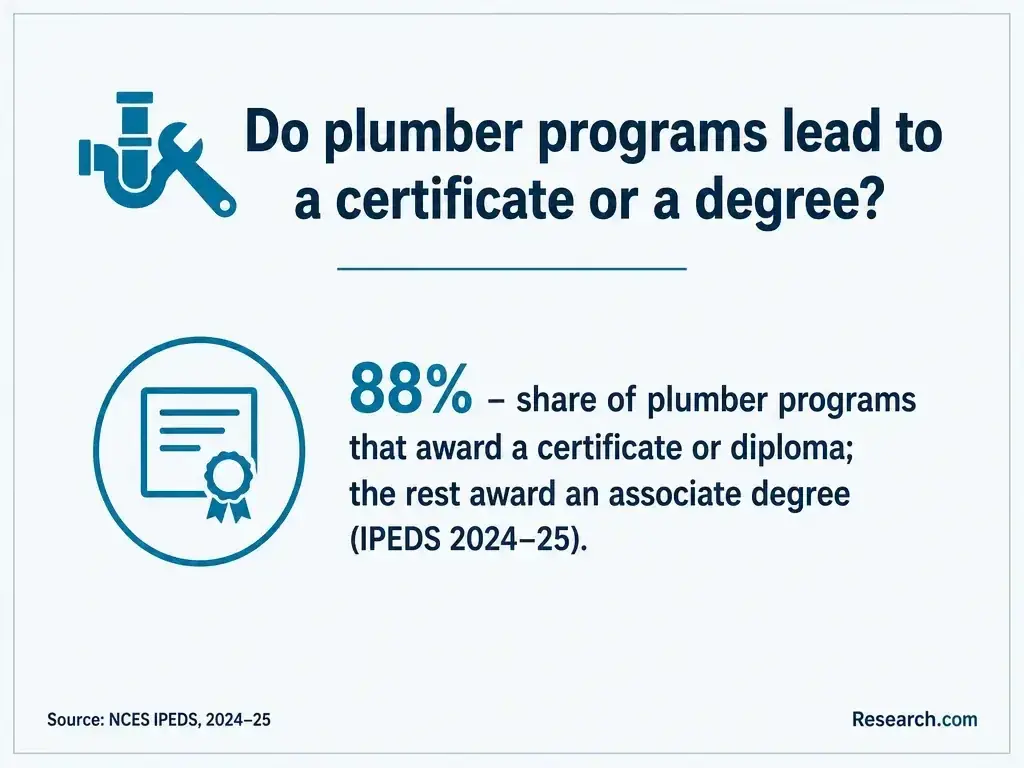
certificate or diploma

Audited and Verified:
Our Editorial and Data Verification Process
Research.com uses government datasets, official education statistics and primary institutional information to support its career and degree guides. Our review process checks factual accuracy, occupational definitions, source dates and the requirements associated with the credentials discussed.
How This Article Was Fact-Checked
Our editorial team verifies salary estimates, employment projections, education requirements and program information against original data providers and official organizations. Salary figures are checked against the relevant occupational definitions and reporting periods. Information about licensure, accreditation and required in-person training is reviewed separately.
Fact-checked and verified on:

Co-Founder and Chief Data Scientist

Reviewed by Karolina Broda
Fact-Checker and Data Verification
The cheapest plumbing program is not necessarily the least expensive route to a plumbing career: tools, travel, unpaid training time, and access to paid apprenticeships can change the calculation. The U.S. Bureau of Labor Statistics projects 6.8% national employment growth for plumbers, pipefitters, and steamfitters from 2025 to 2035. For prospective students and career changers, this guide compares New York training paths, costs, and local licensing considerations. It will feature a Most Affordable Plumber Trade Schools in New York for 2027 ranking, created by the Research.com team of data scientists to help students identify programs worth considering.
Expect a mix of classroom instruction and supervised practice: measuring and cutting pipe, assembling joints, reading drawings, identifying fixtures, and applying safety and code principles. Ask to see the shop schedule. A program with demonstrations but little individual tool time is not equivalent to one with substantial supervised installation practice, even if both award a certificate.
The main choice is whether to pay for introductory training before seeking work or pursue an apprenticeship that teaches the trade while you earn wages. This comparison separates the credentials and experiences that similarly named "plumbing programs" may provide.
| Pathway | Typical outcome | Best fit and principal limitation |
| Trade-school certificate or diploma | School credential and shop instruction | Useful for building entry-level skills; confirm whether an employer or apprenticeship sponsor credits the training. |
| Public technical-college plumbing program | Institutional credential; sometimes broader technical coursework | Useful when the curriculum and schedule fit; check resident tuition and whether added study advances your plumbing goal. |
| Registered apprenticeship | Paid, supervised work plus related instruction and an apprenticeship completion credential | Strong fit for learners ready for worksite training; entry depends on sponsor selection and available openings. |
| Employer-sponsored entry route | Paid experience and employer-provided training; credential varies | Can avoid upfront school costs; confirm supervision, instruction, and whether experience is documented for future progression. |
If your priority is entering work quickly, compare job placement and apprenticeship access before buying an accelerated course. Lists of easy degrees that pay well do not answer the key plumbing question: how will you obtain supervised, hands-on experience after training?
Plumbing trainees may work for residential service contractors, commercial construction firms, building-maintenance employers, or organizations maintaining public facilities. Work differs: service calls demand diagnosis and customer communication, while construction work emphasizes plans, installation sequencing, and coordination with other trades (U.S. Bureau of Labor Statistics, Occupational Outlook Handbook).
Location affects both opportunity and expense. New York City-area work may involve dense commercial sites and substantial commuting costs; elsewhere, a smaller employer may offer broader repair experience but fewer nearby apprenticeship openings. Check the actual worksite and training-center locations before enrolling. If you are weighing other in-demand trade jobs, compare their local apprenticeship openings and entry requirements - not just national wage figures.
The U.S. median annual wage for plumbers, pipefitters, and steamfitters was $63,800 in May 2025 (U.S. Bureau of Labor Statistics, Occupational Outlook Handbook). This is a national figure for a combined occupation, not a New York starting wage or an estimate for someone finishing a short course.
For a local decision, compare the latest New York State Department of Labor wage data for the occupation in the region where you expect to work, then ask prospective employers or apprenticeship sponsors about entry-level pay, scheduled raises, benefits, and travel between sites. A higher posted wage may be less attractive if the route requires substantial unpaid preparation or an expensive commute.
A short school program can provide introductory skills faster than an apprenticeship, but completion does not mean you have completed the supervised work needed for advanced responsibilities. Registered apprenticeships generally extend over multiple years because related instruction is paired with progressively skilled work (U.S. Department of Labor, Apprenticeship.gov). Exact schedules and required hours depend on the sponsor and program.
Ask each school for total clock hours, individual shop hours, weekly attendance, and any documented credit toward an apprenticeship. Ask sponsors whether prior training earns advanced standing; do not assume it does. Even if you are comparing education searches such as 12 month master's programs, a short completion timeline is the wrong measure for plumbing unless it also leads to the worksite training you need.
Online lessons can cover drawings, calculations, terminology, and code concepts. They cannot, by themselves, demonstrate that you can safely cut and join pipe, install fixtures, test a system, or diagnose a leak. Campus shops, supervised fieldwork, and employer worksites provide that practical assessment.
A hybrid course makes sense if it specifies where hands-on sessions occur, who supervises them, and how attendance fits your commute and work schedule. A fully remote course may be useful preparation, but do not treat it as equivalent to practical training or proof of local licensing eligibility. Resources about degree programs for older adults online address a different decision; for plumbing, verify the in-person component first.
There is no single dependable statewide average covering private schools, public programs, union training, and paid apprenticeships: they report costs differently, and college datasets do not capture every provider (National Center for Education Statistics, IPEDS; U.S. Department of Labor, Apprenticeship.gov). A published school tuition figure is therefore more useful as one line in a personal budget than as a statewide price benchmark.
Compare the following costs for each option over the full period until you can enter the work you want. The categories matter because a paid route with a longer timeline can cost less out of pocket than a shorter course.
| Cost or offset | What to compare |
| School charges | Tuition, mandatory fees, books, consumables, and payment-plan charges |
| Job-readiness expenses | Tools, safety gear, required checks, and any applicable exam or application fees |
| Attendance and earnings | Travel to shops or worksites, schedule-related lost earnings, and apprenticeship wages |
| Assistance | Confirmed grants, scholarships, employer support, and aid eligibility |
Ask the provider for an itemized written estimate and confirm federal-aid eligibility with the school and Federal Student Aid; eligibility is not automatic for every trade program. New York workforce offices can also help identify available training assistance (New York State Department of Labor). Comparisons with most affordable online doctoral programs are not useful cost benchmarks for plumbing: the relevant comparison is a local school route versus paid training and its associated expenses.
Depending on the provider, you may receive a school certificate or diploma; a registered apprenticeship has its own completion credential. Some programs may also prepare students for an industry credential, but preparation is not the same as earning it. Request the exact credential name and ask employers or apprenticeship sponsors whether they recognize it or award credit for the training.
Keep the distinctions clear: institutional accreditation concerns the school; state school authorization concerns permission to operate; apprenticeship registration concerns the training arrangement; and occupational licensure governs work where a locality requires it. None automatically substitutes for the others (U.S. Department of Education; New York State Department of Labor; New York City Department of Buildings).
Requirements vary by provider. Schools may assess educational preparation and the ability to participate safely in shop work; apprenticeship sponsors set their own application, assessment, interview, and work-eligibility procedures. Do not mistake admission to a school for acceptance into a paid apprenticeship.
Before paying an application fee, ask for the current admissions requirements and the next start date. If placement is advertised, ask whether it means an employer interview, a confirmed opening, or simply help with applications. For an apprenticeship, confirm the sponsor is registered and ask when recruitment opens (New York State Department of Labor).
Relevant instruction includes pipe materials and joining methods, fixture installation, drainage and water-supply systems, blueprint reading, measurements, troubleshooting, jobsite safety, and applicable plumbing-code concepts. Worksite learning adds coordination with other trades, efficient installation, and communicating about repairs (U.S. Bureau of Labor Statistics, Occupational Outlook Handbook).
Compare syllabi against the tasks you want to perform. Someone aiming for service work should look for diagnosis and repair practice; someone pursuing construction should look for layout, drawings, and installation exercises. Ask how many hours each student - not just the class as a whole - spends using tools and receiving instructor feedback.
Check the municipality where you plan to work. New York does not offer a single statewide plumber license that overrides local rules. New York City regulates master plumbers and has requirements for journeyman-plumber registration; the applicable rules for other municipalities must be checked locally (New York City Department of Buildings; New York State Department of Labor).
A trainee may work under appropriate supervision without personally holding the credential needed to contract independently, but a school certificate alone does not authorize independent licensed plumbing work. Before enrolling, ask the local building or licensing authority which experience, supervision, registration, examination, and application rules apply to your intended role. Ask a school how it documents training and whether its placements provide qualifying experience; obtain confirmation from the authority rather than relying on a marketing claim.
Start with your intended job and locality, then compare programs against that goal. The following checks can prevent the most expensive mistakes - especially choosing on sticker price or a ranking position while overlooking practical experience.
A program is worth the investment when its practical training and employer recognition justify its total cost for your goal. For a fuller return-on-investment comparison, consider the training period, lost earnings, aid, likely debt, your current income, realistic post-training pay, and the possibility of not completing - not a median wage alone.
Introductory training can support applications for plumbing-helper, trainee, or apprentice positions. With supervised experience, workers may move into service plumbing, new construction, pipefitting, or steamfitting where their training matches the role. Later progression can include crew leadership, estimating, or operating a plumbing business, subject to applicable local licensing rules (U.S. Bureau of Labor Statistics, Occupational Outlook Handbook; New York City Department of Buildings).
Choose training for the first position you can realistically obtain, not only a distant supervisory title. A prospective service plumber benefits from repair exposure; a prospective business owner also needs to plan for documented experience and the licensing requirements of the municipality where the business will operate.
National employment for plumbers, pipefitters, and steamfitters is projected to grow 6.8% from 2025 to 2035 (U.S. Bureau of Labor Statistics, Employment Projections). That supports investigating the trade, but it does not measure openings near a particular New York school or guarantee an apprenticeship place.
For a local decision, use New York State Department of Labor regional projections alongside current sponsor recruitment and employer vacancies. Compare the occupation and region carefully: a statewide construction trend may not describe service-repair opportunities in your commuting area. Ask providers which local employers hired recent completers and whether those jobs were plumbing positions.
Choosing where to invest in plumbing training is consequential, especially when a low advertised tuition may not reflect the full cost of attendance. Research.com's team built the accompanying affordability ranking to help readers compare reported costs and debt among programs in the same occupation and location. The team uses multiple education and training sources to check the relevance and credibility of its comparisons.
Only programs with completions reported to the Integrated Postsecondary Education Data System (IPEDS) are eligible. For most affordable rankings, the score considers tuition, cost of attendance, median student debt, and federal loan default rate; an entropy-based method gives more weight to indicators that vary more across eligible programs. Accreditation, support services, completion, and earnings are not part of this affordability score. The separate "best programs" methodology considers outcomes, earnings and costs, accreditation or relevant industry recognition, and support services.
The following sources inform Research.com's rankings and provider checks. Some cover the broader trade-school ranking system rather than plumbing-specific credentials; their inclusion does not imply that a healthcare accreditor accredits plumbing programs.
IPEDS and College Scorecard do not cover every union, employer, or apprenticeship program. A provider's absence from this ranking is not evidence that its training is unavailable or inferior. Use the ranking to narrow your school search, then compare paid apprenticeships and verify current prices, practical training, and local employment requirements. Research.com explains its approach further on its methodology page.
# 1 position
# 2 position

# 3 position
No single trade-school credential is required across the state. A registered apprenticeship or supervised employer training may be an alternative; check local rules for the work you intend to perform (New York State Department of Labor; New York City Department of Buildings).
It can reduce upfront costs and provide wages while you train. Compare tools, travel, related-instruction costs, entry timing, and earnings across the full training period before deciding.
Online coursework can teach concepts, but it cannot replace supervised tool use and worksite experience. Confirm in-person requirements and local employment rules before enrolling.
Not automatically. Licensing and registration requirements depend on the municipality and role; relevant supervised experience and other requirements may apply (New York City Department of Buildings).
Request the full cost, exact credential, individual hands-on hours, completion and placement definitions, and written evidence of any apprenticeship credit. Check those answers against your intended employer and municipality.