# 1 position
Most Affordable Pharmacy Technician Schools & Training in Waco for 2027
Audited and Verified:
Our Editorial and Data Verification Process
Research.com uses government datasets, official education statistics and primary institutional information to support its career and degree guides. Our review process checks factual accuracy, occupational definitions, source dates and the requirements associated with the credentials discussed.
How This Article Was Fact-Checked
Our editorial team verifies salary estimates, employment projections, education requirements and program information against original data providers and official organizations. Salary figures are checked against the relevant occupational definitions and reporting periods. Information about licensure, accreditation and required in-person training is reviewed separately.
Fact-checked and verified on:

Co-Founder and Chief Data Scientist

Reviewed by Karolina Broda
Fact-Checker and Data Verification
Choosing the cheapest pharmacy technician training in Waco is not enough: you also need a route to Texas registration and a workable schedule for hands-on learning. The U.S. Bureau of Labor Statistics projects 6.4% national job growth for pharmacy technicians from 2025 to 2035, making program value worth examining. This guide accompanies the Most Affordable Pharmacy Technician Trade Schools in Waco for 2027 ranking, created by the Research.com team of data scientists to help students identify programs worth considering. Compare costs, credentials, training formats, and career-entry requirements before enrolling.
Key findings about pharmacy technician degrees in Waco
- Texas requires pharmacy technician trainees or technicians to obtain the appropriate Texas State Board of Pharmacy registration; completing a school certificate alone does not authorize pharmacy work.
- The national median pay for pharmacy technicians was $45,750 in May 2025, according to the U.S. Bureau of Labor Statistics. It is not a Waco starting salary.
- For affordability, compare the full cost of a Waco-area certificate with employer-sponsored training: tuition is only one expense, and a paid trainee route may reduce upfront cost.
Table of Contents
- Most Affordable Pharmacy Technician Schools & Training in Waco for 2027
- What can I expect from a pharmacy technician trade school program in Waco?
- Where can I work with a pharmacy technician trade school training in Waco?
What can I expect from a pharmacy technician trade school program in Waco?
Expect training in prescription processing, medication names and calculations, inventory, patient privacy, and pharmacy safety. A classroom-based certificate may add simulated dispensing labs and a supervised pharmacy placement; an employer-sponsored trainee route teaches many tasks at a worksite. Neither format allows an unregistered student to perform regulated pharmacy duties independently. Verify placement arrangements and Texas registration requirements before committing.
These pathways differ most in who pays for training and when practical experience begins:
| Pathway | What you receive | Best fit |
| School certificate or diploma | Structured coursework; labs or placements depend on the program | Students who want guided preparation before seeking pharmacy work |
| Employer-sponsored trainee training | Paid or employer-supported learning while working under supervision | Applicants who can secure a trainee position and learn on the job |
| Associate degree | Pharmacy training plus additional academic coursework | Students who have a specific reason to pursue that longer credential |
The credential name alone does not show how much time you will spend handling pharmacy workflows. Ask for the curriculum, lab schedule, placement policy, and certification-exam preparation plan. If quick occupational entry is your priority, compare a school certificate with paid training and other short certificate programs that pay well rather than assuming a longer program is automatically better.
Where can I work with a pharmacy technician trade school training in Waco?
Potential settings include community pharmacies, hospital pharmacies, clinics, and pharmacy operations that process prescriptions or manage inventory. Tasks vary: a retail role may emphasize customer service and insurance claims, while a hospital role may involve medication distribution and preparation under pharmacist supervision. The U.S. Bureau of Labor Statistics describes pharmacy technicians as working under pharmacists; a training credential does not replace that supervision.
For a Waco applicant, the practical question is which nearby employers offer trainee positions, supervised placements, or jobs requiring an already registered technician. Ask a program where its students complete placements and whether those sites are reachable from your home. A low-cost program can become expensive if required shifts or travel conflict with paid work.
A dependable Waco-specific pay figure should come from a current metropolitan occupational-wage release, not a national median presented as local earnings. As a benchmark, the U.S. Bureau of Labor Statistics reports a $45,750 national median annual wage for pharmacy technicians in May 2025. Half of employed technicians nationally earned more and half earned less; the figure includes experienced workers and should not be treated as an entry-level offer.
When judging whether training will pay off in Waco, compare actual local trainee and registered-technician postings by hourly rate, schedule, benefits, and required certification. Hospital, retail, and other pharmacy jobs may have different duties and hiring standards. If you already have earnings, compare the likely change in pay against total training expense and wages you would give up while attending classes.
A certificate may take several months to about an academic year, depending on its schedule and whether it includes a placement; an associate degree generally takes longer. Employer training follows the employer's work and competency schedule. The U.S. Bureau of Labor Statistics notes that pharmacy technicians commonly learn through postsecondary programs or on-the-job training, so there is no single school-program duration that applies to every entrant.
Do not confuse advertised course length with time to employment. Before enrolling, ask for the total instructional and lab hours, any required placement hours, the time needed to obtain Texas trainee registration for worksite activities, and the program's exam-preparation timeline. Texas registration and national certification are separate steps from finishing classes (Texas State Board of Pharmacy; Pharmacy Technician Certification Board).
Online instruction can cover medication terminology, calculations, law, and insurance concepts. Campus or hybrid instruction can provide supervised practice with prescription workflows and equipment. An online course may be convenient for someone working shifts, but it does not by itself establish practical competence, national certification eligibility, or permission to work in a Texas pharmacy.
Ask an online provider where you will complete any required hands-on activities, who arranges the placement, and whether a site is available near Waco. Confirm that the program meets the eligibility rules of the certification exam you intend to take. Choose campus training if you need scheduled lab support; choose hybrid study if its in-person requirements and travel are manageable. Treat a placement described as "student-arranged" as a real scheduling and cost obligation.
There is no single reliable Waco-wide average that covers school certificates, private training, and employer-sponsored routes on the same basis. Request a written, program-specific cost of attendance instead of using advertised tuition as the total. Add mandatory fees, books or software, uniforms, any required screening, certification exams, Texas registration costs, and travel to labs or placements. Lost wages during unpaid training matter too.
A paid trainee position may lower your upfront expense, although its available hours and training support will differ from a school program. Ask schools about grants, scholarships, and whether their specific program qualifies for federal aid; eligibility is not automatic for every short course. The U.S. Department of Education's Federal Student Aid guidance explains program and school eligibility. Readers comparing delivery formats can also review what online schools accept fafsa, then verify aid for the particular pharmacy technician program.
Most short school routes award a certificate or diploma of completion. An associate-degree route awards an academic degree and includes more coursework. These school awards differ from CPhT national certification and from Texas pharmacy technician registration. The Pharmacy Technician Certification Board sets eligibility and examination rules for its CPhT credential; the Texas State Board of Pharmacy sets the rules for working in Texas.
Ask which exact award appears on your transcript, whether the curriculum prepares you for the certification exam you plan to take, and whether the school reports exam results. A longer credential makes sense if you value its additional coursework for a defined goal, not merely because it sounds more advanced. If you are comparing easy two year degrees, check the actual pharmacy technician curriculum and costs rather than assuming any two-year credential improves entry-level eligibility.
School entry rules vary. A provider may ask for a high school diploma or equivalent, an application, placement testing, or screening before a worksite placement. An employer may instead recruit an eligible trainee and provide training on the job. Ask separately about admission, placement, and Texas registration: meeting one set of requirements does not satisfy the others.
Before paying a deposit, disclose any potential obstacle to a background check and ask the Texas State Board of Pharmacy how its rules apply to your circumstances. Confirm when trainee registration must be obtained, whether a proposed placement accepts trainees, and who is responsible for arranging it. A school's offer of admission is not a board decision or a job offer.
Useful training connects calculations and medication terminology to real dispensing steps: interpreting prescription information, entering data, preparing labels, managing stock, handling claims, and recognizing when to refer a question to a pharmacist. Programs should also teach error prevention, controlled-substance procedures, confidentiality, and communication. These reflect the duties and supervised role described by the U.S. Bureau of Labor Statistics.
Look closely at how skills are assessed. A calculation quiz is valuable, but it is not the same as practicing a complete prescription workflow with feedback. Ask to see the sequence of labs and, if offered, the responsibilities permitted during a placement. Because pharmacy systems and workflows differ by employer, training should build safe habits and adaptability rather than promise familiarity with every workplace.
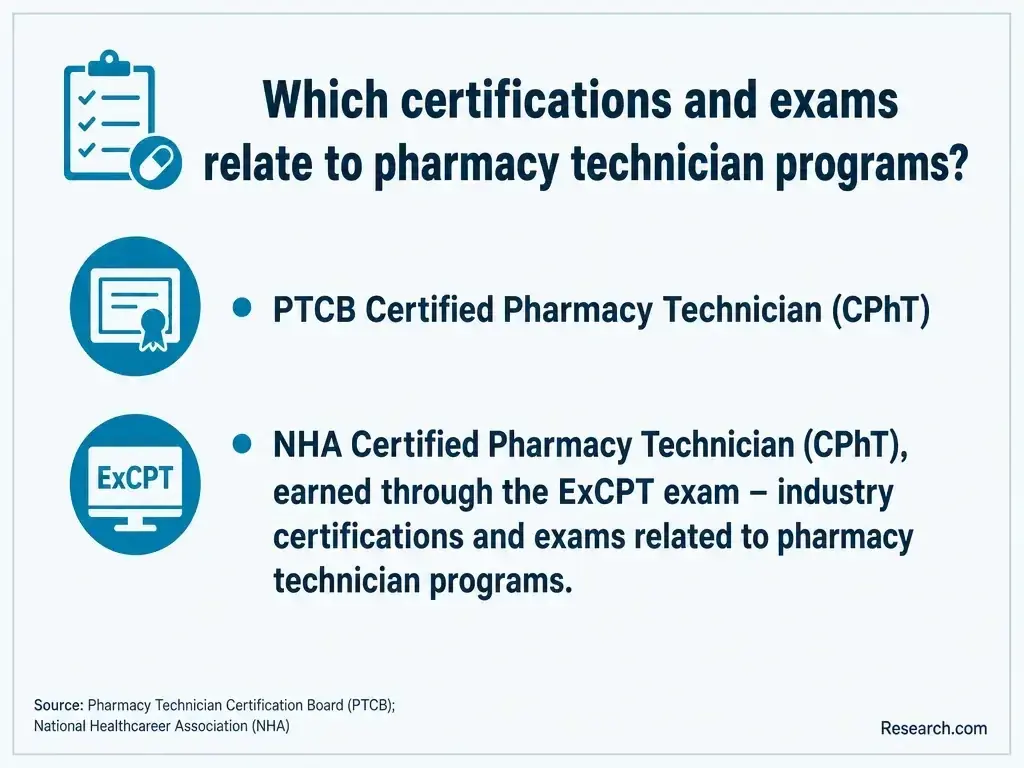
You need the appropriate Texas State Board of Pharmacy registration to work in a Texas pharmacy technician role. Texas distinguishes technician trainee registration from pharmacy technician registration. The board's registered-technician pathway requires qualifying national certification; verify its current accepted examinations and application rules directly with the board before choosing a course (Texas State Board of Pharmacy).
National certification and state registration are not interchangeable. The Pharmacy Technician Certification Board, for example, sets education or work-experience eligibility and an examination for its CPhT credential. Institutional accreditation concerns the school; pharmacy technician programmatic accreditation concerns a particular training program. Neither automatically grants certification or Texas registration. If you plan to work outside Texas, check that state's board requirements rather than assuming your Texas status transfers.
Start with your intended job, then work backward to the required registration, certification, and practical skills. An affordable school program is worth considering if it offers accessible hands-on training and a clear route toward your goal at a cost you can manage. If an employer will train and pay you as an eligible trainee, compare that option before taking on tuition or debt.
Use these checks to turn a ranking shortlist into an enrollment decision:
- Ask the Texas State Board of Pharmacy which registration you need at each stage of training and employment.
- Get the school's complete cost, schedule, lab hours, placement policy, and exact credential in writing.
- Verify institutional accreditation separately from any claimed pharmacy technician programmatic accreditation and certification-exam alignment.
- Compare the full cost and time away from work with a realistic local trainee or technician job offer; ask about aid and employer-paid training.
- Request completion and certification-exam results for the specific program, and ask how the school supports students who cannot secure a placement.
A common mistake is choosing the lowest tuition without checking placement travel or registration eligibility. Another is treating a broad education-cost comparison - such as cheapest online master degrees - as evidence about the value of this occupation-specific training. Compare pharmacy technician routes on their own entry requirements and likely costs.
The immediate path is usually supervised work as a registered technician or, where eligible, a technician trainee while completing the steps for technician registration. Experience can open opportunities involving hospital medication distribution, inventory, insurance resolution, or training other staff. The work available depends on employer needs and any additional competencies or credentials the role requires; a school certificate alone does not confer a senior position (U.S. Bureau of Labor Statistics; Texas State Board of Pharmacy).
If you want to enter pharmacy work quickly, prioritize a route that gets you eligible for the appropriate Texas registration and practical experience. If your goal is unrelated to pharmacy operations, do not choose this training solely because it appears affordable. Guides to best dual degree combinations address a different education decision and cannot establish the return on a pharmacy technician credential.
The U.S. Bureau of Labor Statistics projects 6.4% growth nationally for pharmacy technician employment from 2025 to 2035. This indicates demand across the occupation, not a forecast of Waco vacancies or a guarantee of work after training. Local hiring may depend on openings at pharmacies and healthcare employers, shift availability, and whether applicants already have Texas registration.
Use the national projection as context, then test the local market before enrolling: examine current Waco-area postings for trainee versus registered-technician roles, required certification, schedules, and pay. If few suitable positions are available within your commuting range, an affordable course may still involve a longer job search. If employers are advertising paid trainee routes, those openings deserve comparison with tuition-based programs.
Most Affordable Pharmacy Technician Schools & Training in Waco for 2027
Education is a significant investment, so Research.com designed its affordability ranking to compare pharmacy technician programs with other programs in the same occupation and location. The Research.com team reviews multiple education and workforce sources to improve the ranking's credibility and accuracy. Only programs with completions reported to IPEDS are eligible; the ranking is not a complete directory of Waco-area training options.
Most-affordable rankings score tuition, cost of attendance, median student debt, and federal loan default rate. An entropy-based method gives more weight to measures that vary more across eligible programs. Accreditation and other quality indicators are not part of the affordability score. That differs from Research.com's best-program rankings, which also evaluate completion, retention, earnings, support services, and recognition. Use the affordability ranking to narrow your search, then check each program's training and Texas registration fit yourself.
The following data sources inform Research.com's trade-program ranking work. Some cover other occupations and do not serve as pharmacy technician accreditors or Texas licensing authorities:
- IPEDS database - reported completions and institutional data used to identify and compare eligible programs.
- National Center for Education Statistics - federal education data and definitions.
- College Scorecard database - available institutional cost, debt, and outcomes information.
- Peterson's database - supplementary institution and program information.
- Commission on Accreditation of Allied Health Education Programs (CAAHEP) - recognition information relevant to certain allied-health occupations.
- Accrediting Bureau of Health Education Schools (ABHES) - accreditation information for applicable health education providers.
- Commission on Dental Accreditation (CODA) - program accreditation information for dental occupations, not pharmacy technician programs.
- Dental Assisting National Board (DANB) - dental assisting credential information, not pharmacy technician certification.
- National Center for Construction Education and Research (NCCER) - construction-training recognition information, not pharmacy technician certification.
- Apprenticeship.gov Partner Finder - information on potential work-based training sponsors.
For more detail on ranking methods, see Research.com's methodology. A provider's absence from IPEDS does not mean it is unapproved or ineffective; employer training and other noncollege routes may not appear in this ranking.
# 2 position
West Georgia Technical College - Pharmacy Technician/Assistant.
certificate or diplomaFrequently asked questions about pharmacy technician programs in Waco
What is the cheapest way to train as a pharmacy technician in Waco?
An eligible paid trainee position may have lower upfront costs than a school certificate. Compare wages, supervision, exam preparation, and registration expenses against each school's full written cost; the cheapest tuition is not necessarily the cheapest route to employment.
Can I become a pharmacy technician without attending trade school?
Yes. Employer-sponsored training can be a route, provided you meet the Texas State Board of Pharmacy's requirements for your trainee and subsequent technician registration. Check national certification eligibility before relying on a work-experience pathway.
Does an online certificate qualify me to work in Texas?
Not by itself. Check its practical-training arrangements and certification alignment, then meet the Texas State Board of Pharmacy's registration requirements before working in a regulated role.
Is certification the same as Texas registration?
No. A certifying organization awards national certification after its eligibility and exam requirements are met. The Texas State Board of Pharmacy controls registration to work as a pharmacy technician or trainee in Texas.
Is a pharmacy technician certificate worth the cost?
It may be if its schedule, hands-on training, and certification preparation help you reach your target job at a manageable total cost. Compare it with paid trainee work, and do not use the national median wage as a promised starting salary.
- U.S. Bureau of Labor Statistics - Pharmacy Technicians
Used to verify salary, employment outlook, and typical education requirements.
https://www.bls.gov/ooh/healthcare/pharmacy-technicians.htm - NCES College Navigator (IPEDS)
Used to verify programs offered and institutional accreditation.
https://nces.ed.gov/collegenavigator/ - NHA - ExCPT Pharmacy Technician
Professional certification reference for graduates of this occupation.
https://www.nhanow.com/certifications/pharmacy-technician - West Georgia Technical College - official website
Official school website (programs, tuition, admissions).
https://www.westgatech.edu/