# 1 position
Most Affordable Pharmacy Technician Schools & Training in Hato Rey for 2027
Audited and Verified:
Our Editorial and Data Verification Process
Research.com uses government datasets, official education statistics and primary institutional information to support its career and degree guides. Our review process checks factual accuracy, occupational definitions, source dates and the requirements associated with the credentials discussed.
How This Article Was Fact-Checked
Our editorial team verifies salary estimates, employment projections, education requirements and program information against original data providers and official organizations. Salary figures are checked against the relevant occupational definitions and reporting periods. Information about licensure, accreditation and required in-person training is reviewed separately.
Fact-checked and verified on:

Co-Founder and Chief Data Scientist

Reviewed by Karolina Broda
Fact-Checker and Data Verification
Choosing an affordable pharmacy technician program in Hato Rey means looking beyond tuition: the credential, practical training, and Puerto Rico's entry requirements must fit your goal. The U.S. Bureau of Labor Statistics reports a May 2025 national median wage of $45,750 for pharmacy technicians, but that is not a starting-pay estimate. This guide explains costs, training routes, and career prospects. It also accompanies the Most Affordable Pharmacy Technician Trade Schools in Hato Rey for 2027 ranking, created by the Research.com team of data scientists to help students identify programs worth considering.
Key findings about pharmacy technician degrees in Hato Rey
- The lowest-ranked cost is not necessarily the lowest job-entry cost: compare fees, materials, travel to practical training, and any Puerto Rico application or examination costs.
- A certificate or diploma may be the shortest school-based route, but verify its supervised practice and eligibility with Puerto Rico's Junta de Farmacia; a national certification is not a substitute for territorial authorization.
- The U.S. Bureau of Labor Statistics projects 6.4% national employment growth from 2025 to 2035 for pharmacy technicians. That supports exploring the occupation, not assuming equivalent demand or starting pay in Hato Rey.
Table of Contents
- Most Affordable Pharmacy Technician Schools & Training in Hato Rey for 2027
- What can I expect from a pharmacy technician trade school program in Hato Rey?
- Where can I work with a pharmacy technician trade school training in Hato Rey?
What can I expect from a pharmacy technician trade school program in Hato Rey?
Expect instruction in medication names and dosage forms, prescription processing, calculations, inventory, patient confidentiality, and the technician's role under pharmacist supervision. A useful program also provides opportunities to practice dispensing workflows and pharmacy software, not just memorize terminology. The U.S. Bureau of Labor Statistics identifies retail and hospital pharmacies as major work settings; ask whether a program's practical experience matches the setting you want.
Hato Rey is part of San Juan, so compare commute time to both classes and any assigned pharmacy site. A short classroom schedule can still be difficult for a working student if practical shifts occur elsewhere in the metro area. If speed is the priority, do not treat lists of fast degree programs as a substitute for checking a pharmacy technician program's actual lab, site-placement, and credential requirements.
Where can I work with a pharmacy technician trade school training in Hato Rey?
Potential workplaces include community and chain pharmacies, hospital pharmacies, clinics, and medication-distribution operations in the San Juan area. Duties differ: retail work commonly involves prescription intake and customer interaction, while hospital work can emphasize medication preparation, inventory controls, and coordination with clinical staff. The U.S. Bureau of Labor Statistics describes these as pharmacy technician settings, but an individual employer's hiring and authorization requirements still govern.
Before choosing a placement, ask where recent students completed practical training and whether those sites consider trainees for vacancies. A site near Hato Rey may reduce travel costs; a more distant hospital placement may be worth the commute if hospital pharmacy is your intended path. Neither placement nor graduation guarantees a job.
The U.S. Bureau of Labor Statistics reports a $45,750 U.S. median annual wage in May 2025 for pharmacy technicians. This national midpoint includes experienced workers and different pharmacy settings; it is neither a Hato Rey wage nor a prediction of a new trainee's offer. An unsupported local estimate would be less useful than current job postings and written employer pay information.
For a realistic return-on-investment comparison, collect pay ranges for entry-level positions you could commute to, then weigh expected earnings against training time, lost work hours, aid, and any debt. Hospital and retail roles may have different schedules and duties, so compare offers on hours and benefits as well as pay.
Length depends on the credential, class schedule, and practical component. A focused certificate or diploma can be shorter than a broader associate-degree program, while employer-sponsored training may combine work and instruction. Neither a credential title nor an advertised completion date establishes how many supervised hours you will receive.
Ask each provider for its published total clock or credit hours, lab hours, required practice hours, and expected time to completion for full-time and part-time students. Also ask whether a placement must be secured before graduation and whether previous coursework or documented experience can reduce requirements. Confirm any proposed credit for prior learning in writing; it may not waive practice required for occupational eligibility.
Online delivery can make lectures, readings, and some calculations easier to fit around work. Campus or hybrid delivery can provide scheduled practice with dispensing procedures, software, and supervised tasks. Regardless of where theory is taught, a student must establish how the program assesses hands-on competence and arranges any required in-person experience. Do not assume an online certificate alone meets Puerto Rico's entry rules.
For adults comparing flexible study options, guides to best degree programs for older adults online may offer general scheduling ideas, but pharmacy technician training needs a more specific test: can you attend its labs and assigned pharmacy shifts? Ask where practical work occurs, who arranges the site, and whether you can complete it near Hato Rey before paying a deposit.
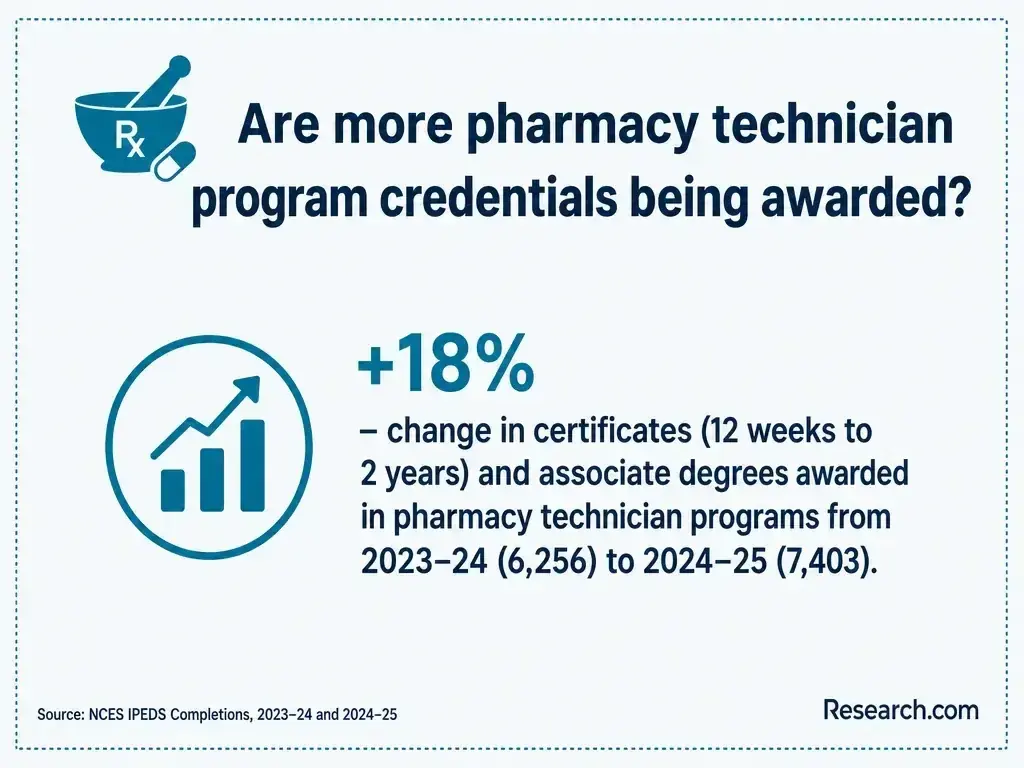
There is no defensible single Hato Rey program average without comparable, current prices for the available credentials. Published tuition may exclude mandatory charges, and a lower sticker price may cost more if a student must travel farther or stop working for daytime practice. Request an itemized, written estimate for your intended enrollment period.
Use the same cost categories for every option so a quoted price does not hide the expense of becoming job-ready:
- School charges: tuition, enrollment and lab fees, books, software, supplies, and any required uniform or protective equipment.
- Entry expenses: applicable examination and application fees, plus any required background check or health documentation.
- Time and travel: commuting to classes and pharmacy sites, childcare if needed, and wages forgone during unpaid training.
- Offsets: grants, scholarships, eligible federal aid, workforce assistance, or wages from employer-sponsored training.
Check federal-aid eligibility for the specific school and program through Federal Student Aid, not from an institution's general advertising. A guide to low tuition universities online that accept financial aid is not evidence that a Hato Rey pharmacy technician program qualifies. Compare your likely out-of-pocket cost and borrowing after aid, not tuition alone.
A school may award a certificate, diploma, or associate degree, depending on the program. These are educational credentials; they are distinct from professional certification and authorization to practice. A longer associate-degree route may appeal to someone seeking broader coursework, but it should not be assumed to confer more occupational authority than an eligible shorter program.
The Pharmacy Technician Certification Board awards the optional national Certified Pharmacy Technician credential to candidates who meet its current eligibility and examination requirements. Puerto Rico's Junta de Farmacia determines applicable territorial practice requirements. Ask a provider exactly what its graduates receive, whether its curriculum prepares them for a named certification examination, and what remains to be done before they may work locally.
School admissions rules and permission to work are separate questions. A provider may require secondary-school completion or its equivalent, an application, and placement or orientation steps; practical sites may impose additional screening or health-document requirements. Verify the current policy with each provider rather than assuming all programs use the same checklist.
Request written answers about language of instruction, schedule, laboratory attendance, placement screening, and whether any conviction or other circumstance could affect a required site assignment or occupational application. This is especially important before making a nonrefundable payment: admission does not establish that a student will qualify for every placement or for authorization from Puerto Rico's Junta de Farmacia.
Core skills include reading prescription information, performing dosage and quantity calculations, recognizing medication names, maintaining inventory, using pharmacy systems, and protecting patient information. Training should also teach when to refer a question to the pharmacist: technician training does not authorize independent clinical judgment. The U.S. Bureau of Labor Statistics describes technicians as working under pharmacists' supervision.
Compare syllabi for assessed practice, not just topic names. Ask students to demonstrate calculations, error-prevention procedures, and realistic dispensing workflows in a lab or supervised setting. Spanish-language patient interactions may be particularly relevant to a Hato Rey placement; confirm the language used in instruction, software practice, and site supervision if that will affect your readiness.
Check the current Puerto Rico Junta de Farmacia requirements for the exact pharmacy role before enrolling or accepting work. Puerto Rico's occupational authorization is a separate matter from a school certificate and from voluntary national certification; holding one should not be presented as automatically satisfying the others. Ask the Junta and prospective employers which education, application, examination, or supervised-experience steps apply to your intended position.
Institutional accreditation concerns the school. Programmatic recognition concerns a particular training program. School authorization concerns permission to operate, while occupational authorization concerns permission to perform regulated work. None is interchangeable. Get the provider's claimed status and its explanation of graduate eligibility in writing, then verify each claim with the relevant accreditor, regulator, or certifying organization.
Start with the job you want and compare only programs that can plausibly prepare you for it. Dewey University-Hato Rey and ICPR Junior College are names a local searcher may encounter, but confirm each institution's current pharmacy technician offering, location, credential, price, and practical arrangements directly; an institution's presence in the area does not establish that a particular program is available.
Use this order to avoid paying for an inexpensive credential that does not meet your goal:
- Ask Puerto Rico's Junta de Farmacia what is required for your intended role, then have each provider explain how its program aligns.
- Verify the school's authorization and claimed accreditation separately from any pharmacy-specific recognition or certification preparation.
- Request a schedule showing instruction, labs, supervised practice, placement location, and who secures the site.
- Compare written total costs after likely aid, alongside completion information, debt, and the work hours you may lose.
- Ask employers whether they recognize the credential and whether a paid training route could meet the same goal.
Affordability rankings are a starting point, not an eligibility check. Likewise, online masters programs cheap are not a useful cost benchmark for entry-level pharmacy technician training: compare programs that lead toward the same occupation and practical requirements. A short, low-cost course is a poor investment if it leaves you unable to complete required hands-on work.
An entry-level technician may seek work in a community pharmacy or hospital setting, then build experience in inventory, medication-distribution workflows, or training other staff. Particular duties and advancement opportunities depend on the employer and the worker's authorization; additional certification can demonstrate knowledge but does not replace required territorial permission.
If you prefer structured, detail-oriented work, pharmacy operations may be worth exploring, but the occupation also involves teamwork and, in retail settings, frequent customer contact. A list of a top career path for introverts cannot tell you whether a specific pharmacy shift fits your preferences. Ask to observe or discuss the actual workflow, and compare employer-sponsored entry training with school-based study before committing to tuition.
The U.S. Bureau of Labor Statistics projects 6.4% growth nationally from 2025 to 2035 for pharmacy technicians. That projection indicates continuing U.S. demand, but it is not a Hato Rey forecast and cannot show how many local openings will suit a newly trained applicant. Competition, schedules, and employer requirements can differ across San Juan-area pharmacies.
To test the local market, review recent postings for the settings and commute you would accept. Note the authorization, experience, certification, and shift requirements that recur, then compare them with a program's curriculum and placements. This is more useful for a Hato Rey enrollment decision than applying a national growth rate directly to local job prospects.
Most Affordable Pharmacy Technician Schools & Training in Hato Rey for 2027
Investing in occupational training is an important decision. Research.com created this ranking to help readers compare programs against other options in the same occupation and location, rather than against unrelated schools. The team checks multiple education and recognition sources to improve the ranking's quality, credibility, and accuracy.
The most-affordable ranking scores costs and debt only: tuition, cost of attendance, median student debt, and federal loan default rate. Indicator weights are assigned using an entropy-based method, which gives more weight to measures that differ more across programs. Accreditation, student support, earnings, and completion are not part of this affordability score; a low-cost rank is not a finding that a program meets Puerto Rico's occupational requirements.
Only programs with completions reported to IPEDS are eligible. This means the ranking may omit employer training and other legitimate routes that do not report those completions. The following sources inform Research.com's ranking work; some track recognition in other trades and should not be interpreted as pharmacy technician accreditors:
- IPEDS database - program completions and institutional education data.
- National Center for Education Statistics - federal education data and definitions.
- College Scorecard database - available cost, debt, and outcome measures.
- Peterson's database - supplementary institutional information.
- Commission on Accreditation of Allied Health Education Programs - allied-health recognition information where relevant.
- Accrediting Bureau of Health Education Schools - health-education accreditation information where relevant.
- Commission on Dental Accreditation - occupation-specific recognition information for dental programs, not pharmacy technician approval.
- Dental Assisting National Board - dental credential information, not pharmacy technician certification.
- National Center for Construction Education and Research - construction-training recognition information, not pharmacy technician recognition.
- Apprenticeship.gov Partner Finder - information on potential work-based training partners.
For comparison, Research.com's best-program rankings also consider student outcomes, earnings and return on investment, and quality and recognition. Those broader measures should not be confused with this cost-and-debt ranking. Readers can review the full approach on the Research.com methodology page, then verify current program prices and eligibility directly before enrolling.
# 2 position
ICPR Junior College - Pharmacy Technician/Assistant.
certificate or diplomaFrequently asked questions about pharmacy technician programs in Hato Rey
What is the cheapest way to train as a pharmacy technician?
Compare written total costs for school-based programs with any available paid employer training. Include fees, travel, lost earnings, and the remaining steps needed to work in Puerto Rico; the lowest tuition is not always the lowest-cost route.
Can I complete pharmacy technician training entirely online?
Some theory may be delivered online, but verify how the program teaches and assesses practical skills and arranges any required in-person experience. Do not assume an online credential alone establishes eligibility to work in Puerto Rico.
Does graduating from a Hato Rey program mean I can work immediately?
Not necessarily. Confirm the applicable requirements with Puerto Rico's Junta de Farmacia and the employer. A school credential, national certification, and occupational authorization are separate.
Is a certificate or an associate degree better?
Choose based on the job you want, verified eligibility, practical training, time, and total cost. A broader or longer credential is not automatically necessary for entry-level technician work.
Are Hato Rey pharmacy technician salaries the same as the national median?
Do not assume so. The U.S. Bureau of Labor Statistics' May 2025 national median is $45,750 and includes workers at different experience levels. Check current San Juan-area openings for pay relevant to your first job.
- U.S. Bureau of Labor Statistics - Pharmacy Technicians
Used to verify salary, employment outlook, and typical education requirements.
https://www.bls.gov/ooh/healthcare/pharmacy-technicians.htm - NCES College Navigator (IPEDS)
Used to verify programs offered and institutional accreditation.
https://nces.ed.gov/collegenavigator/ - PTCB - Certified Pharmacy Technician (CPhT)
Professional certification reference for graduates of this occupation.
https://www.ptcb.org/credentials/certified-pharmacy-technician - Dewey University-Hato Rey - official website
Official school website (programs, tuition, admissions).
https://dewey.edu/ - ICPR Junior College - official website
Official school website (programs, tuition, admissions).
https://www.icprjc.edu/