# 1 position
Most Affordable Pharmacy Technician Schools & Training in Mayaguez for 2027
Audited and Verified:
Our Editorial and Data Verification Process
Research.com uses government datasets, official education statistics and primary institutional information to support its career and degree guides. Our review process checks factual accuracy, occupational definitions, source dates and the requirements associated with the credentials discussed.
How This Article Was Fact-Checked
Our editorial team verifies salary estimates, employment projections, education requirements and program information against original data providers and official organizations. Salary figures are checked against the relevant occupational definitions and reporting periods. Information about licensure, accreditation and required in-person training is reviewed separately.
Fact-checked and verified on:

Co-Founder and Chief Data Scientist

Reviewed by Karolina Broda
Fact-Checker and Data Verification
The cheapest pharmacy technician program is not necessarily the least expensive route into a pharmacy job: fees, travel, practical training, and Puerto Rico's entry requirements can change the calculation. The Research.com team of data scientists created the Most Affordable Pharmacy Technician Trade Schools in Mayaguez for 2027 ranking to help students make an informed choice about programs worth considering. With U.S. pharmacy technician employment projected to grow 6.4% from 2025 to 2035, this guide helps prospective students compare credentials, total costs, training formats, and career prospects before enrolling (U.S. Bureau of Labor Statistics).
Key findings about pharmacy technician degrees in Mayaguez
- Compare the total cost to become job-ready, not tuition alone: pharmacy labs or practice placements, travel, fees, and lost work time can change which Mayaguez option is most affordable.
- Puerto Rico career-entry requirements need a separate check with its pharmacy board; a school credential, institutional accreditation, and voluntary national certification are not interchangeable (Puerto Rico Junta de Farmacia; Pharmacy Technician Certification Board).
- The U.S. median annual wage for pharmacy technicians was $45,750 in May 2025, but that national figure is not a Mayaguez starting wage or a forecast of an individual graduate's pay (U.S. Bureau of Labor Statistics).
Table of Contents
- Most Affordable Pharmacy Technician Schools & Training in Mayaguez for 2027
- What can I expect from a pharmacy technician trade school program in Mayaguez?
- Where can I work with a pharmacy technician trade school training in Mayaguez?
What can I expect from a pharmacy technician trade school program in Mayaguez?
Pharmacy technician training prepares students to assist pharmacists with prescription processing, medication inventory, calculations, recordkeeping, and customer or patient service. A technician works under a pharmacist's supervision; completing training does not authorize someone to practice as a pharmacist or independently make clinical decisions (U.S. Bureau of Labor Statistics).
In Mayaguez, the most useful distinction is between a program that teaches these tasks and arranges practical experience and one that offers coursework without a workable local placement. Before committing, ask each provider for its written curriculum, lab hours, practice-site arrangements, credential awarded, and the Puerto Rico requirements its graduates are prepared to meet. Do not infer those details from a program title or ranking position.
A career-school certificate or diploma may suit someone seeking focused entry training. A longer technician-focused associate program may offer broader coursework, but its additional time and expense need a clear payoff for the student's goal. Employer-sponsored training can reduce upfront school costs for someone who can secure a position, although its schedule, supervision, and eligibility terms may be less flexible. Availability and recognition of any particular pathway should be confirmed with the provider, employer, and Puerto Rico Junta de Farmacia.
Where can I work with a pharmacy technician trade school training in Mayaguez?
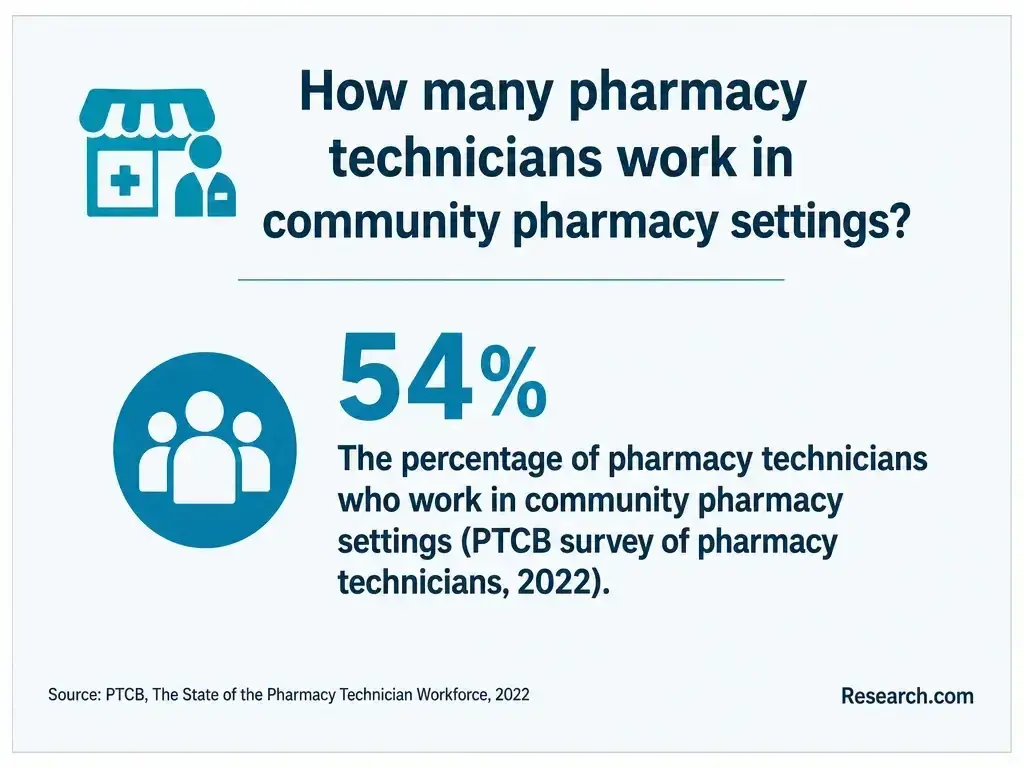
Potential settings include community pharmacies, hospital pharmacies, and other medication-dispensing operations that employ technicians. The setting matters when choosing training: retail work emphasizes prescription intake, insurance transactions, inventory, and patient interaction, while hospital roles may emphasize medication distribution systems and sterile-preparation procedures under facility rules (U.S. Bureau of Labor Statistics).
Ask whether a program's practice sites match the setting you want. A placement reachable from Mayaguez can reduce transportation costs; one requiring a long commute can make a lower-tuition program more expensive in practice. Training and a placement do not guarantee an offer, so ask providers for recent, clearly defined placement outcomes rather than relying on employer logos.
A dependable Mayaguez-specific wage figure is not established here. For a national benchmark, the U.S. Bureau of Labor Statistics reports a May 2025 median annual wage of $45,750 for pharmacy technicians. Half of workers in the occupation earned less and half earned more; the figure includes experienced workers and should not be treated as an entry-level offer in western Puerto Rico.
For a useful local estimate, compare current technician postings by setting, schedule, and required experience, then ask prospective employers what they pay newly qualified applicants. Use the likely difference between your current earnings and realistic entry pay - not the national median alone - when judging whether training costs are recoverable.
Completion time depends on the credential, course load, and when labs and practice placements are available. A focused certificate or diploma generally involves less coursework than an associate program, while employer training follows the employer's work and supervision schedule. No single program length or contact-hour minimum should be assumed for every Mayaguez option.
Request a calendar showing classroom and lab hours, any supervised practice hours, placement start dates, and the time from the final class to credential issuance. If you work, compare the actual weekly schedule, not just the advertised duration: an accelerated daytime program may cost more in foregone wages than a longer part-time route. Confirm separately with the Puerto Rico Junta de Farmacia whether a specified course, experience period, or examination applies to your intended entry route.
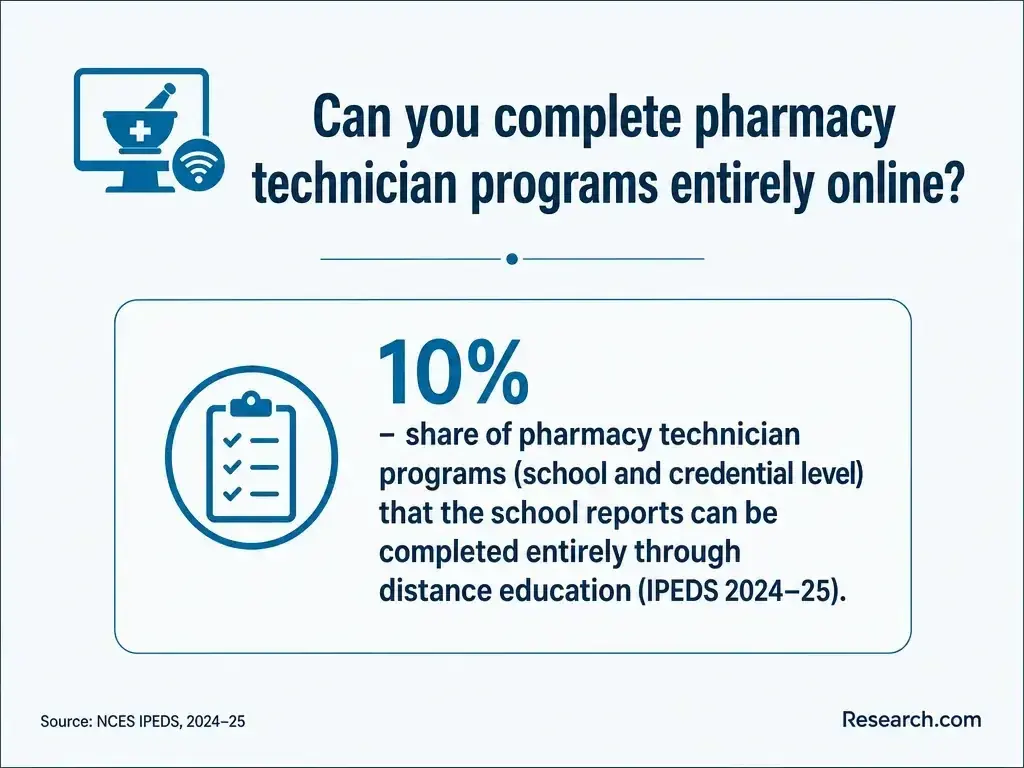
Online delivery can make terminology, calculations, regulations, and other classroom subjects easier to fit around work. It cannot by itself demonstrate safe dispensing workflows, equipment use, or practice-site performance. A hybrid option is only practical if the student can attend its required labs and any supervised placement in person.
The comparison below concerns how training is delivered, not whether either format qualifies a graduate to work. Puerto Rico eligibility and any certification requirements still need independent verification.
| Format | Potential advantage | Cost or entry concern |
| On-campus | Scheduled access to instructors and practical facilities | Regular travel and less scheduling flexibility |
| Hybrid | Remote coursework with scheduled in-person practice | Placement location and lab attendance may still require substantial travel |
| Online coursework | Flexible study location | Practical experience and Puerto Rico eligibility must be verified separately |
When comparing a top school for trade skills online with a local option, ask who arranges and supervises the hands-on component near Mayaguez. An online label is not evidence that a program meets occupational-entry requirements.
A reliable Mayaguez-wide average cannot be stated without comparable, current program-level prices. An advertised tuition figure may exclude expenses needed to finish training and enter work. Request an individualized, written cost estimate from each school before treating any option as the cheapest.
The following cost categories show why two similarly priced programs can have different total costs. They are comparison items, not additional charges every student will necessarily face.
| Cost category | What to confirm | Why it affects affordability |
| School charges | Tuition, mandatory fees, books, software, and lab materials | Advertised tuition may not be the full billed amount |
| Career-entry charges | Any required examination, application, background check, or uniform costs | These may fall due after tuition is paid |
| Attendance costs | Travel to classes and practice sites; earnings lost to scheduling | A distant or accelerated option may cost more overall |
| Offsets | Confirmed grants, eligible aid, employer support, or paid training | These reduce what the student must finance or forgo |
Check federal aid eligibility for the specific institution and program through Federal Student Aid; do not assume every career program qualifies. Ask about scholarships and workforce assistance before borrowing. A useful investment comparison also considers completion likelihood, debt, current earnings, realistic post-training pay, and how long you expect to work in the occupation.
The school-awarded credential may be a certificate, diploma, or, where offered, an associate degree. These describe completed education, not occupational permission to work. National professional certification is a separate credential awarded by a certifying organization after its requirements are met; Puerto Rico occupational authorization is a separate regulatory matter (Pharmacy Technician Certification Board; Puerto Rico Junta de Farmacia).
Ask admissions staff to state the exact credential name that appears on completion documents and whether the program prepares students for a named certification examination. Then verify eligibility directly with the certifier and Puerto Rico Junta de Farmacia. If you may continue studying later, request written transfer or prior-learning-credit policies from the receiving provider; credits are not automatically portable.
School admission rules and permission to enter pharmacy work are different. A provider may ask for evidence of prior schooling, an application, or placement testing; a practice site may have additional screening or health-related conditions. Requirements vary, so obtain the current admissions checklist and ask which conditions must be met before enrollment versus before a placement begins.
Easy entry is useful only if it leads to appropriate training. If you are comparing online college classes open enrollment with a technician program, confirm that the option actually teaches pharmacy-specific skills and offers an achievable practical route. Separately check Puerto Rico's occupational requirements before paying a nonrefundable deposit.
Relevant instruction includes medication names and dosage forms, prescription interpretation, arithmetic and dosage calculations, inventory control, pharmacy systems, confidentiality, and error prevention. Supervised practice should let students apply those skills within a technician's role and recognize when a question belongs to the pharmacist (U.S. Bureau of Labor Statistics; O*NET).
Compare syllabi rather than credential names. In particular, ask how students practice calculations, document accuracy, use dispensing technology, and receive feedback during labs or field experience. If hospital pharmacy is your goal, ask whether the curriculum covers the procedures employers expect there; a retail-focused placement and a hospital-focused placement are not interchangeable merely because both involve medications.
Puerto Rico's Junta de Farmacia is the authoritative place to verify the current requirements for working as a pharmacy technician in Mayaguez, including the applicable occupational credential, education or experience conditions, examination, and application process. Do this before enrolling: school completion alone should not be assumed to confer work authorization (Puerto Rico Junta de Farmacia).
Keep the distinct checks separate. Institutional accreditation concerns the school; any program recognition concerns its training; national certification concerns a certifying organization's standards; occupational authorization concerns Puerto Rico's rules. For example, Pharmacy Technician Certification Board certification has its own eligibility and examination requirements and should not be assumed to replace a Puerto Rico credential. Ask the board and the prospective employer which credentials each requires (Pharmacy Technician Certification Board; Puerto Rico Junta de Farmacia).
Start with the job you want, then compare programs on eligibility, practical experience, and the amount you will actually spend. A low affordability-ranking price is valuable only if the program offers a feasible route to your intended pharmacy setting.
Use these checks when speaking with admissions staff; request documents or a regulator's confirmation rather than relying on a verbal assurance.
- Identify the credential awarded and verify current Puerto Rico technician-entry requirements with the Junta de Farmacia.
- Ask who provides labs and practice placements, where they take place, and what happens if no nearby placement is available.
- Obtain a written total-cost estimate, including mandatory charges, travel, and any separate career-entry expenses; subtract only aid or employer support you can confirm.
- Check the school's accreditation and authorization separately from any occupation-specific recognition, and verify certification-exam eligibility with the certifying organization.
- Compare schedules, completion information, and clearly defined employment outcomes with your work obligations and target job.
Do not substitute a broad education-price list - including an affordable phd comparison - for evidence about technician training. The decisive question is whether this specific program provides an affordable, practical, and regulatorily appropriate route into the pharmacy role you want.
Entry roles can lead toward more specialized responsibilities in community or hospital pharmacy, depending on employer needs, experience, and any additional training. Inventory coordination, medication-distribution systems, and supervision are possible directions; a program credential does not automatically place a new worker into an advanced role (U.S. Bureau of Labor Statistics).
For someone considering certification that pay well, the important test is whether the particular certification is recognized for the desired pharmacy job and whether its requirements can be met. Ask local employers which credentials they prefer for entry roles and which, if any, support advancement. That evidence is more useful than assuming every additional certificate raises pay.
The U.S. Bureau of Labor Statistics projects 6.4% national employment growth for pharmacy technicians from 2025 to 2035. That indicates a growing occupation nationally, not a measured Mayaguez growth rate or a guarantee of local openings.
Use that projection as context, then examine recent western Puerto Rico postings for location, shift, language, credential, and experience requirements. If most suitable openings are outside a workable commute, factor relocation or travel into the investment decision. Technology can change how pharmacies process prescriptions, so training in accurate records, pharmacy systems, and safe workflow remains more useful than preparation for a single routine task (U.S. Bureau of Labor Statistics).
Most Affordable Pharmacy Technician Schools & Training in Mayaguez for 2027
Investing in occupational training is a consequential decision. Research.com's team assembled the affordability ranking to make locally relevant cost comparisons more transparent, checking multiple education and training sources for the credibility and accuracy of the information used. Programs are compared with others in the same occupation and location; only programs reporting completions to IPEDS are eligible. That limit means an employer training route or a provider absent from IPEDS is not necessarily unavailable or unsuitable.
The most affordable ranking scores tuition, cost of attendance, median student debt, and federal loan default rate. It uses an entropy-based weighting method, which gives more weight to cost and debt indicators that vary more across eligible programs. Accreditation and other quality measures are not part of this affordability score. Readers should therefore use the ranking to narrow their cost comparison, then verify practical training and career-entry eligibility separately.
The following sources were consulted in creating the ranking. Several cover other trades or health occupations and should not be mistaken for pharmacy technician program approval.
- IPEDS database - program completions and institutional reporting.
- National Center for Education Statistics - federal education data and definitions.
- College Scorecard database - available institutional cost, debt, and outcome information.
- Peterson's database - supplementary institution and program information.
- Commission on Accreditation of Allied Health Education Programs (CAAHEP) - accreditation information where relevant to an occupation.
- Accrediting Bureau of Health Education Schools (ABHES) - health education accreditation information.
- Commission on Dental Accreditation (CODA) - dental-program accreditation information, not pharmacy technician approval.
- Dental Assisting National Board (DANB) - dental credential information, not pharmacy technician certification.
- National Center for Construction Education and Research (NCCER) - construction training information, not pharmacy technician recognition.
- Apprenticeship.gov Partner Finder - information on potential work-based training partners.
For more detail on Research.com's ranking approach, see its methodology. An affordability position is a starting point, not a finding that a particular credential satisfies Puerto Rico's occupational requirements.
# 2 position
ICPR Junior College-Mayaguez - Pharmacy Technician/Assistant.
certificate or diplomaFrequently asked questions about pharmacy technician programs in Mayaguez
What is the cheapest pharmacy technician program in Mayaguez?
No single program can be identified as cheapest without current, comparable totals. Compare written tuition and fee quotes alongside materials, practical-site travel, career-entry charges, aid, and lost work time.
Can I become a pharmacy technician with online-only training?
Do not assume so. Confirm how you will complete practical training and whether the resulting route meets Puerto Rico's current occupational requirements before enrolling.
Is national certification the same as Puerto Rico authorization?
No. A certifying organization awards national certification under its own rules; the Puerto Rico Junta de Farmacia determines applicable occupational requirements. Verify both if your intended employer asks for certification.
Is a short program a better investment than a longer one?
It can be if it provides sufficient practical preparation and the appropriate entry route at a lower total cost. A longer program may be worthwhile when its additional training matches a specific career goal. Compare realistic outcomes, not duration alone.
Should I choose a school or employer-sponsored training?
Choose based on access and fit. School training may offer a structured credential and placement support; employer training may reduce upfront cost but depend on securing a suitable position. Confirm what either route means for Puerto Rico eligibility.
Does the national median wage show what I will earn after training?
No. The May 2025 U.S. median includes workers at different experience levels and locations (U.S. Bureau of Labor Statistics). Check local entry-level offers before estimating your return.
- U.S. Bureau of Labor Statistics - Pharmacy Technicians
Used to verify salary, employment outlook, and typical education requirements.
https://www.bls.gov/ooh/healthcare/pharmacy-technicians.htm - NCES College Navigator (IPEDS)
Used to verify programs offered and institutional accreditation.
https://nces.ed.gov/collegenavigator/ - NHA - ExCPT Pharmacy Technician
Professional certification reference for graduates of this occupation.
https://www.nhanow.com/certifications/pharmacy-technician - Pontifical Catholic University of Puerto Rico-Mayaguez - official website
Official school website (programs, tuition, admissions).
https://mayaguez.pucpr.edu/ - ICPR Junior College-Mayaguez - official website
Official school website (programs, tuition, admissions).
https://www.icprjc.edu/