# 1 position
Best Pharmacy Technician Training Programs & Trade Schools in Dallas for 2027
Audited and Verified:
Our Editorial and Data Verification Process
Research.com uses government datasets, official education statistics and primary institutional information to support its career and degree guides. Our review process checks factual accuracy, occupational definitions, source dates and the requirements associated with the credentials discussed.
How This Article Was Fact-Checked
Our editorial team verifies salary estimates, employment projections, education requirements and program information against original data providers and official organizations. Salary figures are checked against the relevant occupational definitions and reporting periods. Information about licensure, accreditation and required in-person training is reviewed separately.
Fact-checked and verified on:

Co-Founder and Chief Data Scientist

Reviewed by Karolina Broda
Fact-Checker and Data Verification
Choosing pharmacy technician training in Dallas means weighing speed and cost against hands-on practice and Texas registration requirements. The U.S. Bureau of Labor Statistics projects 6.4% national employment growth for pharmacy technicians from 2025 to 2035, but that does not make every program a sound investment. This guide explains credentials, costs, career options, and questions to ask before enrolling. It also accompanies a Best Pharmacy Technician Trade Schools in Dallas for 2027 ranking created by the Research.com team of data scientists to help students identify programs worth considering.
Key findings about pharmacy technician degrees in Dallas
- Texas occupational entry requires the appropriate Texas State Board of Pharmacy registration; a school certificate or national certification alone does not authorize someone to work as a registered pharmacy technician.
- The national median annual wage for pharmacy technicians was $45,750 in May 2025, according to the U.S. Bureau of Labor Statistics. That is an occupation-wide benchmark, not expected starting pay in Dallas.
- Compare a Dallas program's full job-entry cost and hands-on placement against employer-sponsored training. The lower-tuition option is not necessarily cheaper if required fees, travel, or unpaid time away from work differ.
Table of Contents
- Best Pharmacy Technician Training Programs & Trade Schools in Dallas for 2027
- What can I expect from a pharmacy technician trade school program in Dallas?
- Where can I work with a pharmacy technician trade school training in Dallas?
What can I expect from a pharmacy technician trade school program in Dallas?
Expect instruction in medication names, dosage calculations, prescription processing, inventory, safety, and pharmacy law, followed by supervised practice where the program includes an externship. Pharmacy technicians assist pharmacists; they do not independently make clinical decisions. A Dallas program should explain which tasks students practice in a lab and which they perform at a pharmacy site under appropriate supervision.
Private career-school certificates and diplomas can suit students seeking structured, relatively direct preparation. Community-college or public technical-college certificates may offer a different schedule and price. Employer-sponsored training can make more sense for someone who can secure a pharmacy position and learn while earning, provided they meet Texas registration rules. Do not choose an accelerated schedule merely because it ends sooner: ask whether its lab access and worksite arrangements fit your intended retail or hospital setting. Listings of colleges with accelerated programs are not a substitute for checking pharmacy-specific practical training and Texas eligibility.
Where can I work with a pharmacy technician trade school training in Dallas?
Dallas-area opportunities include community and chain pharmacies, hospital pharmacies, health-system outpatient sites, specialty and mail-order operations, and long-term-care pharmacy services. The setting changes the preparation worth prioritizing: retail work emphasizes prescription intake, insurance claims, and customer communication, while hospital work may require more preparation for sterile compounding, medication distribution, and work with clinical teams. The U.S. Bureau of Labor Statistics describes these settings as distinct parts of pharmacy technician employment.
Ask a provider where its students complete supervised practice and whether those sites match your preferred workplace. An externship location also affects your budget in a large metro area: a placement that is difficult to reach can add transport costs or conflict with paid work.
The latest national median annual wage supplied by the U.S. Bureau of Labor Statistics is $45,750 for pharmacy technicians in May 2025. It covers workers across experience levels and settings; it is neither a Dallas wage estimate nor a forecast of a new graduate's offer. Compare actual Dallas-area postings by setting, schedule, certification preference, and experience requirement before estimating what you could earn.
For an investment decision, compare likely additional earnings against your current pay - not just against the national median. Include the time spent training, any earnings you give up, financing costs, and the possibility that you do not complete the program or secure your preferred role immediately. A higher-priced program is easier to justify only if its practical experience and outcomes offer value you can verify.
Program length varies with scheduling, lab instruction, and externship requirements. A short certificate may provide a faster route to applying for work, while a part-time schedule may preserve current earnings. Compare published clock or contact hours, supervised worksite hours, and the time from enrollment to completed externship - not just the advertised number of weeks. Texas State Board of Pharmacy registration and any certification examination add separate steps before a person can work in the corresponding registration category.
Ask how quickly externship placements are assigned and whether required hours can be completed around your job. A compressed course that delays worksite practice may not be the fastest route to employment. Searches such as what are the easiest bachelor degrees to get answer a different education question; pharmacy technician entry depends on the relevant practical skills, certification route, and Texas registration, not that kind of credential.
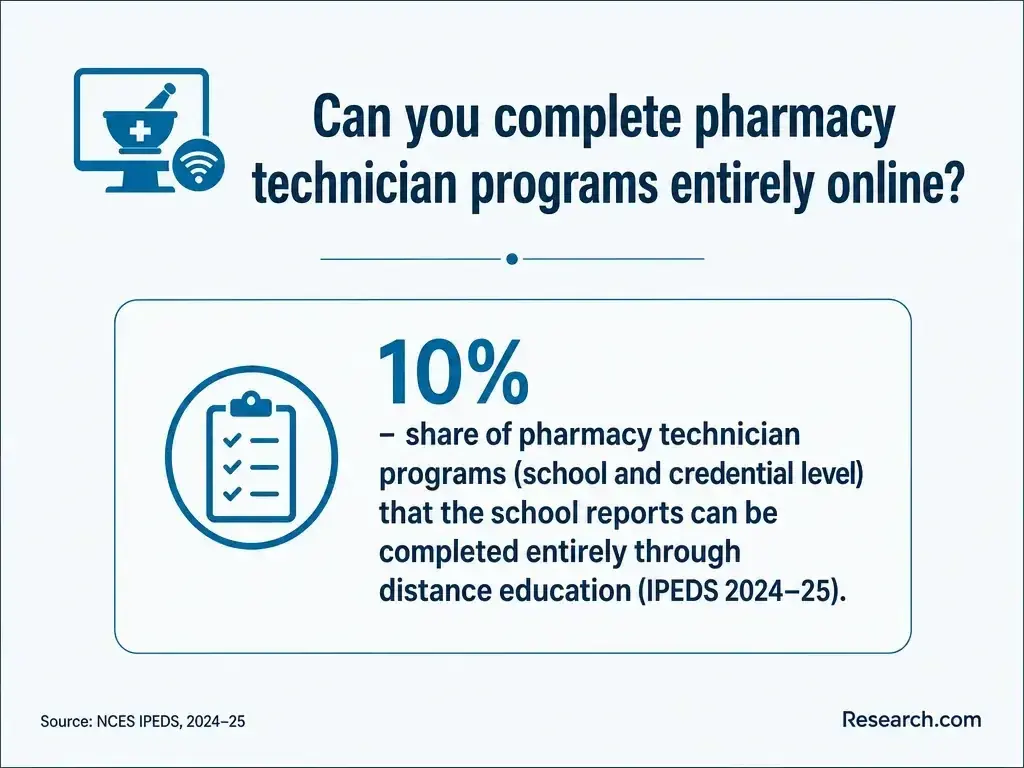
Online coursework can cover terminology, calculations, law, and prescription-processing concepts. In-person labs and supervised pharmacy experience address tasks that cannot be demonstrated adequately through reading or video alone, such as workflow, inventory handling, and setting-specific safety procedures. A hybrid program can work well for a Dallas student with a job if it identifies its lab location, attendance schedule, and externship arrangements before enrollment.
An online listing is not evidence of Texas registration eligibility or an available local placement. Ask where practical competencies are assessed and who arranges a Dallas-area worksite. Lists of top online universities do not answer those pharmacy-specific questions.
There is no single reliable Dallas-wide average that captures private-school programs, public certificates, and employer-paid training on the same basis. Request a written, itemized price from each provider rather than treating advertised tuition as the cost of becoming job-ready. Include mandatory fees, books or software, uniforms, background checks or other placement requirements, certification examination and Texas application fees, travel to labs and externships, and earnings lost while training.
Use each school's current aid offer, not a generic discount, when comparing net cost. Federal aid depends on the student, institution, and program; eligible workforce assistance may also be available through Texas workforce services. Employer-sponsored training may reduce upfront expense and provide wages, but check any work commitment. A list of cheap online schools for job holders cannot establish what a pharmacy technician program will cost after required in-person work.
A school typically awards its own certificate or diploma after completion. That credential is distinct from national certification, such as Pharmacy Technician Certification Board (PTCB) certification or National Healthcareer Association (NHA) certification, and from registration issued by the Texas State Board of Pharmacy. Employer training may produce documented experience without a school credential.
These distinctions matter when comparing similarly named programs. Ask which examination the curriculum prepares you for, whether its training meets that organization's current eligibility rules, and what graduates must still do to obtain Texas registration. Institutional accreditation addresses the institution; pharmacy-specific programmatic accreditation, where held, addresses a program against a different set of standards. Neither is itself a state registration.
Schools set their own admission rules, which may include prior education, an application, and requirements for participation at a pharmacy site. A worksite may separately require screening, immunization documentation, or scheduling availability. Request those requirements before paying a deposit; an applicant who can attend classes but cannot complete the required placement may be unable to finish the credential.
School admission is not occupational authorization. The Texas State Board of Pharmacy sets registration requirements for pharmacy technician trainees and pharmacy technicians, including application-related checks. Confirm which registration category you would need before any worksite activity and which steps you can complete while enrolled. Do not assume that acceptance into a program means you are cleared to work in a pharmacy.
Useful training connects drug terminology and calculations to real dispensing workflow: receiving prescriptions, preparing labels, managing inventory, processing insurance claims, protecting patient information, and recognizing when to refer a question to the pharmacist. Hospital-oriented instruction may also cover sterile-preparation concepts and medication distribution. The U.S. Bureau of Labor Statistics identifies these administrative and technical tasks as central to pharmacy technician work.
Compare what students actually do, not just course titles. Ask to see the lab equipment, the assessment of calculations and safety, and the duties permitted at an externship site. A program focused on retail claims processing may be a reasonable fit for a retail goal but offer less relevant practice for a student aiming at hospital compounding.
Texas registration is the key state requirement. The Texas State Board of Pharmacy distinguishes pharmacy technician trainee registration from pharmacy technician registration and sets the conditions for each. For the registered technician route, verify the board's current national-certification requirement and accepted examinations, including those offered by PTCB and NHA. National certification and Texas registration are separate: passing an exam does not by itself grant state authorization.
A school certificate is likewise not a license. PTCB provides an education-or-work-experience route to eligibility for its Pharmacy Technician Certification Examination; applicants should check its current rules before choosing a program or employer-training route. Ask the Texas board what registration is required for your proposed externship or job, and confirm timing before beginning pharmacy duties. Requirements can change, so use current board and certifier instructions rather than a school's general assurance.
Start with your target setting and compare programs on the route to that job, not on rank alone. The College of Health Care Professions-Dallas and Remington College-Dallas Campus are examples of providers a prospective student may investigate; confirm each campus's current pharmacy technician offering, costs, and outcomes directly rather than assuming a listing describes a current intake.
Use these checks before committing money or leaving a job:
- Ask for the credential awarded, full schedule, clock hours, lab hours, and the location and availability of supervised pharmacy practice.
- Confirm the institution's accreditation, any pharmacy-specific programmatic accreditation, and applicable Texas school authorization separately; then verify certification eligibility and Texas registration steps with the certifier and board.
- Request an itemized total cost and a written explanation of grants, aid, refund terms, and any placement-related expenses.
- Ask for program-specific completion and job-placement definitions, the reporting period, and whether reported jobs are pharmacy technician roles in the Dallas area.
- Compare the result with a realistic employer-sponsored route, including wages during training, supervision, examination preparation, and scheduling.
A warning sign is a claim that "accredited" means automatically certified, registered, or employed. Another is an online program that cannot identify how you will complete practical work. Broad searches for online masters programs cheap address a different goal and should not influence a pharmacy technician training decision.
Common starting points are retail and outpatient pharmacy support, with potential movement into hospital distribution, specialty-pharmacy operations, inventory coordination, or technician supervision as experience and employer requirements allow. Additional training or credentials may help with specialized duties, particularly sterile compounding, but they are not substitutes for required Texas registration. Ask employers which competencies they expect before paying for an advanced course.
This path fits someone who wants structured, detail-focused healthcare work without independently diagnosing or prescribing. Someone primarily seeking direct clinical decision-making should not assume pharmacy technician training leads to that responsibility. Compare entry-level openings with their stated experience and certification preferences to judge whether your chosen program prepares you for the first job, not only a later specialization.
The U.S. Bureau of Labor Statistics projects 6.4% growth in U.S. pharmacy technician employment from 2025 to 2035. This national projection supports considering the occupation, but it does not measure Dallas openings or guarantee a position after training. Local demand also differs by setting: a hospital applicant may face different experience requirements from a retail applicant.
Before enrolling, check current Dallas-area postings for the registration category, certification, schedule, and practical skills employers request. Then compare those requirements with the program's worksite training. Pharmacy software and automated dispensing systems make accuracy, troubleshooting, and safe handoffs valuable skills; training should show how technicians work with these tools under pharmacist supervision, not suggest technology removes that supervision.
Best Pharmacy Technician Training Programs & Trade Schools in Dallas for 2027
Investing in training is a consequential decision. Research.com created this ranking to help readers compare pharmacy technician programs against other programs in the same occupation and location, rather than against unrelated schools. Only programs with completions reported to the Integrated Postsecondary Education Data System (IPEDS) are eligible. That boundary matters: an employer training route or another provider absent from IPEDS is not necessarily unavailable or poor quality.
For its best-programs rankings, Research.com evaluates student outcomes; earnings and return on investment; costs and debt; and quality and recognition. Programmatic accreditation or occupation-relevant industry recognition receives 20% of the score, institutional accreditation 10%, and student support services 10%. The remaining 60% covers completion and full- and part-time retention, earnings one year after completion, earnings relative to annual attendance cost, tuition, attendance cost, median debt - including debt held by students who withdrew - and federal loan default rate. An entropy-based method gives more weight to indicators that vary more across programs. Separate most-affordable-programs rankings score only tuition, attendance cost, median debt, and default rate using that method; accreditation and other quality indicators are not part of those affordability scores.
The team uses the following data sources to check program, institution, outcome, and recognition information. Some cover other trades and do not represent pharmacy technician accreditation or Texas registration approval:
- IPEDS database - program completions and institution-reported education data.
- National Center for Education Statistics - federal education data and definitions.
- College Scorecard database - available institutional cost, debt, and earnings information.
- Peterson's database - supplementary institution and program information.
- Commission on Accreditation of Allied Health Education Programs - relevant allied-health accreditation information where applicable.
- Accrediting Bureau of Health Education Schools - health-education accreditation information where applicable.
- Commission on Dental Accreditation - occupation-specific accreditation information for other health programs, not pharmacy technician approval.
- Dental Assisting National Board - recognition information for dental assisting, not pharmacy technician certification.
- National Center for Construction Education and Research - industry recognition information for construction trades.
- Apprenticeship.gov Partner Finder - information about apprenticeship pathways.
These checks make the ranking a starting point for a shortlist, not a substitute for confirming current tuition, practical training, certification eligibility, and Texas registration requirements with each provider. See Research.com's methodology for more about how the ranking is created.
# 2 position
Remington College-Dallas Campus - Pharmacy Technician/Assistant.
associate# 3 position
Remington College-Dallas Campus - Pharmacy Technician/Assistant.
certificate or diplomaFrequently asked questions about pharmacy technician programs in Dallas
Can I become a pharmacy technician in Dallas without trade school?
Potentially. Employer-supervised training can be an alternative, but you must meet the applicable Texas State Board of Pharmacy registration rules and the certification requirements for the role you seek. Confirm what an employer provides before relying on that route.
Does a Dallas pharmacy technician certificate make me certified?
No. A school certificate documents program completion. National certification requires meeting a certifier's eligibility rules and passing its examination; Texas registration is a separate state process.
Can I complete pharmacy technician training entirely online?
Some theory can be taught online, but a program preparing you for pharmacy work should clearly explain how you will practice and demonstrate hands-on skills. Confirm any required lab or worksite arrangements before enrolling.
Is the cheapest program the best value?
Not necessarily. Compare total job-entry cost, time away from work, practical training, completion prospects, and whether the program supports your intended certification and Texas registration route.
Should I choose retail or hospital-focused training?
Choose based on the jobs you intend to seek. Retail-oriented practice emphasizes prescriptions, claims, and customer interaction; hospital roles may call for stronger medication-distribution or sterile-preparation experience. Check current employer requirements before selecting a program.
- U.S. Bureau of Labor Statistics - Pharmacy Technicians
Used to verify salary, employment outlook, and typical education requirements.
https://www.bls.gov/ooh/healthcare/pharmacy-technicians.htm - NCES College Navigator (IPEDS)
Used to verify programs offered and institutional accreditation.
https://nces.ed.gov/collegenavigator/ - NHA - ExCPT Pharmacy Technician
Professional certification reference for graduates of this occupation.
https://www.nhanow.com/certifications/pharmacy-technician - The College of Health Care Professions-Dallas - official website
Official school website (programs, tuition, admissions).
https://www.chcp.edu/ - Remington College-Dallas Campus - official website
Official school website (programs, tuition, admissions).
https://www.remingtoncollege.edu/locations/dallas/