# 1 position
Most Affordable Pharmacy Technician Schools & Training in Mckinney for 2027
Audited and Verified:
Our Editorial and Data Verification Process
Research.com uses government datasets, official education statistics and primary institutional information to support its career and degree guides. Our review process checks factual accuracy, occupational definitions, source dates and the requirements associated with the credentials discussed.
How This Article Was Fact-Checked
Our editorial team verifies salary estimates, employment projections, education requirements and program information against original data providers and official organizations. Salary figures are checked against the relevant occupational definitions and reporting periods. Information about licensure, accreditation and required in-person training is reviewed separately.
Fact-checked and verified on:

Co-Founder and Chief Data Scientist

Reviewed by Karolina Broda
Fact-Checker and Data Verification
The cheapest pharmacy technician program is not necessarily the least expensive route to a job: fees, travel, exam preparation, and time away from work all matter. The Research.com team of data scientists created the Most Affordable Pharmacy Technician Trade Schools in Mckinney for 2027 ranking to help students identify programs worth considering. With U.S. pharmacy technician employment projected to grow 6.4% from 2025 to 2035, according to the U.S. Bureau of Labor Statistics, this guide helps McKinney readers compare training costs, Texas registration requirements, and alternatives to school.
Key findings about pharmacy technician degrees in Mckinney
- Texas permits a pharmacy technician trainee route under Texas State Board of Pharmacy registration; paying for a school credential is not the only way to begin supervised work.
- The U.S. pharmacy technician median annual wage was $45,750 in May 2025, according to the U.S. Bureau of Labor Statistics. That national figure is not a McKinney starting salary.
- Compare a program's full job-ready cost and hands-on access, not tuition alone; Texas registration and national certification are separate from a school certificate.
Table of Contents
- Most Affordable Pharmacy Technician Schools & Training in Mckinney for 2027
- What can I expect from a pharmacy technician trade school program in Mckinney?
- Where can I work with a pharmacy technician trade school training in Mckinney?
What can I expect from a pharmacy technician trade school program in Mckinney?
A pharmacy technician training program prepares students to assist pharmacists with prescription processing, medication inventory, calculations, insurance claims, and patient-service tasks. Technicians work under pharmacist supervision; training does not authorize them to practice pharmacy independently. For a McKinney applicant, the central question is whether a program builds useful dispensing skills and fits the Texas registration route they intend to use.
The main pathways differ in what students receive and what they pay for:
| Pathway | Credential or experience | Best fit and key trade-off |
| College or career-school certificate | School-issued certificate; labs or placement depend on the program | Fits students who want structured instruction and exam preparation; ask whether practical experience is included. |
| Employer-sponsored trainee route | Supervised workplace experience; no school certificate required solely to start | Fits applicants who can secure a trainee position and learn while working; instruction and scheduling depend on the employer. |
| Registered apprenticeship, if available | Paid work and structured instruction under a registered sponsor | Fits applicants seeking an organized earn-while-learning route; local openings and admission terms must be confirmed. |
Do not assume two certificates with similar names offer equivalent practice. Ask how students demonstrate prescription-entry accuracy, calculations, inventory handling, and patient privacy skills, and whether an advertised placement is arranged by the provider or left to the student.
Where can I work with a pharmacy technician trade school training in Mckinney?
Pharmacy technicians can work in retail and grocery pharmacies, hospitals, health-system outpatient pharmacies, and medication-distribution operations, according to the U.S. Bureau of Labor Statistics. These settings are not interchangeable: customer-facing retail work emphasizes prescriptions and insurance issues, while hospital work may involve medication distribution and additional training for specialized tasks.
McKinney students should compare clinical or employer placements across the wider Collin County and Dallas-Fort Worth commuting area, not just locations within city limits. A farther placement can expand opportunities but add transportation costs and make evening or weekend attendance harder. Ask providers which work settings their recent placements actually covered; a placement opportunity is not a job guarantee.
The U.S. Bureau of Labor Statistics reports a $45,750 national median annual wage for pharmacy technicians in May 2025. Half of workers in that occupation earned less and half earned more; the figure includes experienced technicians and does not establish likely entry pay in McKinney. Compare local job postings by setting, schedule, experience requirement, and certification preference before estimating your own return on training.
For a realistic comparison, calculate how much more a prospective job would pay than your current work, then weigh that difference against program cost, debt, missed wages, and time to completion. A low-cost program can still be a poor investment if its schedule makes completion unlikely; paid trainee work may reduce the amount you must finance.
Completion time depends on the provider's calendar, whether you study part-time, and whether it includes an externship. A short course may finish sooner than a longer certificate, but speed alone says little about supervised practice or certification preparation. Request the published total clock hours and a separate breakdown of classroom, lab, and worksite hours; do not treat course hours as automatically equivalent to employment hours.
PTCB offers an eligibility route based on completion of a PTCB-recognized education or training program and another based on 500 hours of equivalent pharmacy technician work experience, according to the Pharmacy Technician Certification Board. That work-experience figure is a PTCB exam-eligibility route, not a Texas school-hour requirement. If you are comparing accelerated options, general searches for fast track college programs cannot substitute for checking the pharmacy-specific hours and schedule.
Online instruction can cover terminology, calculations, pharmacy law, and exam review. On-campus or hybrid instruction can add supervised practice with pharmacy workflows and equipment; an employer site may provide further work-based experience. "Online" describes delivery, not Texas registration eligibility or a guarantee of hands-on training.
For an applicant with a fixed work schedule, remote coursework may save commuting time. Before enrolling, ask where any required labs or externships occur, who arranges the site, what hours it operates, and whether travel across the Dallas-Fort Worth area is necessary. A useful starting point for comparing delivery formats is Research.com's guide to the most popular school for trade skills online; verify pharmacy-specific practical requirements with each provider.
There is no defensible single "average cost" for McKinney pharmacy technician training without a comparable set of current, complete program prices. School certificates and paid employer training have different cost structures, and a tuition quote can omit expenses required to become job-ready. Get an itemized written estimate from each option.
The following cost categories belong in that comparison; some may be paid by an employer or included in a provider's quoted price.
| Cost category | What to verify |
| Instruction | Tuition, mandatory fees, textbooks, software, and lab materials |
| Career entry | Exam preparation, certification exam, Texas registration application, and any required background-check costs |
| Participation | Uniforms, transportation to labs or work sites, and earnings forgone while training |
| Offsets | Grants, scholarships, eligible aid, employer payment, and wages from trainee work |
Federal aid depends on both the student's eligibility and the program's eligibility; a short continuing-education course should not be assumed to qualify. Federal Student Aid is the authority on aid rules. Readers exploring remote study can use this guide to online colleges fafsa as background, then confirm the specific pharmacy technician program's eligibility with its financial-aid office. Ask Texas workforce staff about available training assistance rather than counting on an award before approval.
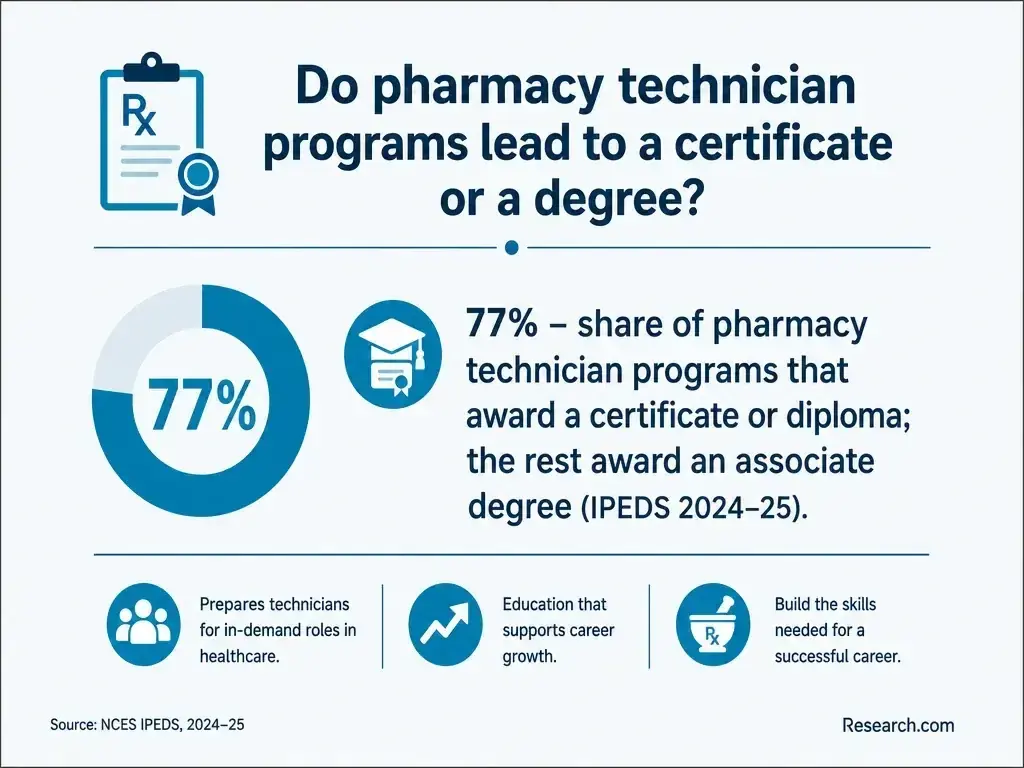
A completed trade-school program typically awards the provider's certificate of completion or occupational certificate, as specified in its catalog. That school credential is distinct from national certification - such as PTCB's CPhT credential - and from Texas State Board of Pharmacy registration. Finishing a course does not by itself grant either of the latter credentials.
Ask the provider to identify the exact award, whether its curriculum meets a national certification exam's education route, and what steps remain for Texas registration. A search for most valuable bachelor's degrees addresses a different education decision; it should not be used to judge whether a technician certificate supports entry into this occupation.
School admission rules vary: a provider may request evidence of prior education, an application, or prerequisites, while a worksite placement may have its own screening and schedule requirements. Request the current catalog and distinguish admission to training from eligibility to work as a registered trainee. The Texas State Board of Pharmacy sets the registration rules, not the admissions office.
Before paying a deposit, disclose any concern about a background check through the appropriate official process and ask when registration must be active for a lab or worksite assignment. If a provider promises a placement, obtain its eligibility conditions and any costs in writing. Employer-sponsored positions can avoid school admission but still require the employer's hiring process and applicable Texas registration.
Relevant instruction combines medication names and forms, dosage calculations, prescription processing, inventory control, insurance workflows, Texas and federal pharmacy rules, and patient privacy. The U.S. Bureau of Labor Statistics identifies accuracy, attention to detail, and communication as important to pharmacy technician work. Programs should give students a way to practice and receive feedback on these tasks, not just memorize exam answers.
Some workplaces add specialized training, such as sterile compounding, after entry. Do not pay extra for a specialty on the assumption that every first job requires it. Instead, compare the curriculum with the work setting you want and ask an employer whether it trains new technicians for specialized duties.
Yes - Texas registration matters. The Texas State Board of Pharmacy distinguishes pharmacy technician trainee registration from pharmacy technician registration. Its trainee route allows supervised work while an applicant works toward the qualifications for technician registration; it is not a permanent substitute for completing that transition. Check the board's current eligibility, application, fingerprinting, and renewal rules before choosing a start date.
National certification and state registration serve different purposes. The board recognizes qualifying national certification for its technician-registration route, while certifiers such as the Pharmacy Technician Certification Board set their own exam-eligibility rules. Institutional accreditation addresses a school; pharmacy-technician programmatic accreditation or industry recognition addresses training; neither replaces a board registration. Confirm the precise certification and registration steps with the board and certifier rather than relying on a school's "certification included" claim.
Start with the job you want - retail, hospital, or another pharmacy setting - then compare only options that fit your schedule and Texas entry route. An affordability ranking is a shortlist, not a finding that the lowest-priced option has the strongest instruction or outcomes. Collin County Community College District is one provider to investigate; verify its current pharmacy technician offering, campus or worksite arrangements, and full price directly rather than assuming a listed institution has a particular course available in 2027.
Use these questions when speaking with each provider or prospective trainee employer:
- What is the complete price through certification and Texas registration, including required travel and supplies?
- What credential is awarded, and what classroom, lab, and supervised worksite experience is actually included?
- Which national exam eligibility route does the training support, and who verifies that claim?
- Who arranges practical experience, where does it take place, and can a working student attend?
- What are the program's completion and placement definitions, and are outcomes specific to pharmacy technician students?
Then compare likely earnings against your current income over a realistic time horizon, accounting for aid, debt, time away from work, and the chance you may not complete. The common mistakes are comparing tuition alone, assuming an online course provides a placement, and treating a school certificate as Texas registration. For federal-aid questions, verify the particular program rather than relying on a school's general aid eligibility.
The usual first step is supervised trainee work or an entry-level technician role consistent with Texas registration. With experience and the credentials an employer requires, a technician may move toward hospital distribution, inventory coordination, specialized pharmacy workflows, or a lead role. Those are possible progressions, not automatic promotions or entry-level promises.
Choose training around the setting you want: retail-focused practice may help someone seeking an immediate customer-facing job, while a student targeting hospital work should ask about relevant placement access and additional employer training. Searches for an easiest phd concern a different path and do not answer the practical question here: which training, registration, and workplace experience will help you enter pharmacy technology?
The U.S. Bureau of Labor Statistics projects 6.4% national employment growth for pharmacy technicians from 2025 to 2035. This indicates continued demand across the occupation, not a forecast of openings in McKinney or a guarantee that any graduate will be hired. The board's registration rules and an employer's requirements still govern an individual's path into work.
To test the local market before enrolling, review current vacancies within a commute you would actually accept. Note how often postings seek trainee applicants versus registered or certified technicians, and whether the shifts and pharmacy settings fit your plan. That evidence is more useful for choosing between paid trainee work and a school program than applying a national growth rate to one city.
Most Affordable Pharmacy Technician Schools & Training in Mckinney for 2027
Education is a consequential investment, so Research.com evaluates programs against others in the same occupation and location rather than treating every training market as interchangeable. Only programs with completions reported to IPEDS are eligible. That makes the ranking useful for comparing included programs, but it does not cover every employer-training option or prove that an unlisted provider is unsuitable.
For the most affordable ranking, the Research.com team scores tuition, cost of attendance, median student debt, and federal loan default rate. An entropy-based method gives more weight to cost and debt indicators that vary more across programs. Unlike the separate best-programs rankings, this affordability score does not include accreditation, student support, completion, or earnings. The team uses these sources to check program and institutional information, cost data, and relevant recognition where available; sources covering other trades do not establish pharmacy technician program approval:
- IPEDS database: reported completions and institutional data.
- National Center for Education Statistics: federal education data and definitions.
- College Scorecard database: available cost, debt, and outcome measures.
- Peterson's database: supplemental institutional information.
- Commission on Accreditation of Allied Health Education Programs: allied-health recognition information where relevant.
- Accrediting Bureau of Health Education Schools: health-education accreditation information.
- Commission on Dental Accreditation: occupation-specific recognition information for other health programs in the broader source set.
- Dental Assisting National Board: certification information for other health programs in the broader source set.
- National Center for Construction Education and Research: trade recognition information outside pharmacy technology.
- Apprenticeship.gov Partner Finder: information about registered work-based training alternatives.
Readers can use the ranking to narrow a cost comparison, then independently verify current prices, practical training, and Texas registration eligibility. More detail about Research.com's approach appears on its methodology page.
# 2 position
Collin County Community College District - Pharmacy Technician/Assistant.
certificate or diplomaFrequently asked questions about pharmacy technician programs in Mckinney
Can I become a pharmacy technician in McKinney without trade school?
Texas has a pharmacy technician trainee registration route for supervised work. Confirm current eligibility with the Texas State Board of Pharmacy and ask employers whether they hire and train trainees.
Is a school certificate the same as Texas registration?
No. A provider awards its certificate; the Texas State Board of Pharmacy handles state registration. National certification is a separate credential with its own requirements.
Is online training enough?
Online lessons can teach theory, but they do not automatically provide practical experience, certification eligibility, or Texas registration. Verify each requirement and any worksite arrangements before enrolling.
What should I compare if two programs have similar tuition?
Compare mandatory fees, exam and registration costs, travel, practical training, scheduling, financial aid, and what each provider can document about completion and placement.
Is the national median wage a realistic starting offer?
Not necessarily. The Bureau of Labor Statistics' May 2025 median of $45,750 covers U.S. technicians across experience levels. Check local trainee and entry-level postings for a more useful pay comparison.
- U.S. Bureau of Labor Statistics - Pharmacy Technicians
Used to verify salary, employment outlook, and typical education requirements.
https://www.bls.gov/ooh/healthcare/pharmacy-technicians.htm - NCES College Navigator (IPEDS)
Used to verify programs offered and institutional accreditation.
https://nces.ed.gov/collegenavigator/ - PTCB - Certified Pharmacy Technician (CPhT)
Professional certification reference for graduates of this occupation.
https://www.ptcb.org/credentials/certified-pharmacy-technician - Collin County Community College District - official website
Official school website (programs, tuition, admissions).
https://www.collin.edu/