# 1 position
Best Pharmacy Technician Training Programs & Trade Schools in Salem for 2027
Audited and Verified:
Our Editorial and Data Verification Process
Research.com uses government datasets, official education statistics and primary institutional information to support its career and degree guides. Our review process checks factual accuracy, occupational definitions, source dates and the requirements associated with the credentials discussed.
How This Article Was Fact-Checked
Our editorial team verifies salary estimates, employment projections, education requirements and program information against original data providers and official organizations. Salary figures are checked against the relevant occupational definitions and reporting periods. Information about licensure, accreditation and required in-person training is reviewed separately.
Fact-checked and verified on:

Co-Founder and Chief Data Scientist

Reviewed by Karolina Broda
Fact-Checker and Data Verification
Choosing pharmacy technician training in Salem, Oregon, means looking beyond a course title: you need a path to hands-on competence, certification eligibility, and the right Oregon credential. The U.S. Bureau of Labor Statistics projects 6.4% national employment growth for pharmacy technicians from 2025 to 2035. This guide compares training routes, costs, and career prospects so you can judge what is worth considering. It will also feature the Research.com team of data scientists' Best Pharmacy Technician Trade Schools in Salem for 2027 ranking to help students make an informed choice.
Key findings about pharmacy technician degrees in Salem
- For Salem applicants, the decisive comparison is whether a program's practical training and exam preparation fit the Oregon Board of Pharmacy credential they intend to pursue - not whether it awards a certificate with a familiar name.
- The national median annual wage for pharmacy technicians was $45,750 in May 2025; that is an occupation-wide benchmark, not an expected starting wage in Salem (U.S. Bureau of Labor Statistics).
- A college certificate is not the only route: employer training may reduce upfront cost, while a structured program may offer more predictable labs and certification preparation. Compare the complete cost and the availability of supervised practice.
Table of Contents
- Best Pharmacy Technician Training Programs & Trade Schools in Salem for 2027
- What can I expect from a pharmacy technician trade school program in Salem?
- Where can I work with a pharmacy technician trade school training in Salem?
What can I expect from a pharmacy technician trade school program in Salem?
A Salem pharmacy technician program should prepare you to assist a pharmacist with prescription processing, medication inventory, customer or patient communication, and safety procedures. Technicians work under pharmacist supervision; the training is not a license to make independent clinical decisions (U.S. Bureau of Labor Statistics; Oregon Board of Pharmacy).
The main routes differ in what you receive and how you practice. This comparison helps you decide whether paying for a school program offers enough additional structure to justify its cost.
| Route | What to expect | Best fit and trade-off |
| College or career-school certificate | Defined coursework, often with labs and possible worksite experience; earns a school credential | Useful if you want structured preparation; verify the practical component and total price |
| Associate degree with pharmacy technician training | Occupational courses plus additional academic coursework; earns an academic degree | May suit a broader education goal, but takes more time and may cost more than necessary for technician entry |
| Employer-sponsored training | Workplace instruction with supervised duties; the employer may cover some training costs | Can lower upfront expense, but openings and the scope of instruction depend on the employer |
| Registered apprenticeship, if available locally | Paid work and structured instruction under a registered sponsor | Worth investigating if you need wages while learning; confirm that a pharmacy-specific opening exists and how it supports Oregon credentialing |
Ask any provider how much practice takes place in a lab versus a pharmacy, who arranges placements, and whether placement depends on a background check or employer screening. Two certificates are not equivalent if one provides supervised prescription-workflow practice and the other provides only readings and quizzes.
Where can I work with a pharmacy technician trade school training in Salem?
Training can lead to work in community and hospital pharmacies, as well as long-term-care and other medication-distribution settings (U.S. Bureau of Labor Statistics). In Salem, your intended setting should shape your program choice: a hospital applicant should ask about sterile-compounding exposure and hospital placements, while a retail applicant may value insurance-claim practice and patient-facing communication.
A worksite placement is especially useful when it lets you test that setting before applying for a permanent job. Ask where recent students completed their practical training; do not assume a Salem placement is guaranteed or that every employer accepts students from every program.
The national median annual wage for pharmacy technicians was $45,750 in May 2025 (U.S. Bureau of Labor Statistics). Half of workers in the occupation earned less and half earned more; the figure combines experienced and newer workers across employers and locations. It is not a Salem starting-salary estimate.
To judge whether a particular offer makes training worthwhile, compare the employer's stated starting pay, schedule, benefits, and potential advancement with your current earnings. Hospital, retail, and other roles can differ in duties and compensation, so use local job postings and written offers rather than the national median as your personal forecast.
A certificate program may take months rather than years, but the calendar length alone does not tell you when you can work. Course load, lab scheduling, worksite placement, and Oregon credential processing can all affect your timeline. Associate degree routes generally include more coursework; employer training follows an employer's schedule.
Ask for the program's published clock hours or credits, the hours spent in person, and any required supervised worksite hours. Do not assume a universal Oregon classroom-hour requirement applies to every route: confirm current eligibility directly with the Oregon Board of Pharmacy and, for an exam, its certifying organization. If speed is the priority, compare the complete time to job readiness - not just advertised course length. A broader comparison of best accelerated associate's degree online options can clarify why an accelerated academic credential is a different commitment from a shorter technician certificate.
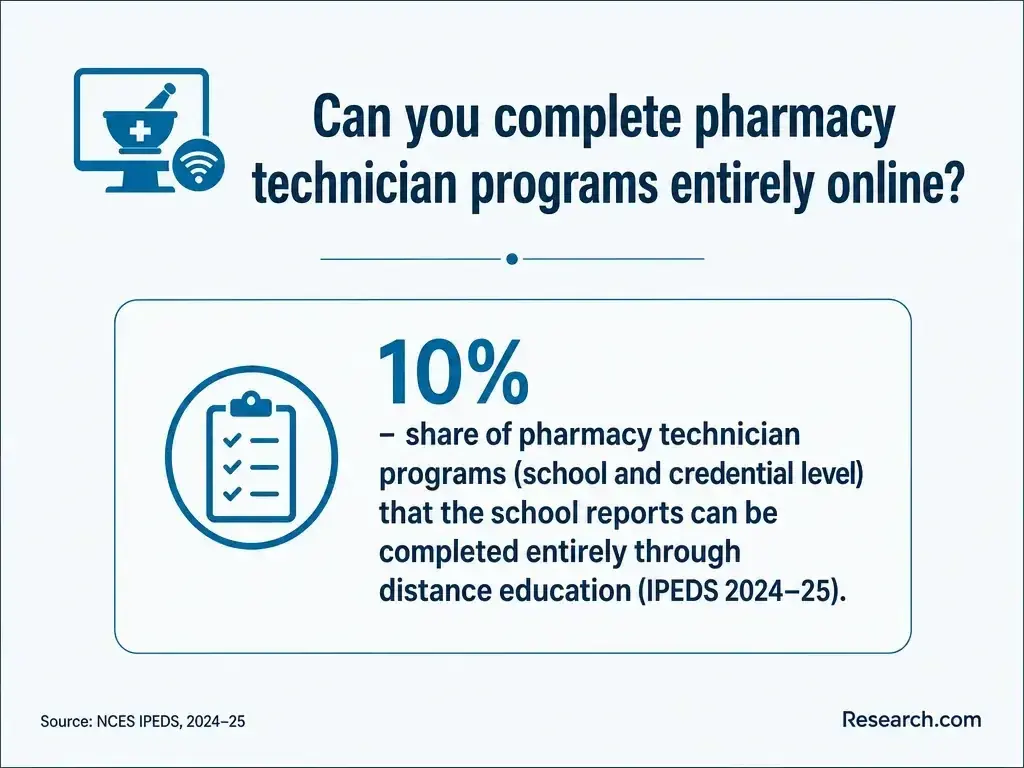
Online coursework can be practical for medical terminology, pharmacy calculations, law, and insurance concepts. It cannot by itself demonstrate every hands-on skill involved in medication handling and pharmacy workflow. Before choosing a remote program, establish where you will complete any required labs or supervised practice in or near Salem.
Format matters most where it changes your access to practice. The comparison below identifies what to verify rather than assuming one format automatically meets Oregon requirements.
| Format | Potential advantage | Essential check |
| On-campus | Scheduled access to instructors and labs | Whether lab times and any pharmacy placement fit your commute and work schedule |
| Hybrid | Remote theory with scheduled in-person practice | Where and when labs and worksite experience occur |
| Fully online coursework | Flexible study schedule | Who provides practical training and whether the route meets your intended exam and Oregon credential requirements |
Institutional accreditation is one check, not proof of occupational eligibility. A guide to online colleges with national accreditation can help you understand that distinction, but verify the specific pharmacy technician program and its practical-training arrangements separately.
There is no reliable single Salem-wide price for pharmacy technician training: providers can differ in credential, length, included supplies, and whether training is paid. Request a written total cost to become job-ready, not just a tuition quote. Include mandatory fees, books or software, lab supplies, uniforms, background checks, travel to a worksite, certification-exam and Oregon application fees, and income you would forgo while attending.
A longer academic route deserves its own cost comparison; how much does it cost to get an associate's degree is a useful starting question, but published college prices still need to be matched to the specific program. Compare net cost after grants or employer support, likely borrowing, completion risk, and the time until you can begin earning. Paid employer training may improve that calculation even when a school's tuition looks affordable.
A school may award a certificate, diploma, or associate degree, depending on its program. Those are educational credentials, not the same thing as national certification or an Oregon Board of Pharmacy credential. Confirm the exact award on the program's current catalog rather than relying on "certified technician" in advertising.
National certification is a separate examination-based credential. The Pharmacy Technician Certification Board administers the Pharmacy Technician Certification Exam, and the National Healthcareer Association administers the ExCPT; each organization sets its own eligibility rules (Pharmacy Technician Certification Board; National Healthcareer Association). Before paying tuition, ask which exam the curriculum prepares you for and whether your particular training route satisfies that organization's current eligibility criteria.
Program admission and permission to work in a pharmacy are separate steps. A provider may require an application, foundational math or reading skills, and documents needed for a worksite placement. A placement site may impose additional screening. Request the current requirements in writing, particularly if you have a background issue that could affect placement or credentialing; an admissions offer does not resolve that question.
If you plan to use aid, confirm that the specific program is eligible, not merely that its institution participates in federal aid. Federal Student Aid eligibility depends on the student and program, and some short or noncredit training is ineligible (Federal Student Aid). Lists of schools with low tuition programs that accept financial aid can help frame an affordability search, but they do not establish aid eligibility for a Salem pharmacy technician offering.
Useful training connects drug names and dosage forms with calculations, prescription intake, labeling, inventory, insurance processing, privacy, and error prevention. The work also demands careful data entry, communication with patients and pharmacists, and recognition of questions that must go to the pharmacist (U.S. Bureau of Labor Statistics; O*NET).
Look beyond the topic list. Ask how students practice measuring and preparing medications, handling simulated prescriptions, resolving an insurance rejection, and catching a possible error. If you want hospital work, ask whether sterile-compounding instruction and supervised practice are actually included; a mention of the topic in a course description is not the same as demonstrated competence.
Yes - plan on meeting Oregon Board of Pharmacy requirements before working as a pharmacy technician in Salem. Oregon distinguishes pharmacy technician credentials from certified pharmacy technician credentials, and national certification is relevant to the certified route (Oregon Board of Pharmacy). Check the board's current application categories, conditions, fees, and renewal rules before selecting a training program; requirements can change.
Keep the approvals separate: institutional accreditation concerns the school, any applicable programmatic accreditation concerns the training program, national certification comes from a certifying organization, and Oregon credentials come from the state board. The American Society of Health-System Pharmacists and Accreditation Council for Pharmacy Education jointly accredit eligible pharmacy technician training programs; that recognition does not itself grant an Oregon credential (ASHP/ACPE; Oregon Board of Pharmacy). Ask the board and exam provider to confirm your intended route rather than assuming graduation automatically qualifies you.
The best fit is the least costly workable route that gives you the practice, credential eligibility, and schedule you need - not automatically the highest-ranked or shortest program. Use the ranking to build a shortlist, then check the details that can determine whether you finish and enter the job you want.
Ask each provider these questions before committing; written answers make substantially different offers easier to compare.
- What exact credential will I earn, and which national exam eligibility route does this training support?
- How many hours are spent in labs and supervised pharmacy work, and who secures a Salem-area placement?
- What is the full cost after mandatory fees, supplies, screening, exam costs, and available aid?
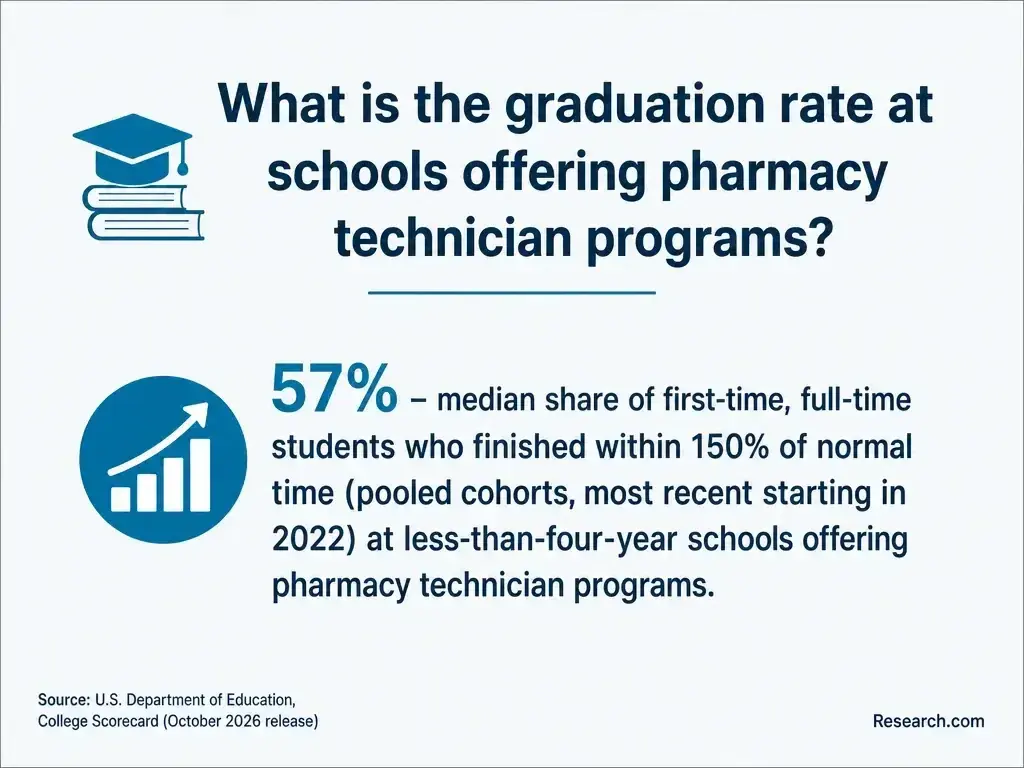
- What are the current completion, exam, and placement outcomes for this specific program, and how are they measured?
- Will prior learning or transfer credit reduce my cost or time without removing required practical training?
Check Chemeketa Community College's current catalog if you want to assess a local college option, and compare its published requirements with any other route you are considering. Red flags include an "online-only" promise with no clear plan for practice, an unsupported claim that graduation confers state credentials, or a price that excludes required worksite and examination expenses.
Entry-level work may focus on prescription intake, inventory, or dispensing support under a pharmacist. With experience and appropriate training, technicians may pursue roles involving hospital medication systems, sterile preparation, purchasing, or training other technicians. Employers set job-specific requirements, and additional certification or skills do not automatically bring a promotion (U.S. Bureau of Labor Statistics; Pharmacy Technician Certification Board).
If your goal is a specialized role, search Salem-area postings first and note the credentials and experience employers actually request. That is a more useful way to evaluate certifications for jobs that pay well than assuming any extra certificate will raise your pay. A basic program makes the most sense when it gets you into a supervised position from which you can build the specific experience your target employers value.
National pharmacy technician employment is projected to grow 6.4% from 2025 to 2035 (U.S. Bureau of Labor Statistics, Employment Projections). That signals continuing demand across the occupation, but it does not measure openings in Salem or guarantee a job after training.
For a local decision, compare current postings by workplace and shift, and check whether they ask for an Oregon credential, national certification, or prior pharmacy experience. Technology can change how pharmacies process prescriptions, but accurate medication handling and pharmacist-supervised safety work remain central to the occupation (U.S. Bureau of Labor Statistics). Choose training that develops those practical skills, not merely familiarity with software.
Best Pharmacy Technician Training Programs & Trade Schools in Salem for 2027
Education is a substantial investment, so the Research.com team designed the ranking to compare pharmacy technician programs with other programs in the same occupation and location - not with unrelated schools nationwide. The team reviews outcomes, costs, and quality indicators to make the comparison more credible and useful. Only programs with completions reported to the Integrated Postsecondary Education Data System (IPEDS) can appear; a missing employer-training route or nonreporting provider should not be read as a poor-quality option.
Best-program rankings evaluate student completion and full- and part-time retention; earnings one year after completion and earnings relative to annual attendance cost; tuition, attendance cost, debt, and federal loan defaults; and accreditation, relevant industry recognition, and student support. Relevant programmatic accreditation or industry recognition receives 20% of the score, institutional accreditation 10%, and student support 10%. The remaining 60% covers outcomes, earnings, and costs, with entropy-based weighting that gives more weight to indicators that vary more across programs. Separate most-affordable rankings score only cost and debt measures; accreditation and other quality measures are not part of that affordability score.
The team uses the following data sources to check program and institutional information. Some cover other trades in Research.com's broader rankings and should not be mistaken for pharmacy technician program accreditation.
- IPEDS database
- National Center for Education Statistics
- College Scorecard database
- Peterson's database
- Commission on Accreditation of Allied Health Education Programs (CAAHEP)
- Accrediting Bureau of Health Education Schools (ABHES)
- Commission on Dental Accreditation (CODA)
- Dental Assisting National Board (DANB)
- National Center for Construction Education and Research (NCCER)
- Apprenticeship.gov Partner Finder
The ranking can narrow a shortlist, but students should still confirm current program details and Oregon credential requirements before enrolling. Research.com explains its approach further on its methodology page.
# 2 position
Chemeketa Community College - Pharmacy Technician/Assistant.
certificate or diplomaFrequently asked questions about pharmacy technician programs in Salem
Can I become a pharmacy technician in Salem without trade school?
Possibly. Employer-sponsored training may be an alternative, but you still need to meet the Oregon Board of Pharmacy's requirements for your intended role. Confirm the employer's training and supervision arrangements before accepting an offer.
Is national certification the same as an Oregon credential?
No. A national certifying organization awards certification; the Oregon Board of Pharmacy administers state credentials. Check both sets of current requirements.
Can I complete pharmacy technician training entirely online?
You may be able to study theory online, but you should verify where practical skills and any required worksite training will occur. Do not assume online coursework alone meets exam or Oregon requirements.
Is a certificate or associate degree better?
A certificate may be the more direct route to technician work. An associate degree may fit if you want its additional coursework, but compare the extra time and total cost against your actual career goal.
What should I ask about a pharmacy placement?
Ask who arranges it, where it takes place, what screening it requires, and whether all students who need a placement can obtain one on their preferred schedule.
- U.S. Bureau of Labor Statistics - Pharmacy Technicians
Used to verify salary, employment outlook, and typical education requirements.
https://www.bls.gov/ooh/healthcare/pharmacy-technicians.htm - NCES College Navigator (IPEDS)
Used to verify programs offered and institutional accreditation.
https://nces.ed.gov/collegenavigator/ - PTCB - Certified Pharmacy Technician (CPhT)
Professional certification reference for graduates of this occupation.
https://www.ptcb.org/credentials/certified-pharmacy-technician - Chemeketa Community College - official website
Official school website (programs, tuition, admissions).
https://www.chemeketa.edu/