# 1 position
Best Pharmacy Technician Training Programs & Trade Schools in Vancouver for 2027
Audited and Verified:
Our Editorial and Data Verification Process
Research.com uses government datasets, official education statistics and primary institutional information to support its career and degree guides. Our review process checks factual accuracy, occupational definitions, source dates and the requirements associated with the credentials discussed.
How This Article Was Fact-Checked
Our editorial team verifies salary estimates, employment projections, education requirements and program information against original data providers and official organizations. Salary figures are checked against the relevant occupational definitions and reporting periods. Information about licensure, accreditation and required in-person training is reviewed separately.
Fact-checked and verified on:

Co-Founder and Chief Data Scientist

Reviewed by Karolina Broda
Fact-Checker and Data Verification
Choosing pharmacy technician training in Vancouver means checking more than tuition: Washington licensing rules and hands-on experience can determine whether a program leads to the job you want. The U.S. Bureau of Labor Statistics projects 6.4% national job growth for pharmacy technicians from 2025 to 2035. This guide explains local training choices, costs, credentials, and career prospects. It also accompanies the Best Pharmacy Technician Trade Schools in Vancouver for 2027 ranking, created by the Research.com team of data scientists to help students identify programs worth considering.
Key findings about pharmacy technician degrees in Vancouver
- Start with Washington eligibility, not a program's name: confirm that its training route is accepted by the Washington Pharmacy Quality Assurance Commission and prepares you for the required national certification examination (Washington State Department of Health).
- The national median annual wage for pharmacy technicians was $45,750 in May 2025; it is not a Vancouver starting-salary estimate (U.S. Bureau of Labor Statistics).
- Compare the full route to employment - credential, supervised practice, examination and licensing costs, and time away from work - before choosing a campus, hybrid, or employer-based option.
Table of Contents
- Best Pharmacy Technician Training Programs & Trade Schools in Vancouver for 2027
- What can I expect from a pharmacy technician trade school program in Vancouver?
- Where can I work with a pharmacy technician trade school training in Vancouver?
What can I expect from a pharmacy technician trade school program in Vancouver?
Expect training in prescription processing, medication names and calculations, inventory, safety, and communication with patients and pharmacists. A pharmacy technician works under a pharmacist's supervision; classroom knowledge alone does not replace practice with dispensing workflows and workplace controls (U.S. Bureau of Labor Statistics; Washington State Department of Health).
In Vancouver, a college-based certificate may suit someone who wants a structured schedule and supervised practice. Clark College is a local provider to investigate, but applicants should confirm its current pharmacy technician offering, credential, practical placement, and Washington approval directly before enrolling. Employer-sponsored training may better suit someone who needs to earn while learning, provided the training meets the state's requirements. A list of top online schools can help locate remote coursework, but it cannot establish that a pharmacy technician program provides local practical training or licensing eligibility.
Where can I work with a pharmacy technician trade school training in Vancouver?
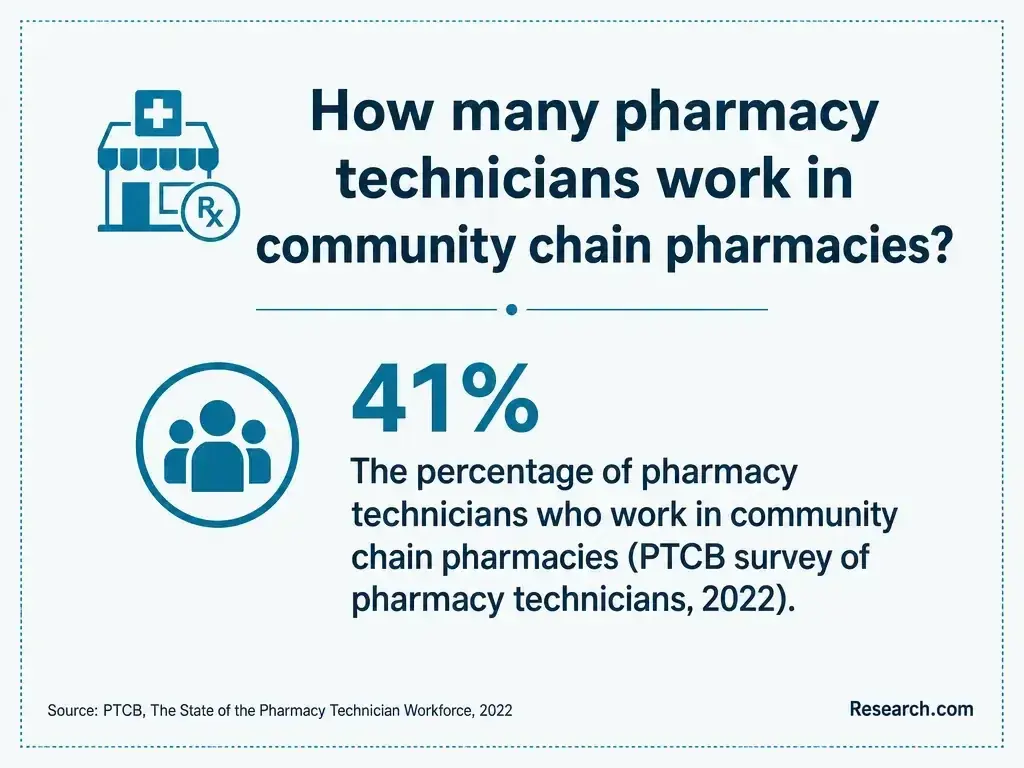
Potential settings include community and hospital pharmacies, health-system outpatient pharmacies, and medication-distribution operations. Retail work emphasizes prescription intake, insurance processing, and customer interaction; hospital work may involve unit-dose preparation, inventory systems, and more specialized medication workflows (U.S. Bureau of Labor Statistics). Ask prospective training providers where students complete practical experience: a placement aligned with your preferred setting is more useful than one chosen solely for convenience.
Vancouver's proximity to Portland broadens the area in which residents may look for work, but it also creates a licensing question. Washington authorization does not automatically authorize practice in Oregon. Check the Oregon Board of Pharmacy's requirements before treating an across-the-river job as part of your employment plan.
The U.S. Bureau of Labor Statistics reports a $45,750 national median annual wage for pharmacy technicians in May 2025. A median describes workers across experience levels and settings, not what a newly trained Vancouver applicant will be offered. Compare current Vancouver-area postings by employer, shift, and required experience; a hospital position with specialized duties may not be comparable to an entry-level community-pharmacy opening.
For a realistic return-on-investment estimate, compare a plausible starting offer with your current earnings. Include the time needed to finish training and obtain a license, rather than assuming you will immediately earn the national median.
Duration depends on the credential, course schedule, and time required for practical training. A focused certificate can be shorter than a broader occupational associate program; employer training may fit around paid shifts but depends on the employer's training capacity. Do not choose by advertised course length alone: ask when supervised experience occurs and how long recent students took to finish the entire licensing pathway.
If you are comparing an occupational associate option with a shorter certificate, guides on how to get associate's degree online fast offer context on accelerated study - not proof that pharmacy labs or workplace competencies can be completed remotely. Request the current curriculum and practical-training schedule from each provider. Washington's training and examination requirements, rather than a generic program-hour claim, should determine whether its timeline is workable (Washington State Department of Health).
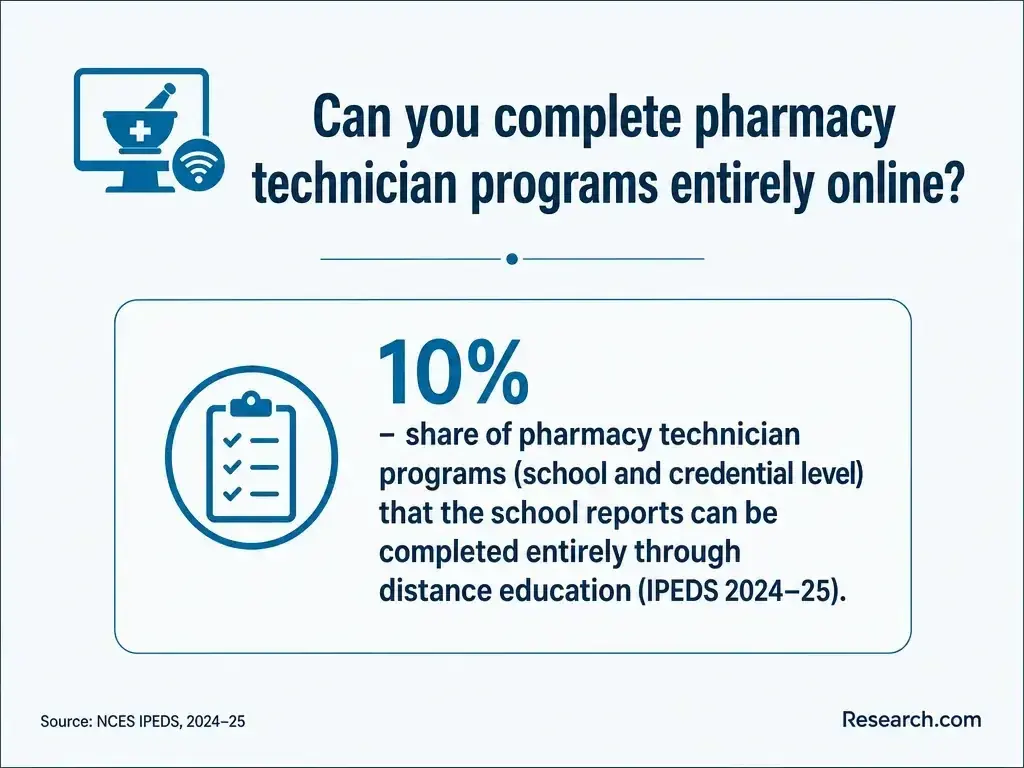
Online coursework can make terminology, calculations, and regulatory topics easier to fit around work. On-campus or hybrid training offers scheduled access to equipment and direct observation of practical skills. Neither format eliminates the need to verify how the program handles supervised, in-person pharmacy experience and Washington licensing eligibility.
The comparison below separates convenience from career-entry requirements. Ask providers to identify the site and supervisor for every practical component before paying a deposit.
| Format | Potential advantage | Issue to verify |
| On-campus | Scheduled instruction and skills practice | Commute, lab schedule, and placement availability |
| Hybrid | Remote theory with some in-person training | Required campus visits and workplace placement |
| Online coursework | More flexible theory study | Where practical competencies occur and whether the full route meets Washington requirements |
A guide to the easiest degrees to get online addresses a different question: pharmacy technician entry depends on occupation-specific training, certification, and licensing, not how conveniently coursework can be delivered.
There is no single reliable Vancouver-wide average covering college programs, career-school offerings, and employer training on comparable terms. Request a written total cost to become job-ready, not just a tuition figure. Include mandatory fees, books and software, uniforms or other required supplies, examination and licensing charges, any required background check, and transportation to both classes and practice sites.
Employer-sponsored training may offset tuition and lost earnings if it is paid, but confirm the wage, schedule, and any repayment agreement. Ask each school whether the specific program qualifies for federal aid, Washington aid, scholarships, or workforce funding; institutional accreditation alone does not establish aid eligibility. A lower-priced course is not the better investment if it leaves you needing additional approved training before you can apply for a license (Federal Student Aid; Washington State Department of Health).
A training provider may award a certificate or an occupational associate credential, depending on its curriculum. That school credential is distinct from national certification, which follows an examination administered by a certifying organization, and from a Washington pharmacy technician license, which the state issues to eligible applicants. Completing one does not automatically confer the others (Washington State Department of Health; Pharmacy Technician Certification Board; National Healthcareer Association).
Ask for the exact credential printed on the completion record and whether the program's training is accepted for Washington licensure. If considering an occupational associate program, compare its additional coursework and time cost with what the pharmacy jobs you want actually require.
Admissions requirements vary by provider and are separate from the state's requirements to practice. Ask about prior education, placement testing, prerequisite coursework, background screening, and any conditions for entering a practical site. A student may be admitted to classes yet face a separate barrier to workplace placement or licensing.
Before committing, disclose relevant concerns through the appropriate official process rather than relying on a recruiter's assurance. Request written answers about eligibility for supervised training, national examination preparation, and the Washington license application (Washington State Department of Health).
A useful curriculum connects medication knowledge and dosage calculations to the actual workflow: interpreting prescription information, entering and checking records, managing inventory, protecting patient information, and recognizing when a question must go to the pharmacist. Depending on the practice site, training may also address sterile or nonsterile preparation. These are supervised technician competencies, not independent authority to make clinical decisions (U.S. Bureau of Labor Statistics; Washington State Department of Health).
Compare programs by what students practice and how performance is assessed, not by course titles alone. Ask to see the lab topics, practical-training objectives, and exam-preparation plan; similar-looking certificates can provide materially different workplace exposure.
Yes, for pharmacy technician practice in Washington. The Washington Pharmacy Quality Assurance Commission, through the Washington State Department of Health, sets the education and training, national certification examination, and licensing requirements. Verify the current approved training routes and application instructions directly with the department before enrolling. Graduation alone is not a license, and school accreditation is not a substitute for state acceptance of the training route.
A pharmacy assistant is a distinct Washington registration with different duties; it is not an interchangeable name for a licensed technician. If a Vancouver resident intends to work in Oregon, check that state's board separately rather than assuming Washington credentials transfer automatically (Washington State Department of Health; Oregon Board of Pharmacy).
Choose the program that offers a credible, affordable route to the specific job and state license you want - not simply the highest rank or shortest advertised course. Use the ranking to make a shortlist, then ask each provider for evidence on these points:
- Confirm the exact credential, Washington-accepted training route, national examination preparation, and steps still required after completion.
- Identify where practical training occurs, who supervises it, and whether a placement is arranged or left to the student.
- Get an itemized total-cost estimate and compare aid, debt, commuting, and earnings forgone while training.
- Ask for program-specific completion and examination outcomes, their reporting periods, and how many students were included.
Compare those answers with employer-sponsored training if you need paid work sooner. A wider guide to what are the best college majors for the future may help with broader career reflection, but it cannot answer whether a particular technician program meets Washington's occupational requirements. Red flags include a promised license upon graduation, an "entirely online" practical experience, or a price that omits required career-entry costs.
After licensing, a technician may seek community-pharmacy or hospital work and build experience in inventory, medication-distribution systems, or other specialized workflows. Some employers offer lead or supervisory responsibilities after substantial experience. Additional credentials can support particular roles, but check job postings before paying for an optional specialization; it does not replace Washington's entry requirements (U.S. Bureau of Labor Statistics; Washington State Department of Health).
If you prefer detail-focused work, consider the balance of tasks rather than the job title alone. Pharmacy technicians coordinate with pharmacists, patients, and other staff; a list of best high paying jobs for introverts cannot tell you whether a busy pharmacy's communication demands suit you. Ask to observe or speak with technicians in the setting you hope to enter.
The U.S. Bureau of Labor Statistics projects 6.4% growth nationally from 2025 to 2035 for pharmacy technicians. That projection signals continuing demand across the occupation, but it is not a Vancouver hiring forecast or a promise of a local opening. Examine recent vacancies on both sides of the state line, noting which require experience, particular shifts, or a license from the state where the job is located.
Automation and pharmacy software can change the mix of tasks, making accurate data entry, safety checks, and adaptable workflow skills valuable alongside medication knowledge (U.S. Bureau of Labor Statistics). For a prospective student, the practical test of demand is whether reachable employers are hiring newly licensed technicians in the settings for which a program prepares you.
Best Pharmacy Technician Training Programs & Trade Schools in Vancouver for 2027
Education is a consequential investment, so the Research.com team built the ranking to compare pharmacy technician programs with other programs serving the same occupation and location. Only programs with completions reported to IPEDS qualify for inclusion. That boundary matters: an employer training route or another provider may be viable even if it does not appear in the ranking.
Best-program rankings assess student outcomes; earnings and return on investment; costs and debt; and quality and recognition. Programmatic accreditation or relevant industry recognition accounts for 20% of the score, institutional accreditation for 10%, and student support for 10%. The remaining 60% covers completion and retention, earnings, tuition and attendance costs, debt, and federal loan defaults; its indicator weights are assigned using an entropy-based method. Most-affordable rankings instead score only costs and debt using that method. They do not include accreditation or other quality indicators in the score.
The team used the following data sources to check comparable measures and relevant recognition. A source's presence does not mean its standards apply to pharmacy technician programs; occupation-specific eligibility still requires separate verification.
- IPEDS database - reported program completions and institutional data.
- National Center for Education Statistics - federal education data and definitions.
- College Scorecard database - available costs, debt, earnings, and outcomes data.
- Peterson's database - supplemental institutional and program information.
- Commission on Accreditation of Allied Health Education Programs - occupation-relevant accreditation checks where applicable.
- Accrediting Bureau of Health Education Schools - health-education accreditation checks where applicable.
- Commission on Dental Accreditation - accreditation reference for relevant occupations, not a pharmacy technician licensing authority.
- Dental Assisting National Board - certification reference for relevant occupations, not a pharmacy technician certifier.
- National Center for Construction Education and Research - industry-recognition reference for relevant trades, not pharmacy technician approval.
- Apprenticeship.gov Partner Finder - registered-apprenticeship pathway information where relevant.
These checks help readers compare reported outcomes without mistaking a ranking for a licensing decision. For more detail on the approach, see Research.com's methodology.
# 2 position
Clark College - Pharmacy Technician/Assistant.
certificate or diplomaFrequently asked questions about pharmacy technician programs in Vancouver
Is a pharmacy technician certificate enough to work in Washington?
No. A school certificate documents training; you must also meet Washington's current examination and licensing requirements before practicing as a pharmacy technician (Washington State Department of Health).
Can I become a pharmacy technician entirely online?
Online theory may be available, but confirm how supervised practical training is completed and whether the full route is accepted for Washington licensure. Do not assume an online credential is sufficient.
Is paid employer training an alternative to trade school?
It can be if the employer's training route meets Washington's requirements. Compare its pay, supervision, examination preparation, and any repayment terms with a college program.
Should I choose the cheapest or fastest program?
Choose neither on that basis alone. Compare total cost, practical training, completion time, and licensing eligibility; an inexpensive course that requires additional training can cost more overall.
Can I train in Vancouver and work in Portland?
Potentially, but Oregon has its own pharmacy regulatory requirements. Check Oregon Board of Pharmacy eligibility before selecting training specifically for a Portland job.
- U.S. Bureau of Labor Statistics - Pharmacy Technicians
Used to verify salary, employment outlook, and typical education requirements.
https://www.bls.gov/ooh/healthcare/pharmacy-technicians.htm - NCES College Navigator (IPEDS)
Used to verify programs offered and institutional accreditation.
https://nces.ed.gov/collegenavigator/ - PTCB - Certified Pharmacy Technician (CPhT)
Professional certification reference for graduates of this occupation.
https://www.ptcb.org/credentials/certified-pharmacy-technician - Clark College - official website
Official school website (programs, tuition, admissions).
https://www.clark.edu/