# 1 position
Umpqua Community College - Electrician.
associate

Audited and Verified:
Our Editorial and Data Verification Process
Research.com uses government datasets, official education statistics and primary institutional information to support its career and degree guides. Our review process checks factual accuracy, occupational definitions, source dates and the requirements associated with the credentials discussed.
How This Article Was Fact-Checked
Our editorial team verifies salary estimates, employment projections, education requirements and program information against original data providers and official organizations. Salary figures are checked against the relevant occupational definitions and reporting periods. Information about licensure, accreditation and required in-person training is reviewed separately.
Fact-checked and verified on:

Co-Founder and Chief Data Scientist

Reviewed by Karolina Broda
Fact-Checker and Data Verification
Choosing affordable electrician training in Roseburg means looking beyond tuition: a low-cost course may not provide the supervised experience needed for an Oregon license. The U.S. Bureau of Labor Statistics projects 9.2% national growth for electricians from 2025 to 2035, making the pathway worth examining. This guide compares training routes, costs, credentials, and licensing steps. It also accompanies the Most Affordable Electrician Trade Schools in Roseburg for 2027 ranking, created by the Research.com team of data scientists to help students make an informed choice about programs worth considering.
Expect electrical theory alongside practical work: reading plans, identifying conductors and components, applying code rules, installing circuits, testing equipment, and working safely. Labs can build familiarity with tools, but classroom or shop work alone is not the same as supervised employment on an electrical jobsite (U.S. Bureau of Labor Statistics; Oregon Building Codes Division).
The most important distinction is the training route. A short pre-apprenticeship may help someone test the trade and prepare to apply; a college certificate may provide broader technical instruction; a registered apprenticeship combines instruction and paid, documented work experience toward a specific occupation. Ask Umpqua Community College which electrical offerings are currently available, what credential they award, and whether an Oregon apprenticeship sponsor recognizes any completed coursework. Do not assume that a similarly named program elsewhere provides the same licensing progress.
If your immediate goal is independent electrical work, prioritize a route with a documented path to Oregon's experience and examination requirements. If you are still deciding whether the trade fits, a shorter introductory program may carry less financial risk - but check its cost before enrolling.
Electricians work for electrical contractors and in construction, maintenance, and industrial settings; the work can include residential wiring, commercial systems, troubleshooting, or equipment maintenance (U.S. Bureau of Labor Statistics). For a Roseburg resident, the practical question is whether a prospective employer or apprenticeship sponsor can provide the type of supervised work required for the license sought under Oregon rules.
A small local market may require commuting to varied jobsites or accepting assignments beyond the city. Ask a sponsor where apprentices usually work, how travel is handled, and whether its projects provide the experience needed for your intended license. For a broader view of what jobs you can get with a vocational education, compare each occupation's entry requirements before choosing training.
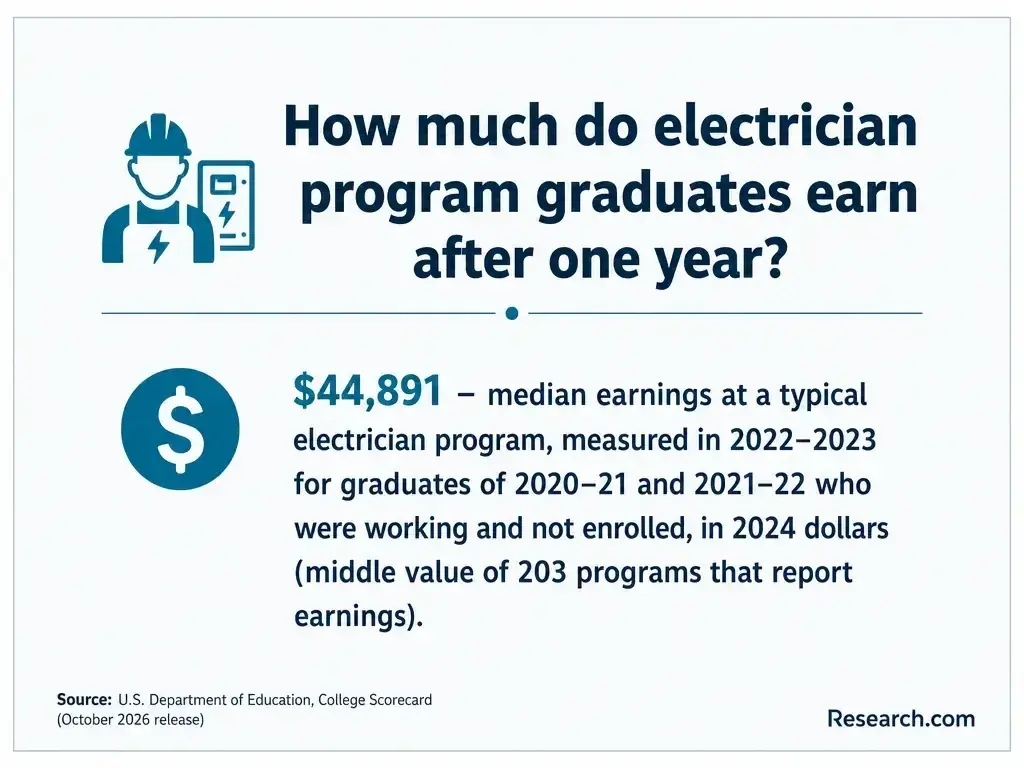
A verified Roseburg-specific electrician wage is not available here. The U.S. Bureau of Labor Statistics reports a $63,190 national median annual wage for electricians for May 2025. That figure includes experienced workers and should not be used as an estimate of an apprentice's first-year pay or a guaranteed local wage.
To estimate what training will mean financially, request the current wage progression from each apprenticeship sponsor and compare it with local job postings for the license and experience level you expect to hold. Include commuting and periods when work may be less available. A paid apprenticeship can improve cash flow during training even if its starting wage is below the occupational median.
Program length depends on what you intend to finish. An introductory course or pre-apprenticeship can end well before you qualify for an electrician license; a registered apprenticeship extends through related instruction and supervised work. Oregon's general journeyman pathway generally involves 8,000 hours of qualifying experience plus required training and an examination, subject to the Oregon Building Codes Division's rules for the applicable route. Other electrical license classifications have different scopes and requirements (Oregon Building Codes Division).
Before comparing an accelerated program with a longer one, ask what its advertised completion time actually measures: the classroom credential, apprenticeship entry, or progress toward a specific license. A quick certificate can be useful preparation, but it does not compress the supervised experience Oregon requires.
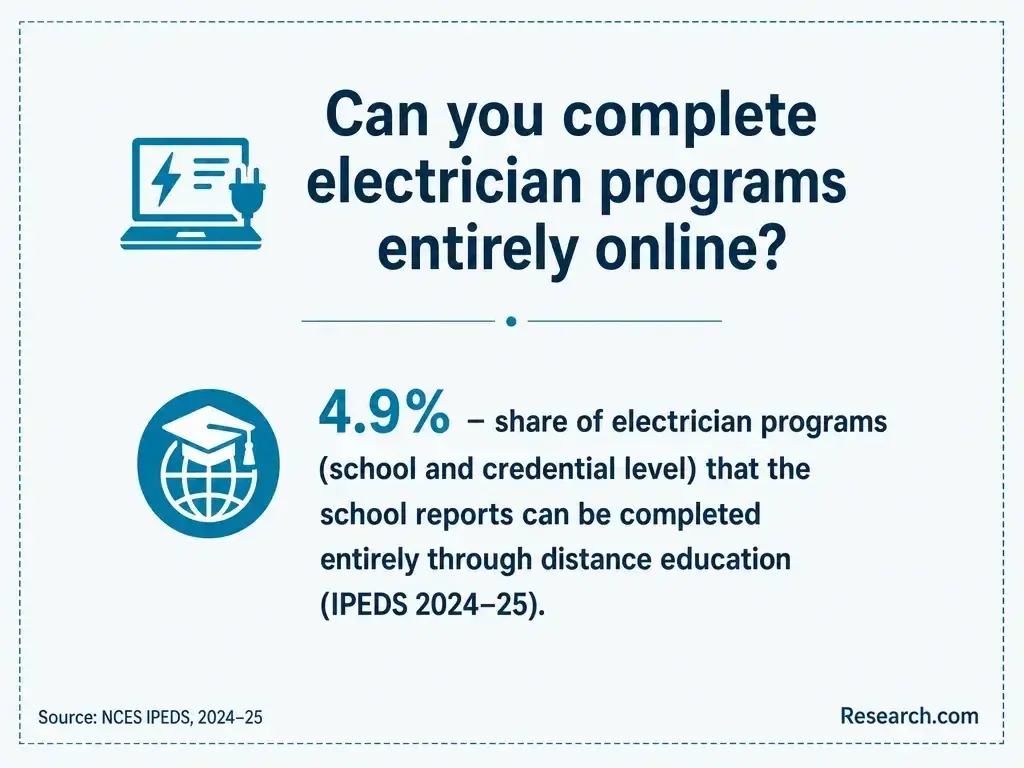
Online instruction can be useful for electrical theory, calculations, and code study. In-person labs and supervised jobsites are where students practice installation, tool use, testing, and safe procedures. An online completion certificate should not be treated as proof that Oregon's practical-experience or licensing requirements have been met (Oregon Building Codes Division).
For someone in Roseburg, a hybrid option may reduce trips for classroom sessions, but the location and schedule of labs and work placements still matter. Compare the whole arrangement - not just the online tuition - when reviewing top affordable online courses & degree programs. Ask where practical training occurs, who supervises it, and whether a registered apprenticeship sponsor accepts the instruction.
There is no single reliable Roseburg average that covers college courses, pre-apprenticeships, and paid apprenticeships on the same basis. Published tuition alone also misses important costs. Request a current, itemized quote from Umpqua Community College for any relevant offering and a written cost-and-wage schedule from each apprenticeship sponsor you are considering.
These cost categories make a comparison more useful than tuition by itself:
For return on investment, compare the net cost and likely debt with completion time, your current earnings, and the wage progression available to you. Federal aid eligibility depends on the institution and program; ask the provider and verify eligibility through Federal Student Aid rather than assuming every short course qualifies. A course among the best 6 month programs that pay well may be a useful comparison for speed, but electrician licensing requires more than finishing a short course.
The answer depends on the provider and route: you might receive a course-completion document, a certificate, an associate degree from an eligible college program, or a registered-apprenticeship completion credential. These are not interchangeable with an Oregon electrician license. Oregon's Building Codes Division determines occupational licensing requirements; apprenticeship registration and training records are separate from institutional accreditation and a school-issued credential (Oregon Building Codes Division; Oregon Bureau of Labor and Industries).
Ask for the exact credential name and whether instruction transfers into a registered apprenticeship. If you already have relevant work or training, ask the sponsor whether documented experience can receive credit or advanced standing; approval is not automatic. The right credential is the one that advances your intended licensed occupation, not necessarily the one with the shortest name or completion time.
College-course admission and apprenticeship selection are different processes. A training provider may assess readiness for technical math, reading, and safe shop work. An apprenticeship sponsor may also require an application, evidence of prerequisite education, an assessment or interview, and the ability to perform work under supervision; exact criteria and openings depend on the sponsor (Oregon Bureau of Labor and Industries; U.S. Department of Labor).
Before paying an application fee, request the current entry checklist and ask when the next class or apprentice intake starts. If a program advertises "job placement," ask whether that means assistance applying, a confirmed sponsor interview, or an actual position. None of those should be assumed from admission alone.
Useful preparation connects theory to jobsite tasks: electrical calculations, circuits, blueprint reading, code navigation, grounding, testing, troubleshooting, and safe work practices. The U.S. Bureau of Labor Statistics describes electricians as installing, maintaining, and repairing electrical power, communications, lighting, and control systems; programs should give students a way to practice skills relevant to the work they seek.
Ask to see the lab schedule and equipment list, not just a course catalog. A program centered on residential wiring may fit a different goal than one emphasizing industrial controls. Employers and apprenticeship sponsors may also value reliable documentation, communication with other trades, and the ability to identify when a task needs a licensed supervisor. Those habits matter alongside technical skill on changing worksites.
Oregon regulates electrical work and licenses electricians by classification. Training, supervised experience, and an examination are central to the general journeyman route; other classifications have different authorized work and requirements. A school certificate, industry training credential, or institutional accreditation does not itself grant permission to perform licensed electrical work independently (Oregon Building Codes Division).
Check the Building Codes Division's current requirements for the precise license you want before enrolling. Then ask the provider or sponsor to identify which required instruction and experience its program supplies, how hours are documented, and who is responsible for apprenticeship registration. That verification is especially important if a program is advertised as fully online or "license-ready."
Start with the license and kind of electrical work you want, then compare programs against that destination. An affordability ranking can narrow the search, but it cannot establish that a program offers the right hands-on training or a place in a registered apprenticeship.
Use this sequence when speaking with Umpqua Community College or an apprenticeship sponsor:
A warning sign is a promise that a short or entirely online certificate automatically makes you a licensed electrician. Also be cautious of a low tuition figure without tool and travel costs. If you are comparing this investment with a shortest masters degree program, keep the decisions separate: electrician entry turns on supervised trade experience and Oregon licensing, not an unrelated academic credential.
An applicant may enter through introductory training, then seek a registered apprenticeship or another qualifying supervised route. After meeting Oregon's requirements and obtaining the applicable license, an electrician can pursue work within that license's scope. Additional experience may support specialization, supervision, or contracting, but those steps can involve separate licensing and business requirements (Oregon Building Codes Division).
Match early training to the work you hope to do. Someone drawn to troubleshooting equipment should ask about exposure to maintenance and controls; someone targeting building construction should ask about the range of projects available to apprentices. For perspective on very different education routes, what is the easiest phd to get online does not answer the key electrician question: whether training provides qualifying, supervised practical experience.
The U.S. Bureau of Labor Statistics projects 9.2% national employment growth for electricians from 2025 to 2035. This supports investigating the trade, but it is not a forecast of Roseburg openings or a guarantee that a local apprenticeship place will be available when you apply.
For a local decision, check current apprenticeship intakes, contractor hiring notices, and the travel radius of available jobs. Ask sponsors whether apprentices can gain a steady mix of qualifying work. If local openings are limited, the ability to commute may matter as much as the location of classroom instruction.
Education is a significant investment, so Research.com designed this ranking to help readers compare affordable options within the same occupation and location. The team checks multiple education and training data sources for accuracy and context. The ranking includes only programs with completions reported to IPEDS; it does not cover every apprenticeship, employer-sponsored program, or other electrician training option available to Roseburg residents.
For this most affordable ranking, the score uses tuition, cost of attendance, median student debt, and federal loan default rate. An entropy-based method assigns more weight to cost and debt indicators that vary more across included programs. Accreditation, student outcomes, and other quality indicators are not part of the affordability score, so readers should evaluate those separately. Research.com's best-program rankings use a different model that also considers outcomes, earnings, support, and recognition.
The following sources inform Research.com's trade-program ranking work. Some cover other occupations and should not be mistaken for electrician-program approval or Oregon licensing authorities:
Use the ranking to identify programs for closer review, then confirm current prices and whether each option fits your licensing goal. More detail about the approach appears on Research.com's methodology page.
# 1 position
# 2 position
Compare the full cost of an introductory course with registered apprenticeships that pay wages during training. The cheapest upfront option is not necessarily the lowest-cost route to an Oregon license.
No certificate alone grants an Oregon electrician license. Check the Oregon Building Codes Division's requirements for your intended classification, including qualifying experience and examination.
Ask the college for its current electrical offerings and credential details; availability can change. Confirm whether any coursework is recognized by an Oregon apprenticeship sponsor before enrolling for that purpose.
Online study can cover some theory, but it does not replace required practical training and supervised electrical work. Verify any program's licensing alignment with Oregon authorities.
It may be the stronger fit if you can secure a place and want wages alongside qualifying work experience. A preparatory program may help if you need foundational skills first, provided its cost and apprenticeship value are clear.