# 1 position


Audited and Verified:
Our Editorial and Data Verification Process
Research.com uses government datasets, official education statistics and primary institutional information to support its career and degree guides. Our review process checks factual accuracy, occupational definitions, source dates and the requirements associated with the credentials discussed.
How This Article Was Fact-Checked
Our editorial team verifies salary estimates, employment projections, education requirements and program information against original data providers and official organizations. Salary figures are checked against the relevant occupational definitions and reporting periods. Information about licensure, accreditation and required in-person training is reviewed separately.
Fact-checked and verified on:

Co-Founder and Chief Data Scientist

Reviewed by Karolina Broda
Fact-Checker and Data Verification
Choosing an electrician program in Fairfield, Maine, means comparing more than tuition: practical training, paid apprenticeship options, and the path to a Maine license can change its value. The U.S. Bureau of Labor Statistics projects 9.2% national growth in electrician employment from 2025 to 2035. For prospective students and career changers, this guide explains those trade-offs. It also features a Most Affordable Electrician Trade Schools in Fairfield for 2027 ranking, created by the Research.com team of data scientists to help students identify training programs worth considering.
Expect electrical theory alongside shop practice: reading plans, sizing and installing circuits, using test instruments, and working safely around energized systems. A school credential can prepare you to seek supervised work, but classroom completion alone does not establish the field experience or examination eligibility needed for every Maine license category (Maine Electricians' Examining Board).
Fairfield students can investigate Kennebec Valley Community College and compare its current electrical offerings with registered apprenticeships and employer-sponsored training reachable from home. Ask for the current catalog and a written breakdown of lab time, credential awarded, and any arrangements for supervised work; programs with similar names can differ substantially in practical preparation.
A school-first route can suit someone who wants structured labs before approaching employers. Someone ready to work and able to secure an apprenticeship may prefer earning wages while learning. For readers comparing time commitments, fast associate degree programs online illustrate a different scheduling model - but electrician training still requires in-person skill development.
Potential worksites include residential and commercial construction, building maintenance, and industrial facilities in and around central Maine. Duties differ: a construction trainee may spend much of the day installing wiring on changing jobsites, while a maintenance trainee may diagnose equipment at one facility (U.S. Bureau of Labor Statistics). That distinction matters when choosing labs, an apprenticeship sponsor, and a feasible commute.
Training is a starting point, not permission to perform electrical work independently. Ask prospective employers which supervised role they hire for, what transportation their jobsites require, and how they document experience toward Maine licensing (Maine Electricians' Examining Board).
The national median annual wage for electricians was $63,190 in May 2025 (U.S. Bureau of Labor Statistics). That figure covers experienced workers as well as newer entrants; it is not a verified Fairfield wage or an apprentice pay offer. For a local decision, request the actual starting wage and raise schedule from employers or apprenticeship sponsors you could realistically join.
Compare pay against the entire route to independent work, not just the first job. A paid apprenticeship can reduce foregone earnings during training, while an unpaid school schedule may require more savings or borrowing. Neither arrangement guarantees a better long-term return without considering completion, debt, and subsequent work opportunities.
There is no single duration: a short introductory credential, a longer college program, and a registered apprenticeship serve different purposes. An apprenticeship combines classroom instruction with supervised, paid on-the-job training over a longer period; completing a shorter school program does not necessarily shorten the experience required for a Maine license (U.S. Department of Labor; Maine Electricians' Examining Board).
Before committing, obtain the program's published calendar and ask which instructional hours, if any, the Maine board recognizes for your intended license. If a provider promises "fast licensure," request the applicable board rule and a written explanation of how you would obtain and document the remaining work experience.
Online study can be useful for theory, calculations, and some code instruction. It cannot replace supervised installation, tool use, testing, and safety practice on real or simulated equipment. A hybrid program is only a practical Fairfield option if its required labs and worksites are accessible on your schedule.
Check the location and frequency of every in-person requirement before paying a deposit. Institutional accreditation - even when evaluating nationally accredited online colleges - does not by itself establish that remote electrical coursework satisfies Maine licensing requirements (Maine Electricians' Examining Board). Ask the board about the specific instruction and experience you plan to claim.
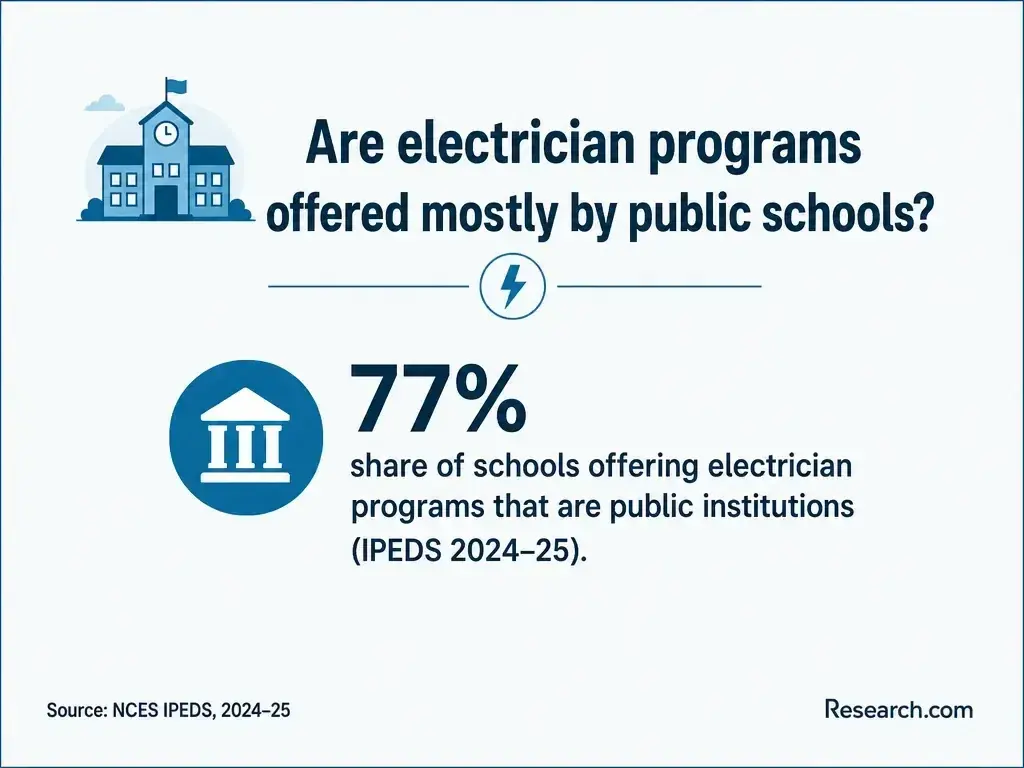
A defensible Fairfield average cannot be stated without comparable, current prices for the available school and apprenticeship routes. Published tuition alone would also miss much of the cost of becoming employable. Request an itemized estimate for the full training period, then compare these categories:
Ask Kennebec Valley Community College for its current program-specific estimate and aid eligibility; ask apprenticeship sponsors what they cover and when wages begin. Federal aid depends on the student and eligible program, not simply on whether a provider calls itself a trade school (Federal Student Aid). An advertised low price is a red flag if essential tools or required practical training are excluded.
The credential depends on the route: a school may award a certificate, diploma, or associate degree; a registered apprenticeship awards its own completion credential after its requirements are met (institutional catalog; U.S. Department of Labor). None is interchangeable with a Maine occupational license. Ask precisely what appears on the completion document and whether the provider supplies records of instruction or supervised hours for a licensing application.
If you may continue training elsewhere, request written policies on transfer credit, recognition of prior learning, or credit for apprenticeship instruction. Do not assume a new provider - or the licensing board - will accept hours merely because two programs cover similar topics.
School and apprenticeship entry rules differ. Confirm the current provider's requirements for prior schooling, math readiness, age, application materials, and any safety or jobsite conditions before applying. An employer or apprenticeship sponsor may also assess whether applicants can reach worksites and perform essential tasks; a school's admission offer is not an apprenticeship placement (provider or sponsor admissions policies).
For Fairfield commuters, scheduling can be as important as eligibility. Ask whether classes, labs, and work assignments can be combined without repeatedly missing paid hours. If you already have relevant experience, bring documentation and ask how it will be evaluated rather than assuming advanced standing.
Useful instruction connects electrical calculations and code concepts to hands-on tasks: interpreting drawings, selecting materials, installing and checking circuits, troubleshooting faults, and following safe work practices (U.S. Bureau of Labor Statistics). Ask to see the current syllabus and the equipment students actually use. A program heavy on theory may be a reasonable introduction, but it should not be mistaken for extensive shop or supervised field experience.
For the kind of work you want, look for matching practice. Construction wiring, facility troubleshooting, and industrial controls place different demands on a new worker. Ask an instructor which tasks students perform themselves, which they only observe, and what further training an entry-level employer will provide.
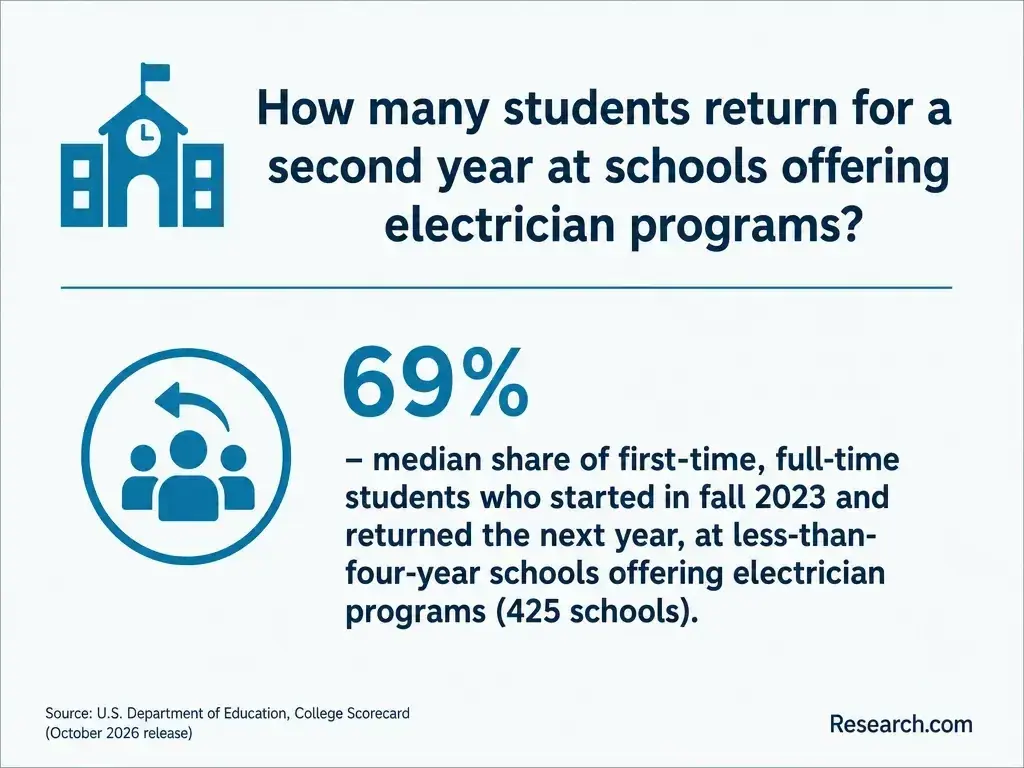
Maine regulates electrical work through its Electricians' Examining Board. The board distinguishes license categories and sets applicable instruction, experience, examination, and supervision requirements; graduating from a Fairfield program does not automatically grant a license (Maine Electricians' Examining Board). Confirm the category appropriate to the work you intend to do and how your proposed training would count.
Keep separate records of school instruction and supervised work. Institutional accreditation concerns the school; apprenticeship registration concerns the training arrangement; an optional industry credential documents particular skills; and occupational licensure determines the electrical work Maine permits you to perform. None automatically substitutes for the others (Maine Electricians' Examining Board; U.S. Department of Labor).
Start with your intended Maine license and the job you want, then compare only routes that can help you meet those requirements. An affordability ranking is a useful shortlist, not proof of licensing eligibility or strong lab instruction. Ask each provider and prospective sponsor these questions before enrolling:
Then compare total investment against realistic employment options: completion probability, time out of paid work, aid, debt, likely entry pay, and the time needed to progress. Broad lists of top earning bachelor degrees do not answer that trade-specific question; an experienced electrician's wage is not a new trainee's likely return.
A realistic progression is from entry-level, supervised electrical work toward the Maine license category matching your documented training and experience, then potentially into more specialized installation, maintenance, or supervisory work (Maine Electricians' Examining Board; U.S. Bureau of Labor Statistics). The path depends on the employer's work and the applicable license - not merely the name of the initial certificate.
If your goal is hands-on electrical work, compare school-based preparation with paid apprenticeship rather than unrelated academic shortcuts. Searches such as the easiest doctorate degree address a different goal and cannot substitute for supervised electrical experience. Ask employers what experience they value for the specific role you want next.
U.S. electrician employment is projected to grow 9.2% from 2025 to 2035 (U.S. Bureau of Labor Statistics, Employment Projections). That national forecast supports investigating the trade, but it does not measure openings in Fairfield or guarantee a local apprenticeship. Your practical market includes the employers and worksites you can reach consistently.
Before choosing a program, speak with area employers and registered-apprenticeship sponsors about openings, hiring schedules, and expected skills. Predictions about what are the shortest phd programs offer no useful substitute for that local evidence. Prioritize a route that develops the competencies employers will test and documents experience Maine will recognize.
Education is a significant investment, so Research.com compares electrician programs with other programs in the same occupation and location - not with unrelated trades. The team checks multiple education, cost, and recognition sources to make the ranking more useful and credible. Only programs reporting completions to IPEDS are eligible; a registered apprenticeship or employer program may be a strong option even if it does not appear in the ranking.
Most affordable rankings use tuition, cost of attendance, median student debt, and federal loan default rates. An entropy-based method gives more weight to measures that differ more across eligible programs. Accreditation and other quality measures do not contribute to the affordability score, so readers should check them separately. For comparison, Research.com's best programs rankings assess student outcomes, earnings and return on investment, costs and debt, and quality and recognition. Their stated weights are 20% for relevant programmatic accreditation or industry recognition, 10% for institutional accreditation, 10% for student support, and 60% distributed across outcomes, earnings, and costs using the entropy-based method.
The following sources support the ranking framework. Occupation-specific sources are applied where relevant; the healthcare organizations listed here are not electrician licensing authorities.
Use the ranking to narrow a cost comparison, then verify each program's current charges, hands-on training, and fit with Maine's licensing rules. Research.com explains the broader approach on its methodology page.
# 1 position
# 2 position
Not necessarily. A registered apprenticeship or employer-supported route may combine instruction and supervised work. Check the Maine Electricians' Examining Board's requirements for your intended license before choosing between routes.
It can reduce costs because apprentices generally earn wages while training, but compare actual wages, fees, tools, travel, and the time required. A school route may offer useful lab preparation before you seek supervised work.
Online coursework can cover some theory, but practical electrical skills and supervised jobsite experience require in-person participation. Confirm how any proposed coursework fits Maine's licensing rules before enrolling.
No. The ranking includes eligible programs with completions reported to IPEDS. Compare those programs with registered apprenticeships and employer training, which may not appear in college-oriented datasets.
Get the full cost, lab schedule, credential name, and placement arrangements in writing. Then confirm with the Maine Electricians' Examining Board how the instruction and any supervised work relate to your intended license.