2027 Highest-Paying Jobs You Can Get With an Online MBA

Co-Founder and Chief Data Scientist
An online MBA can be a practical route out of mid-level career stagnation, but the degree only pays off when it is matched to the right role, industry, specialization, and level of experience. The strongest outcomes usually go to professionals who use the MBA to move into leadership, finance, consulting, technology management, or strategy-focused positions rather than treating the credential alone as a salary guarantee.
Reports show that MBA holders earn a median salary boost of over 20% compared to those with only a bachelor’s degree. That potential increase makes the online MBA an attractive option for working professionals who want graduate business training without leaving the workforce. Still, salary outcomes vary widely by employer, accreditation, prior experience, location, specialization, and the graduate’s ability to show measurable business impact.
This guide explains the highest-paying career paths for online MBA graduates, how salaries differ by specialization, which skills and industries matter most in 2026, and how to evaluate tuition against realistic salary outcomes. It is designed for professionals comparing online MBA options, planning a career pivot, or deciding whether the degree is likely to produce a strong return on investment.
Key Benefits
- Many top MBA-level roles—such as management consultant, financial manager, and marketing director—offer six-figure salaries, giving graduates access to far higher income ceilings than non-MBA professionals.
- An online MBA opens doors to strategic, high-impact positions that often require advanced business training, including roles in operations, finance, and corporate strategy.
- Graduates can transition into high-paying sectors like tech, healthcare, finance, consulting, and e-commerce, allowing them to pursue well-paid opportunities in diverse fields.
What are the top-paying career paths available with an online MBA?
The top-paying career paths for online MBA graduates are usually roles that directly affect revenue, cost control, risk, strategy, or enterprise-wide performance. Executive leadership, management consulting, finance, analytics, operations, and technology management tend to offer the strongest compensation because employers pay more for people who can make high-stakes decisions and lead complex business functions.
Highest-paying paths to consider
- Executive and senior leadership: Roles such as Chief Operating Officer, VP of Strategy, general manager, and division leader can place experienced MBA graduates in positions where median pay often exceeds $150,000. These jobs typically require more than a degree; employers look for a record of leading teams, managing budgets, and improving business results.
- Management consulting: Consulting firms and internal strategy teams often value MBA graduates who can diagnose operational, financial, or market problems. Salaries often reach $120,000+ for candidates who combine analytical ability with client-facing communication and industry knowledge.
- Finance and corporate strategy: Corporate finance managers, financial controllers, investment-focused analysts, and strategy leaders frequently earn salaries between $110,000 and $160,000. These roles reward strong financial modeling, forecasting, risk analysis, and executive communication.
- Technology and product leadership: MBA graduates with business and technical fluency can move into product management, program leadership, IT strategy, or digital transformation roles. Compensation is often strongest when the role connects technology decisions to revenue growth, customer retention, or operational efficiency.
How to choose the right path
The best path depends on your starting point. A finance professional may get the fastest return by moving toward corporate finance leadership or risk management. A project manager in technology may be better positioned for product or program management. A professional with broad operations experience may be competitive for general management, supply chain leadership, or consulting.
Program reputation can also affect mobility. Students who choose accredited options, including an AACSB-accredited online MBA, may benefit from stronger employer recognition, especially when applying to competitive companies or roles that screen heavily for institutional credibility.
Why these roles pay more
High-paying MBA roles are not paid more simply because they require graduate education. They pay more because the decisions involved are expensive, visible, and measurable. A strong executive can improve margins. A consultant can identify millions in savings. A finance leader can reduce risk. A product manager can influence revenue growth. The online MBA helps most when it builds the business judgment, financial fluency, and leadership confidence needed for those outcomes.
How do salaries compare across online MBA specializations?
Salaries differ significantly by online MBA specialization. In general, specializations tied to revenue generation, financial decision-making, technology, analytics, or enterprise strategy lead to higher pay than broader or less technical concentrations. The specialization does not determine salary by itself, but it can help position a graduate for higher-value roles.
Common salary ranges by specialization
| Online MBA specialization | Typical high-paying roles | Salary information stated |
| Finance | Risk manager, investment analyst, financial director, corporate finance manager | $110,000–$150,000 |
| IT and tech management | Product manager, IT director, technology program leader | Often exceed $130,000, especially in SaaS or AI sectors |
| Consulting or strategy | Strategy consultant, transformation consultant, internal strategy manager | $120,000–$140,000 |
| Analytics-focused business | Analytics director, business intelligence leader, data-driven operations manager | Often strongest when paired with industry experience and leadership responsibility |
What drives the salary gaps
The highest-paying specializations tend to share three traits: they affect profit, require specialized judgment, and are difficult to automate fully. Finance roles require risk and capital allocation decisions. Technology management roles require leaders who can translate technical capabilities into business outcomes. Consulting roles require structured problem-solving, persuasion, and the ability to deliver results across organizations.
Lower-cost MBA options can still produce strong value when the program is credible and the student already has relevant work experience. For example, professionals comparing affordable online MBA programs should look beyond tuition and examine accreditation, alumni outcomes, employer partnerships, course rigor, and whether the curriculum supports the specialization they plan to use.
How to select a specialization
Choose a specialization based on the role you want next, not only on the highest published salary. A finance specialization may be powerful for someone with accounting, banking, or corporate planning experience. A technology management concentration may be better for someone already working in software, data, systems, or product-adjacent roles. A consulting or strategy focus may suit candidates with strong communication skills and a record of solving cross-functional problems.
What skills help online MBA graduates land the highest-paying roles?
The skills that help online MBA graduates land the highest-paying roles are the skills employers can connect to business impact: strategic decision-making, data analysis, financial modeling, leadership, communication, and the ability to manage change. The MBA credential may open the door, but demonstrated competence usually determines who gets hired, promoted, and paid at the top of the range.
Strategic and analytical skills
High-paying MBA roles require more than understanding business concepts. Employers want candidates who can interpret market data, compare strategic options, forecast outcomes, and recommend a course of action. This is especially important in consulting, corporate strategy, product management, and executive-track roles where decisions affect growth, investment, and competitive positioning.
- Market and competitor analysis
- Business case development
- Forecasting and scenario planning
- Performance measurement and KPI design
- Problem framing and executive-level recommendations
Digital and technology fluency
Digital competence has become a major salary differentiator. MBA graduates do not always need to be software engineers, but they do need to understand how technology changes business models, operations, customer experience, and workforce planning. Data visualization, AI literacy, process automation, and product thinking can help graduates compete for higher-paying roles in tech-enabled organizations.
Financial and operational judgment
Financial literacy remains central to MBA-level leadership. Roles such as controller, finance director, operations manager, and general manager require budgeting, valuation, risk assessment, cost control, and resource allocation. Employers pay more for leaders who can connect day-to-day decisions to margins, cash flow, and long-term performance.
Leadership and communication
Many candidates underestimate how much communication affects compensation. Senior roles require the ability to influence executives, explain trade-offs, lead teams through uncertainty, and turn analysis into action. Graduates who can present clearly, negotiate effectively, and manage stakeholders often stand out from candidates with similar technical skills.
Students can build these capabilities through rigorous online programs, including flexible and affordable options such as an online MBA with no GMAT and low cost. The key is to choose a program that develops applied skills through projects, case studies, simulations, and leadership-oriented assignments rather than relying only on theory.
The industries that hire online MBA graduates into high-paying roles most often include technology, healthcare, finance, and consulting. These sectors need managers who can lead growth, control costs, interpret data, manage risk, and guide organizations through disruption. They also tend to offer clearer paths from management roles into director, vice president, and executive-level positions.
Industries with strong salary potential
- Technology: Product management, operations, business strategy, and data-focused roles often exceed $120,000 in salary. Candidates with experience in SaaS, AI, platforms, cybersecurity, or digital transformation may be especially competitive.
- Healthcare: Hospital administration, health systems leadership, operations, and strategy roles continue to grow as healthcare organizations manage cost pressure, regulation, staffing, and technology adoption.
- Finance: Corporate finance, risk management, investment analysis, and financial planning remain among the highest-paying MBA paths because these roles influence capital, compliance, and enterprise risk.
- Consulting: Strategy, operations, transformation, and technology consulting continue to attract MBA graduates who can solve complex business problems and communicate recommendations to senior leaders.
Why these industries pay more
These industries pay more because management decisions carry high financial consequences. A technology product leader may influence recurring revenue. A healthcare administrator may manage large budgets and service quality. A finance leader may reduce exposure to risk. A consultant may help a client restructure operations or enter a new market. In each case, employers are paying for judgment, accountability, and measurable outcomes.
How to position yourself by industry
Graduates should tailor their MBA projects, electives, certifications, and networking toward a target sector. A generic MBA résumé is less persuasive than one that shows industry-specific results. For example, a healthcare applicant should highlight process improvement, compliance awareness, and patient or system outcomes. A technology applicant should show product, data, operations, or digital transformation experience.
Some professionals increase their earning potential by pursuing executive-level formats designed for experienced managers. Those comparing advanced options can review factors such as executive MBA online cost, schedule flexibility, cohort profile, and leadership curriculum before deciding whether an executive track is a better fit than a standard online MBA.
Most top-paying MBA-level jobs require more than completion of the degree. Employers typically look for professional experience, leadership exposure, measurable accomplishments, and evidence that the candidate can manage complexity. The online MBA is most powerful when it builds on a strong work history rather than replacing one.
Experience levels that matter
- Early management or project leadership: Professionals with 3–5 years of supervisory or project experience often move fastest into higher-paying management roles after earning an MBA. They can show that they have already led people, budgets, timelines, or business initiatives.
- Senior-level readiness: For director or VP-level roles, 7–10 years of experience plus cross-functional leadership is common. These roles usually require evidence of enterprise thinking, not just strong performance in one function.
- Specialized technical or industry experience: Candidates in finance, technology, healthcare, analytics, or operations may qualify for higher-paying roles when their MBA adds leadership and business strategy to an already valuable technical background.
What employers want to see
Hiring managers often evaluate MBA candidates by asking whether they have already produced results similar to what the new role requires. Strong examples include improving revenue, reducing costs, leading a transformation project, managing a team, building a financial model, launching a product, or presenting recommendations to executives.
Common mistake to avoid
A common mistake is assuming the MBA automatically qualifies a graduate for senior leadership. In competitive hiring, the degree is part of the evidence, not the whole case. Affordable pathways, including the cheapest MBA programs, can still lead to strong opportunities when paired with meaningful experience, a credible program, and a clear career story.
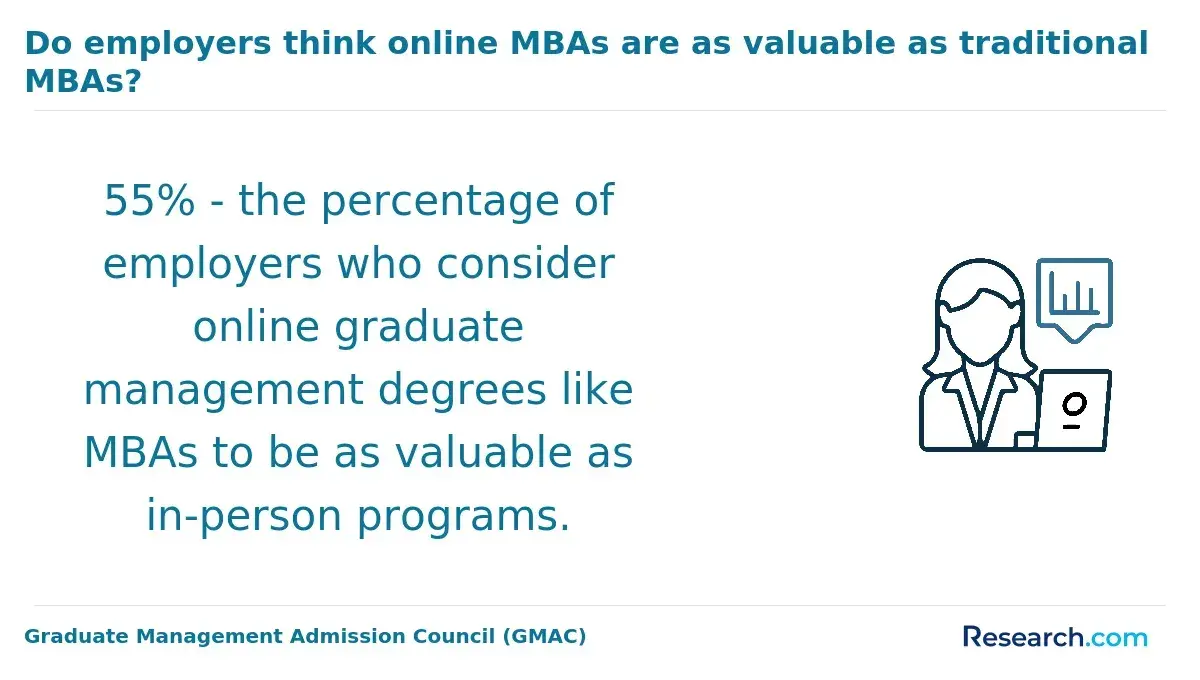
Employers increasingly view online MBAs as comparable to traditional MBAs when the program is accredited, reputable, and backed by strong professional experience. The delivery format matters less than program quality, institutional credibility, student outcomes, and the candidate’s ability to perform in the role.
What employers usually evaluate
- Accreditation and reputation: Accreditation, especially AACSB, signals that the program meets recognized standards for business education. A familiar university name or respected business school can also help in competitive hiring.
- Work experience: Employers often place more weight on accomplishments than on whether the MBA was completed online or on campus. A candidate who has led teams, managed budgets, or delivered measurable results will usually be more compelling than a candidate with the degree alone.
- Skill relevance: Hiring managers want to know whether the program helped the graduate build skills tied to the target role, such as finance, analytics, operations, strategy, leadership, or technology management.
- Communication and professionalism: Online MBA graduates often work while studying, which can demonstrate discipline, time management, and digital collaboration. Those strengths should be made clear in interviews and application materials.
Why perceptions have improved
Online MBA credibility has improved as established universities expanded digital programs and remote work made virtual collaboration normal. Employers are now more accustomed to distributed teams, online training, and digital project management. As a result, many focus less on classroom format and more on whether the graduate can lead, analyze, communicate, and deliver results.
How to present an online MBA effectively
Graduates should list the university and degree clearly without overexplaining the online format. In interviews, the stronger approach is to discuss projects, leadership growth, quantitative results, and how the MBA prepared them for the employer’s specific challenges. If asked about format, emphasize rigor, accreditation, collaboration, and the discipline required to complete graduate study while managing professional responsibilities.
Students can maximize salary potential after earning an online MBA by making deliberate career moves before, during, and after the program. The highest earners usually do not wait until graduation to think about salary. They choose a target role, build relevant skills, use career services, expand their network, and document measurable achievements.
Build specialized expertise
Specialized knowledge improves competitiveness in higher-paying fields. Analytics, AI, financial strategy, product management, operations improvement, and digital transformation can all strengthen a graduate’s positioning. The goal is to become more than a general business candidate; employers should be able to see where the graduate creates value.
Strengthen your leadership portfolio
Salary growth is often tied to scope of responsibility. Students should look for opportunities to manage people, lead cross-functional projects, own budgets, improve processes, or present recommendations to senior leaders. These experiences become evidence during promotion discussions and salary negotiations.
Use career services early
Many students wait too long to use career support. Résumé reviews, mock interviews, employer events, mentorship, and alumni introductions are most useful when used throughout the program. Career services can also help students translate academic projects and professional experience into language that fits target roles.
Negotiate with evidence
Graduates should prepare for salary conversations with market research, examples of measurable impact, and a clear explanation of how their MBA skills align with the employer’s needs. Strong negotiation is not just asking for more pay; it is showing why the role, responsibility level, and expected contribution justify a higher offer.
The job market trends shaping high-paying MBA roles in 2026 include AI adoption, digital transformation, global competition, hybrid workforce leadership, and rising attention to financial risk. These trends favor MBA graduates who can combine business fundamentals with technology fluency, analytical judgment, and change leadership.
Top 2026 trends affecting MBA careers
- AI integration: Leaders who understand AI strategy earn higher wages because organizations need managers who can identify useful applications, evaluate risk, redesign workflows, and connect AI investments to business outcomes.
- Hybrid workforce leadership: Remote and hybrid teams require managers who can lead distributed operations, maintain accountability, communicate clearly, and build culture across locations.
- Financial risk expansion: Volatile markets increase demand for finance and compliance talent. MBA graduates with risk, forecasting, budgeting, and scenario-planning skills may be better positioned for senior roles.
- Tech-sector growth: Product and program management roles remain highly paid, especially for professionals who can coordinate technical teams, customer needs, financial goals, and executive priorities.
What this means for students
Students should treat the MBA as a platform for adaptability. Courses and projects that involve data, technology, finance, strategy, and organizational change may be especially valuable for 2026 hiring. Affordable programs, including the cheapest MBA programs, can still align well with emerging trends if they offer relevant coursework, experienced faculty, applied projects, and access to career support.
Tuition costs for online MBA programs vary, and salary outcomes vary even more. Many graduates may recoup costs within two to five years because of salary increases, but that outcome depends on tuition, debt, employer support, specialization, work experience, and whether the graduate moves into a higher-paying role after finishing the degree.
Tuition and salary figures to compare
- Typical online MBA tuition: $25,000–$45,000.
- Average post-MBA salary: $90,000–$120,000.
- High-paying paths: Finance, consulting, and tech often exceed $130,000.
How to evaluate ROI
A strong return on investment is not based only on the lowest tuition or the highest advertised salary. Students should compare the total cost of attendance, employer tuition reimbursement, expected debt, time to completion, opportunity cost, program reputation, and likely career path. A lower-cost program can be a smart choice if it is accredited and aligned with the student’s goals. A more expensive program may be worthwhile if it provides stronger recruiting access, alumni networks, or brand recognition in the target industry.
Questions to ask before enrolling
- Does the program have accreditation and employer recognition in my target field?
- Will the curriculum help me qualify for the roles I want, or is it too general?
- Can I keep working while enrolled to reduce opportunity cost?
- What career services, alumni access, and employer connections are available?
- How much salary growth would I realistically need to justify the tuition?
What career advancement opportunities come after landing a high-paying MBA job?
After landing a high-paying MBA job, graduates may advance into director roles, vice president positions, executive leadership, specialized expert tracks, or global management assignments. The next step depends on whether the professional wants broader authority, deeper specialization, larger teams, or responsibility for enterprise-level strategy.
Common advancement paths
- Director and VP-level roles: Many graduates move into positions such as Director of Operations, Director of Finance, VP of Strategy, or business unit leader within a few years. These roles usually require broader accountability, stronger executive communication, and ownership of measurable outcomes.
- Executive and C-suite roles: Some graduates eventually reach COO, CFO, CMO, or Chief Strategy Officer roles. This path usually requires sustained performance, political judgment, leadership credibility, and the ability to guide strategy across the organization.
- Specialized expert tracks: Not every high earner moves into general management. Some MBA graduates build high-paying careers in corporate finance, risk, analytics, product strategy, transformation, or consulting expertise.
- Global or enterprise roles: Multinational organizations may offer advancement through regional leadership, global operations, international strategy, or cross-border transformation roles.
Why MBA graduates can advance faster
MBA graduates often advance more quickly when they can combine analytical ability, financial literacy, leadership readiness, and strategic communication. These skills make them stronger candidates for succession planning and larger assignments. However, advancement is still earned through performance. The graduates who move up fastest are usually those who continue to deliver visible results after the degree.
How to keep momentum after the first high-paying role
Professionals should track accomplishments, seek assignments with larger scope, maintain executive relationships, and continue building skills in technology, finance, and leadership. A high-paying MBA job should be treated as a platform, not a finish line. The strongest long-term career outcomes come from using each role to prove readiness for the next level of responsibility.
Other Things You Should Know About Highest-Paying Jobs You Can Get With an Online MBA
In 2027, graduates with an online MBA can access high-paying roles such as Chief Financial Officer (CFO), Marketing Manager, and IT Director, where salaries can range from $120,000 to over $200,000, depending on the industry and location.
Finance, consulting, and strategy concentrations usually align with the highest-paid online MBA roles in 2027. A finance focus supports investment banking and corporate finance jobs, while consulting and strategy specializations fit management consulting and operations leadership, where employers often prefer analytical coursework and case-based training.
- Graduate Management Admission Council. (2024). The Corporate Recruiters Benchmark Survey 2024. Retrieved from https://www.gmac.com/market-intelligence-and-research/market-research/corporate-recruiters-survey/the-corporate-recruiters-benchmark-survey-2024
- Graduate Management Admission Council. (2023). 2023 Corporate Recruiters Survey — U.S. Starting Salaries for MBA Graduates. Retrieved from https://www.gmac.com/-/media/files/gmac/research/employment-outlook/2023-crs-regional-reports/2023_gmac_corporaterecruiters_report_unitedstates.pdf
- AACSB. (2025, October 29). The business school job market in 2025. Retrieved from https://www.aacsb.edu/insights/articles/2025/10/the-business-school-job-market-in-2025
- UTK Online MBA. (2024, March 26). MBA salary expectations: How a degree can impact your earning potential. Retrieved from https://onlinemba.utk.edu/articles/mba-salary-expectations-how-a-degree-can-impact-your-earning-potential/
- Aurora University Online MBA. (n.d.). MBA Career Paths & Salaries: What can you earn? Retrieved from https://online.aurora.edu/career-outcomes/mba-salary-expectations-by-industry/
- Bureau of Labor Statistics. (2024). Occupational outlook handbook: Business and financial occupations. Retrieved from https://www.bls.gov/ooh/business-and-financial/home.htm