2027 Online Physics Degrees That Prepare Students for Applied Technical Careers

Co-Founder and Chief Data Scientist
Choosing an online physics degree is really a career-fit decision: will the program build enough lab, math, coding, and instrumentation skill for technical work? The need is timely because the BLS reports a May 2024 median annual wage of $112,590 for data scientists, one applied path where physics-trained graduates often compete.
This guide is for students considering online or hybrid physics programs who want practical roles in industry, labs, energy, aerospace, computing, or advanced manufacturing. You will learn how to compare degree types, costs, accreditation, skills, and career outcomes before enrolling.
Key Things You Should Know
- Online physics degrees can prepare students for applied technical careers when they include calculus-based physics, laboratory work, programming, data analysis, electronics, modeling, and a supervised project or internship.
- Fully online physics bachelor's programs are less common than hybrid options because physics requires lab validation; students should confirm how experiments, equipment access, and proctored assessments are handled before applying.
- According to BLS 2024 wage data, physics-adjacent roles vary widely: physicists have a median annual wage of $166,290, while data scientists report $112,590, so ROI depends heavily on the occupation pursued after the degree.
What is an online physics degree and how does it prepare students for applied technical careers?
An online physics degree is a college program that teaches the laws of matter, motion, energy, waves, electricity, magnetism, optics, thermodynamics, quantum behavior, and mathematical modeling through distance-based coursework. For applied technical careers, the most useful programs do more than teach theory; they connect physics concepts to measurement, instrumentation, computation, materials, electronics, and real-world problem solving.
The phrase "applied technical careers" usually refers to roles where physics knowledge is used in industry, government, healthcare technology, energy, manufacturing, aerospace, defense, environmental monitoring, or computing. Graduates may not have the job title "physicist" immediately, especially with only a bachelor's degree. Instead, they may work as laboratory technicians, test engineers, data analysts, optical systems specialists, quality engineers, research assistants, or technical sales engineers.
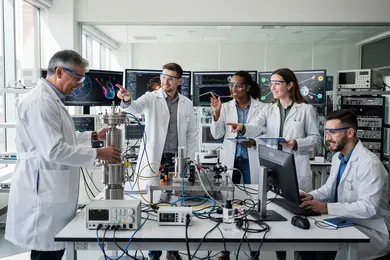
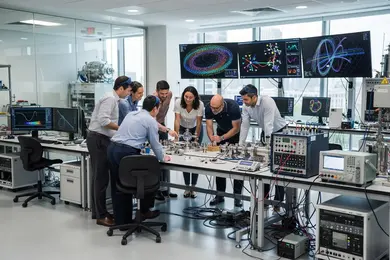
The best online physics programs usually include three learning environments: asynchronous lectures for theory, synchronous sessions for problem solving, and structured labs through home lab kits, remote instrumentation, simulation software, short campus residencies, or approved local lab arrangements. This blend matters because employers hiring for technical roles often want evidence that a graduate can measure, troubleshoot, document, analyze, and communicate results, not just pass exams.
Students should consider an online physics degree if they want a flexible route into technical work, already have transfer credits, need to keep working while studying, or plan to combine physics with coding, engineering, data science, or graduate study. Students who want a heavily equipment-based undergraduate experience, direct access to research labs, or ABET-accredited engineering licensure preparation may be better served by an on-campus engineering or engineering technology program.
Which types of online physics degrees are best for applied technical roles?
The best degree type depends on the student's target job, prior credits, math readiness, and whether graduate study is part of the plan. A bachelor's degree is usually the minimum for professional technical roles, while associate degrees and certificates can support entry-level laboratory or instrumentation work.
The table below compares common online or hybrid physics-related credentials and the applied technical outcomes they typically support. Use it to match the credential to the level of responsibility you want after graduation.
| Credential type | Best fit | Applied technical value | Limitations to check |
| Associate degree in physics or physical science | Students planning transfer or entry-level lab support | Builds calculus, general physics, chemistry, and introductory lab skills | Usually not enough for engineering, research, or analyst roles without further study |
| Bachelor of Science in Physics | Students seeking technical roles or graduate school preparation | Strongest general preparation in mechanics, electromagnetism, quantum physics, labs, and computation | May require in-person labs, advanced math, and careful elective planning |
| Bachelor of Arts in Physics | Students combining physics with teaching, business, computing, or interdisciplinary work | Can support technical communication, product support, education technology, or analyst roles | May have fewer advanced labs or theoretical courses than a BS |
| Applied physics or engineering physics degree | Students focused on industry applications | Often includes electronics, materials, optics, instrumentation, or design projects | Availability online is limited, and engineering licensure alignment varies |
| Post-baccalaureate certificate | Career changers with a STEM degree who need physics prerequisites | Can fill gaps for graduate school, teaching, or technical specialization | May not qualify as a stand-alone degree for many jobs |
| Master's in applied physics or related field | Students seeking advanced technical, research, or leadership roles | Can deepen expertise in optics, materials, computational physics, or instrumentation | Often expects a strong undergraduate physics and math background |
A practical rule is to choose the most technical curriculum you can complete successfully. If two programs look similar, the better applied-career option is usually the one with stronger labs, coding, statistics, instrumentation, and employer-connected projects.
How do online physics programs compare to campus-based options for technical training?
Online physics programs can be effective, but they are not simply campus programs moved onto a screen. Physics depends on solving difficult problems and learning how measurement behaves in the real world, so students should compare delivery format as carefully as they compare tuition.
The table below summarizes the major trade-offs between online, hybrid, and campus-based physics study. It can help you decide whether flexibility is worth any limits in hands-on access.
| Format | Strengths | Trade-offs | Best for |
| Fully online | Maximum scheduling flexibility; easier for working adults and students outside commuting range | Lab quality depends on kits, simulations, remote tools, or local arrangements | Students with strong self-direction and clear confirmation of lab requirements |
| Hybrid or low-residency | Combines online theory with scheduled in-person labs or intensives | Requires travel, planning, and possible added costs for residencies | Students who need flexibility but want credible hands-on training |
| Campus-based | Direct access to faculty, labs, equipment, peers, research groups, and tutoring | Less flexible for students with work, family, or location constraints | Students seeking research-heavy preparation, graduate physics pathways, or extensive equipment access |
Online physics is also more lab-intensive than many online humanities or information programs. Students comparing digital learning models may notice that programs such as online MLIS programs can often operate with fewer physical lab constraints, while physics must prove that students can perform or interpret experimental work accurately.
The strongest online programs reduce the gap by requiring live recitations, frequent problem sets, remote lab notebooks, instructor feedback on experimental design, and capstone work. The weakest programs rely too heavily on passive lectures and automated quizzes, which may leave graduates underprepared for technical interviews or lab-based roles.
What accreditation and quality standards should online physics degrees meet?
Accreditation is the first quality filter for any online physics degree. U.S. students should verify that the institution is accredited by an accreditor recognized by the U.S. Department of Education or the Council for Higher Education Accreditation; without recognized institutional accreditation, transfer credits, graduate admission, federal financial aid, and employer acceptance can become difficult.
Programmatic accreditation is more nuanced. Pure physics degrees are not commonly accredited in the same way engineering programs are, but related engineering physics, engineering technology, or applied science programs may have program-level review. If a student's goal is professional engineering licensure, the program's relationship to ABET standards and state licensing rules should be checked before enrollment.
Students should review these quality indicators before applying because they reveal whether the degree can support technical employment, transfer, or graduate study:
- Recognized institutional accreditation and clear listing in official accreditation databases.
- Calculus-based physics sequence rather than only conceptual or algebra-based physics.
- Documented laboratory requirements with real measurement, uncertainty analysis, lab reports, and safety expectations.
- Faculty with graduate training in physics, applied physics, astronomy, engineering, materials science, or closely related fields.
- Transparent transfer-credit rules, especially for prior calculus, chemistry, programming, and physics courses.
- Career services that support technical resumes, portfolios, internships, research experiences, and employer networking.
Red flags include vague lab descriptions, no named faculty, unclear accreditation language, extremely compressed timelines for a full physics major, or promises of guaranteed employment. A reputable program should be able to explain exactly how online students complete advanced labs and how their work is evaluated.
What core courses and technical skills are taught in online physics programs?
Applied physics training rests on a sequence of math, theory, lab, and computing courses. Students who want technical careers should look beyond course titles and ask whether assignments require modeling, measurement, coding, troubleshooting, and clear technical documentation.
Most career-oriented online physics programs include a version of the following course areas. These subjects matter because they map directly to the tools used in laboratories, manufacturing, energy systems, aerospace testing, and data-heavy technical roles.
- Calculus, differential equations, linear algebra, and mathematical methods for physics.
- Classical mechanics, electricity and magnetism, waves, optics, thermodynamics, and statistical physics.
- Modern physics, quantum mechanics, atomic physics, nuclear physics, or solid-state physics.
- Laboratory methods, uncertainty analysis, sensors, electronics, instrumentation, and technical reporting.
- Programming for scientific computing, often using Python, MATLAB, R, C++, or similar tools.
- Data analysis, numerical modeling, simulation, visualization, and experimental design.
- Capstone, research project, internship, or applied problem-solving project tied to an industry or laboratory question.
The current trend is that physics graduates are increasingly expected to show computational fluency. Students who want to compete for analytics, simulation, or AI-adjacent roles should build a portfolio that includes code, reproducible notebooks, data cleaning, visualization, and model interpretation; comparing physics coursework with a data science degree can help students see where extra statistics or machine learning electives may be useful.
Technical skill development should be visible, not hidden inside transcripts. By graduation, students should be able to show lab reports, GitHub repositories, simulation outputs, instrument-control work, calibration procedures, or a capstone presentation that demonstrates how they solved a measurable problem.
What admission requirements do online physics degrees typically have for U.S. students?
Admission requirements vary by school and degree level, but physics programs are usually more math-dependent than many online bachelor's degrees. A student who enters without strong algebra, trigonometry, and pre-calculus preparation may need developmental or prerequisite coursework before taking calculus-based physics.
Applicants commonly encounter the following requirements. Reviewing them early helps students avoid being admitted to a school but delayed from entering the actual physics major sequence.
- High school diploma, GED, or equivalent for undergraduate admission.
- Official transcripts from high school and any colleges previously attended.
- Placement or completed prerequisites in college algebra, pre-calculus, calculus, chemistry, and introductory physics, depending on entry level.
- Minimum GPA requirements, which may be higher for transfer admission into upper-division major courses.
- Personal statement, resume, or statement of goals for some degree-completion or graduate programs.
- Letters of recommendation for many master's programs and some selective undergraduate pathways.
- Proof of English proficiency for applicants whose prior education was not in English.
Transfer students should ask for a course-by-course evaluation before committing. Physics sequences do not always transfer cleanly because lecture and lab credits may be separated, calculus-based and algebra-based courses may not be equivalent, and quarter-system credits may not match semester requirements.
For graduate-level applied physics programs, admissions committees usually expect prior coursework in mechanics, electromagnetism, quantum mechanics, thermal physics, advanced mathematics, and laboratory methods. Students from engineering, mathematics, computer science, or chemistry backgrounds may qualify, but they may need bridge courses.
How long do online physics degrees take, and what do they cost?
Program length depends on degree level, transfer credits, enrollment intensity, and lab scheduling. A full bachelor's degree typically takes about four years of full-time study, while degree-completion students with substantial transfer credit may finish faster; part-time students often need longer because upper-division physics courses are sequential.
Cost should be evaluated as total cost of attendance, not just tuition. The College Board's 2024 pricing data reported average published tuition and fees of $11,610 for in-state students at public four-year institutions and $43,350 at private nonprofit four-year institutions for the 2024-2025 academic year; online students may pay different rates, but the comparison shows why residency status and institution type can strongly affect affordability.
Students should request a written cost breakdown that includes all charges likely to affect physics majors. Common cost categories include:
- Tuition per credit or per term.
- Online learning, technology, laboratory, proctoring, and graduation fees.
- Home lab kits, safety materials, software licenses, calculators, textbooks, or instrument rentals.
- Travel, lodging, and time away from work for any required campus lab intensives.
- Transfer-credit evaluation fees or costs for prerequisite courses taken elsewhere.
- Lost income or reduced work hours if the program requires daytime labs or synchronous sessions.
Students comparing online STEM tuition should also recognize that lab needs differ by field. For example, cost structures for an animal science bachelor degree online may include field or clinical components, while physics may involve lab kits, remote instrumentation, or campus residencies.
To reduce costs, prioritize accredited public options, maximize transferable general education credits, ask whether calculus and programming prerequisites can be completed at a community college, and compare net price after grants rather than relying on sticker price. Avoid choosing the cheapest program if it lacks credible labs or upper-division physics depth; the lowest tuition can become a poor investment if the degree does not support the intended technical path.
What applied technical careers can graduates of online physics programs pursue?
Graduates of online physics programs can pursue a range of applied technical careers, but the exact path depends on degree level, lab experience, coding ability, internships, security clearance eligibility, location, and industry demand. A bachelor's degree can open doors to technical support and analyst roles, while research physicist roles often require graduate education.
The table below shows common applied career directions for physics-trained graduates. It focuses on responsibilities so students can identify which roles match their interests and skill evidence.
| Career direction | Typical responsibilities | Helpful preparation |
| Laboratory or research technician | Operate equipment, collect data, maintain lab records, prepare samples, and support experiments | Lab methods, safety, instrumentation, uncertainty analysis, and technical writing |
| Test or validation engineer support | Run tests, troubleshoot systems, document failures, and analyze performance data | Mechanics, electronics, sensors, statistics, Python or MATLAB, and quality methods |
| Optics or photonics technician | Work with lasers, lenses, detectors, imaging systems, and alignment procedures | Optics, electromagnetism, lab alignment, electronics, and safety protocols |
| Data analyst or scientific programmer | Clean data, build models, visualize results, automate workflows, and communicate findings | Programming, statistics, numerical methods, databases, and domain knowledge |
| Materials or semiconductor technician | Support testing, fabrication, characterization, process monitoring, or failure analysis | Solid-state physics, chemistry, cleanroom awareness, instrumentation, and documentation |
| Energy or environmental instrumentation specialist | Monitor systems, calibrate sensors, analyze field data, and support compliance or operations teams | Thermodynamics, fluids, sensors, data acquisition, and field measurement methods |
| Technical sales or applications specialist | Explain complex products, support customers, run demonstrations, and translate technical needs | Physics fundamentals, communication, product knowledge, and problem solving |
Physics also pairs well with adjacent fields. Students interested in climate, energy systems, instrumentation, or field measurement may want to compare physics pathways with jobs for environmental science majors, especially if they prefer environmental monitoring or sustainability-focused work over laboratory or manufacturing roles.
The most employable graduates usually do three things before finishing the degree: complete an internship or research project, build a technical portfolio, and tailor electives toward a specific industry. A general physics degree is powerful, but employers respond better when applicants can show a clear applied direction.
What salary ranges and job outlook can physics-trained technical professionals expect?
Salary outcomes for physics-trained technical professionals vary by occupation, degree level, industry, region, and experience. Students should use wage data as a planning benchmark, not as a promise of what any individual graduate will earn.
The table below summarizes selected U.S. occupations that may align with physics training or physics-plus-computing preparation. The wage figures come from BLS May 2024 occupational data and describe occupation-level medians, not degree-specific earnings.
| Occupation | Median annual wage | How physics training may apply |
| Physicists | $166,290 | Advanced research, modeling, instrumentation, defense, energy, laboratories, or technology development; many roles require graduate study |
| Software developers | $133,080 | Scientific computing, simulation, data pipelines, technical software, or modeling tools when paired with strong programming skills |
| Data scientists | $112,590 | Statistical modeling, machine learning, experiment analysis, sensor data, and technical decision support |
| Materials scientists | $110,780 | Materials testing, semiconductors, energy storage, polymers, metallurgy, and applied research |
| Mechanical engineers | $102,320 | Testing, modeling, thermal systems, mechanics, and product development; engineering roles may require an engineering degree or licensure path |
Job outlook also differs by path. BLS employment projections for 2024 to 2034 show especially strong growth for data scientists at 34%, while physicists and astronomers are projected at 7%; this means students who combine physics with data, software, or instrumentation may have a broader set of openings than students who pursue narrowly defined physicist roles only.
AI and automation are changing the skill mix rather than eliminating the need for physics reasoning. Employers increasingly value people who can interpret model outputs, validate measurements, spot physical impossibilities, and connect data patterns to real systems. For students, the practical takeaway is to pair physics theory with coding, statistics, version control, and domain-specific projects.
How can students evaluate and choose a reputable online physics program?
A reputable online physics program should match your career target, not just your schedule. Before enrolling, define the job family you want, then verify that the curriculum, labs, faculty, support services, and outcomes make that path realistic.
Use the following steps to compare programs in a structured way. They are designed to prevent the most common enrollment mistakes, including choosing a program that is flexible but not technically strong enough.
- Verify recognized institutional accreditation through official databases, not just marketing pages.
- Map the full degree plan and confirm that the physics sequence is calculus-based if you want technical or graduate-school options.
- Ask exactly how each required lab is completed, what equipment is used, how lab reports are graded, and whether travel is required.
- Review faculty qualifications and look for instructors with physics, applied physics, engineering, materials, optics, or computational expertise.
- Compare total cost of attendance, including fees, lab kits, software, travel, and lost work time.
- Request transfer-credit evaluation before enrolling, especially for calculus, chemistry, programming, and previous physics labs.
- Ask for examples of recent capstones, internships, undergraduate research, employer partnerships, or alumni career paths.
- Check whether electives support your target area, such as optics, electronics, materials, data science, energy, or computational modeling.
- Confirm graduate-school preparation if you may later pursue physics, engineering, medical physics, astronomy, or applied science programs.
- Speak with an advisor about pacing because physics courses are sequential and may not be offered every term.
Common red flags include unclear lab requirements, no upper-division physics courses, pressure to enroll quickly, vague career claims, no transfer transparency, and a curriculum that substitutes broad science survey courses for rigorous physics major coursework. If a school cannot explain how online students gain hands-on competence, keep comparing options.
A good final test is to ask, "What evidence will I have at graduation?" Strong answers include lab notebooks, code repositories, technical reports, capstone presentations, internship evaluations, and faculty references. Weak answers focus only on the diploma.
Other Things You Should Know About Physics
Some physics-related degrees are available online, but fully online bachelor's programs in physics are less common because labs are central to the discipline. Many reputable options are hybrid, low-residency, or degree-completion programs with remote or scheduled in-person lab components.
It can be respected if the school is properly accredited and the program includes rigorous math, labs, computation, and applied projects. Employers will often care more about demonstrated technical ability, internships, portfolios, and problem-solving skills than the delivery format alone.
Useful pairings include programming, data science, statistics, electronics, materials science, optics, mechanical systems, and technical communication. The best combination depends on whether you want to work in computing, manufacturing, energy, aerospace, laboratories, or research support.
References
- Are Online Degrees Accredited? How to Identify Quality Distance Learning Programs https://www.umassglobal.edu/blog-news/online-degrees-accredited-identify-quality-distance-learning-programs
- Accreditation, Validation and Recognition of Physics Degrees https://telescoper.blog/2022/09/19/accreditation-validation-and-recognition-in-physics-degrees/
- 9 Best Physics Courses for 2025: Learn Physics Online — Class Central https://www.classcentral.com/report/best-physics-courses/
- ap.io/home https://ap.io/home/prospective-grad/
- Careers in Physics | Academy Online Learning https://academyonlinelearning.com/careers-physics
- What determines whether a school is good for physics https://www.physicsforums.com/threads/what-determines-whether-a-school-is-good-for-physics.592551/
- Online Physics Course: 6 Helpful Considerations - Prereqcourses https://www.prereqcourses.com/online-physics-course/