2027 Online Physics Degrees That Prepare Students for Leadership Roles in Research and Industry

Co-Founder and Chief Data Scientist
Choosing an online physics degree is really a career strategy decision: do you need research depth, industry mobility, or a path into technical leadership? The stakes are high because physics-trained professionals often work in sectors shaped by quantum technology, AI, semiconductors, energy, defense, and advanced manufacturing.
The U. S. Bureau of Labor Statistics reported a May 2024 median annual wage of $155,680 for physicists, showing the earning potential tied to advanced expertise. This guide helps prospective students compare degree levels, accreditation, costs, admissions, online formats, and career outcomes before enrolling.
Key Things You Should Know
- For leadership-track roles, an online bachelor's degree can support entry-level technical work, but research scientist, R&D manager, principal engineer, and university roles usually require a master's or PhD.
- Cost varies widely, but the College Board's 2024-25 benchmark for average published tuition and fees at public four-year colleges was $11,610 for in-state students, making residency and transfer credits major ROI factors.
- Accreditation matters more than delivery mode: verify institutional accreditation, state authorization, and any field-specific expectations such as CAMPEP for medical physics or ABET when the program is engineering-physics oriented.
What are online physics degrees for leadership careers?
Online physics degrees are undergraduate or graduate programs that teach the laws, models, experiments, and computational tools used to explain matter, energy, space, time, and physical systems. For leadership careers, the degree should do more than cover theory. It should build the ability to design experiments, interpret data, manage technical uncertainty, communicate with engineers and executives, and make decisions in research or product-development environments.
These programs can be fully online, mostly online with short residencies, or hybrid with campus-based labs. Fully online physics degrees are less common than online business or computer science programs because physics depends heavily on laboratory work, instrumentation, and supervised research. Graduate-level online options may focus on applied physics, physics education, medical physics prerequisites, computational physics, optics, materials, radiation science, or interdisciplinary engineering applications.
An online physics degree is usually a good fit for working adults, military-connected students, teachers moving into advanced science roles, engineers who want deeper physical modeling skills, or technical employees seeking promotion into R&D leadership. It may not be the best fit for students who want a traditional wet-lab research apprenticeship, a highly funded doctoral assistantship, or a career that requires extensive hands-on access to specialized equipment from the first semester.
For leadership preparation, look for evidence that the program includes the following features rather than relying only on the word "online" in the marketing copy:
- Advanced coursework in mechanics, electromagnetism, quantum physics, statistical mechanics, optics, materials, or computational modeling.
- Research, capstone, thesis, or project work that produces a portfolio employers or doctoral committees can evaluate.
- Access to faculty with active research or industry experience in areas such as photonics, energy systems, radiation detection, quantum information, aerospace, defense, or semiconductor technology.
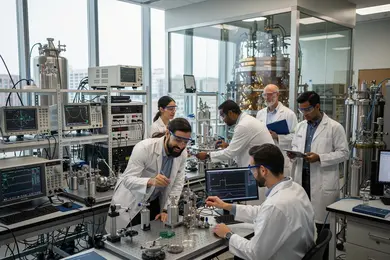
- Laboratory solutions that are credible for the level of study, including mailed lab kits, remote instrumentation, simulation-based labs, campus intensives, or approved local lab placements.
- Professional development in technical writing, grant-style proposals, project management, data analysis, and cross-functional communication.
How do accredited online physics programs compare with campus programs?
Accredited online physics programs can match campus programs in theory, mathematics, coding, data analysis, and seminar-style learning. The biggest differences usually involve lab access, informal networking, research assistantships, and the ease of joining faculty-led experiments. For students targeting leadership, the right format depends on whether they need flexibility or immersive research access more.
The table below compares common decision points. Use it to identify where an online format helps and where you may need a hybrid option, employer lab access, or a campus-based program.
| Factor | Online physics program | Campus physics program | Best fit |
| Schedule flexibility | Often designed for working adults with asynchronous lectures or evening sessions. | More fixed class and lab schedules. | Online is stronger for employed students or caregivers. |
| Laboratory access | May use simulations, remote labs, mailed kits, campus intensives, or local placements. | Direct access to teaching labs, instruments, and research groups. | Campus is stronger for hands-on experimental research. |
| Research mentorship | Possible, but students must confirm faculty availability and project structure. | Usually easier to join research groups and attend seminars. | Campus or hybrid is stronger for PhD preparation. |
| Professional networking | Can be strong if the program has cohort projects, industry partners, and virtual seminars. | Often stronger through lab teams, conferences, and informal faculty contact. | Depends on program design and student initiative. |
| Employer perception | Generally acceptable when the school is accredited and the curriculum is rigorous. | Familiar to research employers and doctoral committees. | Accreditation and evidence of skills matter more than format alone. |
Students comparing online science and engineering formats should pay close attention to how each program handles fieldwork and lab requirements. Similar questions arise in an online environmental engineering degree, where remote coursework may still need credible hands-on or applied project components.
A common mistake is assuming "online" means easier. In physics, the opposite may be true for self-directed learners: advanced math, problem sets, simulations, and lab reports require disciplined weekly study. Ask schools how often students interact with faculty, whether office hours are live, how exams are proctored, and whether online students can participate in research presentations or poster sessions.
Which physics degree level fits research and industry leadership?
The best online physics degree level depends on the role you want. A bachelor's degree can open technical and analytical roles, but leadership in research-intensive environments usually requires graduate education. A master's degree is often the practical middle ground for industry advancement, while a PhD is the standard route for independent research leadership.
The table below shows how degree levels align with common leadership goals. Use it to avoid overpaying for a credential that is either too broad or not advanced enough for your target role.
| Degree level | Typical purpose | Leadership roles it can support | When it makes sense |
| Associate degree or transfer pathway | Build lower-division math, chemistry, programming, and physics foundations. | Lab technician support, quality control assistant, transfer preparation. | Best for cost-conscious students planning to complete a bachelor's degree later. |
| Bachelor's in physics | Develop core theory, labs, mathematics, and computational thinking. | Technical analyst, test engineer support, data analyst, research assistant, science educator pathway. | Best for entry-level technical roles or preparation for graduate school. |
| Master's in physics or applied physics | Add specialized knowledge and project-based expertise. | R&D specialist, systems analyst, senior technical contributor, product-development lead, lab supervisor. | Best for working professionals seeking promotion without committing to a PhD. |
| PhD in physics | Train for original research, publication, grants, and deep specialization. | Research scientist, principal investigator, professor, senior scientist, advanced technology leader. | Best for independent research, university roles, and highly specialized laboratories. |
| Graduate certificate | Build focused skills in areas such as optics, data science, radiation science, or quantum technology. | Specialized project contributor or stepping stone to a master's program. | Best when you already have a STEM degree and need targeted upskilling. |
Students who are drawn to computational physics, simulation, AI, or software-heavy R&D should also compare physics with computer science pathways. An accelerated computer science degree online may be a faster route to software leadership, while physics is stronger for roles that require physical modeling, instrumentation, or scientific research depth.
Choose the lowest degree level that credibly supports your target role, but do not underestimate gatekeeping in research. If job postings repeatedly ask for a PhD, a master's may improve your technical profile but may not qualify you for principal investigator or tenure-track roles. If postings emphasize systems modeling, programming, test design, or product development, a master's plus strong projects may be enough to compete.
What accreditation should an online physics program have?
The most important accreditation for an online physics degree is institutional accreditation from an agency recognized by the U.S. Department of Education or the Council for Higher Education Accreditation. This affects credit transfer, graduate school eligibility, employer confidence, and access to federal financial aid. Accreditation is not a guarantee of career outcomes, but lacking it is a major red flag.
Physics itself does not have one universal programmatic accreditor for all degrees. However, related tracks may have additional expectations. Engineering physics or applied engineering programs may seek ABET accreditation. Medical physics programs may need CAMPEP accreditation for students who plan to pursue certain residency or board-certification pathways. Radiation safety and health physics roles may follow employer, state, or federal requirements depending on the setting.
Before enrolling, use this checklist to verify whether a program's approval status fits your goal:
- Confirm the institution appears in recognized accreditation databases and that the accreditation is current, not expired or under severe sanction.
- Ask whether the online program is covered by the same institutional accreditation as campus programs.
- Check state authorization rules if you will study from a state different from the school's location.
- Ask whether the degree title appears exactly on the transcript as physics, applied physics, engineering physics, or another related field.
- For medical physics, radiation safety, engineering licensure, or teaching pathways, confirm requirements with the relevant board, employer, or state agency before enrolling.
Common red flags include schools that avoid naming their accreditor, promise unusually fast doctoral completion without substantial research, offer vague "life experience" credit for advanced physics courses, or cannot explain how online labs are assessed. If a program is inexpensive but not accredited, the apparent savings may disappear when employers, licensing bodies, or graduate schools do not recognize the credential.
What courses are included in an online physics curriculum?
An online physics curriculum usually combines mathematical foundations, core physics theory, laboratory or simulation work, programming, and advanced electives. Leadership-focused programs add research methods, technical communication, project management, or industry-facing capstones so students can show they can apply physics to real problems.
The following course areas are common across rigorous programs. The exact mix depends on whether the degree is undergraduate, graduate, applied, research-focused, or education-oriented.
- Mathematics for physics, including calculus, differential equations, linear algebra, probability, and complex variables.
- Classical mechanics, covering motion, forces, energy, oscillations, Lagrangian methods, and dynamical systems.
- Electricity and magnetism, including fields, circuits, Maxwell's equations, waves, and electromagnetic applications.
- Quantum mechanics, covering wave functions, operators, angular momentum, perturbation methods, and quantum systems.
- Thermodynamics and statistical mechanics, including entropy, ensembles, transport, and phase behavior.
- Laboratory methods, instrumentation, measurement uncertainty, data acquisition, error analysis, and scientific reporting.
- Computational physics, numerical methods, Python or similar programming, modeling, simulation, and high-performance computing basics.
- Advanced electives such as optics, photonics, condensed matter, plasma physics, materials science, astrophysics, nuclear physics, medical physics, or quantum information.
- Capstone, thesis, or applied research project tied to a faculty question, employer problem, or industry use case.
Online students should ask how lab learning is validated. Simulations can be valuable, especially for modeling complex systems, but they are not a full substitute for instrumentation experience when the target role involves experimental research, device testing, radiation measurement, or manufacturing environments. If you need hands-on lab leadership, prioritize programs with residencies, local lab partnerships, or employer-based projects.
Coursework can also shape adjacent career options. For example, students interested in scientific data systems, archives, or research information management may compare physics training with the cheapest MLIS degree online if their long-term goal is managing scientific collections, data repositories, or technical knowledge systems rather than conducting physics research.
What admission requirements do online physics programs usually require?
Admission requirements vary by degree level, but physics programs are more math-sensitive than many online degrees. Schools want evidence that applicants can handle calculus-based problem solving, abstract reasoning, lab analysis, and independent study. Graduate programs also look for research readiness, faculty fit, and preparation in upper-division physics.
Applicants should expect requirements like these, especially for bachelor's-completion, master's, or doctoral pathways:
- High school diploma, associate degree, prior college credit, or bachelor's degree, depending on entry level.
- Prerequisites in calculus, general physics, chemistry, differential equations, linear algebra, or programming.
- Official transcripts showing academic performance in STEM courses.
- Statement of purpose explaining research interests, professional goals, and reasons for choosing the online format.
- Letters of recommendation from faculty, supervisors, or technical managers who can assess quantitative ability and persistence.
- Resume or CV for graduate programs, especially when applicants have lab, teaching, military, engineering, or technical work experience.
- GRE scores only when required, since many programs have moved to optional or holistic review policies.
- English proficiency documentation for applicants whose prior education was not in English.
If your transcript is light in math or physics, ask whether the school offers bridge courses, conditional admission, or nondegree prerequisite options. Do not assume professional experience alone will replace core physics preparation. A strong engineer or data analyst may still need quantum mechanics, electromagnetism, or mathematical methods before entering advanced coursework.
A practical application strategy is to match your materials to your target outcome. Industry-focused applicants should emphasize technical projects, coding, instrumentation, quality systems, or product work. Research-focused applicants should emphasize publications, posters, lab methods, faculty interests, and readiness for a thesis or dissertation.
How long does an online physics degree take and what does it cost?
Online physics degree timelines depend on transfer credits, enrollment intensity, lab requirements, and whether the program includes a thesis or dissertation. A bachelor's degree usually takes about four years from the start, a bachelor's-completion pathway may take one to three years, a master's degree often takes two to three years part time, and a PhD commonly takes several years because original research cannot be rushed.
For cost context, the College Board reported that average published tuition and fees for public four-year in-state students were $11,610 in 2024-25. That figure is not a physics-specific price, but it is a useful benchmark because online students can sometimes reduce costs through public tuition rates, transfer credits, employer assistance, and part-time enrollment.
The table below summarizes cost drivers that commonly change the total price. Review these items before comparing programs solely by advertised tuition.
| Cost factor | Why it matters | Question to ask |
| Transfer credit | Accepted credits can shorten the program and reduce tuition. | How many STEM credits will apply to the physics major, not just electives? |
| Residency or lab intensives | Travel, lodging, and time off work can add meaningful costs. | Are any campus visits required, and when are they scheduled? |
| Per-credit pricing | Graduate programs may look affordable per course but become costly over many credits. | What is the total estimated program cost through graduation? |
| Employer tuition assistance | Working adults may reduce out-of-pocket cost if the degree aligns with job duties. | Does the employer require grades, service commitments, or approved majors? |
| Financial aid eligibility | Federal aid generally requires eligible programs at accredited institutions. | Is this specific online program eligible for federal financial aid? |
Physics students comparing STEM tuition should look beyond sticker price and examine lab costs, technology fees, and required credits. Reviewing electrical engineering online tuition costs can also provide a useful benchmark because engineering and physics programs often share expensive lab, software, and technical infrastructure requirements.
The biggest cost mistake is focusing only on tuition. A cheaper program may cost more in the long run if it accepts few transfer credits, requires multiple residencies, lacks graduate-school recognition, or does not support the career outcome you want. Ask for a written degree plan and total cost estimate before committing.
What careers can online physics graduates pursue in research and industry?
Physics graduates work in research laboratories, aerospace, defense, semiconductors, energy, optics, medical technology, finance, software, education, and advanced manufacturing. Online graduates can compete in these areas when they can show rigorous preparation, credible projects, and skills that match the employer's needs. The degree format matters less when the applicant can demonstrate modeling, measurement, coding, and problem-solving ability.
The table below connects common roles with responsibilities and typical education expectations. Requirements vary by employer, so use this as a planning guide rather than a universal rule.
| Career path | Typical responsibilities | Common education level | Leadership direction |
| Research scientist | Design studies, analyze results, publish findings, write proposals, and guide technical teams. | PhD often preferred or required. | Principal investigator, senior scientist, research director. |
| R&D engineer or applied physicist | Use physics models to develop products, improve systems, test prototypes, and solve technical failures. | Bachelor's or master's; PhD for advanced roles. | Technical lead, product development manager, chief scientist track. |
| Data scientist or computational modeler | Build simulations, analyze complex datasets, create predictive models, and support decision systems. | Bachelor's or master's with strong programming. | Analytics lead, modeling manager, AI research contributor. |
| Optics or photonics specialist | Work with lasers, imaging, sensors, fiber optics, spectroscopy, or quantum devices. | Master's or PhD for specialized roles. | Photonics team lead, systems architect, lab manager. |
| Medical physicist pathway | Support radiation therapy, imaging, dosimetry, quality assurance, and patient-safety systems. | Graduate education plus specialized clinical pathway. | Clinical physics leader, radiation safety leadership. |
| Science or engineering manager | Plan projects, supervise scientists or engineers, manage budgets, and translate technical work for executives. | STEM degree plus experience; graduate degree often helpful. | R&D manager, director of technology, technical program executive. |
Current trends are expanding the value of physics training in computational and applied settings. AI is increasing demand for people who understand both data and physical constraints, especially in simulation, robotics, materials discovery, energy systems, and sensor-rich environments. Quantum technologies and semiconductor investment also reward graduates who can connect theory with hardware, measurement, and manufacturing realities.
To prepare for leadership, build evidence of applied judgment, not just course completion. Useful portfolio assets include a code repository, simulation report, poster presentation, lab notebook sample, capstone paper, patent contribution, technical memo, or employer-sponsored project. For management roles, add experience with budgets, timelines, safety procedures, regulatory requirements, and cross-functional communication.
What salaries do physics graduates earn in leadership roles?
Salary outcomes depend on degree level, industry, region, security clearance, management scope, and specialization. Physics graduates do not all become physicists, so it is better to compare target roles than to rely on a single "physics degree salary." The U.S. Bureau of Labor Statistics reported a May 2024 median annual wage of $155,680 for physicists, which indicates strong compensation potential but does not represent every graduate or every career path.
The table below provides U.S. salary context for roles that physics graduates may pursue or grow into. These figures are occupational medians, not promises for individual graduates.
| Role or occupation | Relevant leadership connection | U.S. salary context |
| Physicist | Research, modeling, experimentation, and advanced technology development. | BLS May 2024 median annual wage: $155,680. |
| Natural sciences manager | Supervises scientific teams, budgets, research operations, and technical strategy. | BLS 2024 median pay was reported above many individual science occupations. |
| Architectural and engineering manager | Leads technical teams in engineering-heavy organizations where applied physics is valuable. | Compensation is typically tied to management scope and industry. |
| Computer and information research scientist | Relevant for computational physics, AI, simulation, and scientific software roles. | Higher pay is often associated with advanced degrees and specialized technical skills. |
| Postsecondary physics teacher | Combines teaching, research, mentoring, grants, and department service. | Pay varies widely by institution type, rank, tenure status, and research funding. |
The main salary lesson is that leadership pay usually reflects a combination of physics depth and organizational value. A graduate who can connect scientific modeling to product development, mission success, regulatory compliance, or cost reduction may have stronger advancement options than someone with coursework alone.
When estimating ROI, compare total program cost with realistic job postings in your region and sector. Look for degree requirements, years of experience, clearance needs, programming languages, lab equipment, and management responsibilities. Avoid assuming that a graduate degree automatically moves you into leadership; employers typically look for proof that you can lead projects and people, not just solve equations.
What certifications or licensing may physics graduates need?
Most physics careers do not require a general license called "licensed physicist." Requirements are role-specific. Certifications, board credentials, state approvals, or employer clearances may matter in medical physics, radiation safety, engineering, patent work, teaching, or regulated research environments.
The list below summarizes credentials that may become relevant depending on your career direction. Confirm details with the specific certifying body, state board, employer, or graduate program because requirements can change and often depend on education history.
- Medical physics board certification may be important for clinical roles and often depends on specialized graduate education, residency preparation, and exam eligibility.
- Certified Health Physicist credentials may support radiation protection, nuclear, environmental health, or safety leadership roles.
- Radiation Safety Officer eligibility may be required by employers or regulators for facilities using radioactive materials or radiation-producing equipment.
- Professional Engineer licensure may matter when a physics graduate works in engineering roles that involve public responsibility, depending on state rules and degree background.
- Teaching licensure is usually required for public K-12 teaching roles, while college teaching requirements vary by institution and rank.
- Patent agent or patent attorney pathways may be relevant for physics graduates working with intellectual property, but they require separate eligibility and examination steps.
- Security clearance is not a certification, but it can be a major employment condition in defense, aerospace, national laboratory, and government contracting roles.
A common mistake is choosing a physics program first and checking certification rules later. This is especially risky for medical physics, teaching, and engineering-adjacent careers. If a credential is central to your plan, ask the school to identify exactly how its curriculum supports eligibility and request examples of recent graduates who followed that path.
Students who are interested in research administration, technical information systems, or scientific knowledge management should also recognize that physics is not the only route. Some roles may be better served by data science, engineering management, or library and information science credentials, depending on whether the work centers on research production, technical systems, or information stewardship.
Other Things You Should Know About Physics
In 2027, a fully online physics degree often includes virtual labs, interactive modules, and real-time lectures. These programs integrate advanced simulations to substitute traditional lab experiences, making remote learning feasible without compromising comprehensive education.
It can be, if the institution is accredited and the program has rigorous coursework, credible labs, and strong projects. Employers usually care about skills, degree level, school reputation, research experience, and evidence that you can solve technical problems.
For independent research scientist, principal investigator, and tenure-track university roles, a PhD is commonly expected. For industry leadership, a master's degree plus strong technical experience may be enough in applied physics, engineering, data, or product-development settings.
Ask about accreditation, lab delivery, faculty research access, total program cost, transfer credits, graduate outcomes, thesis or capstone options, state authorization, and whether the degree supports any certification or licensing pathway you may need.
References
- Open Online Courses in Physics https://www.onlinecourses.com/physics/
- Explore online physics courses and programs | edX https://www.edx.org/learn/physics
- Medical Physicist License Requirements in Illinois (2026) | American Association of Physicists in Medicine https://careers.aapm.org/career-resources/get-the-job-2/medical-physicist-license-requirements-in-illinois-2026-122
- Careers - Vault https://vault.com/professions/physicists/requirements
- Careers in Physics | Academy Online Learning https://academyonlinelearning.com/careers-physics
- Where Can I Find a Physics Online Course for Credit? 5 Great Options - Prereqcourses https://www.prereqcourses.com/physics-online-course-for-credit/
- Physics World Jobs | jobs | Choose from 342 live vacancies https://www.physicsworldjobs.com/
- Licenses and Certs for Physics Major? https://www.physicsforums.com/threads/licenses-and-certs-for-physics-major.679518/
- 2025 Best Online Degrees in Physics https://www.onlineu.com/degrees/physics
- 9 Best Physics Courses for 2025: Learn Physics Online — Class Central https://www.classcentral.com/report/best-physics-courses/