2027 Best Hybrid PharmD Programs With the Best Rotation Placement Support

Co-Founder and Chief Data Scientist
Choosing a hybrid PharmD program is not just about online flexibility; it is about whether the school can place you in high-quality rotations that meet licensing requirements. The stakes are high: the U. S. Bureau of Labor Statistics reported a May 2024 median pharmacist wage of $137,480, but entry into the profession depends on accredited training, licensure exams, and clinical experience. This guide is for pre-pharmacy students, career changers, and working adults comparing hybrid options. You will learn how rotation support works, which program features matter most, and how to avoid costly enrollment mistakes.
Key Things You Should Know
- Hybrid PharmD programs can offer online didactic coursework, but ACPE-accredited programs still require substantial in-person experiential education, including at least 300 IPPE hours and 1,440 APPE hours under current accreditation expectations.
- The best rotation placement support usually means the school has a dedicated experiential education office, approved site networks, preceptor training, compliance tracking, and clear policies for students who live outside the school's home region.
- Salary potential is strong but not automatic: BLS reported a May 2024 median pharmacist wage of $137,480, while employment outcomes vary by state licensure, residency completion, work setting, and local demand.
What is a hybrid PharmD program and how does rotation placement support work?
A hybrid PharmD program is a Doctor of Pharmacy pathway that blends online academic coursework with required in-person learning. Students may complete lectures, discussions, simulations, quizzes, and some team-based activities online, while traveling to campus for labs, assessments, skills intensives, and professional activities. The "hybrid" label does not mean the degree is fully online; pharmacy education requires hands-on patient care training.
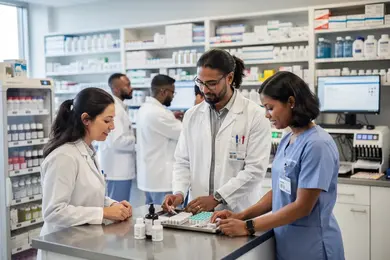
Rotation placement support is the system a pharmacy school uses to help students complete required experiential education. In PharmD programs, rotations are not optional internships. They are structured, supervised learning experiences that help students apply pharmacotherapy, communication, documentation, medication safety, and clinical decision-making in real healthcare settings.
Most PharmD students encounter two major experiential components. The table below explains the difference because applicants often underestimate how early and how often rotations appear in the curriculum.
| Experiential component | Typical timing | What students do | Why placement support matters |
| Introductory Pharmacy Practice Experiences | Early to middle years of the program | Observe and practice foundational skills in community, institutional, and patient-care environments | Students need approved sites that match early competency goals and fit the academic calendar |
| Advanced Pharmacy Practice Experiences | Final professional year or final phase of the curriculum | Complete full-time rotations in areas such as community pharmacy, hospital pharmacy, ambulatory care, internal medicine, and electives | Students need enough high-quality placements to meet graduation and licensure preparation requirements |
Strong support usually includes more than a list of possible sites. A well-run hybrid program should verify preceptor credentials, maintain affiliation agreements, monitor student compliance requirements, coordinate evaluations, and help resolve site disruptions. This is especially important for students living far from campus because they may need rotations near their home region, not only near the university.
Applicants should also understand the limits of support. Some programs assign most rotations directly, while others allow students to request geographic preferences or help identify potential sites. A school may support out-of-state placements, but state authorization, site availability, preceptor capacity, and local competition can affect what is possible.
How do hybrid PharmD programs compare to fully on-campus and online options?
Hybrid PharmD programs sit between traditional campus-based programs and mostly online formats. For many students, the biggest advantage is being able to complete much of the academic coursework remotely while still meeting the in-person clinical and skills requirements expected of pharmacist education.
The comparison below helps clarify which format fits different students. It is especially useful if you are balancing geography, work, family responsibilities, learning style, and access to clinical sites.
| Program format | Best fit | Main advantage | Main trade-off |
| Hybrid PharmD | Students who want flexibility but can travel for labs, immersions, and rotations | Remote coursework with required hands-on training | Rotation logistics can be more complex if the student lives far from the school's core site network |
| Fully on-campus PharmD | Students who want daily in-person access to faculty, labs, student organizations, and local health systems | Simpler access to campus resources and nearby experiential sites | Less geographic flexibility and often more relocation-related cost |
| Mostly online or distance pathway | Students who need maximum didactic flexibility and can meet scheduled in-person requirements | Greater ability to remain in a home community during coursework | Students must be highly self-directed and confirm rotation support before enrolling |
A hybrid PharmD may be the better choice if you are disciplined with online learning, live in a region where the school already has rotation relationships, and can attend mandatory campus sessions. It may be a poor fit if you need a completely remote degree, cannot travel on short notice, or expect the school to guarantee every preferred rotation location.
Students who primarily want to shorten the time to graduation should compare hybrid pathways with an accelerated PharmD option. Accelerated formats can reduce calendar time, but they may also compress coursework and rotation preparation, so the right choice depends on your academic readiness and schedule tolerance.
What accreditation and licensing requirements must hybrid PharmD programs meet?
In the United States, a PharmD program should be accredited by the Accreditation Council for Pharmacy Education. Accreditation matters because state boards of pharmacy generally require graduation from an ACPE-accredited professional pharmacy program before a candidate can proceed through pharmacist licensure steps. A hybrid delivery format does not remove this requirement.
Licensure is state-based, so students should verify requirements in the state where they plan to practice. Most candidates must graduate from an accredited PharmD program, complete required internship or experiential hours, pass the North American Pharmacist Licensure Examination, pass a pharmacy law exam or state jurisprudence requirement, and satisfy background check or character-and-fitness rules.
The most important accreditation and licensure checks are practical, not theoretical. Before applying, students should confirm the following with both the school and the relevant state board:
- The PharmD program is ACPE-accredited or has an accreditation status that supports the student's licensure timeline.
- The hybrid pathway is included within the school's accredited professional program, not marketed as a separate non-licensure track.
- The school is authorized to enroll students in the applicant's state if online coursework will be completed there.
- The program's experiential education model satisfies IPPE and APPE expectations, including required patient-care categories.
- The school can explain how it supports students who want rotations outside the university's home state or core region.
- The program publishes or provides recent NAPLEX and MPJE-related outcomes in a way applicants can interpret responsibly.
One common mistake is assuming that "online" or "hybrid" automatically means national licensure portability. It does not. Pharmacy licensure is portable only through the rules of each state, and states may differ on intern registration, background checks, jurisprudence exams, and transfer processes.
Which hybrid PharmD programs are known for strong rotation placement support?
The strongest hybrid PharmD choices are usually programs that combine flexible course delivery with a mature experiential education infrastructure. Because rotation availability changes by year, location, preceptor capacity, and state authorization, applicants should treat any "best" list as a starting point for verification rather than a substitute for direct school questions.
The programs below are commonly discussed among distance or hybrid PharmD applicants because they publicly emphasize experiential education support, remote-access coursework, campus intensives, or rotation coordination. Always confirm current format, accreditation status, state eligibility, and placement policies before applying.
| Program | Hybrid or distance feature | Rotation placement support signal | Best for |
| Creighton University School of Pharmacy and Health Professions | Long-established distance pathway with required campus experiences | Experienced experiential education structure serving distance learners across multiple regions | Students who want a mature distance PharmD model with defined in-person requirements |
| University of Colorado Skaggs School of Pharmacy and Pharmaceutical Sciences | Remote pathway with online learning and scheduled on-campus components | Academic medical center environment and structured experiential education coordination | Students seeking a public university option connected to health-system and clinical training resources |
| Lake Erie College of Osteopathic Medicine School of Pharmacy | Distance education pathway with required in-person components | Rotation coordination through approved sites and preceptors, with attention to distance student logistics | Students comfortable with a structured professional curriculum and scheduled campus visits |
| Duquesne University School of Pharmacy | Online or hybrid PharmD pathway with in-person skills requirements | Experiential education office support for required practice experiences and site compliance | Students who want a private university model with remote coursework and professional formation |
| Butler University College of Pharmacy and Health Sciences | Online pathway supported by campus-based professional pharmacy resources | Experiential learning support designed to connect didactic preparation with practice sites | Students looking for an established pharmacy college with flexible delivery options |
| University of Findlay College of Pharmacy | Distance PharmD option with synchronous and experiential requirements | Practice experiences coordinated through approved rotation processes | Students who prefer live remote engagement and a defined pathway into clinical rotations |
When comparing these programs, focus less on brand recognition and more on site access in your intended practice region. A school with excellent rotation support near its main campus may not be the best choice for a student who needs most placements several states away.
A practical shortlist should include no more than four to six schools. For each one, ask the experiential education office how many students in your state were placed recently, what types of APPE sites were available, and what happens if a site cancels before the rotation begins.
How do hybrid PharmD schools secure and manage clinical rotation sites?
Hybrid PharmD schools secure clinical rotation sites through a combination of affiliation agreements, preceptor recruitment, alumni networks, health-system partnerships, community pharmacy relationships, and student geographic planning. The process is highly regulated because rotations involve patient care, student supervision, privacy rules, and professional liability.
A strong experiential education office usually works behind the scenes long before a student arrives at a site. The goal is to make sure the location is educationally appropriate, the preceptor is qualified, and the student can complete required competencies safely and on time.
Schools typically manage rotation placements through a sequence like this:
- The experiential education office approves practice sites based on educational fit, patient-care opportunities, supervision, and compliance requirements.
- The school establishes affiliation agreements that define responsibilities for the university, site, preceptor, and student.
- Preceptors receive orientation or training on learning outcomes, assessment expectations, professionalism standards, and reporting procedures.
- Students submit geographic preferences, compliance documentation, immunization records, background checks, drug screens, and scheduling constraints by program deadlines.
- The school matches or assigns students to required and elective rotations while checking accreditation categories and graduation requirements.
- Faculty or experiential staff monitor evaluations, intervene when problems arise, and document completion of required competencies.
The most important trend for hybrid students is the move toward more formalized digital rotation management. Many schools now use online systems to track site agreements, onboarding documents, evaluations, attendance, and student progress. This can improve transparency, but it does not eliminate local constraints such as limited hospital slots or competition with nearby pharmacy, medical, nursing, and PA programs.
Applicants should be cautious if a program implies that students can simply "find their own" rotations. Student-identified sites can be useful, especially in underserved regions, but the school must still approve the site, execute agreements, and ensure the experience meets curricular and accreditation standards.
What should applicants look for when evaluating rotation placement support in PharmD programs?
Rotation placement support should be one of the first things applicants evaluate, not a question saved until after admission. A PharmD program can have appealing tuition, flexible coursework, and strong faculty, but weak rotation logistics can create stress, travel costs, delayed graduation risk, or limited exposure to preferred practice settings.
Use the questions below when speaking with admissions staff, experiential education directors, current students, and recent graduates. The best programs can answer these questions clearly and consistently.
- How many IPPE and APPE sites are currently approved in the regions where distance or hybrid students live?
- Does the school assign rotations, use a lottery or matching system, or require students to propose sites?
- Which rotations must be completed near campus, and which can be completed near the student's home location?
- How early does the school begin geographic planning for distance students?
- What percentage of required APPE categories can typically be completed within a student's preferred region?
- What happens if a preceptor leaves, a site closes, or a health system cancels a rotation?
- Are travel, housing, parking, onboarding, background check, immunization, and licensing expenses included in the published cost of attendance?
- How does the program evaluate preceptor quality and remove sites that do not meet expectations?
There are also red flags that should slow down your decision. Watch for vague answers about out-of-state placements, no direct access to experiential education staff during the admissions process, heavy reliance on students to build the school's site network, or no clear policy for canceled rotations.
A good rule is to ask for evidence, not reassurance. Helpful evidence may include a rotation map, examples of recent APPE categories completed by distance students, student handbook policies, preceptor onboarding procedures, and published licensure exam outcomes. None of these guarantees your individual placement, but they show whether the program manages experiential education systematically.
What are typical admissions requirements for hybrid PharmD programs in the United States?
Hybrid PharmD admissions requirements are usually similar to campus-based PharmD requirements. Schools want evidence that applicants can handle biomedical science, communicate professionally, manage a demanding workload, and succeed in both online and in-person learning environments.
Most programs review a combination of academic preparation, prerequisite completion, professional exposure, and fit. Specific requirements vary by school, but applicants commonly encounter the following:
- Completion of prerequisite coursework in areas such as general chemistry, organic chemistry, biology, anatomy or physiology, microbiology, calculus or statistics, English, and social sciences.
- A minimum college GPA and science GPA, with stronger applicants often showing consistent performance in chemistry and biology sequences.
- Official college transcripts from all institutions attended.
- PharmCAS application materials if the school participates in centralized admissions.
- Letters of recommendation from faculty, pharmacists, supervisors, or healthcare professionals.
- A personal statement explaining motivation for pharmacy, readiness for hybrid learning, and professional goals.
- Interview participation, often using behavioral, ethical, teamwork, or communication-based questions.
- Healthcare, pharmacy technician, research, service, or shadowing experience, which may be recommended or strongly preferred even when not required.
The PCAT has become less central in PharmD admissions than it once was, and many programs no longer require it. Applicants should verify each school's current policy rather than preparing for an exam that may not improve their application.
Career changers should pay close attention to prerequisite age limits and transfer policies. A student with an older bachelor's degree may still need to retake sciences if the school requires recent coursework. If you are comparing healthcare pathways more broadly, direct entry MSN programs for non-nurses online may be relevant, but nursing licensure and pharmacist licensure lead to different scopes of practice and should not be treated as interchangeable options.
How long do hybrid PharmD programs take, and what are the total expected costs?
Most professional PharmD programs take four academic years after prerequisites, although some pathways are structured on accelerated calendars. Hybrid delivery may reduce relocation or commuting time during didactic coursework, but it does not remove the required clinical rotation sequence.
The timeline below shows how the path typically unfolds for a student who enters after completing prerequisites. Exact sequencing varies, especially in three-year or year-round programs.
| Stage | Typical length | Main focus | Cost considerations |
| Prerequisites | Two to four years depending on prior credits | Science, math, communication, and general education requirements | Community college transfer options may reduce cost if accepted by the PharmD school |
| Didactic PharmD coursework | First two to three professional years | Pharmacology, therapeutics, calculations, patient care, law, ethics, and skills labs | Tuition, technology fees, campus travel, lab immersions, books, equipment, and professional fees |
| IPPE rotations | Integrated across early professional years | Introductory practice exposure in approved settings | Transportation, onboarding, immunizations, background checks, and schedule flexibility |
| APPE rotations | Often the final professional year | Full-time advanced practice experiences | Housing, travel, parking, state intern registration, and possible lost work income |
Total costs vary widely by public versus private tuition, residency status, program length, living arrangements, and rotation geography. Applicants should calculate total cost of attendance rather than tuition alone. For federal borrowing context, graduate and professional students can generally borrow up to $20,500 per academic year in Direct Unsubsidized Loans before considering Grad PLUS or other financing; this limit matters because many PharmD students need a larger financing plan.
When comparing programs, include all likely expenses in one worksheet. The most commonly missed costs include:
- Mandatory campus travel for labs, assessments, orientation, ceremonies, or skills intensives.
- Short-term housing during campus sessions or distant APPE rotations.
- Rotation onboarding fees, background checks, drug screens, immunizations, CPR certification, and health documentation.
- State intern license or registration fees if rotations occur in more than one state.
- Technology requirements such as a laptop, webcam, testing software, and reliable high-speed internet.
- Lost wages if APPE rotations make part-time work unrealistic.
- Licensure exam preparation, NAPLEX fees, MPJE or state law exam fees, and license application expenses after graduation.
A lower-tuition program is not always cheaper if it requires repeated travel or offers limited rotation access near your home. Conversely, a higher-tuition program may be more practical if it has reliable clinical placements in your region and reduces disruption during the final year.
What career paths, settings, and roles are available to hybrid PharmD graduates?
Graduates of ACPE-accredited hybrid PharmD programs pursue the same pharmacist licensure pathway as graduates of campus-based PharmD programs. Employers generally focus on licensure, clinical readiness, rotation quality, communication skills, residency training when relevant, and fit for the practice setting rather than whether didactic coursework was delivered online or on campus.
PharmD graduates can work in several practice environments. The table below summarizes common settings and how rotation choices can influence competitiveness.
| Setting | Typical responsibilities | Rotation experiences that help | Additional preparation often valued |
| Community pharmacy | Medication dispensing, immunizations, counseling, medication therapy management, workflow supervision | Community pharmacy, ambulatory care, public health, patient counseling | Strong communication, vaccination certification, business and operations awareness |
| Hospital or health-system pharmacy | Medication verification, sterile products, interdisciplinary rounds, transitions of care, medication safety | Internal medicine, institutional pharmacy, critical care, infectious disease, emergency medicine | Postgraduate residency is often preferred for clinical roles |
| Ambulatory care | Chronic disease management, collaborative practice, patient education, outcomes tracking | Ambulatory care, primary care, cardiology, endocrinology | Residency or board certification may strengthen advancement options |
| Managed care | Formulary management, prior authorization, population health, medication-use policy | Managed care, outcomes research, drug information | Data literacy and understanding of payer systems |
| Industry or pharmaceutical companies | Medical information, regulatory affairs, pharmacovigilance, clinical trials, medical science liaison support | Drug information, research, industry elective, specialty pharmacy | Fellowship, research experience, and scientific communication skills |
| Academia or research | Teaching, precepting, scholarship, curriculum development, clinical practice faculty roles | Teaching elective, research, specialty clinical rotations | Residency, fellowship, publications, or graduate training may be useful |
Hybrid students should be strategic with APPE electives. If you want a residency, prioritize clinically rigorous rotations, strong preceptor evaluations, presentations, research, and leadership. If you want community pharmacy leadership, look for placements with immunization programs, medication therapy management, adherence services, and workflow management.
Some students comparing pharmacy with broader healthcare leadership roles may find that the fastest online master's in healthcare management is a better fit if they want administration rather than direct medication-use responsibility. The PharmD is a clinical professional doctorate, so it makes the most sense for students who want pharmacist licensure and medication-focused patient care.
What is the current salary outlook and demand for pharmacists trained in hybrid programs?
Salary outcomes for hybrid PharmD graduates should be evaluated through the same labor market lens as traditional PharmD graduates: licensure status, region, setting, residency training, experience, and employer type all matter. The degree format alone does not determine pay.
The U.S. Bureau of Labor Statistics reported a May 2024 median annual wage of $137,480 for pharmacists. This figure is useful as a national benchmark, but applicants should not treat it as a guaranteed starting salary. New graduates may enter lower or higher depending on location, shift differentials, clinical specialization, residency completion, and whether they work in retail, hospital, managed care, or industry settings.
Demand is changing rather than disappearing. Traditional dispensing roles continue to face pressure from automation, central-fill systems, mail-order services, and corporate workflow redesign. At the same time, pharmacists are increasingly involved in immunizations, chronic disease support, medication management, specialty pharmacy, pharmacogenomics, transitions of care, and population health initiatives.
For career planning, students should think about demand in terms of setting-specific skills. Employers increasingly value pharmacists who can document interventions, work in teams, use electronic health records, analyze medication-use data, counsel diverse patients, and support measurable outcomes. AI tools may assist with drug information retrieval, documentation, inventory forecasting, or prior authorization workflows, but they do not replace the need for licensed clinical judgment and patient communication.
Applicants who are drawn to prescribing, diagnosis, and longitudinal mental health care may want to compare pharmacy with online Psych NP programs. That comparison is not about which career is "better"; it is about scope of practice, licensure structure, patient relationship, and the type of clinical decisions you want to make.
Other Things You Should Know About PharmD
Most hybrid PharmD programs in 2027 do not require applicants to have a pharmacy technician background. However, having prior experience in the pharmacy field can be beneficial for applicants, as it enhances their familiarity with the industry and strengthens their application. Always check the specific prerequisites of each program.
Yes, if they graduate from an accredited PharmD program and meet residency application requirements. Residency competitiveness depends on grades, rotations, recommendations, leadership, research, interviews, and clinical readiness, not simply the hybrid format.
The biggest risk is enrolling without confirming rotation logistics in your region. Before committing, ask how placements are assigned, whether students in your state have completed rotations recently, and what support exists if a site cancels or cannot meet required competencies.
References
- Career options for MPharm graduates https://pharmacistsupport.org/i-need-help-managing-my/work-life/careers-advice-and-options-for-pharmacy-graduates/
- Student Rotations - Cascadia Pharmacy Group https://www.cascadiapharmacygroup.com/student-rotations/
- Pharmacy Accreditation | NABP Accreditation Programs https://nabp.pharmacy/programs/accreditations/
- Clinical Experience https://www.westernu.edu/pharmacy/programs/academic/pharmd-clinical-experience/
- What are unique career paths for PharmD graduates? https://www.mcw.edu/education/pharmacy-school/prospective-students/chat-with-us/unique-careers-blog
- Exploring Nontraditional Postgraduate Career Options in Pharmacy https://transpharmd.com/pharmacy-fellows/f/exploring-nontraditional-post-graduate-career-options
- www.idstewardship.com: Verifying that you are not a robot... https://www.idstewardship.com/seeking-pharmaceutical-industry-fellowship-positions-5-considerations-applicants/
- Pharmacist Job Outlook: Supply Versus Demand - Health Care Logistics® https://www.gohcl.com/posts/pharmacist-job-outlook-supply-versus-demand
- Online vs Hybrid vs Campus Learning in Healthcare: Which Is Right for You? https://www.edumed.org/articles/online-vs-hybrid-vs-campus/
- You Can Do Your Pharmacy Rotations From Home. Here's How That Actually Works - Lake Erie College of Osteopathic Medicine https://lecom.edu/you-can-do-your-pharmacy-rotations-from-home-heres-how-that-actually-works/