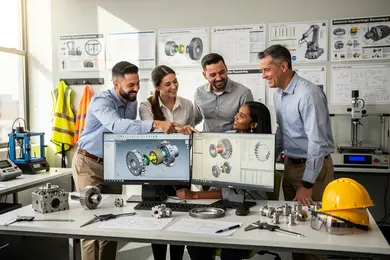
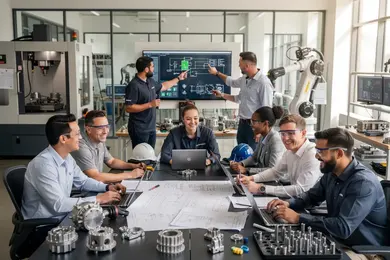
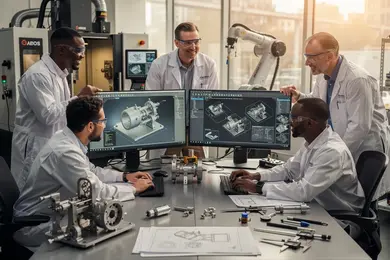
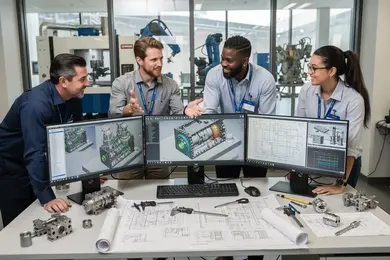
2027 Online Mechanical Engineering Degrees for Students Who Want Mechanical Design Careers

Co-Founder and Chief Data Scientist
Choosing an online mechanical engineering degree is a high-stakes decision if your goal is mechanical design, product development, CAD, robotics, or manufacturing engineering. The U.S. Bureau of Labor Statistics reports a 2024 median pay of $102,320 for mechanical engineers, but outcomes depend heavily on accreditation, hands-on design work, software skills, and internships.
This guide is for students comparing online programs and career paths. You will learn how respected online degrees are, which credentials matter, what programs cost, and how to choose a degree that supports real design-engineering opportunities.
Key Things You Should Know
- For mechanical design careers, an ABET-accredited bachelor's degree in mechanical engineering is the strongest online option, especially for students who may later pursue Engineer in Training or Professional Engineer credentials.
- Mechanical engineers had a 2024 median annual wage of $102,320 according to the U.S. Bureau of Labor Statistics, but design-focused salaries vary by industry, region, software skill, experience, and security-clearance requirements.
- Online mechanical engineering programs can be respected when they include the same engineering math, lab, CAD, finite element analysis, manufacturing, and capstone requirements as campus programs; weak programs often lack ABET accreditation, lab transparency, or employer-connected projects.
What is an online mechanical engineering degree and how does it prepare for mechanical design careers?
An online mechanical engineering degree is a bachelor's or master's program delivered primarily through distance learning that teaches students how to analyze, design, build, test, and improve mechanical systems. For design-focused students, the most important degree is usually a Bachelor of Science in Mechanical Engineering because it covers the engineering foundation employers expect for entry-level mechanical design engineer roles.
Mechanical design is not just drawing parts in CAD. It combines engineering science, product constraints, manufacturability, materials selection, safety, cost, and testing. A strong online program should help students move from "I can model a part" to "I can justify why this geometry, material, tolerance, load path, and manufacturing method make sense."
Online mechanical engineering programs usually prepare students through a mix of asynchronous lectures, live problem-solving sessions, simulation tools, remote or in-person labs, proctored exams, and team-based design projects. The better programs also require a senior capstone project that mirrors industry work: defining requirements, creating concepts, testing prototypes, documenting decisions, and presenting results.
Students should also understand how mechanical engineering differs from related fields. Mechanical engineering is broad and design-heavy, while manufacturing engineering emphasizes production systems, industrial engineering emphasizes process optimization, and environmental engineering applies engineering principles to air, water, waste, and sustainability problems.
Students more interested in pollution control or infrastructure sustainability may want to compare an environmental engineering degree instead of a mechanical design path.
The table below summarizes common online mechanical engineering degree options and how each fits a design career goal:
| Degree option | Best fit | Design-career value | Important limitation |
| Online BS in Mechanical Engineering | First-time engineering students and transfer students | Strongest route for entry-level mechanical design engineer roles | Must verify ABET accreditation and lab requirements |
| Online BS in Mechanical Engineering Technology | Students interested in applied design, testing, CAD, and manufacturing support | Useful for design technologist, CAD designer, test technician, and applications roles | May not be treated the same as an engineering degree for some engineering or licensure roles |
| Online MS in Mechanical Engineering | Engineers who already have a bachelor's degree | Helpful for advanced design, simulation, thermal systems, robotics, or product development roles | Usually not a substitute for an ABET-accredited bachelor's degree |
| Online certificate in CAD, FEA, or product design | Working professionals who need targeted software or design skills | Good supplement to an engineering degree or technical background | Rarely enough by itself for engineer-title roles |
For most students who want to become mechanical design engineers, the safest education path is an ABET-accredited bachelor's degree, followed by internships, project work, and a portfolio that shows CAD, analysis, and manufacturing decisions.
Are online mechanical engineering programs as respected as campus programs for design-focused students?
Online mechanical engineering programs can be respected by employers when the credential, curriculum, accreditation, and assessments match the campus standard. Employers usually care less about whether lectures were online and more about whether the student completed rigorous engineering coursework, solved real design problems, used industry tools, and could communicate technical decisions clearly.
The key distinction is not "online versus campus." It is "credible engineering program versus weak credential." A respected online program should have regional institutional accreditation, program-level ABET accreditation for undergraduate engineering when available, transparent lab arrangements, qualified faculty, and meaningful design projects.
The comparison below shows how online and campus formats differ for students pursuing mechanical design careers:
| Factor | Online mechanical engineering | Campus mechanical engineering | What design students should look for |
| Lecture delivery | Recorded, live online, or hybrid | In-person lectures and discussion | Clear access to faculty, office hours, and problem-solving support |
| Labs | Remote labs, lab kits, simulation labs, short campus residencies, or approved local labs | Campus lab facilities | Hands-on or equivalent experiments in materials, fluids, heat transfer, controls, and manufacturing |
| Design projects | Virtual team projects, employer-sponsored projects, or local fabrication options | In-person shop and team access | Capstone with requirements, prototypes, analysis, testing, and documentation |
| Networking | Requires more intentional outreach | Easier access to clubs, labs, and recruiters | Career services, online engineering clubs, internship pipelines, and alumni contacts |
| Flexibility | Stronger for working adults and transfer students | Stronger for students who want full-time immersion | Schedule that still leaves time for internships and portfolio projects |
An online degree may be the better choice for working adults, military students, parents, or students who cannot relocate. A campus program may be better for students who want daily access to machine shops, research labs, Formula SAE teams, robotics clubs, or face-to-face recruiting.
Common mistake: assuming "online" automatically means easier. Engineering programs remain math-heavy and time-intensive. Students should expect calculus, physics, statics, dynamics, thermodynamics, fluid mechanics, machine design, and analysis courses to require sustained weekly study time regardless of format.
Which U.S. online mechanical engineering degrees are ABET-accredited for mechanical design careers?
ABET accreditation is one of the most important filters for online mechanical engineering degrees because it signals that an engineering program meets recognized standards for faculty, curriculum, student outcomes, continuous improvement, and engineering design. It also matters for students who may later pursue Fundamentals of Engineering exam eligibility, Engineer in Training status, or Professional Engineer licensure, although exact requirements vary by state.
Fully online ABET-accredited mechanical engineering bachelor's options are limited in the United States. Students should always verify a program directly through the ABET Accredited Program Search and confirm that the online pathway leads to the same accredited degree listed by the institution.
The table below lists examples of U.S. institutions known for distance-accessible mechanical engineering bachelor's pathways that students commonly evaluate for online or mostly online study. Accreditation status can change, so this table should be treated as a starting point, not a substitute for direct verification.
| Institution | Online design-relevant degree pathway | ABET relevance | Best-fit student |
| Arizona State University | Online Bachelor of Science in Engineering with a mechanical engineering focus or equivalent mechanical engineering pathway | Students should confirm the exact program name and ABET listing before enrolling | Students seeking a large public university with broad online engineering infrastructure |
| University of North Dakota | Distance Bachelor of Science in Mechanical Engineering | Commonly reviewed by students seeking an ABET-accredited online mechanical engineering route | Students who want an established distance engineering model with lab planning |
| The University of Alabama | Distance Bachelor of Science in Mechanical Engineering pathway | Students should verify that the distance option maps to the ABET-accredited mechanical engineering program | Transfer students and working adults looking for a public research university option |
Students should be especially careful with similarly named degrees. "Mechanical engineering," "mechanical engineering technology," "engineering technology," "product design," and "manufacturing design" may all lead to useful careers, but they are not identical credentials. Some employers and licensing boards distinguish sharply between engineering and engineering technology programs.
Before applying, students should confirm these accreditation details directly with the school and ABET:
- The exact degree title that appears on the diploma and transcript.
- Whether the specific program is accredited by the Engineering Accreditation Commission of ABET or another ABET commission.
- Whether online students graduate from the same accredited program as campus students.
- Whether any required labs, residencies, or proctored exams create travel or scheduling obligations.
- Whether the program meets educational requirements for FE exam eligibility in the student's state.
A strong rule of thumb: if a school's admissions page makes accreditation hard to verify, ask for the exact ABET program listing in writing before committing tuition money.
What admission requirements do online mechanical engineering programs typically have for prospective design engineers?
Online mechanical engineering admissions are usually more demanding than many online bachelor's programs because students must be ready for calculus-based engineering work. Requirements vary by school and by whether the applicant is a first-year student, transfer student, military student, or second-degree student.
Prospective design engineers should pay special attention to math placement. Falling behind in calculus can delay physics, statics, dynamics, mechanics of materials, and machine design, which can add time and cost to the degree.
The table below summarizes common admissions requirements and why each matters for mechanical design preparation:
| Requirement | What schools may ask for | Why it matters for design careers |
| High school or college transcripts | Proof of graduation, GPA, and completed coursework | Shows readiness for math, science, and engineering sequence work |
| Math preparation | Precalculus, trigonometry, calculus placement, or prior calculus credit | Design analysis depends on mechanics, equations, geometry, and modeling |
| Science preparation | Physics and chemistry coursework, often calculus-based at the college level | Supports materials, thermodynamics, fluids, and testing courses |
| Transfer credits | Prior college credits evaluated course by course | Can shorten the timeline if credits fit the engineering plan exactly |
| Personal statement or resume | Sometimes required for transfer, adult, or graduate applicants | Can show technical experience, CAD exposure, military training, or design interest |
| Graduate prerequisites | ABET engineering bachelor's degree or prerequisite engineering courses | Online MS programs often assume prior engineering depth |
Students coming from community college should request a transfer plan before enrolling in lower-division courses. Engineering sequences are less flexible than many majors, and a course that transfers as general credit may not satisfy a required statics, circuits, calculus, or physics requirement.
Applicants can reduce risk by completing these steps before submitting enrollment deposits:
- Ask the engineering department, not only general admissions, to review transfer credits.
- Confirm the first math course you will take and whether it keeps you on a four-year or transfer timeline.
- Request a sample full-time and part-time degree plan that includes labs and capstone requirements.
- Ask whether online students can access tutoring, faculty office hours, CAD software, simulation tools, and career services.
- Confirm whether internships, co-ops, or employer projects can count toward degree requirements or professional experience.
Admissions rules also differ widely by discipline. For example, a professional graduate path such as an MLIS degree usually evaluates applicants differently than an engineering program because mechanical engineering depends on a strict math-and-science course sequence.
How do online mechanical engineering curricula cover core mechanical design courses and technical skills?
A design-focused online mechanical engineering curriculum should build from math and science into applied engineering design. Students typically start with calculus, physics, chemistry, programming, and engineering graphics, then move into statics, dynamics, mechanics of materials, thermodynamics, fluid mechanics, heat transfer, controls, materials science, manufacturing, and machine design.
The design value of the degree comes from integration. A student designing a bracket, pump component, robotic arm, HVAC subsystem, or drivetrain needs to understand loads, motion, material behavior, safety factors, thermal effects, manufacturing limits, tolerances, and cost trade-offs.
The table below connects common courses to the mechanical design skills employers often expect from entry-level candidates:
| Course area | Design skill developed | Typical tools or outputs |
| Engineering graphics and CAD | Creating parts, assemblies, drawings, and design documentation | SolidWorks, Creo, Inventor, NX, CATIA, GD&T drawings |
| Statics and dynamics | Understanding forces, motion, equilibrium, and load paths | Free-body diagrams, motion calculations, design assumptions |
| Mechanics of materials | Evaluating stress, strain, deflection, and failure risk | Beam calculations, safety factors, material comparisons |
| Materials science | Selecting metals, polymers, composites, and heat treatments | Material specifications, strength and durability analysis |
| Machine design | Designing shafts, bearings, gears, fasteners, springs, and mechanisms | Component sizing, tolerance decisions, design reviews |
| Manufacturing processes | Designing parts that can be fabricated efficiently | DFM decisions, machining, casting, additive manufacturing, welding considerations |
| FEA and simulation | Testing design behavior virtually before prototyping | Stress plots, mesh studies, validation notes |
| Capstone design | Solving an open-ended engineering problem with constraints | Prototype, test report, presentation, portfolio artifact |
Students should not rely on coursework alone. Mechanical design hiring often rewards evidence of applied skill. A strong student portfolio can include CAD assemblies, engineering drawings, FEA results, design calculations, prototype photos, test plans, and a short explanation of trade-offs.
Students can strengthen their design readiness by building a portfolio around these practical outputs:
- A CAD assembly with properly constrained parts, drawings, tolerances, and a bill of materials.
- A hand calculation or spreadsheet that validates a design decision before simulation.
- An FEA model with boundary conditions, mesh assumptions, and a plain-language interpretation of results.
- A manufacturing-aware redesign that reduces part count, simplifies machining, or improves assembly.
- A capstone or independent project showing requirements, concept selection, testing, and lessons learned.
AI and automation are also changing design work. Generative design, simulation automation, digital twins, and AI-assisted CAD can speed up concept exploration, but they do not replace engineering judgment. Employers still need engineers who can define constraints, validate outputs, understand failure modes, and defend design decisions.
How long do online mechanical engineering degrees take and what do they cost for design students?
A full online bachelor's degree in mechanical engineering usually takes about four years of full-time study for first-time students. Transfer students may finish sooner, but only if prior credits fit the engineering sequence. Part-time students often need longer because prerequisite chains make it hard to skip ahead.
Cost varies widely by institution, residency status, transfer credit, course load, software fees, lab travel, and whether the program is public, private nonprofit, or private for-profit.
The College Board's 2024 Trends in College Pricing reported average published tuition and fees of $11,610 for in-state students at public four-year institutions and $43,350 at private nonprofit four-year institutions for the 2024-25 academic year. Online engineering students should use these figures as context, not as a program quote, because online tuition models can differ from campus pricing.
The table below shows cost and time factors that matter specifically for online mechanical engineering students:
| Factor | How it affects time or cost | What to ask before enrolling |
| Transfer credits | Can reduce total credits, but engineering courses may transfer narrowly | Will each course satisfy a specific degree requirement? |
| Math placement | Starting below calculus can add semesters | What math course will I start with? |
| Lab format | May require kits, local arrangements, or campus visits | Are lab fees or travel costs required? |
| Software access | CAD, simulation, and programming tools may require licenses or hardware | Are software licenses included in tuition? |
| Residency pricing | Public universities may charge different rates for in-state and out-of-state students | Is online tuition flat-rate or residency-based? |
| Course availability | Some advanced courses may be offered once per year | Can I see a two-year course rotation? |
Students should calculate the total cost of completion rather than comparing only per-credit tuition. Engineering programs can include fees, textbooks, lab kits, exam proctoring, software, hardware upgrades, and travel for any required campus experiences.
A practical cost-control plan should include these steps:
- Complete lower-division calculus, physics, chemistry, and general education courses at a community college only after confirming transfer equivalency.
- Choose an ABET-accredited program that accepts the most applicable transfer credits, not just the cheapest advertised tuition.
- Ask whether employer tuition assistance, military benefits, state grants, or scholarships apply to online engineering students.
- Compare part-time and full-time pacing because taking too few courses can delay graduation and postpone full-time engineering income.
- Budget for a capable computer that can run CAD and simulation software smoothly.
The lowest tuition is not always the lowest-risk option. A slightly more expensive program with better transfer clarity, stronger labs, ABET accreditation, and employer-connected projects may offer better career value than a cheaper program that does not support engineering-design outcomes.
What mechanical design jobs can graduates of online mechanical engineering programs qualify for?
Graduates of credible online mechanical engineering programs can pursue many of the same entry-level roles as campus graduates, especially when they have strong projects, internships, CAD skills, and evidence of engineering analysis. Employers may use titles differently, so students should read job descriptions carefully instead of relying only on job titles.
Mechanical design careers often sit at the intersection of product development, manufacturing, testing, quality, and customer requirements. A graduate may start by creating drawings and calculations, then move into subsystem ownership, design reviews, vendor coordination, testing, and project leadership.
The table below summarizes common design-related roles and what graduates may do in each one:
| Job title | Typical responsibilities | Useful preparation |
| Mechanical design engineer | Design parts, assemblies, mechanisms, and systems; create drawings; run calculations; support prototypes | CAD, machine design, mechanics of materials, GD&T, FEA |
| Product development engineer | Turn customer or market needs into tested products | Capstone projects, prototyping, design reviews, manufacturing awareness |
| Manufacturing engineer | Improve production methods, tooling, fixtures, and assembly processes | Manufacturing processes, CAD, lean methods, quality tools |
| Test engineer | Plan and run tests to validate components or systems | Instrumentation, data analysis, lab experience, technical writing |
| Applications engineer | Help customers select, configure, and implement technical products | Mechanical systems knowledge, communication, sales engineering awareness |
| CAD designer or design technologist | Create models, drawings, layouts, and documentation under engineering supervision | Advanced CAD, drafting standards, product data management |
| Robotics or automation engineer | Design or integrate mechanical motion systems, actuators, sensors, and controls | Dynamics, controls, mechatronics, programming, robotics projects |
Mechanical design graduates work in industries such as aerospace, automotive, medical devices, energy, HVAC, industrial equipment, consumer products, defense, robotics, and advanced manufacturing. Some roles require U.S. citizenship or security clearance, especially in defense and aerospace.
Students who like engineering-adjacent environmental work should compare the day-to-day duties carefully. Mechanical design roles differ from many jobs for environmental science majors, which may focus more on field sampling, environmental compliance, conservation, or sustainability analysis.
Students can improve entry-level competitiveness by pursuing internships, co-ops, student design competitions, research assistant roles, or independent projects. For online students, this often requires extra initiative because campus-based recruiting may be less automatic.
What salary ranges and earning potential do mechanical design engineers with online degrees have?
Salary potential depends on job title, industry, location, experience, software skill, degree level, clearance eligibility, and whether the role is truly engineering-design work or primarily drafting support. Employers generally evaluate the accredited degree, skills, and experience rather than the delivery format alone.
The U.S. Bureau of Labor Statistics reported a 2024 median annual wage of $102,320 for mechanical engineers. That figure is useful as a national benchmark, but it should not be read as an entry-level salary guarantee. New graduates in lower-cost regions, CAD-heavy support roles, or smaller firms may start below the national median, while experienced engineers in high-demand industries may earn above it.
The table below explains how different role types can affect earning potential without treating any salary as automatic.
| Career stage or role type | How compensation is usually influenced | What can improve earning potential |
| Entry-level mechanical design engineer | Often tied to degree accreditation, internship experience, CAD skill, and local market demand | ABET degree, portfolio, co-op experience, strong design calculations |
| CAD-focused designer or drafter | May pay less than engineer-title roles if the job does not require engineering analysis | Advanced CAD, GD&T, manufacturing knowledge, pathway into engineering duties |
| Simulation or analysis engineer | Can command stronger pay when the role requires FEA, thermal analysis, or advanced modeling | Graduate coursework, validated simulation projects, programming skill |
| Manufacturing or tooling engineer | Pay often reflects industry, plant complexity, and production responsibility | Lean manufacturing, automation, robotics, quality systems |
| Senior mechanical engineer | Usually depends on years of experience, project ownership, technical depth, and leadership | Licensure where relevant, system-level design, mentoring, cross-functional leadership |
Students evaluating return on investment should compare total education cost with realistic local job opportunities. A lower-cost online program can be financially attractive if it has ABET accreditation, strong transfer credit acceptance, and credible employer recognition. However, a low-cost credential with weak design training may not lead to the roles the student actually wants.
Common mistake: assuming an online master's degree will automatically raise pay. A graduate degree may help in specialized design, simulation, thermal systems, aerospace, robotics, or research-heavy roles, but work experience and project ownership often matter just as much.
What is the job outlook and industry demand for mechanical design engineers in the United States?
The outlook for mechanical engineers is favorable compared with many occupations. The U.S. Bureau of Labor Statistics projects 9% employment growth for mechanical engineers from 2024 to 2034, which suggests continued demand across manufacturing, automation, energy, transportation, and product development. For students, this means the field has broad opportunity, but competition can still be strong for the most desirable design roles.
Demand is being shaped by several trends. Advanced manufacturing needs engineers who can design for automation, robotics, additive manufacturing, and quality control. Electrification is changing automotive, aerospace, HVAC, and energy systems. Medical devices and consumer products continue to need engineers who can balance performance, safety, manufacturability, and regulation. AI-enabled design tools are also increasing the value of engineers who can validate automated outputs rather than simply operate software.
The industries below commonly hire mechanical design talent, although hiring cycles can vary by region and economic conditions:
| Industry | Why mechanical design skills matter | Examples of design work |
| Aerospace and defense | Complex systems require strength, weight, thermal, and reliability trade-offs | Brackets, housings, mechanisms, thermal components, test fixtures |
| Automotive and transportation | Electrification and efficiency create new design constraints | Battery enclosures, drivetrains, chassis components, cooling systems |
| Medical devices | Products must meet usability, safety, and manufacturing requirements | Device housings, mechanisms, fixtures, test equipment |
| Industrial equipment | Factories need durable machines, tooling, and automation systems | Conveyors, actuators, frames, tooling, robotic end effectors |
| Energy and HVAC | Efficiency, thermal performance, and reliability drive design decisions | Heat exchangers, pumps, fans, enclosures, thermal systems |
| Consumer products | Design must balance cost, performance, aesthetics, and manufacturability | Plastic parts, hinges, enclosures, mechanisms, packaging-related fixtures |
Online students can position themselves for these markets by choosing electives and projects intentionally. For example, a student interested in aerospace should prioritize structures, materials, FEA, and rigorous documentation. A student interested in robotics should add controls, mechatronics, programming, and actuator selection.
The strongest candidates are not just software users. They can explain why a design works, what assumptions could fail, how it will be manufactured, and how it should be tested.
How can students evaluate and choose a reputable online mechanical engineering program for design careers?
The best online mechanical engineering program is not simply the cheapest, fastest, or highest-ranked option. It is the program that fits your starting point, budget, schedule, accreditation needs, learning style, and target design career. For most aspiring mechanical design engineers, ABET accreditation, lab quality, transfer clarity, and project depth should carry more weight than marketing claims.
Students should evaluate programs using a structured process. This prevents common mistakes such as choosing a non-ABET program by accident, underestimating lab travel, or assuming all engineering credits transfer smoothly.
Use these steps before applying or enrolling:
- Verify institutional accreditation and program-level ABET accreditation for the exact degree title.
- Ask whether the online pathway leads to the same credential as the campus pathway.
- Review the full curriculum for statics, dynamics, mechanics of materials, thermodynamics, fluids, heat transfer, machine design, manufacturing, controls, and capstone design.
- Confirm how labs are completed and whether any campus visits, lab kits, local proctors, or special equipment are required.
- Request a transfer evaluation before committing, especially for calculus, physics, chemistry, engineering graphics, and programming courses.
- Ask for examples of recent capstone projects, employer partners, internship support, and student design portfolios.
- Compare the total cost of completion, including fees, software, hardware, travel, and credits that may not transfer.
- Check whether career services support online engineering students with resumes, internships, interview prep, and employer connections.
- Ask how faculty support works for difficult courses, including tutoring, office hours, discussion boards, and exam review.
- Speak with current students or alumni when possible to understand workload, course availability, and responsiveness.
The table below highlights common red flags and better alternatives when comparing online mechanical engineering degrees.
| Red flag | Why it is risky | Better alternative |
| No clear ABET information | May limit engineering recognition or licensure pathways | Verify the exact program in ABET's database before enrolling |
| Vague lab descriptions | Hands-on requirements may be weak, expensive, or logistically difficult | Ask for a lab schedule, cost list, and required travel details |
| Heavy emphasis on speed | Engineering prerequisite chains are difficult to compress responsibly | Choose a realistic plan that protects learning and project quality |
| No capstone or weak project work | Design employers want evidence of applied problem-solving | Look for team-based design, testing, documentation, and presentation requirements |
| Unclear transfer policy | Credits may not apply to the engineering major | Get a course-by-course written evaluation |
| Software not included or unsupported | CAD and simulation access can affect project quality | Confirm licenses, hardware requirements, and technical support |
Students comparing online education options in other fields should use the same consumer-protection mindset. For instance, someone evaluating a library science degree online would also need to check accreditation, career alignment, costs, and employer expectations, even though the accrediting bodies and job outcomes differ from engineering.
A reputable online mechanical engineering program should make requirements easy to verify. If admissions staff cannot answer detailed questions about accreditation, labs, course sequencing, design projects, or career support, keep looking or ask to speak directly with the engineering department.
Other Things You Should Know About Mechanical Engineering
Not always. Many product design, manufacturing, robotics, and aerospace roles do not require a PE license. However, licensure can matter in consulting, public safety, government work, HVAC, building systems, and roles where engineers sign or seal designs. Requirements vary by state.
Online mechanical engineering programs in 2027 pose unique challenges like needing self-discipline for independent study and developing hands-on skills virtually. Access to laboratories may be limited, requiring simulations or virtual labs, which can differ from the tactile experience on-campus students have. Effective time management becomes crucial in balancing remote coursework and practical training opportunities.
Sometimes, but it depends on the employer and role. Engineering technology programs can be strong for applied design, CAD, testing, and manufacturing roles, but some engineer-title jobs specifically require a mechanical engineering degree.
Students should become comfortable with at least one major CAD platform such as SolidWorks, Creo, Inventor, NX, or CATIA. They should also learn engineering drawings, GD&T basics, spreadsheet calculations, and introductory simulation or FEA tools.
References
- 2025 Best Online Mechanical Engineering Degrees https://www.onlineu.com/degrees/mechanical-engineering
- Campus vs Online Engineering Degrees - What Employers Think https://www.itcareerfinder.com/brain-food/blog/entry/what-employers-think-about-online-engineering-degrees.html
- Mechanical Engineering Jobs in Demand by 2030 | CADD https://caddcentre.com/blog/mechanical-engineering-jobs-in-demand-by-2030/
- Online Mechanical Engineering Courses | WiredWhite https://wiredwhite.com/course-category/mechanical-engineering/
- Top-Rated Mechanical Design Courses: Your Fast-Track to High-Paying Jobs in 2025 https://skill-lync.com/blogs/top-rated-mechanical-design-courses-your-fast-track-to-high-paying-jobs-in-2025
- Online Mechanical Engineering Degrees - MSME, BSME https://www.onlineengineeringprograms.com/mechanical
- Mechanical Engineer - Salary, How to Become, Job Description & Best Schools https://www.onlinedegree.com/careers/engineering/mechanical-engineer/
- Blog - How to become a Mechanical Design Engineer https://www.redlinegroup.com/insight-details/how-to-become-a-mechanical-design-engineer
- How Long to Become a Mechanical Engineer? | University of Bridgeport https://www.bridgeport.edu/news/time-to-become-a-mechanical-engineer/
- Find Programs - ABET https://www.abet.org/accreditation/find-programs/