2027 Online General Studies Degrees With Veteran-Friendly Funding Support

Co-Founder and Chief Data Scientist
Choosing an online general studies degree is often a funding and credit-transfer decision as much as an academic one. For veterans, the right program can turn military training, prior college, and VA benefits into a faster path to a bachelor's credential.
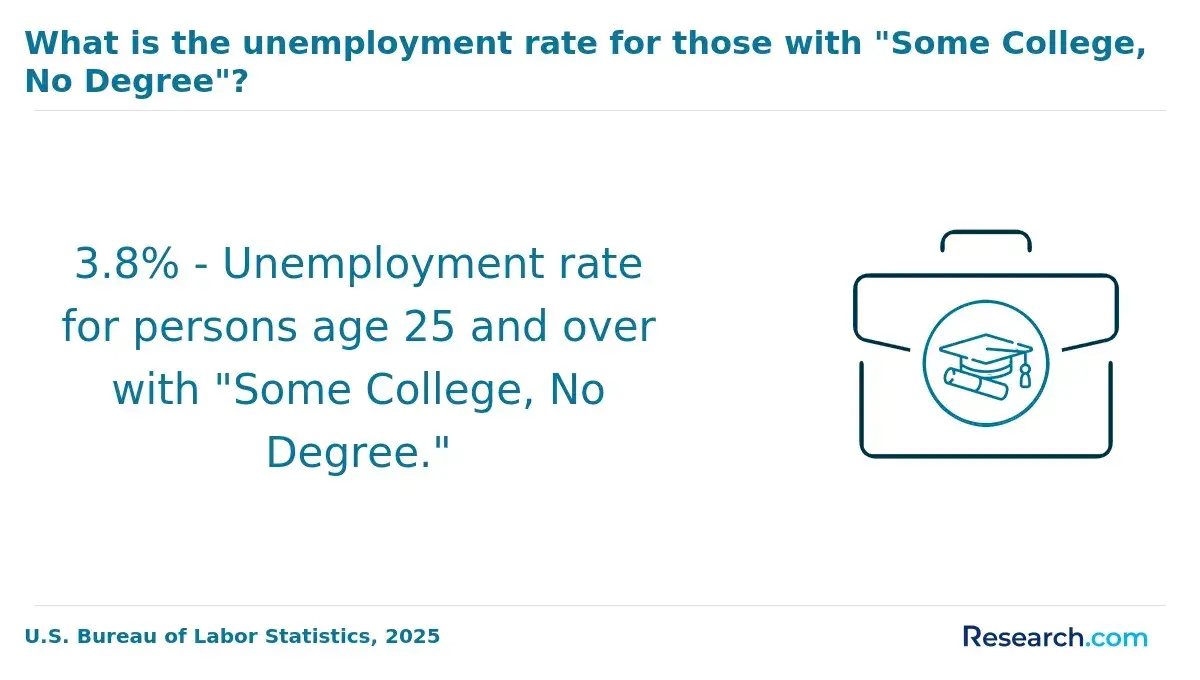
BLS 2024 data shows workers with a bachelor's degree had median weekly earnings of $1,543, compared with $1,057 for those with some college but no degree. This guide explains program fit, costs, benefits, accreditation, careers, and red flags so you can compare options with less guesswork.
Key Things You Should Know
- Veterans should prioritize regionally accredited programs that award ACE/JST credit, have a VA certifying official, and publish clear GI Bill and Yellow Ribbon policies before enrollment.
- For 2024-25, the Post-9/11 GI Bill private and foreign school tuition cap is $28,937.09, while the maximum Federal Pell Grant is $7,395; these figures make total cost, not sticker tuition alone, the key comparison point.
- A general studies degree is most useful when paired with focused electives, certificates, internships, or prior military experience because employers usually hire for demonstrable skills, not the degree title by itself.
What is an online general studies degree with veteran-friendly funding support?
An online general studies degree is a flexible associate or bachelor's program that combines core general education with electives across areas such as business, communication, humanities, social science, technology, public administration, and leadership. It is designed for students who have varied prior credits or career goals that do not fit neatly into one traditional major.
For veterans and military-connected students, "veteran-friendly funding support" usually means the school is approved for VA education benefits, has staff trained in military benefits, reviews Joint Services Transcript credits, participates in federal student aid, and may offer military tuition rates or Yellow Ribbon support. The best fit is not simply the cheapest program; it is the program that accepts the most applicable transfer credit while still supporting your next job or graduate-school goal.
This degree can make sense if you already have credits from multiple schools, completed military training evaluated by the American Council on Education, or need a broad bachelor's credential for promotion. It may be less ideal if your target job requires a specialized major, state licensure, a lab-based curriculum, or a tightly sequenced technical program.
Students comparing flexible online degrees should look beyond convenience and ask whether the curriculum creates a coherent skills story for employers. A veteran with logistics experience, for example, may build a general studies plan around operations, business writing, analytics, and project management instead of taking unrelated electives.
How do online general studies programs compare to campus options for military and veteran students?
Online and campus general studies programs can lead to the same degree when they are offered by the same accredited institution, but the student experience differs. For military and veteran learners, the biggest differences are scheduling flexibility, housing allowance rules, campus support access, and how easily the program accommodates deployments, work shifts, caregiving, or disability-related needs.
The table below summarizes the practical trade-offs. Use it to decide whether the online format supports your life circumstances or whether a campus or hybrid option gives you better structure and benefits.
| Comparison point | Online general studies | Campus general studies | Best fit |
| Schedule | Often asynchronous or evening-friendly | Set class times and on-campus attendance | Online is stronger for working adults, caregivers, and active-duty students |
| Military mobility | Easier to continue after relocation | May require local attendance | Online is usually better for PCS moves or uncertain schedules |
| Peer and faculty interaction | Discussion boards, video meetings, virtual advising | In-person advising, clubs, veterans centers, and networking | Campus is stronger for students who need face-to-face structure |
| VA housing allowance | Online-only enrollment may reduce the housing allowance | In-person enrollment can qualify for locality-based housing rates if eligible | Campus or hybrid may be financially better for some GI Bill users |
| Support services | Depends heavily on virtual advising quality | More visible on-campus offices and events | Either can work if support is proactive and veteran-specific |
Online programs are increasingly normalized, but format still matters. If your goal is speed, an accelerated online bachelor's degree may be attractive; if your goal is maximizing the Post-9/11 GI Bill housing allowance, compare online-only, hybrid, and in-person enrollment carefully before committing.
Which accredited schools offer online general studies degrees with strong veteran benefits?
Many accredited public, private nonprofit, and private institutions offer online general studies or closely related interdisciplinary degrees. The examples below are not a ranking; they illustrate the kinds of schools veterans often compare because they combine online delivery with military or veteran support infrastructure.
When reviewing schools, verify current program names, tuition, VA approval, Yellow Ribbon participation, and transfer-credit rules directly with the institution and the VA before enrolling.
| School | Relevant online degree option | Accreditation context | Veteran-support features to verify |
| University of Maryland Global Campus | Online general studies and career-focused bachelor's pathways | Regionally accredited | Military advising, VA benefit processing, military-affiliated tuition, transfer credit review |
| Indiana University Online | Bachelor of General Studies | Regionally accredited | Veterans services, transfer-credit evaluation, online advising, VA education benefit support |
| Fort Hays State University | Online Bachelor of General Studies | Regionally accredited | Affordable public tuition, military-connected student services, VA benefit certification |
| Eastern Kentucky University | Online Bachelor of General Studies | Regionally accredited | Veteran services, credit for prior learning, online student support |
| Southern New Hampshire University | Online Bachelor of Arts in General Studies | Regionally accredited | Military tuition policies, transfer-friendly structure, VA benefit support |
| Liberty University | Online interdisciplinary or general studies-related pathways | Regionally accredited | Military tuition discounts, Yellow Ribbon participation, military affairs office |
A strong veteran-friendly school should be able to explain how many of your credits apply to the degree before you enroll. Be cautious if a school gives enthusiastic verbal estimates but will not provide a written degree audit, transfer evaluation, or clear remaining-credit plan.
What admission requirements do online general studies programs typically have for veterans and adult learners?
Admissions requirements for online general studies programs are usually more flexible than those for highly sequenced majors, but they still vary by degree level and institution. Veterans and adult learners should expect the school to review academic history, identity, benefit eligibility, and transfer documents before a final enrollment plan is created.
Most applicants should prepare the following materials early because missing documents can delay admission, transfer evaluation, and VA certification:
- High school transcript, GED documentation, or prior college transcript, depending on the program level and transfer status.
- Official transcripts from every college previously attended, including schools where credits were attempted but not completed.
- Joint Services Transcript, Community College of the Air Force transcript, or other military training records when applicable.
- DD Form 214, Certificate of Eligibility, or other benefit documentation requested by the school's veterans office.
- Placement information or prior coursework in writing and math if the school uses it to determine readiness for college-level classes.
- Personal statement or advising questionnaire if the program requires students to define an academic concentration or career direction.
Test scores are often optional for adult learners, especially in transfer-friendly online programs. However, admission is not the same as degree applicability: a school may admit you with many prior credits but count only some of them toward graduation. That distinction is one of the most important questions for veterans with mixed military, community college, and prior university coursework.
A practical approach is to request an unofficial estimate first, then wait for an official evaluation before using benefits. If the remaining degree plan is much longer than expected, compare another school before you spend GI Bill entitlement or take federal loans.
How long do online general studies degrees take, and what do they cost with military benefits?
Completion time depends mainly on how many credits transfer, whether the program is associate or bachelor's level, and how many courses you can take each term. A bachelor's degree usually requires about 120 semester credits, but veterans with prior college and ACE-recommended military credit may need fewer credits at the enrolling institution.
Recent national pricing data helps frame the decision. College Board's 2024 pricing data lists average published tuition and fees of $11,610 for in-state students at public four-year institutions and $43,350 at private nonprofit four-year institutions for 2024-25. Online tuition may be lower, similar, or higher than campus tuition, so veterans should compare the full bill after transfer credit and benefits rather than relying on institutional category alone.
- Average in-state public four-year tuition and fees for 2024-25: $11,610
- Average private nonprofit four-year tuition and fees for 2024-25: $43,350
- Post-9/11 GI Bill private and foreign school tuition cap for 2024-25: $28,937.09
- Maximum Federal Pell Grant for 2024-25: $7,395
The table below shows how timeline and cost pressure can change based on starting point. It is meant to help you estimate the kind of enrollment scenario to discuss with admissions and financial aid, not to predict an exact bill.
| Starting point | Typical remaining path | Cost and funding implications | Decision note |
| No prior college credit | About four years full time for a bachelor's degree | GI Bill entitlement may not cover every term if enrollment is extended or interrupted | Consider community college transfer or associate-to-bachelor planning |
| Military training and some college | Often shortened if credits apply to requirements | Largest savings come from credits that replace required courses, not just elective credit | Insist on a written degree audit before committing |
| Associate degree completed | Often about two years full time for a bachelor's completion program | Benefits may stretch further if the school has a generous transfer agreement | Check whether lower-division general education is fully satisfied |
| Many scattered credits | Could be fast or inefficient depending on applicability | A flexible general studies curriculum may reduce excess-credit loss | Compare at least two transfer evaluations |
Also budget for books, technology fees, graduation fees, exam proctoring, and possible course materials not covered by a tuition-only estimate. For loan borrowers, the 2024-25 federal undergraduate Direct Loan interest rate is 6.53%, which makes avoiding unnecessary credits especially important.
What core curriculum and electives are included in most online general studies programs?
Most online general studies programs combine a broad liberal arts foundation with a customizable concentration or elective block. The degree is flexible, but the strongest plans are intentionally designed around a career theme, graduate-school prerequisite, or promotion requirement.
A typical curriculum may include these components, though exact requirements vary by school:
- General education courses in written communication, quantitative reasoning, natural science, social science, humanities, and information literacy.
- Upper-division interdisciplinary courses that require students to connect ideas across fields and apply research or problem-solving methods.
- Elective clusters in areas such as business, psychology, criminal justice, communication, public service, leadership, technology, or foreign language.
- Career-focused assignments such as portfolios, capstone projects, applied research papers, presentations, or workplace problem analyses.
- Transfer-credit or prior-learning credits that may satisfy elective, general education, or lower-division requirements.
Veterans should avoid treating the elective block as a place to collect random credits. A better strategy is to create a concentration that translates military experience into civilian language, such as logistics and operations, organizational leadership, emergency management, human services, or business administration.
Language and cultural skills can also strengthen a broad degree, especially for public service, education support, intelligence-adjacent civilian roles, and global business settings. If that direction fits your goals, comparing options such as a bachelors in Spanish online can help you decide whether a full language major or a general studies degree with language electives is the better fit.
How do GI Bill, Yellow Ribbon, and other veteran education benefits work for these programs?
Veteran education benefits can significantly change the net cost of an online general studies degree, but they are not automatic discounts. Benefits are governed by VA rules, institutional participation, enrollment intensity, program approval, and your remaining entitlement.
The major funding sources work differently, so it is important to understand what each one may cover before you enroll:
- Post-9/11 GI Bill: May cover tuition and fees up to applicable limits, plus a books stipend and monthly housing allowance for eligible students; online-only housing rates can differ from in-person rates.
- Yellow Ribbon Program: Helps eligible students cover tuition and fee costs above the Post-9/11 GI Bill cap at participating schools, subject to school-specific contribution limits and availability.
- Montgomery GI Bill: Provides a monthly education payment to eligible veterans, but tuition is paid by the student unless other aid is used.
- Veteran Readiness and Employment: May support education for eligible veterans with service-connected disabilities when the program fits an approved employment plan.
- Tuition Assistance: May apply to eligible active-duty, Guard, or Reserve students, but rules differ by service branch and can interact with other benefits.
- Federal student aid and scholarships: Pell Grants, loans, institutional scholarships, and state benefits may help fill gaps, but coordination with VA benefits matters.
The key question is not simply "Does the school take the GI Bill?" A better question is whether the specific online general studies program is VA-approved, whether your enrollment level will preserve the benefits you expect, and whether Yellow Ribbon or institutional aid applies to online students in the same way it applies to campus students.
Before using benefits, ask the school's veterans office to estimate tuition, required fees, benefit coverage, expected out-of-pocket cost, and remaining entitlement after the term. Also ask what happens financially if you withdraw, pause enrollment, fail a course, or change programs, because benefit overpayments and repeated courses can create avoidable problems.
What career paths and entry-level roles can a general studies degree support?
A general studies degree can support many entry-level and advancement-oriented roles, but it is not a direct pipeline into one occupation the way nursing, accounting, engineering, or teacher licensure programs can be. Its value depends on how well your electives, military background, internships, certifications, and resume align with employer needs.
The table below shows common civilian directions where a broad degree can be useful, especially when paired with relevant experience or targeted coursework.
| Career direction | Common entry-level or advancement roles | Relevant general studies focus | What employers usually look for |
| Business operations | Operations coordinator, administrative manager trainee, project coordinator | Business, analytics, communication, leadership | Process improvement, reporting, scheduling, vendor coordination |
| Public service | Program assistant, case coordinator, government services specialist | Public administration, social science, writing, ethics | Policy awareness, documentation, client service, compliance |
| Human resources and training | HR assistant, training coordinator, workforce development assistant | Psychology, communication, organizational leadership | People skills, confidentiality, onboarding, presentation ability |
| Sales and customer success | Account coordinator, customer success associate, sales operations assistant | Communication, business, data literacy | Relationship management, CRM tools, problem-solving |
| Security, logistics, and emergency services administration | Logistics coordinator, emergency management assistant, security operations coordinator | Criminal justice, emergency management, operations, leadership | Military experience, planning, documentation, chain-of-command fluency |
Veterans who want a clearer business pathway may compare a general studies degree with a more specialized option such as the cheapest online business management degree. General studies is often better for maximizing transfer credits, while business management may be better when the target roles explicitly prefer business coursework.
AI and automation are also changing how employers evaluate broad-degree graduates. Routine administrative tasks are increasingly supported by software, so students should build durable skills such as data interpretation, writing, project coordination, ethical judgment, and cross-functional communication.
What salary expectations and job outlook are common for general studies graduates?
Salary outcomes for general studies graduates vary widely because the degree can lead into different industries. A graduate entering nonprofit program coordination, sales, logistics, HR support, or government administration will face different pay ranges, advancement timelines, and local labor markets.
The most useful national benchmark is educational attainment rather than a single "general studies salary." BLS 2024 data reports median weekly earnings of $1,543 for workers with a bachelor's degree, compared with $1,099 for associate degree holders and $1,057 for workers with some college but no degree. This does not mean a general studies graduate will earn that amount, but it shows why completing the bachelor's credential can matter for roles that screen applicants by degree level.
Job outlook should also be interpreted by target role, not by major name. BLS projections released in 2024 show overall U.S. employment is projected to grow from 2023 to 2033, but growth differs sharply by occupation. Business, data, healthcare administration, public service, and technology-adjacent roles may have different demand patterns than general office support roles that are more exposed to automation.
Use salary data carefully. Location, security clearance, supervisory experience, industry, union coverage, federal grade level, remote-work competition, and certifications can all affect compensation. Veterans may improve their outlook by pairing the degree with a focused resume, measurable achievements, civilian-recognized credentials, and internships or SkillBridge-style transition experiences when available.
How can veterans choose a reputable, military-supportive online general studies program?
A reputable online general studies program should help you complete a coherent degree, use benefits responsibly, and leave with skills you can explain to employers. The strongest programs are transparent before enrollment, not just supportive after you have committed.
Use the following steps to compare programs before you apply or use VA entitlement:
- Confirm institutional accreditation through an official accreditation database and make sure the specific program is eligible for federal aid and VA benefits.
- Request a written transfer-credit evaluation showing which credits satisfy general education, major, elective, and residency requirements.
- Ask whether ACE-recommended military credit is accepted, how the Joint Services Transcript is evaluated, and whether credits apply beyond free electives.
- Compare total remaining cost after tuition, required fees, books, technology costs, benefit caps, Yellow Ribbon support, grants, and scholarships.
- Ask for online student outcomes, retention support, career services access, and examples of capstone or portfolio work.
- Check whether the school has a dedicated veterans office, VA certifying official, disability services, mental health support, and flexible deployment or stop-out policies.
- Build a degree plan around a career theme and confirm that electives support the roles you want after graduation.
Common red flags include pressure to enroll before transfer credits are evaluated, vague claims about "military friendly" status without specific services, unclear tuition and fee schedules, poor responsiveness from the veterans office, limited online advising, and promises of job placement or salary outcomes. A school can be legitimate and still be a poor fit if it wastes too many of your prior credits.
The best choice is usually the program that balances accreditation, low net cost, maximum applicable transfer credit, strong benefit processing, and a curriculum you can turn into a credible career story. If two schools look similar, choose the one that gives you the clearest written plan before asking you to spend benefits or borrow.
Other Things You Should Know About General Studies
Yes. Most accredited online general studies programs accept VA education benefits, including the Post-9/11 GI Bill and the Montgomery GI Bill, if the school is approved by the U.S. Department of Veterans Affairs. To use benefits, veterans usually submit a VA Certificate of Eligibility and the school’s certification office reports enrollment each term.
A general studies degree can enhance veterans' military leadership skills by broadening their expertise in diverse subjects. This flexibility allows them to integrate prior leadership experience with new knowledge, making them more versatile in civilian careers.
They are closely related but not always identical. General studies is often highly flexible, liberal studies may emphasize humanities and social sciences, and interdisciplinary studies may require a planned concentration across multiple fields. Always compare the actual curriculum.
Yes, it can help convert experience into a bachelor's credential for jobs that require a degree. To make it more marketable, align coursework with leadership, operations, communication, analytics, or public administration instead of taking unrelated electives.
References
- Online Degrees for Veterans: Why Flexible Learning is a Great Fit https://www.ucumberlands.edu/blog/benefits-of-online-degrees-for-veterans
- Trident Serves Those Who Serve Our Country https://www.trident.edu/military-and-veteran/veterans/
- General Studies Degree Jobs: 10 Careers + Salaries (2026) | Extern https://www.extern.com/post/general-studies-degree-jobs-career-guide
- Yellow Ribbon vs. Post-9/11 GI Bill: Understanding the Difference | Jobs for Veterans | G.I. Jobs https://www.gijobs.com/education/yellow-ribbon-vs-post-911-gi-bill/
- General Studies Degree Programs https://www.dean.edu/academics/majors-degrees/general-studies/
- Future Career Outlook: General Studies Degree | ALU https://alu.edu/alublog/future-career-outlook-general-studies-degree-alu/
- The Yellow Ribbon Program: A Comprehensive Guide for Veterans https://valoannetwork.com/the-yellow-ribbon-program/
- Online Bachelor's Degree: General Studies https://www.umgc.edu/online-degrees/bachelors/general-studies
- The Best Military Friendly Online Colleges & Universities https://www.learnhowtobecome.org/online-universities-and-colleges/military/
- Affordable College Options for Veterans: The Best Ways to Maximize Education Benefits and Save Money on Your Degree https://www.straighterline.com/blog/affordable-college-options-for-veterans-how-to-maximize-your-education-benefits-and-save-money-on-your-degree