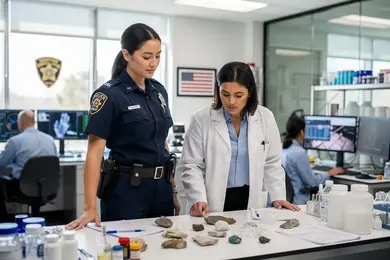
2027 Online Criminal Justice Degrees for Students Who Want Federal Justice Careers

Co-Founder and Chief Data Scientist
Federal justice careers demand navigating complex hiring landscapes where timing and flexibility can determine access to scarce entry-level roles. Many aspiring agents and analysts juggle work, family, and training, yet 53% of adult learners enrolled in online programs in 2024 according to NCES data, signaling a shift toward education that accommodates nontraditional schedules.
This shift matters because rigid on-campus formats often delay career advancement, while well-structured online criminal justice degrees offer strategic acceleration without sacrificing credential integrity.
This article evaluates these online options, focusing on program flexibility, federal hiring realities, and how students can optimize their education timeline for federal justice employment.
Key Things You Should Know
- Federal agencies prioritize candidates with degrees featuring specialized federal law coursework; however, programs emphasizing broad criminal justice theories often delay job qualification, raising average federal entry-age to 27, per USAJobs data.
- Employers in federal justice sectors increasingly require combined credentials, such as Cybersecurity minors or language proficiencies, reflecting DOJ workforce diversification reported by OPM, forcing students to invest extra semesters for competitive advantage.
- Cost barriers intensify as nearly 65% of students financing degrees via loans face repayment hurdles given median federal criminal investigator salaries only rising 3% since 2022, a gap detailed in BLS occupational wage reports.
What is an online criminal justice degree and how can it lead to federal justice careers?
An online criminal justice degree programs for federal careers offer foundational knowledge and targeted skills aligned with the expectations of federal agencies, but they present tradeoffs in access and practical preparation.
While these programs enable working professionals to integrate their current roles with specialized coursework, such as forensic science, criminal law, and cybersecurity, they require careful selection to ensure course content and internships meet stringent federal standards.
Federal justice career paths with an online criminal justice degree often demand more than academic credentials. They emphasize competencies in data analysis, federal statutes, ethics, and report writing—skills that must be demonstrable during hiring processes. For instance, federal criminal investigators must apply critical thinking within complex regulatory frameworks, a capability sharpened through applied training embedded in some online curricula but less accessible without campus-based networking.
Job candidates also face challenges like securing federally recognized internships and navigating security clearance requirements, factors often complicated for remote learners. Regardless, median federal salaries ranging from $64,520 to $96,730 reflect a tangible incentive to pursue these careers, conditional on supplemental hands-on experience and credential alignment with agency protocols.
Prospective students weighing online options should review program rigor and practical training scope to avoid credential mismatches that can delay or derail employment. This practical perspective is distinct from promotional viewpoints and essential when targeting federal law enforcement roles.
Additional insight into the operational realities can be found by exploring the specific competencies needed in a profiler job.
Which types of criminal justice degrees best qualify students for federal justice jobs?
In federal hiring for justice careers, degrees in forensic science and criminology diverge sharply in practical value and target roles. Forensic science degrees equip candidates with specialized scientific training, chemistry, biology, crime scene techniques, that align closely with technical positions, such as forensic science technicians whose employment is projected to grow 14% by 2033, far outpacing average job growth.
Conversely, criminal justice degrees focus more broadly on law enforcement, policy, and administrative competencies, providing a foundation better suited for managerial or investigative roles within federal agencies.
Federal employers increasingly prioritize hands-on experience tied to relevant degrees. Forensic science graduates with internships at government or forensic labs enjoy a competitive advantage for technical roles compared to general criminal justice majors lacking practical exposure.
Meanwhile, those pursuing federal law enforcement field positions benefit from curricula emphasizing operational skills and federal statutes, a consideration critical when evaluating online criminal justice degree programs for federal careers.
The choice between forensic science and criminal justice degrees hinges on whether one prioritizes technical specialization or broader administrative latitude. Specialized forensic degrees face a narrower yet higher-demand labor market, whereas criminal justice degrees serve a wider spectrum but contend with larger applicant pools. Prospective students, including those exploring degrees felons can get, should weigh these tradeoffs in the context of their career aims.
How do online criminal justice programs compare to campus-based options for federal careers?
Online criminal justice programs often match campus-based degrees in core content but fall short on critical practical experiences valued by federal employers. Agencies seeking candidates for roles requiring security clearances prioritize applicants with verified internships, ride-along experiences, or hands-on simulations, which are more accessible through campus-based programs.
For example, a prospective federal detective leveraging campus alumni networks can gain agency contacts and insight into interdepartmental collaboration far more quickly than a remote learner. This gap creates a hiring disadvantage for those relying solely on online education without supplemental in-person exposure.
Tuition at public four-year colleges has increased roughly 12% (inflation-adjusted) from 2019 to 2024, yet starting salaries for criminal justice graduates have grown faster, promoting a nuanced cost-benefit calculation. Students eyeing federal pathways must weigh lower online tuition against the necessity of securing local internships or federal work-study to remain competitive. The best federal career pathways through online criminal justice degrees hinge on integrating theoretical learning with practical, local experience.
Hiring criteria emphasize:
- Verification of law enforcement internships or field exercises
- Familiarity with federal protocols and technology
- Security clearance eligibility requiring physical presence during background checks
Those pursuing online degrees should proactively seek hands-on opportunities to offset inherent networking limitations. For a thorough comparison of cost-efficient options balancing affordability and degree quality, consult the best online colleges for forensic science.
What accreditation should online criminal justice programs have for federal employment eligibility?
Federal employment eligibility for criminal justice roles hinges on strict accreditation standards that many online programs overlook. A degree from an institution lacking accreditation recognized by the U.S. Department of Education, such as the Higher Learning Commission (HLC), Middle States Commission on Higher Education (MSCHE), or Southern Association of Colleges and Schools (SACS), can result in automatic disqualification during federal background checks. This is a critical filter, not merely a bureaucratic hurdle.
Choosing an online criminal justice program accreditation for federal jobs requires more than checking a logo; it means confirming the curriculum aligns with law enforcement procedures, criminal law, and investigative practices valued by federal agencies. Candidates who neglect this alignment risk wasted time and money, as unsupported degrees do not meet clearance or promotion thresholds.
With projections of 63,000 police and detective positions opening nationwide, demand is high but the path is exacting. Accredited online criminal justice degrees for federal employment ease transitions into these roles, addressing both eligibility and market competitiveness. Conversely, graduates from nonaccredited or narrowly accredited providers often confront dead ends.
Prospective students should weigh these realities carefully, especially if pursuing accelerated options such as a fast track architecture degree reflects a growing trend in compressed educational timelines that criminal justice applicants might also consider-provided accreditation and curriculum rigor remain intact.
What courses and specializations prepare online students for careers in federal justice agencies?
Federal justice careers demand a precise educational focus that balances technical knowledge and applied skills relevant to agencies like the FBI, DEA, and U.S. Marshals. Prioritizing core subjects such as constitutional law, federal criminal procedure, forensic science, and cybercrime investigations is essential, as these underpin day-to-day functions within federal environments.
Specializations in homeland security, federal corrections, or intelligence analysis provide targeted expertise but may narrow eligibility if students overlook foundational competencies.
Practical skills, like report writing, case management, and evidence handling, are often decisive in hiring for roles like probation officers or correctional treatment specialists. For example, an online juvenile justice track with federal internship opportunities can better prepare candidates to influence parole decisions in youth offender programs, blending theory with simulated or real-world case experience.
Tradeoffs emerge when balancing broad criminal justice knowledge against program length and cost: narrowly focused curricula accelerate entry into federal roles but risk gaps in accreditation and flexibility. Employment projections suggest steady demand, with probation officers earning an average of $64,520 and a 4% growth rate through 2033, yet clearance requirements and subsequent certifications complicate straightforward career transitions.
Ultimately, students should critically assess program accreditation, applied learning components, and explicit alignment with federal standards to optimize federal hiring prospects and minimize costly retraining or extended credentialing after graduation.
What are typical admission requirements for online criminal justice degrees aimed at federal careers?
Federal criminal justice roles demand more than passing academic thresholds; applicants must demonstrate sufficient foundational knowledge and ethical reliability early in admissions.
Programs targeting these careers typically require a high school diploma or GED, with bachelor's or advanced degrees often necessitating prior college credits or prerequisite coursework. Official transcripts generally reflect a minimum 2.5 to 3.0 GPA, a standard that balances academic rigor with practical accessibility.
Standardized test scores (SAT/ACT) may remain part of the undergraduate entry process but are frequently waived for candidates with relevant work experience or prior college history, recognizing varied pathways into the field.
Importantly, federal employment prospects hinge on successful background checks and drug screenings, which makes disclosure of legal history during admission a vital step. Letters of recommendation and personal statements emphasize ethical fitness and motivation, critical attributes for handling sensitive federal investigations.
Applicants with military, law enforcement, or government internship experience possess a competitive advantage, especially at the graduate level, where federal hiring benchmarks intensify. Restrictive admissions policies based on citizenship or residency often reflect clearance requirements for federal work, narrowing candidate eligibility.
Given the existence of over 100 accredited U.S. online criminal justice programs by 2025, careful scrutiny of accreditation and curriculum alignment with current federal investigative standards is essential. Prospective students should also consider technology readiness and program-specific prerequisites that influence their path to federal employment.
How long do online criminal justice programs take, and what do they cost overall?
Pursuing an online criminal justice degree requires balancing time, cost, and long-term employability outcomes. Most programs range from 2 to 4 years, with associate degrees typically demanding 60 credit hours and bachelor's degrees around 120.
Accelerated paths can reduce these periods to as little as 18 months for associate-level or three years for bachelor's degrees by utilizing continuous terms and transfer credits. For working professionals targeting federal investigative roles, part-time study is common but lengthens completion times.
Cost variations hinge on institution type and credit rates: community colleges charge roughly $150-$300 per credit, resulting in associate degrees costing $9,000-$18,000; public universities charge $300-$600 per credit for bachelor's programs, totaling $36,000-$72,000; private institutions often exceed $90,000. Graduate degrees range between $20,000 and $50,000+. Additional expenses for books, technology, and certification exams should factor into budgeting.
Federal investigative employers generally require a bachelor's degree as a minimum, which positions candidates competitively in a moderately growing job market projected at 5% growth over the next decade. Roughly 3,600 annual openings reflect steady demand but underscore competitive hiring pressures.
Students must weigh the upfront investment in time and money against the concrete necessity of credential requirements and the realities of federal hiring practices to make strategic educational decisions.
What federal justice career paths can graduates pursue and what are the main job roles?
Federal criminal justice careers demand more than academic credentials; successful candidates must navigate stringent physical, psychological, and background clearance barriers. For instance, FBI special agents require a rare blend of investigative rigor, federal jurisdiction knowledge, and geographic flexibility, often relocating to Washington, D.C., or regional field offices. These roles prioritize specialized skills that go beyond a general criminal justice degree.
Similarly, federal probation officers and correctional treatment specialists manage complex caseloads requiring law, psychology, and case management expertise. Their work environment is less field-intensive but involves persistent social and behavioral challenges.
Forensic science technicians stand out as a financially attractive path, with median salaries well above the national average, reflecting the technical proficiency in chemistry and biology needed to process evidence in federal laboratories. Advancement here leans heavily on certification and continual skill refinement rather than rank progression typical in enforcement roles.
Other federal positions such as intelligence analysts and cybersecurity specialists require additional technical training. Candidates should weigh these requirements carefully, understanding that a general criminal justice degree may not suffice without supplementary certifications.
Key considerations for students include understanding multi-month hiring pipelines, the impact of relocation on personal stability, and meeting physical and security clearance standards. Strategic internship selection and skill development aligned with targeted roles can significantly improve hiring outcomes.
What salary ranges and benefits can criminal justice graduates expect in federal positions?
Federal criminal justice positions typically start between $48,000 and $65,000 annually, with specialized or investigative roles aligned to GS levels 11 or 12 offering closer to $53,000-$79,000. Experienced agents and officers can exceed $100,000, but navigating federal hiring requires accommodating extended security clearances and application timelines that often delay onboarding by months.
For example, candidates applying to agencies like the FBI or U.S. Marshals Service must consider both credential requirements and the advantage of internships or military experience, which significantly improve hiring prospects amid thousands of USAJOBS listings favoring relevant degrees.
Benefits form a critical component of total compensation, often offsetting base salary disparities with the private sector.
Federal roles provide:
- Comprehensive health coverage with multiple plan options and subsidized premiums.
- Robust retirement packages including defined benefits and Thrift Savings Plan contributions.
- Paid leave comprising annual, sick, and up to 13 federal holidays.
- Extra pay opportunities such as overtime and law enforcement availability pay.
Private sector positions may offer higher upfront pay but typically lack the long-term security and benefits federal employment guarantees. Prospective students and professionals must weigh these tradeoffs carefully, factoring in job stability, benefits, and hiring hurdles when planning educational investments or career pivots in criminal justice.
How can students evaluate and choose a reputable online criminal justice program for federal careers?
Federal hiring standards impose specific constraints on online criminal justice degrees, primarily requiring regional accreditation and curriculum rigor verified by recognized bodies like the Council for Higher Education Accreditation. Candidates for roles such as police officers or forensic science technicians must navigate programs that incorporate practical components, synchronous labs, virtual simulations, or federal partnerships, because many degrees lack the applied experience federal agencies demand.
Employment forecasts vary distinctly by specialization, with forensic science technician roles growing faster (14%) compared to a modest 4% for police and probation officers (U.S. Bureau of Labor Statistics). This necessitates deliberate program selection aligned with workforce realities.
For example, students focused on forensic careers must prioritize STEM-heavy curricula with robust lab access, while probation specializations require legal and rehabilitative coursework.
Security clearances present another hurdle, as clearance eligibility often ties to program reputation and federal affiliations. Degree programs linked to U.S. Department of Justice advisory committees or federal training centers better facilitate clearance processes. Important due diligence includes evaluating alumni federal employment rates and faculty experience in federal roles.
Balancing cost and time-to-completion is crucial for working professionals. Accelerated tracks or credit for prior law enforcement service reduce career pivot time but may trade off comprehensive practical experience, increasing risk in competitive federal hiring scenarios. Delivery flexibility and state authorization also materially impact candidates who must maintain federal eligibility while transferring credits or working across jurisdictions.
Other Things You Should Know About Criminal Justice Degrees
Internship opportunities for online criminal justice degree students in federal justice careers include placements with agencies like the FBI, DEA, or DHS. These internships often provide practical experience and can enhance job prospects upon graduation, typically requiring applications a year ahead.
Graduates can pursue entry-level roles with the FBI, U.S. Marshals Service, Secret Service, ATF, DEA, and Department of Homeland Security. Most competitive federal jobs require U.S. citizenship, a background investigation, and, for many positions, a bachelor’s degree from an accredited program completed by graduation.
Broad criminal justice programs may provide foundational knowledge but can leave graduates underprepared for agency-specific procedures and policies critical to federal roles. Programs focusing on federal law enforcement frameworks, national security issues, and interagency cooperation better align graduate skills with employer expectations. Students targeting federal agencies should prioritize curricular content that develops expertise in federal statutes, investigative techniques, and federal agency cultures to maximize employability.
References
- Salary Guide for Criminal Justice Professionals in New York https://www.allcriminaljusticeschools.com/criminal-justice/criminal-justice-salaries/new-york/
- Online Criminal Justice Degree & Career Information https://www.criminaljustice.com/online-degrees/
- Earning a Criminal Justice Degree Online | University of Bridgeport https://www.bridgeport.edu/news/earning-a-criminal-justice-degree-online/
- Jobs with a degree in Criminal Justice | Monroe University https://www.monroeu.edu/academics/undergraduate-programs/school-criminal-justice/what-can-you-do-criminal
- Top Online Criminal Justice Degree and Other FBI Degree Programs https://www.fbiagentedu.org/online-degrees/
- Find Top Online Bachelor's In Criminal Justice Programs https://www.accreditedschoolsonline.org/criminal-justice/bachelors/
- Criminal Justice Salary Guide: What Every Career Actually Pays in 2026 https://policeofficer.org/criminal-justice-salary/
- Online Bachelor’s Degree in Criminal Justice | Warner Pacific https://www.warnerpacific.edu/programs/criminal-justice/
- Earn An Online Criminal Justice Degree | OEDb.org https://www.oedb.org/rankings/online-criminal-justice-programs/