2027 AI Bachelor's Degree Programs With Foundation Semesters

Co-Founder and Chief Data Scientist
Many individuals with undergraduate degrees outside STEM fields encounter substantial barriers when seeking to enter the artificial intelligence industry. A lack of foundational knowledge in programming, math, and data science often delays or derails career pivots. Traditional degree programs typically demand prior expertise, limiting accessibility for career changers and working professionals.
Foundation semester programs embedded within AI bachelor's degrees offer a crucial solution by providing essential preparatory coursework. This article explores the available AI bachelor's degree programs that include foundation semesters, highlighting flexible, accredited pathways tailored to equip students from diverse academic backgrounds for success in the competitive AI job market.
Key Things You Should Know
- Many 2026 AI bachelor's programs include foundation semesters to ensure students acquire essential math and programming skills for advanced AI coursework.
- Foundation semesters boost retention rates by up to 20%, particularly benefiting students without prior coding experience or STEM backgrounds.
- Institutions increasingly align foundation semester curricula with industry needs, preparing graduates for roles in AI development, data analysis, and machine learning engineering.
What is a foundation semester in AI bachelor's degree programs?
A foundation semester in AI bachelor's degree programs serves to equip students with essential skills like mathematics, programming, and critical thinking before advancing to complex topics such as machine learning. This phase addresses academic gaps commonly found in students without a strong STEM background, ensuring everyone starts with a solid base. Typical coursework includes calculus, linear algebra, basic Python coding, and introductory logic.
The purpose of foundation semester in AI studies is to help students build competence early on and reduce risks like course failure or academic probation. These programs often combine theory with practical labs, problem-solving workshops, and assessments to track progress. They also benefit working professionals or career changers seeking to refresh fundamentals after a break from formal education.
According to the National Center for Education Statistics, 41% of first-year undergraduates enroll in at least one remedial course, highlighting the widespread need for foundational study to improve academic outcomes. Institutions may refer to this phase as a preparatory semester or bridge program but maintain the same core goal.
Prospective students should review syllabi and seek advising to understand requirements. For those interested in a quicker route to a degree, exploring a 2 year bachelor degree computer science program may be worthwhile.
Which accredited U.S. colleges offer AI bachelor's programs with foundation semesters?
Several accredited U.S. colleges offer bachelor's degree programs in artificial intelligence that include foundation semesters, designed to prepare students in core STEM subjects. These semesters typically cover mathematics, programming fundamentals, and computing principles before moving into specialized AI coursework. Notable institutions such as the University of Central Florida and Northeastern University provide structured foundation semesters to ensure students meet rigorous entry requirements.
Foundation semesters serve to bridge gaps for students without previous computer science experience, support career changers, and assist those from diverse academic backgrounds. For example, Northeastern's AI bachelor's program includes a preparatory semester focused on discrete mathematics and introductory coding, providing a solid base before advancing to topics like machine learning and neural networks. Many of the best U.S. universities for Artificial Intelligence bachelor's programs including foundation semesters follow similar patterns to accommodate diverse student needs.
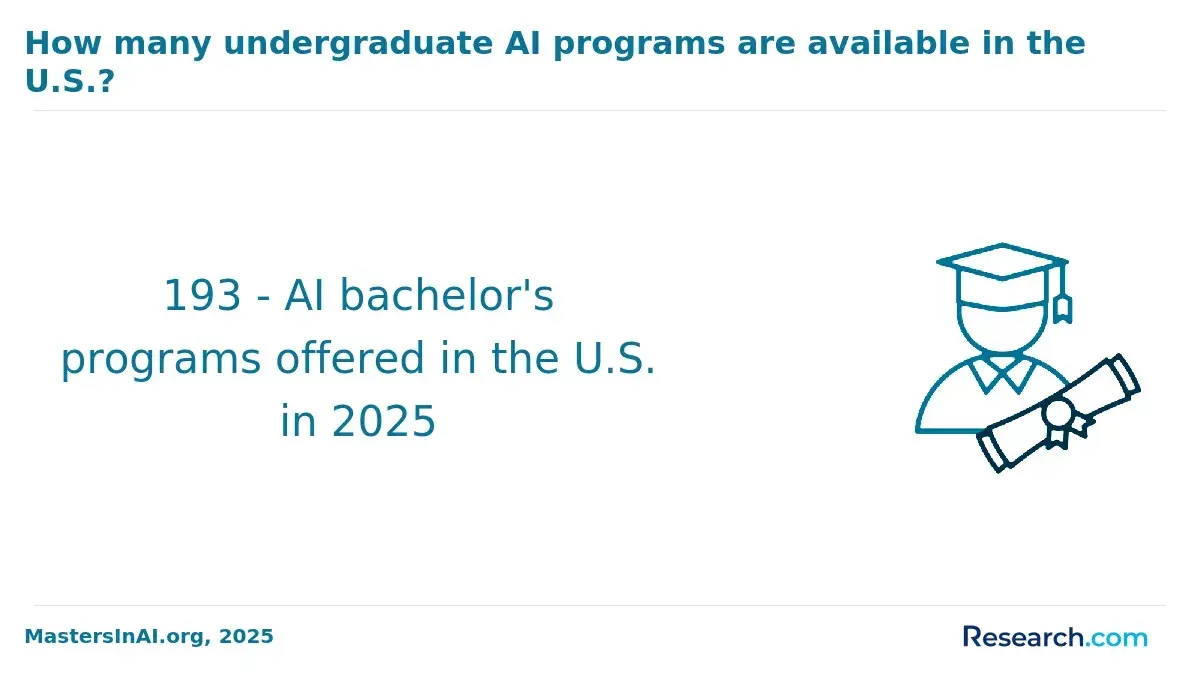
More than 100 U.S. institutions offer an artificial intelligence bachelor's degree listed in the federal College Scorecard dataset, all with accreditation verified by the U.S. Department of Education. Prospective students should use this dataset to confirm program legitimacy and ensure access to federal financial aid. Program requirements vary; some colleges integrate foundation courses into the first year, while others offer separate prerequisite tracks, so reviewing each program carefully is important.
For students comparing options, it's helpful to consider programs with flexible foundation semesters aligned with your background and career goals. Additionally, exploring related fields can broaden opportunities-many students also look into mechanical engineering online degrees as complementary disciplines for tech careers.
How do foundation semesters prepare students for AI coursework and math prerequisites?
Foundation semesters for preparing AI coursework build essential skills in logic, algebra, and analytical thinking, setting a strong base for advanced studies. These courses cover core topics like discrete mathematics, probability, statistics, and linear algebra-subjects crucial to machine learning algorithms, data modeling, and programming concepts in AI. For instance, students learn set theory and functions, fundamental for understanding computation and database structures.
Such courses bridge gaps in math prerequisites for AI bachelor's degree in the United States, helping many students overcome challenges after high school. Through structured practice and problem-solving exercises, learners develop confidence in quantitative reasoning and coding logic, easing their transition to advanced topics like neural networks or natural language processing. Computational thinking, often part of the curriculum, teaches breaking down complex problems, a vital skill in AI system design.
Employers emphasize analytical and critical thinking, cited as the top skill in demand in U.S. job postings according to Lightcast 2024 Talent Trends. Strengthening these skills before diving into AI-specific content enhances both academic success and employability. Students also gain practical experience by applying logical reasoning to real-world AI tasks such as dataset analysis and basic algorithm development.
For those interested in related fields, a game development online degree offers another avenue into technology and programming disciplines.
What courses are typically included in an AI foundation semester curriculum?
A typical ai foundation semester in bachelor's programs prioritizes essential technical and mathematical skills for further study. The curriculum usually begins with introductory programming, primarily Python, recognized as the top programming language in data-science and machine learning job postings. Students learn syntax, data structures, control flow, and relevant libraries for AI applications.
Mathematics courses cover linear algebra, calculus, and discrete math to build the foundation for understanding algorithms and models. Key topics include matrices, vectors, derivatives, and logic, which support machine learning and neural network design.
Statistics and probability classes teach data analysis concepts such as distributions, random variables, and hypothesis testing, enabling students to interpret model outputs and make data-driven decisions.
Some programs introduce basics of computer science, including algorithms, data structures, and computational complexity, which help students grasp software efficiency critical to AI systems.
Introduction to artificial intelligence or machine learning surveys provide overviews of AI history, ethics, and applications. This context is important for understanding challenges in the field. Additional courses may address data management topics like databases and data wrangling, crucial for handling large AI datasets.
The typical curriculum for foundation semester in ai degrees helps students build coding proficiency, mathematical reasoning, and problem-solving skills necessary for advanced AI topics. Students preparing for this rigor might also explore complementary fields like a cyber security degree to expand career opportunities.
What are the admission requirements for AI programs with foundation semesters?
Admission to AI bachelor's degree programs with foundation semesters prioritizes academic preparedness over standardized test scores. Around 80% of U.S. bachelor's institutions weigh high-school GPA heavily, reflecting the importance of strong performance in math and science courses, according to the National Association for College Admission Counseling (NACAC). Foundation semesters support students without direct computer science or advanced math prerequisites, often requiring a minimum GPA between 2.5 and 3.0 and demonstrating steady academic progress.
Many programs have shifted away from SAT/ACT scores; less than half considered these tests for recent admissions, favoring holistic reviews instead.
Typical admission requirements include
- Personal statements outlining interest in AI and career ambitions
- Letters of recommendation focused on academic skills and motivation
- Placement or diagnostic tests to gauge readiness for foundational coursework
- Proof of basic math proficiency, usually algebra
Some programs may also review extracurricular activities or previous programming experience but place greater emphasis on core academic factors.
Requirements can vary-competitive programs might ask for higher GPAs or interviews to vet candidates' potential. Prospective students should consult specific institutions for precise criteria to ensure they meet all expectations for a strong foundation in AI studies.
How long do AI bachelor's programs with foundation semesters take to complete?
AI bachelor's degree programs that include foundation semesters generally take between four and five years to finish. These foundation semesters provide students lacking a strong technical or math background with essential skills in programming, mathematics, and critical thinking, helping them succeed in later AI coursework. This preparatory phase extends the typical four-year timeline but improves knowledge retention and completion rates.
Students enrolled in programs without foundation semesters usually have solid STEM preparation from high school and can complete their degrees in four years. Those needing extra support benefit from foundation courses, which act as an academic on-ramp, reducing dropout risks linked to inadequate preparation.
Data from the National Center for Education Statistics shows only 46% of first-time, full-time bachelor's students graduate within four years at 4-year institutions, highlighting the challenges of on-time completion. Foundation semesters address this by enabling students to build crucial skills early, increasing the chances of finishing within five years.
When planning, students should consider this potential extension and explore options like accelerated foundation semesters or summer courses that shorten duration. Program specifics vary, so verifying available support services and course intensity is important for prospective students.
What are typical tuition costs and financial aid options for these AI programs?
Tuition for AI bachelor's degree programs that include foundation semesters often surpasses average in-state tuition at U.S. public 4-year colleges, which is $11,610 for 2024-25 according to the College Board. The foundation semester extends program length, increasing total costs. Public universities typically charge between $12,000 and $18,000 annually for full-time in-state students, while out-of-state and private institutions may range from $25,000 to $50,000 per year.
Managing these expenses often requires leveraging financial aid such as Pell Grants for eligible low-income students and Direct Loans with fixed interest and income-driven repayment plans. Many colleges provide scholarships based on merit or financial need, including those targeting STEM or AI students to help reduce overall costs.
Additional options include work-study and cooperative education programs that offer income while gaining industry experience. Some employers also sponsor tuition assistance for employees pursuing AI degrees. Investigating state-specific aid relevant to your residency can further ease financial burdens.
Considering net costs after aid is essential. For example, a public college tuition of $15,000 might effectively reduce to $8,000 with grants and scholarships. Financial planning should factor in extended program durations caused by foundation semesters, as these impact living expenses and cumulative loan debt.
Are online AI bachelor's programs with foundation semesters as reputable as campus programs?
Online AI bachelor's programs with foundation semesters are increasingly seen as credible as traditional campus degrees, provided they hold proper institutional accreditation. The format-online or in-person-is less important than the program's accreditation status. According to the National Center for Education Statistics (NCES), over half of U.S. undergraduates enroll in at least one distance-education course, reflecting growing acceptance of online learning.
Foundation semesters in these programs help bridge knowledge gaps for students from non-technical backgrounds by covering essential topics like math, programming, and basic computing. This helps align online coursework with campus standards. For instance, Oregon State University offers an online AI bachelor's degree with foundation courses that mirror their on-campus curriculum.
Employer recognition depends mainly on the institution's reputation and accreditation rather than delivery method. Graduates of accredited online programs typically have access to similar internships, research opportunities, and professional networks as their on-campus peers. While online students may face challenges such as less face-to-face mentorship, tools like virtual labs, interactive forums, and faculty engagement help overcome these barriers.
Prospective students should verify a program's accreditation, review course content for equivalence, and assess support services. Many leading tech employers increasingly prioritize skills and portfolios over whether a degree was earned online or on campus.
What AI jobs can you qualify for after completing these bachelor's programs?
Completing a bachelor's degree in AI with a foundation semester opens up diverse career opportunities in tech sectors. Graduates often pursue roles such as machine learning engineer, data scientist, and AI software developer, all of which demand strong skills in machine learning algorithms, data processing, and programming. A machine learning engineer, for instance, develops models that help computers learn from data-skills honed through hands-on projects during foundational coursework.
Other career paths include AI product management, AI research assistantships, and AI system integration. Product management focuses on bridging AI technology with business needs, utilizing project management and communication skills gained early in the program. Research assistants support ongoing AI studies, relying on theoretical knowledge established in initial semesters.
Practical experience is key. Many programs integrate internships and portfolio work during the foundation semester, enhancing job prospects. The World Economic Forum Future of Jobs Report 2025 noted a 30% rise in machine learning engineer job postings in the U.S., highlighting increasing demand. Graduates must be proficient in tools like Python, TensorFlow, and cloud platforms.
Specialized coursework can lead to careers in natural language processing, computer vision, and robotics, making these degrees a thorough route into AI-driven fields.
What salary ranges and job outlook can AI bachelor's graduates expect in the U.S.?
Graduates with a bachelor's degree in artificial intelligence who complete foundation semesters in the U.S. can expect competitive salaries and strong job growth. Data scientists, a key career path for AI graduates, had a median annual salary of $108,020 as of May 2024, based on U.S. Bureau of Labor Statistics data. Employment in this field is projected to increase by 35% from 2022 to 2032, much faster than the average for all occupations.
Salary ranges depend on experience, geographic location, industry, and specific job roles. Entry-level AI analysts or junior data scientists often start near $70,000 annually, while experienced machine learning engineers and AI research specialists in tech hubs like Silicon Valley and New York can earn over $130,000. Specialized roles in healthcare, finance, and autonomous systems typically offer premium compensation.
Career opportunities extend beyond data science to include AI software engineers, robotics specialists, and AI product managers. A solid foundation in mathematics, programming (especially Python), and data analysis is crucial. Practical skills using machine learning frameworks enhance employability and salary potential.
Staying updated on emerging AI ethics and policy creates additional pathways in regulatory and consultancy roles. According to the U.S. Bureau of Labor Statistics' Occupational Employment and Wage Statistics and Occupational Outlook Handbook, artificial intelligence bachelor's graduates are well-positioned for financial and professional success in this expanding sector.
Other Things You Should Know About Artificial Intelligence
Foundation semesters in AI bachelor's degree programs lay the groundwork for future studies by introducing essential concepts in mathematics, statistics, and computer science. These courses build a robust foundation in critical thinking and problem-solving skills, essential for advanced AI topics and research methodologies.
Mathematics is foundational for AI studies, particularly topics like linear algebra, calculus, statistics, and probability. A strong grasp of these areas enables students to understand machine learning algorithms and data modeling. Foundation semesters often reinforce these math skills to ensure students can keep pace with advanced AI coursework.
Yes, AI bachelor's degrees equip graduates with versatile skill sets applicable to fields such as data science, robotics, software development, and cybersecurity. The interdisciplinary nature of AI means graduates can pursue roles that intersect with software engineering, analytics, and research. This expands career opportunities beyond strictly AI-focused positions.
Many students find the technical rigor challenging, especially mastering programming languages and complex mathematical concepts. Time management can also be difficult due to the demanding coursework and projects. Support services, tutoring, and collaborative learning are important resources to help students navigate these challenges successfully.
References
- Exploring Artificial Intelligence and Machine Learning Courses for Undergraduates https://tetr.com/blog/exploring-artificial-intelligence-and-machine-learning-courses-for-undergraduates
- Artificial Intelligence Course Syllabus: Topics and Modules https://futurense.com/blog/artificial-intelligence-course-syllabus
- The Prerequisites for Artificial Intelligence- IABAC - IABAC https://iabac.org/blog/what-are-the-prerequisites-for-artificial-intelligence-a-modern-approach
- Best Colleges for Artificial Intelligence (AI) Majors — Lantern College Counseling https://www.lanterncollegecounseling.com/insights/artificial-intelligence-ai-as-an-undergraduate-major-what-you-need-to-know
- 16 Artificial Intelligence Career Paths https://www.calmu.edu/news/artificial-intelligence-career-paths
- BSc Artificial Intelligence with Foundation Year | Undergraduate Degrees | University of Exeter https://www.exeter.ac.uk/undergraduate-degrees/bsc-artificial-intelligence-with-foundation-year/
- Cost to Study Artificial Intelligence in 2026 https://checkmateittech.com/cost-to-study-artificial-intelligence-usa/
- Jobs in AI | Career Guide by ABD https://allbachelordegrees.com/degrees/computers-it/artificial-intelligence/jobs-in-ai-can-with-a-bachelors-degree/
- AI Jobs in the U.S.: Salaries, Skills, and Career Growth in 2025 https://www.h2kinfosys.com/blog/ai-jobs-in-the-u-s-salaries-skills-and-career-growth-in-2025/