A Seventh-Grader Built An Underwater Robot And Tested Twelve Ponds. The Water Data Surprised Everyone.

Co-Founder and Chief Data Scientist
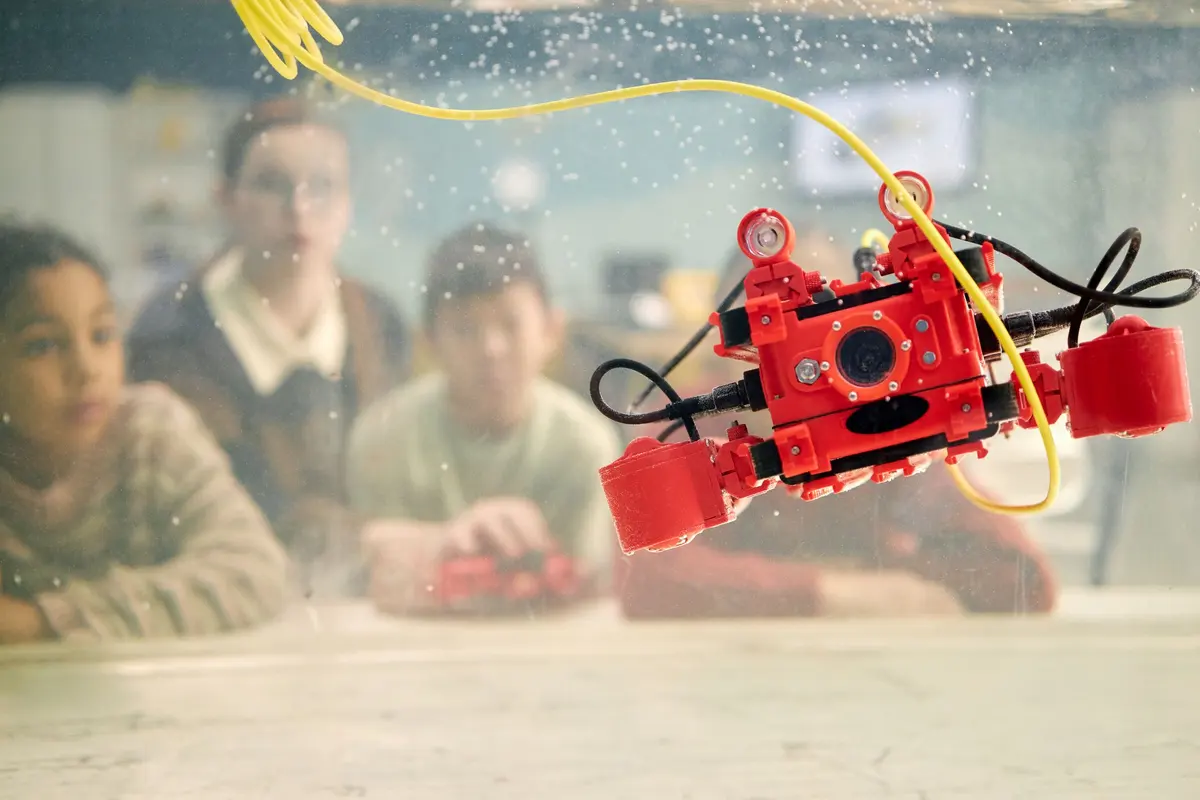
Caden Terence Pohlkamp, then a seventh-grader at Brookside Intermediate School in Friendswood, Texas, built a small remotely operated vehicle that could reach the bottom of a retention pond and bring back a water sample, then ran it through 12 different ponds around his community, according to his own project profile published by the Society for Science. His project, "Is More Green Better? Does Littoral Vegetation Enhance Habitat Suitability of Local Retention Ponds?," was named to the Top 300 of the 2025 Thermo Fisher Scientific Junior Innovators Challenge, a national competition the Society for Science runs for sixth- through eighth-graders.
The finding that got attention wasn't really about the water. It was about the narrow strip of ground around each pond's edge, and how closely a lawn crew mows it.
Retention Ponds Are Required Infrastructure, Not Decoration
Friendswood sits about 20 miles inland from Galveston Bay, in a stretch of the Texas Gulf Coast where flood control is mandatory rather than optional. Many of the ponds scattered through its subdivisions are retention basins, built specifically to collect and hold stormwater runoff during heavy rain, a standard requirement in flood-prone coastal development. Pohlkamp wanted to know whether the same ponds could also support aquatic life, and whether design choices affected the answer.
The ROV Measured More Than Water Temperature
Using his robot, Pohlkamp collected water samples from the bottom of each of the 12 ponds and measured pH, dissolved oxygen, biochemical oxygen demand, turbidity, phosphate levels and temperature, according to the Society for Science profile. He used those measurements to estimate how much aquatic life each pond could realistically support. The pattern that emerged: ponds with between 15 and 30 percent non-grass vegetation along their edges, rather than mowed grass running straight to the waterline, had healthier dissolved oxygen and pH readings. Ponds with fountains also scored better on dissolved oxygen than those without, which Pohlkamp's data linked to lower algae growth; stagnant ponds without fountains showed signs consistent with algae consuming much of the available oxygen.
The Variable That Actually Matters Is One A Homeowners' Association Controls
Homemade ROVs are common science fair projects, and testing pond water is not itself unusual. What distinguishes Pohlkamp's project, as the finding itself demonstrates, is that the strongest variable in his data isn't the weather or the pond's underlying design, both effectively fixed once a subdivision is built. It's landscaping policy. No resident or builder can change how much rain falls on Friendswood in a given year. Someone does decide how close a mower gets to a retention pond's edge.
Pohlkamp reported his results to local officials so they could act on the ponds that scored poorly on his habitat measures, according to the Society for Science.
What A Twelve-Pond Study Can And Cannot Show
The study covers 12 ponds in a single community, sampled over one season in one climate, and it establishes an association between edge vegetation and water quality rather than a demonstrated cause. A pond built with a fountain may differ from its neighbors in other ways too, including when it was constructed and who maintains it, factors the sample size here cannot fully separate out. Pohlkamp has said he became interested in the question because he lives near the Gulf and wanted to know the "optimal way to design" the ponds his community is required to build, so that they could better support the marine life he says he's passionate about. Extending the same measurements to more ponds, across more seasons and more Gulf Coast towns, would show whether the mowing pattern he found holds up outside Friendswood or reflects something more local to the ponds he happened to test.
From Local Data To A National Pipeline
Pohlkamp's project is one of hundreds the Thermo Fisher Junior Innovators Challenge names to its Top 300 each year, drawn from students who first compete at Society for Science-affiliated regional and state fairs, in his case the Science and Engineering Fair of Houston. That local-to-national structure is how a seventh-grader's retention-pond survey ends up documented alongside university-level environmental research: the measurement techniques are the same ones water-quality scientists use, applied at a scale, and to a question, a middle schooler could take on with a homemade robot and access to his own neighborhood.