2027 Speech Pathology ROI by Institution Type: Public vs Private vs Nonprofit Online Programs

Co-Founder and Chief Data Scientist

Reviewed by Rhea Paul, PhD
SLP Education & Research Expert
A lower tuition bill does not always mean a better investment in a speech pathology master's degree. Fees, lost earnings, clinical placement costs, and the time it takes to qualify for work can change the result. This guide is for prospective speech-language pathologists comparing public universities, private institutions, and online programs. It shows how to calculate costs consistently, evaluate outcomes without mistaking national wages for starting salaries, and identify the program that offers the strongest value for your circumstances.
Key Things You Should Know
- Compare total cost, not institution labels: Public programs may offer lower in-state tuition, but aid, fees, travel, and time out of work can reverse an apparent price advantage. Private and nonprofit are overlapping categories; online describes delivery, not ownership.
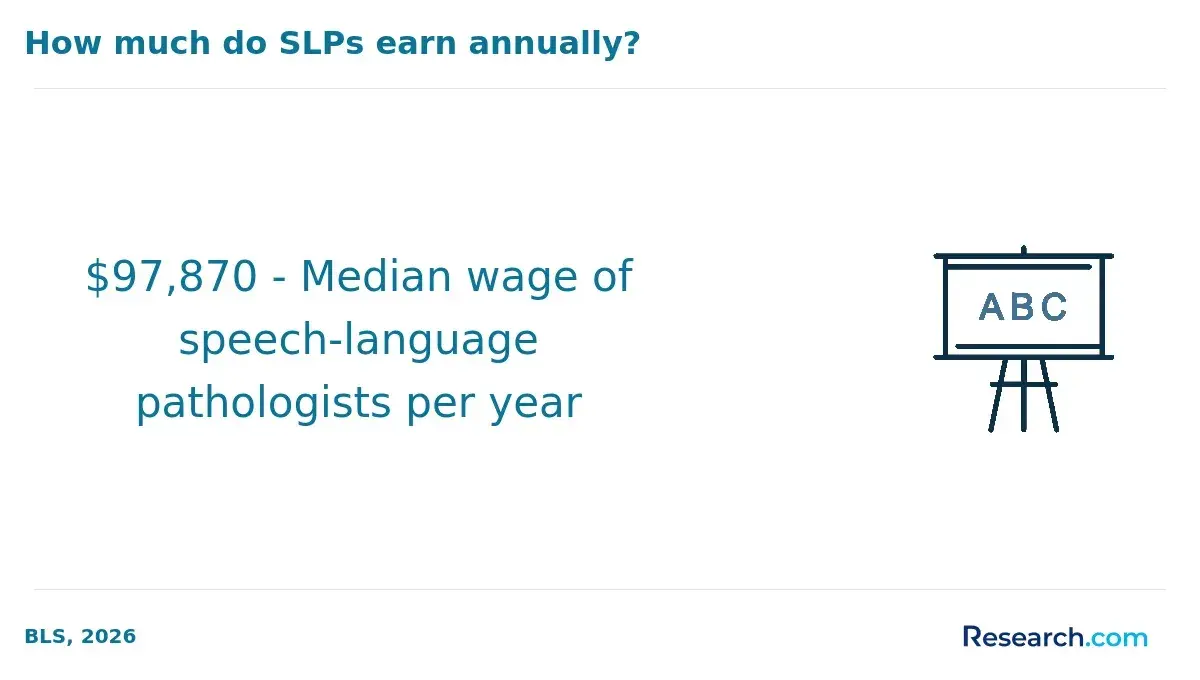
- Use earnings data carefully: The U.S. Bureau of Labor Statistics reports a $97,870 median annual wage for speech-language pathologists in May 2025. That is a national figure for employed professionals, not a projected starting salary or a return for any particular program.
- Protect the path to employment: Verify accreditation status, state licensure eligibility, and clinical placement arrangements before comparing price. A cheaper program offers poor value if it delays or prevents qualification for your intended job.
- How does speech pathology return on investment differ across public, private, nonprofit, and online programs? Speech Pathology ROI
- Which costs determine the true return on investment for each speech pathology program type? True Program Costs
- How do graduation, licensure, employment, and earnings outcomes affect speech pathology ROI? Outcome Drivers
- How should tuition, fees, living expenses, and opportunity costs be measured consistently? ROI Methodology
- What should prospective students verify before comparing speech pathology program ROI claims? ROI Verification
How does speech pathology return on investment differ across public, private, nonprofit, and online programs?
Speech pathology return on investment (ROI) is the value of a program's potential career benefits relative to everything a student spends or gives up to complete it. The useful comparison is not public versus private in isolation. It is each eligible program's full cost against its likely timeline and outcomes for a particular student.
The categories overlap: a public university is generally nonprofit, a private institution may be nonprofit or for-profit, and any of these institutions may offer online coursework. The table separates ownership from delivery so that unlike options are not treated as direct opposites.
| Program characteristic | Potential financial advantage | Cost or outcome to examine |
| Public university | In-state tuition or public funding may lower the price | Residency rules, fees, aid, and whether the schedule permits paid work |
| Private nonprofit institution | Institutional grants may narrow the published price gap | Net price after aid, borrowing needs, and required travel |
| Private for-profit institution | A format or schedule may fit a student's needs | Total price, program outcomes, accreditation, and licensure eligibility |
| Online delivery at any institution | May reduce relocation or commuting costs | Local clinical placement costs, campus visits, technology fees, and work-hour limits |
Bottom line: The strongest ROI usually comes from the least costly viable path to the student's intended license and job - not automatically from the institution with the lowest advertised tuition.
Which costs determine the true return on investment for each speech pathology program type?
The decision-driving figure is net total cost through graduation and entry into practice. Start with required tuition and fees, subtract confirmed grants and scholarships, then add costs that differ between programs: prerequisites, clinical travel, campus visits, supplies, and borrowing costs. Keep living expenses in the calculation, but count only the portion attributable to attending a particular program when comparing alternatives.
Students without the required communication sciences and disorders coursework should also price the courses they must finish before entering a master's program. Those comparing comparing online CSD post-baccalaureate costs should check whether prerequisite credits are included in a quoted graduate price; they often require a separate budget.
Opportunity cost can be just as consequential. A student who must stop working during daytime classes or clinical placements may give up income even when tuition is low. Conversely, continued employment is a financial advantage only if the program's actual coursework and clinical schedule make it feasible.
How do graduation, licensure, employment, and earnings outcomes affect speech pathology ROI?
A program produces financial value only if the student can finish it and use the credential. Compare graduation rates, time to completion, Praxis results where reported, licensure eligibility, and employment outcomes - but ask for the cohort size, reporting period, and definition behind each measure. A placement rate based only on respondents, for example, is not the same as employment for an entire graduating class.
The Bureau of Labor Statistics projects 17% employment growth for speech-language pathologists from 2025 to 2035. That supports a favorable national demand outlook, but it does not establish openings in a student's preferred location or setting. The agency projects about 12,500 openings annually on average over that period; applicants should still investigate local employers and the settings in which they hope to work.
Earnings can vary with setting, geography, experience, and schedule. Readers exploring best-paying speech-language pathology specialties should treat higher-paying paths as possibilities, not as salaries a particular degree will secure. For ROI, compare a realistic early-career earnings range with what you might earn without the degree, rather than applying the national median to every graduate.
How should tuition, fees, living expenses, and opportunity costs be measured consistently?
Use the same study-to-employment window for every school. An annual tuition quote cannot be compared fairly with another school's full-program estimate, and a per-credit price must be multiplied by the credits the student will actually need. Request an itemized estimate for your residency status, enrollment pace, and expected aid.
A comparison sheet should separate charges paid to the institution from expenses and income changes outside it. These categories show which apparent savings are real for your situation.
| Category | Include in the comparison | Common comparison error |
| Direct education costs | Required credits, tuition rate, mandatory fees, and prerequisite courses | Comparing one school's annual tuition with another's total program tuition |
| Attendance costs | Required travel, lodging, clinical transportation, technology, and supplies | Assuming online study eliminates in-person expenses |
| Living expenses | Housing and other costs that change because of enrollment | Counting unchanged living costs as a unique expense of one option |
| Opportunity and financing costs | Foregone earnings, added time before employment, and interest on borrowing | Assuming the lowest tuition also means the least financial disruption |
For a simple payback check, divide the additional net cost of one option by its plausible additional annual earnings or retained income. If the earnings difference cannot be supported, do not invent one: compare cost, completion risk, and career access instead. Students who need to keep working can use affordable part-time online speech pathology master's programs as a starting point, then confirm each school's current schedule and full price directly.
Do online speech pathology programs produce different financial outcomes than campus based programs?
Online delivery alone does not establish better or worse ROI. It may let a student avoid relocating and retain some paid work, but clinical training remains in person. Required placements, live classes, campus visits, or limited local site availability can offset savings and affect how quickly a student finishes.
Ask who secures clinical sites, whether placements can be completed near home, whether students must travel, and what happens if a site falls through. Compare the answers with the campus option's placement support - not just with its commute. Readers weighing shorter timelines should review fast online SLP programs and clinical training standards while confirming each program's current requirements. Faster completion can reduce time out of the workforce, but an intense schedule may also make paid work impractical.
There is no sound basis for assuming that two otherwise comparable graduates will receive different pay solely because one completed online coursework. Licensure eligibility, clinical preparation, location, and employer needs are more useful factors to investigate.
How do public, private, and nonprofit ownership models influence pricing and student value?
Ownership affects how an institution is funded and priced, but it does not set a student's final bill or determine educational quality. Public universities may charge different rates by residency. Private nonprofit schools may have higher published tuition but offer institutional aid. A private school may be nonprofit or for-profit, so "private versus nonprofit" is not a mutually exclusive comparison.
For value, compare each school's written aid offer and required expenses with its clinical support and outcomes. Pay particular attention to whether a scholarship renews, requires full-time enrollment, or excludes prerequisite credits. A low first-term price is not a low program price if later terms cost more or aid disappears.
How do accreditation and state authorization affect the financial value of speech pathology programs?
Accreditation and authorization are financial gatekeepers: without the appropriate educational pathway, a student may spend money on a degree that does not support the intended license or credential. Check the program's current status with the American Speech-Language-Hearing Association's Council on Academic Accreditation (CAA) and verify applicable state licensing requirements. Distinguish accreditation from candidacy rather than assuming they are identical.
For an online program, also verify that the school may enroll residents of your state and read its professional licensure disclosure for that state. Authorization to offer coursework is not, by itself, a determination that graduates meet licensure requirements. Ask the program and the licensing board about unresolved requirements before paying a deposit, especially if you plan to move or work in schools.
How do clinical placements, Praxis requirements, and licensure eligibility change graduate outcomes?
Clinical training determines whether a student can complete the degree on schedule and build experience for the intended work setting. Praxis and state licensing rules add steps between graduation and independent practice. Requirements can differ by state and, for school positions, may involve a separate education credential. A school's general statement that graduates can pursue licensure should not replace a state-specific check.
Before enrolling, get clear answers to three related questions: who finds and approves clinical sites; what support is available if a placement is delayed; and how the curriculum addresses the Praxis exam and requirements in your intended state. A delayed placement can mean additional living costs and later employment, making an apparently inexpensive program more costly in practice.
Which speech pathology program types offer the strongest ROI for different student circumstances?
There is no universal winner. A public in-state program may be the strongest value for someone who can attend its schedule without relocating. A private nonprofit option may compete if confirmed grants substantially reduce net cost. An online program may be especially valuable to a student who can avoid a move and has a workable clinical placement plan.
For a working adult, the deciding issue may be whether part-time enrollment and clinical hours are compatible with continued income - not whether classes are labeled online. For a career changer, prerequisite cost and time may matter more than a modest difference in graduate tuition. Students considering a compressed program should investigate scholarships for accelerated online SLP study alongside the workload: aid helps only if the schedule remains financially and academically manageable.
Choose a more expensive option only when its aid-adjusted price, workable schedule, placement support, or verified career access justifies the difference for you. If neither program can document a meaningful earnings advantage, do not pay a premium based on an assumed salary boost.
What should prospective students verify before comparing speech pathology program ROI claims?
Collect answers in writing from each program and use the same assumptions in every comparison. This short sequence catches the most expensive omissions before an application or enrollment decision.
- Confirm current CAA status, state enrollment eligibility, and the licensing requirements for where you intend to practice.
- Request a full-program estimate covering required credits, fees, prerequisites, travel, and aid conditions - not just an advertised tuition rate.
- Ask how clinical sites are secured, whether visits or live sessions are required, and how often scheduling changes affect completion.
- Request recent cohort-level graduation, Praxis, and employment information, including how each outcome was measured.
- Model your borrowing and lost work income under a realistic schedule; compare the result with a lower-cost or slower-paced alternative.
Red flags include a national wage presented as a graduate starting salary, an online price that omits clinical travel, and an employment claim with no stated denominator. If application flexibility matters, part-time SLP master's admission options can help frame your search, but verify current admissions rules and whether the program actually offers a pace you can afford.
References:
- U.S. Bureau of Labor Statistics - Speech-Language Pathologists https://www.bls.gov/ooh/healthcare/speech-language-pathologists.htm
- ASHA EdFind - Accredited Speech-Language Pathology Programs https://find.asha.org/ed/
- Audiology and Speech-Language Pathology Interstate Compact https://aslpcompact.com/compact-map/
- New York University - Online MS, Communicative Sciences and Disorders (Speech@NYU) https://steinhardt.nyu.edu/degree/online-ms-communicative-sciences-and-disorders
- Nova Southeastern University - SLP Program - Master of Science in Speech-Language Pathology https://osteopathic.nova.edu/degrees/masters/speech-language-pathology/index.html
- University of North Carolina at Greensboro - Speech-Language Pathology, M.A. (Online) https://csd.uncg.edu/graduate/masters-of-arts-online/
- Baylor University - Master of Science in Speech-Language Pathology (Online) https://csd.robbins.baylor.edu/graduate/online-csd-graduate-program
- James Madison University - Master of Science (M.S.) in Speech-Language Pathology (Distance Education / Online) https://www.jmu.edu/chbs/csd/online_ms/index.shtml
Other Things You Should Know About Speech Pathology
Possibly. Compare its price after confirmed aid with any measurable benefits, such as a schedule that lets you keep working or stronger placement support. Do not assume a higher price will produce a higher salary.
That depends on live-class hours, coursework, and in-person clinical assignments. Ask for a term-by-term schedule and speak with the program about whether full-time work is realistic during placements.
Use a conservative income estimate suited to your location, expected setting, and experience instead. The national median includes established professionals and is not an entry-level earnings forecast.
Ask what information it can provide in writing and label missing figures as unknown in your comparison. Do not substitute institution-wide outcomes or an estimated total price without clearly noting their limits.