2027 Speech Pathology Student Debt Report: Borrowing, Monthly Payments, and Repayment Risk

Co-Founder and Chief Data Scientist

Reviewed by Rhea Paul, PhD
SLP Education & Research Expert
A speech pathology master's degree can lead to a licensed clinical career, but its borrowing costs can begin well before a graduate earns a full professional salary. If you are comparing programs or already have student loans, the useful question is not just "How much debt is typical?" It is whether your total borrowing and likely monthly payment fit the work you expect to pursue. This report explains where debt figures fall short, how to estimate payments, which borrowers face greater risk, and what to verify before committing to a program.
Key Things You Should Know
- There is no single reliable debt figure for every speech pathology graduate: compare each program's full cost with your existing undergraduate loans and likely living expenses.
- The Bureau of Labor Statistics reports a $97,870 median annual wage for speech-language pathologists in May 2025, but that is not an entry-level salary or a promise of earnings after graduation.
- Repayment risk rises when borrowing includes costly private loans, unpaid interest during training, or a payment that depends on earning the national median immediately.
- How much student debt do speech pathology graduates typically borrow? Debt Levels
- What are the expected monthly payments for speech pathology student loans? Monthly Payments
- Which speech pathology borrowers face the highest repayment risk? Repayment Risk
- How does speech pathology debt compare with graduate earnings and entry-level salaries? Debt-to-Earnings
- Which accreditation and licensure factors can affect speech pathology students' borrowing decisions? Accreditation Factors
How much student debt do speech pathology graduates typically borrow?
No single national "typical speech pathology debt" figure captures what an applicant is likely to owe. Published program-level debt figures, when available, may omit undergraduate borrowing, exclude some living costs, cover only students with federal loans, or combine graduates from different circumstances. A median also says little about the upper end of a program's debt distribution.
For a more useful estimate, separate what you already owe from what attending a particular program would add. The following comparison shows why a tuition quote alone is an incomplete borrowing estimate.
| Cost or balance | What it includes | Why it matters |
| Existing undergraduate debt | Loans taken before graduate enrollment | It remains part of the eventual repayment burden. |
| Graduate tuition and required fees | Charges for the full program, including required courses | Advertised per-credit prices are not total program costs. |
| Training and living costs | Housing, transport, clinical-placement travel, and other eligible expenses | These costs may require borrowing even when tuition is manageable. |
| Interest added before repayment | Interest that accrues while loans are outstanding | The balance at graduation may exceed the amount originally borrowed. |
Ask each school for a full-program cost estimate and the latest debt information it can substantiate for graduates of the specific program. Compare that estimate with grants, employer support, savings, and income you can realistically earn while completing clinical work. For additional ways to evaluate paying for an online SLP master's program, focus on total required spending rather than the lowest advertised tuition rate.
What are the expected monthly payments for speech pathology student loans?
A monthly payment cannot be estimated responsibly from a degree title alone. It depends on the balance when repayment begins, each loan's interest rate, repayment term, and eligibility for a federal repayment plan. Two graduates who borrowed the same amount can have different bills if one has more accrued interest or uses a different plan.
Under a fixed-payment plan, a higher rate or shorter repayment period generally raises the monthly bill. A longer period can lower the bill while increasing total interest paid. To obtain a decision-ready estimate, enter each projected loan balance and rate into a loan calculator, then compare its standard-plan result with any federal plan for which you may qualify. Repeat the calculation using a conservative starting salary rather than the national occupational median.
Program pace also changes the calculation. A shorter course of study may reduce time spent accruing interest or paying living expenses, but a compressed schedule can limit paid work. When comparing the cost of an accelerated SLP degree, include required fees, clinical training, and any income you would forgo - not just the advertised tuition.
Which speech pathology borrowers face the highest repayment risk?
The greatest risk is not necessarily the largest balance. It is a balance whose required payment is difficult to cover under the borrower's plausible early-career income, especially when there is little room in the budget for a job search, reduced hours, or an unexpected expense.
Risk tends to be higher for students who bring substantial undergraduate debt into graduate school, borrow for most living costs, rely heavily on private loans, or must extend enrollment because of prerequisites or placement scheduling. It can also rise when a borrower assumes that the national median wage will be available immediately after graduation. Part-time work, local pay, and the timing of licensure can make early income different from that assumption.
Before accepting a loan offer, stress-test the budget against a lower-than-hoped-for starting salary and a delayed start to paid clinical work. If the required payment would crowd out housing, transportation, or an emergency cushion, compare a lower-cost program, additional funding, or a different enrollment timeline. Do not treat an affordable payment under one federal plan as proof that every loan in the package will qualify for that plan.
How does speech pathology debt compare with graduate earnings and entry-level salaries?
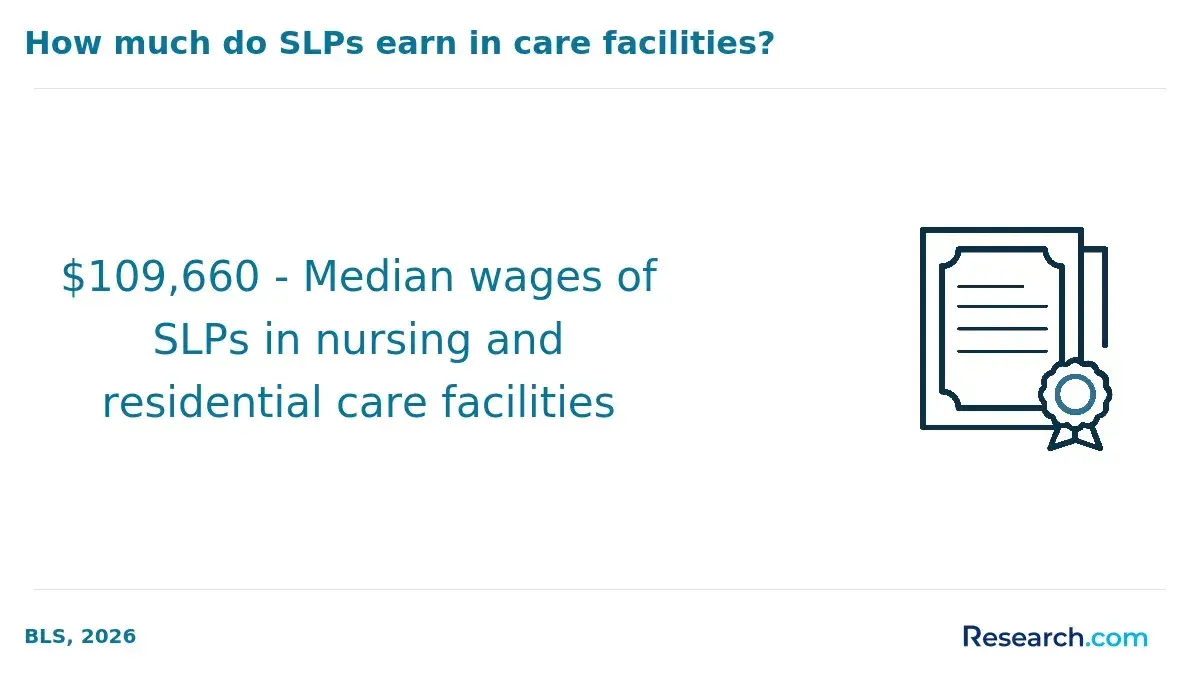
The Bureau of Labor Statistics reports that the median annual wage for speech-language pathologists was $97,870 in May 2025. This is a useful benchmark for the occupation as a whole, not an entry-level wage: it includes workers at different career stages and in different settings. A borrowing plan that works only at the national median may be too optimistic for a new graduate.
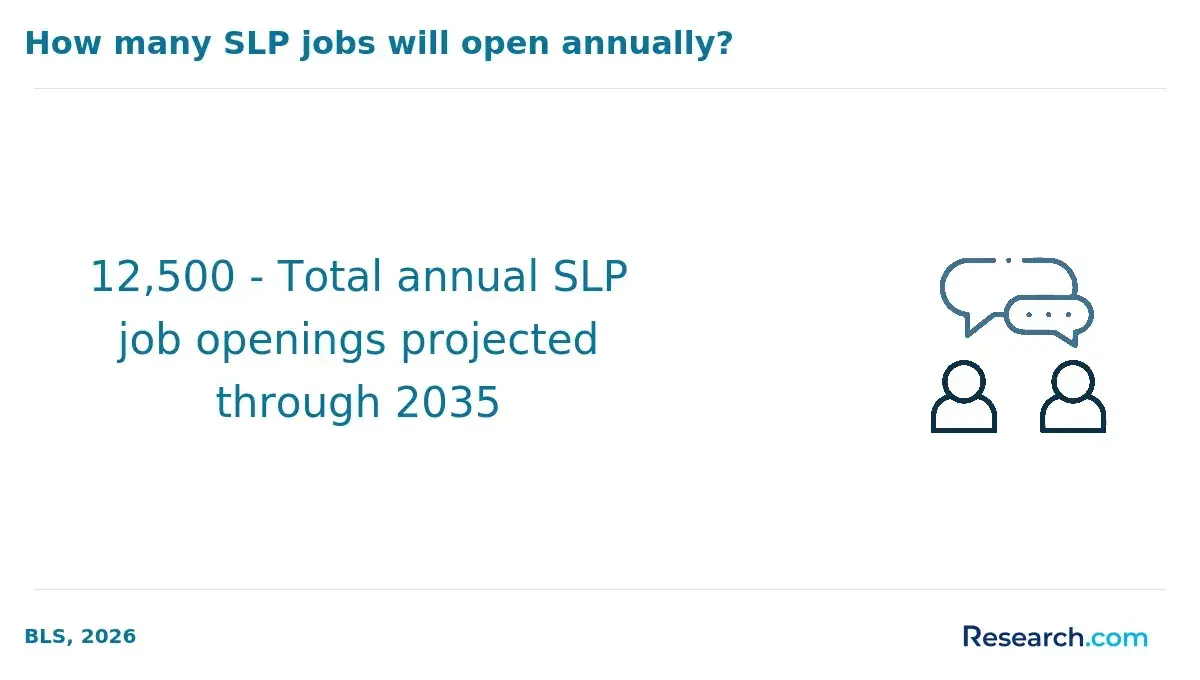
Demand provides context, but not a guarantee of local work or pay. BLS projects 17% employment growth from 2025 to 2035 and about 12,500 openings annually on average over that period. Those projections support investigating the career, while your repayment decision still depends on jobs you could realistically pursue where you plan to live.
Compare the projected annual loan payments with pay ranges in your intended setting and location, allowing for taxes and other essential expenses. School-based schedules, health care positions, and part-time roles need not produce identical annual income. Researching SLP salary by state can help frame a location comparison, but current local job postings and employer pay information are more useful for testing a first-job budget.
How do borrowing and repayment outcomes differ by speech pathology degree type?
A bachelor's degree and a clinical master's degree serve different purposes. A bachelor's program may establish the background for graduate admission or certain support roles, but it should not be budgeted as though it alone qualifies a graduate for independent speech-language pathologist practice. The master's-level path adds tuition, clinical training, and potentially more time with limited earnings.
Degree comparisons become especially important for applicants whose undergraduate major was outside communication sciences and disorders. Required prerequisite or leveling courses can add cost before the master's curriculum begins. Check whether a program includes those courses in its quoted price and whether they qualify for the financial aid you expect. Applicants who need SLP bridge coursework in phonetics or related subjects should price the entire route to eligibility, not only the graduate portion.
A clinical doctorate or other advanced study may make sense for a particular professional goal, but an additional credential should not be assumed to produce a proportionate salary increase. Compare its added debt with the requirements and compensation of the jobs you actually want.
How do federal loan balances, private loans, and interest rates affect repayment costs?
Federal and private loans can look similar on a tuition bill but create different repayment choices. Eligible federal loans may offer income-driven repayment and access to certain federal forgiveness programs. Private-loan rates, payment protections, and hardship options depend on the lender and contract; private loans generally do not qualify for federal repayment programs.
Interest matters before and after graduation. Graduate borrowers should check when interest starts accruing on each loan, whether unpaid interest may be added to principal, and how fees affect the amount owed. If a private lender advertises a low variable rate, compare it with the lender's fixed-rate offer and consider whether a future rate increase would strain your budget.
A common mistake is comparing offers solely by the initial monthly payment. Obtain the loan disclosures and compare the total expected repayment cost, rate type, fees, repayment flexibility, and cosigner obligations. Borrowing less for living expenses can reduce both the principal and the interest charged over time.
How do income-driven repayment plans change speech pathology borrowers' monthly obligations?
For eligible federal loans, an income-driven repayment plan can set a payment using income and family circumstances instead of relying solely on the loan balance. That can make a payment more manageable during a lower-paid first job or a period of reduced income. It does not necessarily make the education cheaper: a lower payment may leave more interest outstanding, and a longer repayment period can increase total cost.
Eligibility and available plan terms can change, so check current federal rules before treating a projected payment or forgiveness outcome as certain. Private loans should be calculated separately because a federal income-driven payment does not cover them. Borrowers considering Public Service Loan Forgiveness should also verify the rules for their employer, loan type, and repayment plan rather than assuming that work in a school or clinic automatically qualifies.
For planning, compare a standard federal payment, an eligible income-driven estimate, and every private-loan payment in the same monthly budget. The combined bill - not the lowest federal estimate - is the figure that matters for affordability.
How do state, school sector, and program costs influence speech pathology debt?
State residency can affect public-university tuition, while clinical-placement travel, housing, and local living costs can change the price of attending any program. Online delivery does not necessarily eliminate in-person expenses. Private institutions may be nonprofit or for-profit; neither label, by itself, establishes whether a program offers good value.
Compare schools using the same boundaries: total required credits, tuition applicable to you, mandatory fees, prerequisite costs, expected clinical travel, and likely time out of paid work. Then subtract aid that you have actually been offered. An attractive scholarship may still leave a larger net cost than a lower-priced alternative.
Admissions requirements can also affect the cost of applying or the options available to you, though they should not outweigh program quality and licensure fit. If testing is a concern, identify speech pathology graduate programs without the GRE, then compare their complete costs and requirements rather than assuming a simpler application means a cheaper degree.
How should speech pathology students interpret debt statistics and repayment-risk measures?
Start by asking whose debt is counted. A program's median federal loan balance may exclude graduates who used only private loans, paid without loans, or arrived with undergraduate debt. A figure reported for an institution may also describe a broader group than speech pathology master's graduates. Without a matching definition, two published debt numbers are not a fair program comparison.
Debt-to-earnings measures have similar limits. They can help flag a program worth investigating, but earnings may reflect different graduation years, locations, work schedules, and stages of licensure. A low reported debt figure does not show whether graduates received substantial family support, while a high figure does not establish that every graduate struggles to repay.
When reviewing an outcome claim, check the credential, graduation cohort, loan types included, measurement date, and whether earnings represent new graduates. If the school cannot supply comparable figures, use its verified total cost and your own conservative payment estimate. Treat missing or suppressed data as unknown, not as evidence of low risk.
Which accreditation and licensure factors can affect speech pathology students' borrowing decisions?
Borrowing for a program that does not fit your intended licensing path is a serious financial risk. Before enrolling, verify the program's current accreditation status through the Council on Academic Accreditation in Audiology and Speech-Language Pathology and review the licensing requirements of the state where you intend to practice. Ask the program how its curriculum and clinical experiences relate to those requirements; do not assume that an online program meets them in every state.
Clinical placements, required campus visits, and post-degree supervised experience can affect when you are able to earn a full professional income. Clarify who arranges placements, whether travel is required, and what expenses you must cover. When estimating the time to certification after an online SLP master's, distinguish finishing classes from completing all applicable certification and state-licensure steps.
Request written answers before paying a deposit, especially if you may move states during or after the program. A lower tuition price is less valuable if unresolved placement or eligibility questions could delay graduation or employment.
References:
- U.S. Bureau of Labor Statistics - Speech-Language Pathologists https://www.bls.gov/ooh/healthcare/speech-language-pathologists.htm
- ASHA EdFind - Accredited Speech-Language Pathology Programs https://find.asha.org/ed/
- ETS Praxis - Speech-Language Pathology (5331) https://praxis.ets.org/test/speech-language-pathology-5331.html
- Maryville University - Master of Science in Speech-Language Pathology https://www.maryville.edu/masters/speech-language-pathology/
- New England Institute of Technology - Master of Science in Speech Language Pathology https://www.neit.edu/academics/graduate-degrees/speech-language-pathology-ms
- University of Scranton - Master of Science (M.S.) in Speech-Language Pathology https://www.scranton.edu/academics/pcps/health-and-human-performance/programs/speech-language-pathology/index.shtml
- Idaho State University - Master of Science in Speech-Language Pathology (Online/Distance Education) https://www.isu.edu/slp/programs-offered/slp-graduate-program/
- Ithaca College - Online Master of Science in Speech-Language Pathology https://slponline.ithaca.edu/programs/masters-speech-language-pathology-online
Other Things You Should Know About Speech Pathology
It depends on the loans' rates, your available cash, and whether delaying graduate study changes your costs or career plans. First build a combined estimate of existing debt and new borrowing; do not use all your savings to pay down loans if doing so leaves you unable to cover enrollment or placement expenses.
Some students can, but coursework and clinical placements may restrict their hours, particularly when schedules are set by placement sites. Ask each program for its typical weekly schedule before relying on employment income to reduce borrowing.
No. Compare the scholarship's renewal conditions and amount against full-program tuition, fees, prerequisites, living costs, and clinical expenses. The relevant figure is what you would still need to pay or borrow.
Recheck the budget with a conservative starting salary, then compare lower-net-cost programs, additional aid, and ways to reduce living expenses. If the payment remains unworkable, reconsider the borrowing plan before enrolling rather than assuming higher future earnings will solve it.