2027 Speech Pathology Career Outcomes by Degree Level Report: Pay, Employment, and Advancement Patterns

Co-Founder and Chief Data Scientist

Reviewed by Rhea Paul, PhD
SLP Education & Research Expert
An associate degree may help you enter speech-language pathology support work, but it does not lead to the same jobs as a clinical master's degree. That distinction matters when you are weighing tuition, time in school, and future earnings.
This report compares what each degree level can realistically qualify you to do, where national salary and employment data apply, and where the evidence is too limited for a fair comparison. Use it to choose a path that matches your intended role - not just the highest salary you see advertised.
Key Things You Should Know
- A master's degree is generally the entry-level clinical degree for speech-language pathologists (SLPs); the U.S. Bureau of Labor Statistics reports a $97,870 median annual wage for the SLP occupation in May 2025, not for everyone with that degree.
- SLP employment is projected to grow 17% from 2025 to 2035, with about 12,500 openings annually on average; these figures do not describe assistant jobs or graduate placement rates.
- Associate and bachelor's pathways can lead to support roles where state rules allow, while doctorates primarily serve specialized clinical, leadership, teaching, or research goals - not an automatic pay increase.
- What do speech pathology salaries look like by associate, bachelor's, master's, and doctoral degree level? Pay by Degree
- How do employment rates and job outcomes vary across speech pathology degree levels? Employment Outcomes
- Which speech pathology degree provides the strongest advancement opportunities and career mobility? Advancement Potential
- What jobs can graduates pursue with each speech pathology degree? Career Options
- Which speech pathology degree level offers the best return for different career goals? Choosing a Degree
What do speech pathology salaries look like by associate, bachelor's, master's, and doctoral degree level?
The clearest national pay benchmark is for the occupation of speech-language pathologist, not for a degree. The Bureau of Labor Statistics (BLS) reports a median annual SLP wage of $97,870 in May 2025. Half of workers in that occupation earned more and half earned less; the figure is not an expected starting salary or a return promised by a master's program.
This comparison separates degree-level possibilities from the wage data actually available. It matters because a doctoral graduate working as an SLP is included in occupational statistics alongside master's-trained SLPs, while an assistant belongs to a different job category.
| Degree level | Potential role, subject to qualifications | How to interpret pay data |
| Associate | Speech-language pathology assistant (SLPA) or another supervised support role where permitted | The BLS SLP median does not apply; pay depends on the assistant role, state, and employer. |
| Bachelor's | SLPA where state requirements are met; other education, health, or communication support roles | There is no single national speech pathology salary for bachelor's graduates. |
| Master's | SLP after applicable licensure requirements are met | The BLS SLP occupational median is $97,870, not a degree-specific graduate outcome. |
| Doctoral | SLP, researcher, faculty member, or leader, depending on the doctorate and role | There is no universal doctoral pay premium; compare wages for the intended job. |
When estimating whether a master's is affordable, compare total tuition and fees with likely borrowing, living costs, and time away from paid work. Explore tuition savings in online speech pathology programs, but verify each program's clinical placement, travel, and state-eligibility costs before treating a lower advertised tuition rate as a lower total price.
How do employment rates and job outcomes vary across speech pathology degree levels?
National projections favor the SLP occupation: BLS expects employment to grow 17% from 2025 to 2035 and projects about 12,500 openings per year on average. That suggests continuing demand for qualified clinicians, but it cannot tell an applicant their probability of getting a job in a particular city or after a particular program.
There is no comparable, authoritative national employment rate covering associate, bachelor's, master's, and doctoral speech pathology graduates on the same basis. Associate and bachelor's outcomes span assistant and nonclinical work; master's outcomes depend partly on licensure; doctoral outcomes span clinical and academic positions. Comparing a school's "employed after graduation" figure with BLS occupational growth would mix two different measures.
Ask programs for recent outcomes using consistent definitions: how many graduates responded, whether jobs were in the field, where graduates worked, and whether reported employment occurred before or after licensure. If your goal is the SLP credential and you already know the field fits, accelerated SLP bachelor's-to-master's pathways may reduce transitions between programs; confirm that their pace still allows you to complete required clinical training.
Which speech pathology degree provides the strongest advancement opportunities and career mobility?
For most people seeking clinical mobility, the qualifying master's degree is the pivotal investment. Once licensed, an SLP may move among eligible school, healthcare, and other practice settings, subject to employer requirements and any additional state credentials. An associate or bachelor's degree can provide experience, but neither independently substitutes for the education required to practice as an SLP.
A doctorate makes more sense when the target job calls for it. A research PhD can support a path toward university research and faculty positions; a clinical doctorate may deepen expertise or support leadership. Neither should be assumed necessary for routine SLP advancement, and neither automatically expands a state license's scope. Consider career advancement for speech pathologists alongside actual job postings: compare required credentials and experience before paying for another degree.
What jobs can graduates pursue with each speech pathology degree?
"Speech pathology graduate" can describe several very different workers. The practical question is whether the degree prepares you for an independently licensed clinical role, a supervised assistant role, or work outside clinical practice.
The table maps common directions rather than guaranteeing eligibility. State rules, coursework, supervision, and employer standards determine which jobs an individual graduate can take.
| Degree level | Jobs to investigate | Important boundary |
| Associate | SLPA in jurisdictions accepting the preparation; communication or classroom support | Assistant duties are supervised and limited by state rules. |
| Bachelor's | SLPA where eligible; special education support, research assistance, or related service coordination | A bachelor's in communication sciences and disorders alone does not qualify someone as an SLP. |
| Master's | Licensed SLP in schools, healthcare, private practice, or other settings | Graduation must be followed by any applicable examination, supervised experience, and licensing steps. |
| Doctoral | Specialized clinical or leadership roles; research and university teaching, particularly with a PhD | Opportunities depend on the doctorate's focus and the job's requirements. |
If your bachelor's degree is in another subject, do not assume you must earn a second bachelor's before applying to graduate school. Some programs accept applicants who complete specified prerequisites; investigate taking individual SLP prerequisite courses online and obtain written confirmation that the target master's program will accept those courses.
How do education requirements shape eligibility for speech-language pathology licensure and certification?
In the United States, SLP licensure is state-regulated. A clinical master's is generally the entry-level degree, but a degree title alone does not establish eligibility. States may also require specified coursework and clinical experience, an examination, supervised post-graduate practice, and other conditions. Public-school employment may involve separate state education-agency requirements.
The American Speech-Language-Hearing Association's Certificate of Clinical Competence in Speech-Language Pathology (CCC-SLP) is a professional certification, not a replacement for a state license. The Council on Academic Accreditation (CAA) accredits qualifying graduate SLP programs; check a program's current status and the licensing board's rules for the state where you intend to work. A clinical doctorate or PhD should not be mistaken for the CAA-accredited entry-level master's pathway.
Online coursework does not remove in-person clinical training requirements. When comparing supervised practicum hours in short slp master's programs, ask who secures placements, whether travel is required, and how the school documents that graduates meet the intended state's requirements. Confirm these points before paying an enrollment deposit, particularly if you may move during the program.
How do speech pathology outcomes differ between speech-language pathology assistants and licensed speech-language pathologists?
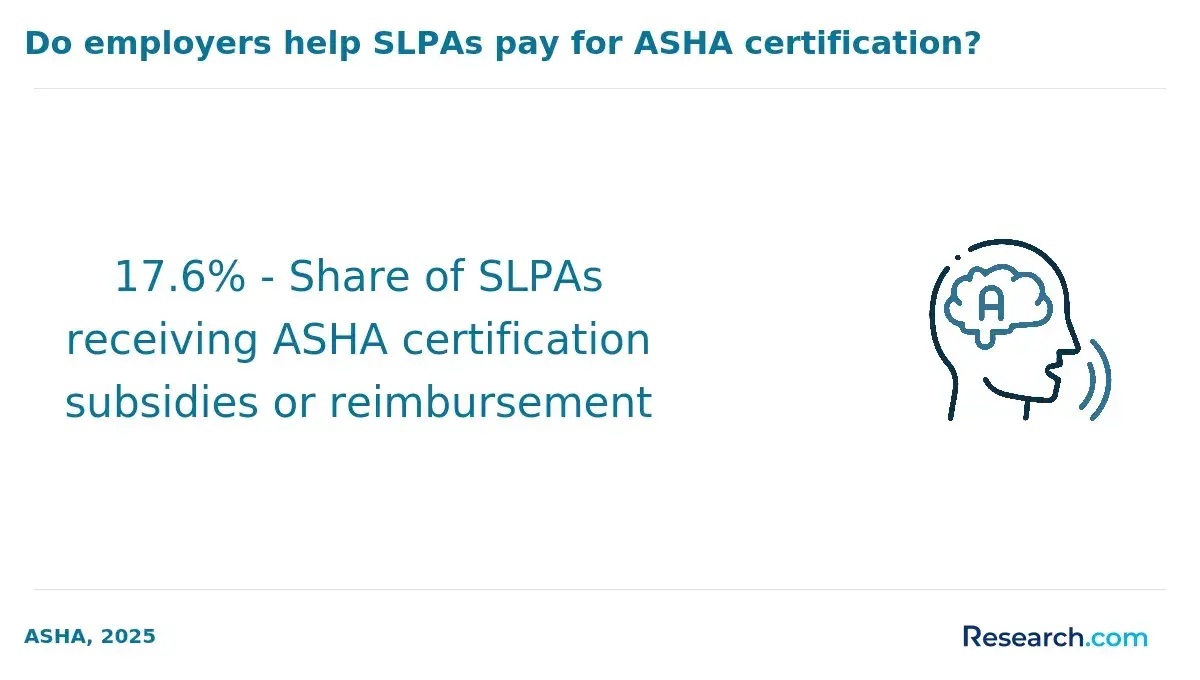
An SLPA helps deliver services under an SLP's supervision within duties allowed by the state and employer. A licensed SLP has broader responsibility for clinical evaluation, diagnosis, treatment planning, and service delivery. Assistants are not simply SLPs with a shorter degree, and supervising an assistant does not transfer an SLP's license or clinical authority to that worker.
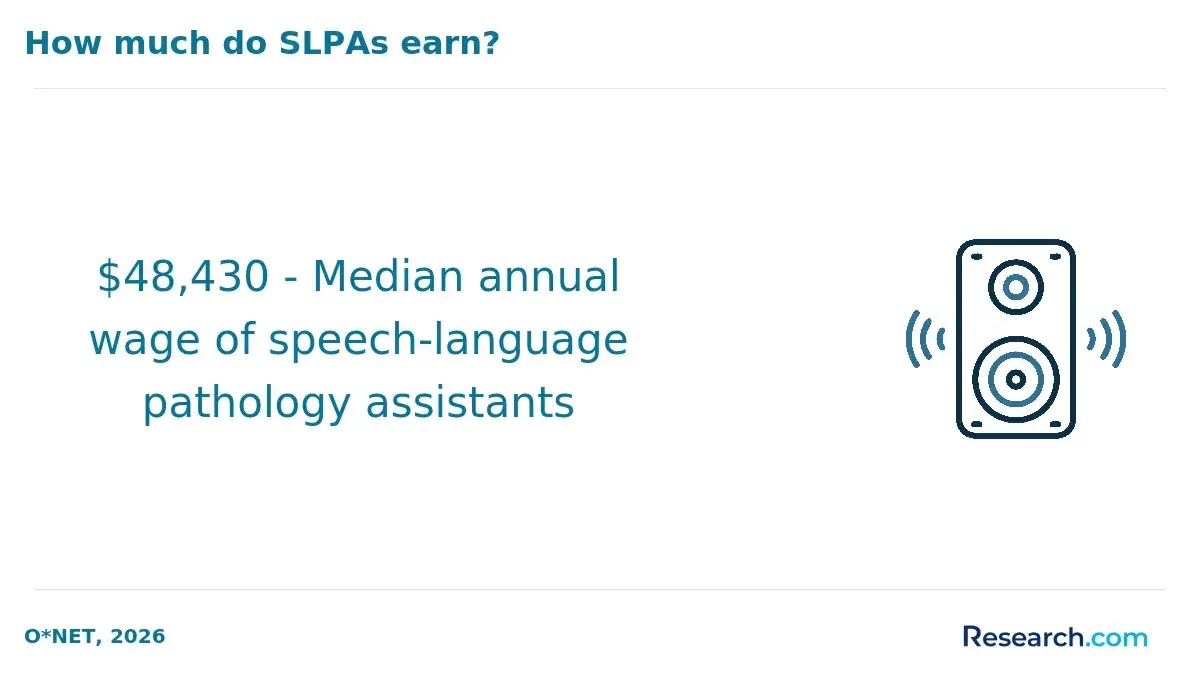
The assistant path can be a sensible way to enter the field sooner and test whether day-to-day client work suits you. Its trade-off is a narrower scope of practice and eligibility rules that differ by state. The SLP path requires substantially more education and clinical preparation, but it opens the licensed clinician role represented by BLS SLP wage and growth statistics. Compare local assistant openings and requirements directly rather than applying those SLP figures to both jobs.
How do work settings and specialties affect pay and employment for speech pathology graduates?
Schools, hospitals, outpatient facilities, rehabilitation settings, and private practices can offer different schedules, caseloads, supervision structures, and compensation arrangements. A school position may follow an academic calendar; a healthcare role may include different hours or patient needs. Compare annual pay with the actual work calendar, benefits, and expected hours rather than ranking offers by a single quoted rate.
Specialty interests - such as pediatric language, swallowing, or adult neurogenic communication - can also change which jobs are available. Clinical competence and employer requirements matter more than a specialty label on a transcript. Digital tools and telepractice may affect how services are delivered, but they do not eliminate the need to check state authorization, privacy obligations, clinical supervision, and employer policies. Seek placements that expose you to the population and setting you hope to enter; experience can be more useful to an entry-level application than an unsupported claim that one specialty always pays more.
What does the evidence show about speech pathology career outcomes by location and employer sector?
The national SLP median is a starting benchmark, not a local offer. Wages and openings can vary with geography, employer sector, experience, and the balance of school and healthcare jobs in a market. State licensing rules can also affect how quickly a graduate may begin work or move between states.
For a location-specific decision, compare BLS occupational wage and employment estimates for the area with current postings for the same role and experience level. Then check the relevant state licensing board and, for school jobs, the state education agency. Read postings for contract length, benefits, travel between sites, and supervision requirements. A higher nominal wage may be less attractive after housing costs or unpaid gaps in work; a lower wage may accompany benefits or a schedule that better fits your goals.
How should readers interpret salary, employment, and advancement statistics in this report?
Use each statistic for the question it actually answers. The BLS May 2025 median describes pay among people employed as SLPs; its 2025-2035 growth projection describes expected change in that occupation. Neither measures graduate earnings, assistant wages, the share of applicants hired, or the financial return from one particular school.
Be especially cautious with outcome claims that omit a timeframe, respondent count, job definition, or location. "Working" may include jobs outside speech pathology, while a high salary figure may describe experienced clinicians rather than new graduates. Advancement claims need the same scrutiny: a degree can make someone eligible to compete for a role without assuring promotion.
For school-specific comparisons, request outcomes for recent graduating cohorts and ask whether the school separately reports licensure or certification results, field-related employment, and debt. If those details are unavailable, label the outcome unknown in your comparison rather than filling the gap with the national SLP median.
Which speech pathology degree level offers the best return for different career goals?
The best return depends on the job you want, not the highest credential you can obtain. An associate or bachelor's route may limit education costs for someone committed to supervised support work, but it is a poor substitute for a master's if the goal is to practice as an SLP. A qualifying master's is usually the direct investment for that goal. A doctorate is easier to justify when a specific research, faculty, or specialized leadership path calls for advanced training.
Before committing, use this sequence to compare the total investment with realistic career options:
- Choose a target role and state, then verify the required degree, accreditation status, clinical training, and license or assistant credential.
- Calculate each program's total tuition, mandatory fees, placement and travel costs, expected borrowing, and income you may give up while studying.
- Compare recent program outcomes and local entry-level postings for that role; treat missing outcome data as uncertainty, not a favorable result.
- Ask whether a less costly path reaches the same goal and whether any extra degree changes eligibility for jobs you actually want.
If your undergraduate record makes a master's application uncertain, research SLP graduate school with a lower GPA without treating an "easier" label as an admissions promise. Confirm each school's current prerequisites, accreditation status, clinical placement arrangements, and total cost. The most expensive mistake is enrolling in a program that does not lead toward your intended credential.
References
- U.S. Bureau of Labor Statistics - Speech-Language Pathologists https://www.bls.gov/ooh/healthcare/speech-language-pathologists.htm
- ASHA EdFind - Accredited Speech-Language Pathology Programs https://find.asha.org/ed/
- ETS Praxis - Speech-Language Pathology (5331) https://praxis.ets.org/test/speech-language-pathology-5331.html
- California State University-Northridge - Master of Science in Communicative Disorders (Online) https://tsengcollege.csun.edu/programs/CDS
- New England Institute of Technology - Master of Science in Speech Language Pathology https://www.neit.edu/academics/graduate-degrees/speech-language-pathology-ms
- University of Scranton - Master of Science (M.S.) in Speech-Language Pathology https://www.scranton.edu/academics/pcps/health-and-human-performance/programs/speech-language-pathology/index.shtml
- Maryville University - Master of Science in Speech-Language Pathology https://www.maryville.edu/masters/speech-language-pathology/
- Ithaca College - Online Master of Science in Speech-Language Pathology https://slponline.ithaca.edu/programs/masters-speech-language-pathology-online
Other Things You Should Know About Speech Pathology
Yes, potentially. Many graduate programs consider applicants from other majors, but they may require specific communication sciences and related prerequisite courses. Check each program's requirements before taking courses elsewhere.
Usually not. Online classes can reduce campus time, but clinical training requires supervised experiences. Ask where placements can occur, who arranges them, and whether campus visits or travel are required.
Possibly, if you meet your state's SLPA requirements and an employer has a supervised position. Assistant work can provide relevant experience, but it does not replace graduate clinical requirements or guarantee admission.
Only if it serves a defined goal that warrants the additional time and cost. First check whether your desired research, teaching, leadership, or clinical role actually requires one; many practicing SLP positions do not.