2027 Online vs Campus Speech Pathology Outcomes Report: Graduation Rates, Cost, and Career Trade-Offs

Co-Founder and Chief Data Scientist

Reviewed by Rhea Paul, PhD
SLP Education & Research Expert
An online speech pathology master's may let you stay employed and train near home, while a campus program may offer easier access to faculty and established clinical sites. Neither format automatically leads to better graduation or career outcomes. This comparison is for prospective speech-language pathologists weighing those trade-offs. It explains which outcomes can be compared reliably, which costs are easy to miss, and what to verify about placements and licensure before you commit.
Key Things You Should Know
- There is no reliable national online-versus-campus graduation rate for speech pathology master's programs. Compare each program's completion data using the same cohort and time frame.
- Tuition alone does not establish the cheaper option: required travel, technology, clinical placement expenses, and income lost during full-time training can change the result.
- Delivery format does not replace accreditation or supervised clinical training. The U.S. Bureau of Labor Statistics reports a $97,870 median annual wage for speech-language pathologists in May 2025, not a salary specific to either format.
- How do online and campus speech pathology programs compare on graduation rates? Graduation Rates
- Which speech pathology format costs less after tuition, fees, technology, and clinical expenses? Total Costs
- How do online and campus programs compare in clinical training and career outcomes? Career Outcomes
- Which factors make graduation rates differ between online and campus students? Completion Factors
- Which speech pathology format best fits working students, campus learners, and future clinicians? Best Fit
How do online and campus speech pathology programs compare on graduation rates?
No dependable national statistic establishes that online speech pathology master's students graduate at a higher or lower rate than campus students. Published program completion figures generally describe individual programs, not a controlled comparison between delivery formats. Students also differ in employment, enrollment pace, prerequisite preparation, and placement availability.
A graduation rate is only useful when its definition is clear. Some schools report completion within the program's published time frame; others may provide a broader count of students who finish later. The following distinctions help prevent an apparent difference from becoming a misleading conclusion.
| Measure to compare | What it can tell you | Important limitation |
| Completion within the published time frame | How often students finish on the advertised schedule | Does not necessarily include students who graduate later |
| Eventual completion | Whether students finish despite delays | May be unavailable or based on different follow-up periods |
| Employment after graduation | Whether graduates report finding relevant work | Excludes students who did not finish |
Ask both schools for recent cohort results, the number of students in each cohort, and their definitions of on-time completion and employment. If an online program advertises a short schedule, distinguish the fastest possible path from the pace students actually follow. That matters when evaluating online SLP master's programs in 20 months: a compressed calendar is not evidence of a higher graduation rate.
Which speech pathology format costs less after tuition, fees, technology, and clinical expenses?
Neither format is consistently cheaper. Online study may remove a relocation expense but add technology charges or travel for required campus visits. Campus study may provide nearby university clinics yet require commuting, parking, or a move. Published per-credit tuition is not the same as the cost of completing the degree.
Build a separate total-cost estimate for each offer. This comparison shows which expenses to include; the amount depends on the school, your location, and the placement arrangements you receive.
| Cost category | Online program | Campus program |
| Tuition and mandatory fees | Check total required credits, online fees, and residency-based rates | Check total required credits, campus fees, and residency-based rates |
| Technology and materials | Check equipment, software, connectivity, and course materials | Check equipment, course materials, and any program-specific charges |
| Travel and housing | Check required visits and travel to clinical sites | Check commuting, parking, or relocation |
| Clinical training | Check screening, insurance, transportation, and unpaid placement time | Check the same expenses; an on-campus clinic may not cover every rotation |
| Income and borrowing | Estimate work hours you can realistically keep and the amount you may borrow | Estimate the same using the campus schedule |
For a fair comparison, request a written estimate covering all required terms, including summer enrollment and any prerequisite coursework you still need. Then add expected living costs and interest on borrowing. A lower tuition quote can be the more expensive choice if placements or required travel substantially reduce your ability to work. See how to evaluate online SLP master's total cost without treating an advertised tuition figure as the final bill.
How do online and campus programs compare in clinical training and career outcomes?
Both formats must prepare students to deliver supervised, in-person clinical services; an online classroom does not make clinical training virtual. The meaningful difference is how a program secures supervisors, coordinates settings, monitors student progress, and responds when a placement falls through.
A campus program may offer access to a university clinic and local referral relationships. An online program may allow placements closer to where a student plans to live and work. Neither advantage is universal. Ask for the actual sequence of clinical settings and how students gain experience with different ages, communication needs, and service models.
Career comparisons also need caution. A school's employment figure applies to its graduates under its stated reporting method; it does not isolate the effect of learning online or on campus. Review completion, certification-exam outcomes where reported, placement experience, and employment together. Strong results in one measure do not erase a weak result in another.
Which factors make graduation rates differ between online and campus students?
Delivery format is only one possible influence on completion. Clinical site availability, the number of courses taken each term, preparation in communication sciences, work obligations, caregiving, and access to advising can all affect whether a student finishes on schedule.
Online flexibility has limits: live classes, group work, and daytime clinical hours may conflict with a full-time job. Campus students may face equally consequential commuting or relocation demands. If employment is essential to your budget, evaluate balancing work and accelerated SLP graduate school against the program's clinical calendar, not just its evening class schedule.
A common mistake is to interpret a delayed graduation as proof of poor teaching - or an on-time graduation as proof of excellent support. Ask how many students changed pace, why placements were delayed, and what advising or remediation was available. Those answers make a completion figure more useful.
How do accreditation and state authorization affect online speech pathology program quality?
For a prospective speech-language pathologist, the key accreditation question concerns the specific graduate program. Verify its current status with the American Speech-Language-Hearing Association's Council on Academic Accreditation in Audiology and Speech-Language Pathology (CAA), rather than relying only on a university's general accreditation or a marketing description. Check any candidacy status and what it means for your intended certification or licensing path.
State authorization answers a different question: whether a school may enroll a student who lives in a particular state. It does not, by itself, establish that the degree meets that state's professional licensure requirements or that the school can arrange clinical training there. Before paying a deposit, ask the program for its current state-specific enrollment and professional licensure disclosures and confirm any uncertain requirement with the state licensing board.
Do not assume that "fully online" means available everywhere. A change in residence during the degree can affect enrollment, placements, or licensure planning, so discuss a possible move with the program in advance.
Do online and campus speech pathology degrees meet certification and licensure requirements equally?
They can, but delivery format alone establishes neither eligibility nor equivalence. For ASHA certification, students should verify that the degree and supervised training align with the current requirements for the Certificate of Clinical Competence in Speech-Language Pathology. State licensure is separate and may impose additional coursework, examination, supervised experience, or application requirements.
A master's degree is also not necessarily the final step before independent practice. Graduates commonly need to complete a supervised clinical fellowship and meet applicable certification or state licensing requirements. School-based positions can involve separate state education-agency rules.
Ask a prospective program to identify where its graduates have sought licensure, whether it has determined that its curriculum meets requirements in your intended state, and how it supports graduates through the next supervised stage. If the program has not made a determination for your state, resolve that uncertainty before enrolling rather than assuming that accreditation settles it.
How do prerequisite courses, admission standards, and program length vary by delivery format?
Online and campus master's programs can both require foundational communication sciences coursework, observation experiences, recommendations, and other application materials. Requirements vary by school, not reliably by format. Applicants without a related undergraduate major may need leveling or bridge courses before - or as part of - the graduate sequence.
That distinction affects both cost and completion time. A published master's timeline may start only after prerequisites are complete; a part-time path may take longer than the advertised full-time schedule. Check whether observation hours must be finished before applying, whether prior coursework has an age limit, and whether missing courses can be taken elsewhere. For career changers, online SLP prerequisites and observation hours deserve a separate plan before comparing master's start dates.
Do not assume an online option is easier to enter or a campus option is faster to finish. Compare the requirements that apply to your transcript and the pace you can sustain through clinical training.
What are the clinical placement trade-offs for online speech pathology students?
Training near home can be a major online-program benefit, particularly if relocation would disrupt work or family life. The risk is that "local placement" may mean different things: a school might arrange a site, help you find one, or expect you to identify potential sites yourself. Availability can depend on local supervisors and agreements, so a preferred location is not a guaranteed placement.
Before enrolling, get clear answers to the questions that most affect your ability to finish. Ask them of campus programs, too, because a university clinic may not supply every required experience.
- Who contacts sites, approves supervisors, and signs placement agreements?
- How far might students travel, and are any campus visits or temporary relocations required?
- What happens if a site cancels or cannot provide the needed clinical experiences?
- How are students supervised and assessed at off-campus sites?
Request the answers in writing where possible. A program that cannot explain its placement responsibilities leaves you with a substantial scheduling and financial uncertainty, regardless of its tuition or advertised finish date.
How do employment settings, salaries, and debt outcomes differ after graduation?
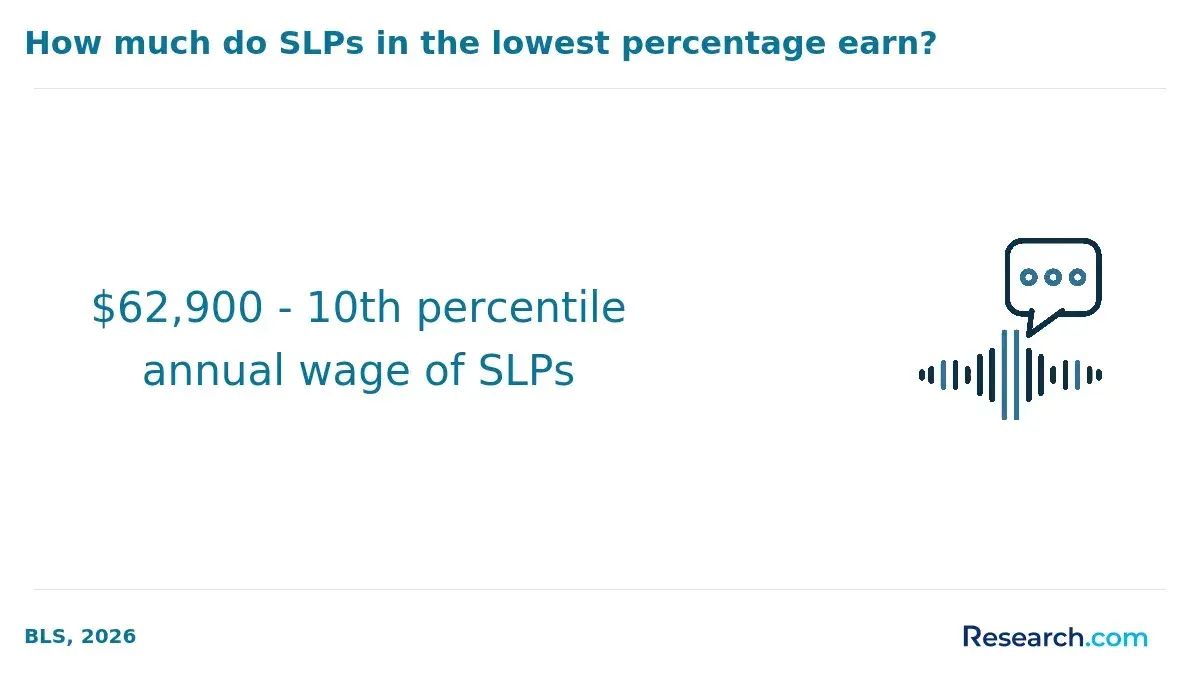
Speech-language pathologists work in settings including schools, healthcare facilities, and private practice. The U.S. Bureau of Labor Statistics reports a median annual wage of $97,870 in May 2025 for the occupation as a whole. That figure is not a starting salary, a program-specific outcome, or evidence that online and campus graduates receive equal offers. Location, setting, experience, and employment terms matter.
BLS projects 17% employment growth for speech-language pathologists from 2025 to 2035. That outlook supports investigating the career, but it cannot predict openings in your preferred city or specialty. If healthcare work is your goal, compare placement opportunities and local employers rather than assuming that a higher reported medical speech-language pathologist salary will be available immediately after graduation.
Debt outcomes are even harder to compare by format because students borrow different amounts and receive different aid. Estimate your own total borrowing - including prerequisite study and living expenses - and compare it with realistic pay for the setting where you intend to work. Treat a school's employment or salary claim cautiously unless it identifies the graduates counted, the reporting period, and the type of work included.
Which speech pathology format best fits working students, campus learners, and future clinicians?
Choose the program whose complete schedule, clinical model, cost, and state eligibility work for you - not the format with the most appealing label. An online program may fit someone who must remain in their community and has a workable local placement plan. A campus program may fit someone who values routine in-person instruction and can afford to live near its training sites.
For a working applicant, the decisive question is how much employment remains feasible once clinical rotations begin. For an applicant seeking frequent in-person contact, ask how much teaching and supervision actually occurs on campus. Either applicant should examine recent completion and employment reports alongside the support available when plans change. Consider assessing readiness for speech pathology graduate school before choosing an accelerated or otherwise demanding schedule.
Before accepting an offer, compare written answers from your finalists on total cost, expected pace, placement responsibility, required travel, accreditation status, and licensure disclosures for your intended state. If a school cannot clarify one of those decision-critical points, keep the uncertainty in your comparison rather than filling it with a favorable assumption.
References:
- U.S. Bureau of Labor Statistics - Speech-Language Pathologists https://www.bls.gov/ooh/healthcare/speech-language-pathologists.htm
- ASHA EdFind - Accredited Speech-Language Pathology Programs https://find.asha.org/ed/
- O*NET OnLine - Speech-Language Pathologists https://www.onetonline.org/link/summary/29-1127.00
- Pepperdine University - Master of Science in Speech-Language Pathology https://healthscience.pepperdine.edu/online-masters-in-speech-language-pathology/
- University of North Carolina at Greensboro - Speech-Language Pathology, M.A. (Online) https://csd.uncg.edu/graduate/masters-of-arts-online/
- Nova Southeastern University - SLP Program - Master of Science in Speech-Language Pathology https://osteopathic.nova.edu/degrees/masters/speech-language-pathology/index.html
- University of Wisconsin-Eau Claire - Master of Science in Speech-Language Pathology (Online) https://www.uwec.edu/speech-language-and-hearing-sciences-department/graduate-program/speech-language-pathology-online
- California State University-Northridge - Master of Science in Communicative Disorders (Online) https://tsengcollege.csun.edu/programs/CDS
Other Things You Should Know About Speech Pathology
Possibly during some coursework, but daytime clinical placements may make full-time work impractical. Ask for a term-by-term schedule that includes live classes and clinical hours before relying on continued income.
The outcome depends on the school's placement policy. You might need to travel, accept another setting, or delay a rotation. Ask who is responsible for finding an alternative and whether a delay changes tuition or your graduation date.
Only if the programs use comparable cohort dates and definitions. Request the number of students counted and ask whether the figure measures on-time or eventual completion.
It can be, especially if the pace lets you work or borrow less. Compare total tuition and fees, living and travel costs, potential lost income, and the timing of entry into paid clinical work - not tuition alone.