2027 Communication Disorders Degree Outlook Through 2030: Enrollment, Salary, and Hiring Projections

Co-Founder and Chief Data Scientist

Reviewed by Rhea Paul, PhD
SLP Education & Research Expert
A communication disorders degree can lead to several careers, but the degree you choose determines which jobs you can pursue - and how much additional training you will need. If you are weighing tuition, graduate admission, and future demand, a promising job market alone is not enough to settle the decision.
This guide separates published labor projections from what can reasonably be said about 2030, compares career paths and work settings, and shows prospective students how to check whether a program supports their intended license and budget.
Key Things You Should Know
- The U.S. Bureau of Labor Statistics (BLS) projects 17% growth in speech-language pathologist employment from 2025 to 2035, with about 12,500 openings annually; these are national projections, not a count of jobs available to each graduate in 2030.
- The May 2025 median annual wage for speech-language pathologists was $97,870. It is a benchmark for the occupation, not an entry-level salary or a pay estimate for everyone with a communication disorders degree.
- A bachelor's degree can support some assistant and related roles, but independent speech-language pathology generally requires a qualifying master's degree and state licensure; audiology generally requires a clinical doctorate and state licensure.
- What is the 2030 outlook for communication disorders enrollment, pay, and hiring? Outlook Snapshot
- How fast are speech-language pathology and audiology jobs projected to grow? Job Growth
- What salary ranges can communication disorders graduates expect by role and setting? Salary Ranges
- Which communication disorders specialties are driving the strongest labor demand? High-Demand Roles
- What data sources and assumptions underlie these projections? Methodology
What is the 2030 outlook for communication disorders enrollment, pay, and hiring?
The outlook through 2030 is favorable for qualified speech-language pathologists, but it is not a single forecast for every communication disorders graduate. BLS projects strong national SLP employment growth across 2025-2035. It does not follow that enrollment, wages, or vacancies will rise at the same rate in every year or location.
For prospective students, the central distinction is between demand for licensed clinicians and access to the education required to become one. A bachelor's program may be an appropriate first step, but applicants should examine graduate prerequisites, clinical training arrangements, and total cost before treating projected SLP demand as their expected return on investment. Comparing affordable online SLP program rankings can help start a cost search; verify each school's current tuition, fees, travel requirements, and clinical placement costs directly.
Pay is also unlikely to follow a uniform path to 2030. Employer, region, experience, work schedule, and specialty affect offers. Use the published occupational median as context, then compare actual local postings and program costs rather than assuming that a future graduate will earn the median immediately.
How fast are speech-language pathology and audiology jobs projected to grow?
BLS projects speech-language pathologist employment to grow 17% from 2025 to 2035, much faster than the average for all occupations. That longer-range projection supports a positive outlook through 2030, but it is not a separate, verified 2030 growth rate.
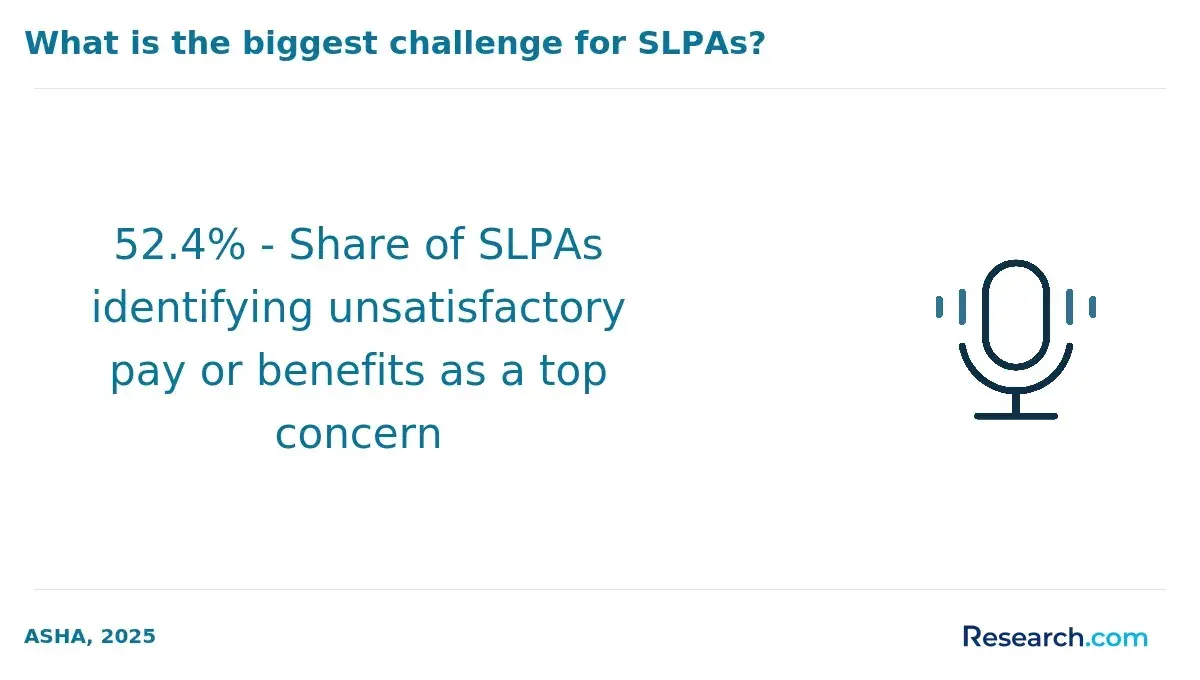
BLS also projects about 12,500 SLP openings per year on average over that decade. Openings include positions arising when workers leave the occupation or labor force as well as those associated with growth; they should not be interpreted as newly created jobs or positions open to new graduates alone.
Audiology has a distinct labor market and credential path. Audiologists assess and treat hearing and balance disorders, typically with a clinical doctorate. Readers comparing it with SLP should check the current BLS audiologist outlook separately rather than applying the SLP growth figure to audiology. In either field, a national projection cannot establish the number of openings near a particular school or home.
What salary ranges can communication disorders graduates expect by role and setting?
There is no responsible single salary range for all communication disorders graduates: an assistant, a licensed SLP, and an audiologist hold different credentials and work in different labor markets. The verified national benchmark here is the BLS May 2025 SLP median annual wage of $97,870, equivalent to $47.05 per hour. Half of employed SLPs earned more than the median and half earned less; it is not a starting-pay quote.
This comparison identifies which pay data to seek before evaluating an offer. A role's credential requirements matter as much as the setting in which the work takes place.
| Role | Typical credential distinction | Useful pay comparison |
| Speech-language pathologist | Qualifying master's degree and state licensure | Compare offers with BLS SLP occupational wages and local employer postings. |
| Audiologist | Clinical doctorate and state licensure | Use audiologist-specific wage data; do not substitute the SLP median. |
| Speech-language pathology assistant | Requirements vary by state and employer; works under required supervision | Compare assistant-specific postings, hours, and benefits rather than clinician salaries. |
School-year schedules, hourly arrangements, benefits, productivity expectations, and year-round clinical positions can make headline salaries misleading. For a closer comparison of SLP compensation by employer type, examine the full offer - including paid hours and benefits - rather than base pay alone.
Which communication disorders specialties are driving the strongest labor demand?
Demand for communication care spans children and adults, including speech, language, swallowing, hearing, and balance needs. For SLPs, school-based services and adult medical care represent different sources of opportunity: schools serve students whose needs affect learning and participation, while medical settings treat conditions such as stroke-related communication or swallowing difficulties. Aging and the need for services across age groups help explain why the occupation has a strong national outlook.
That does not establish a reliable national ranking of the fastest-growing specialties. BLS projects occupations, not every SLP practice niche. A student interested in pediatric language, augmentative and alternative communication, dysphagia, or hearing care should compare regional job postings and clinical placement options for that focus. Choose a program that provides relevant supervised experience without assuming that a specialty label guarantees hiring or higher pay.
How do bachelor's, master's, and doctorate pathways affect career outcomes?
The right degree depends on the job you want to be licensed to perform. A communication sciences and disorders bachelor's degree can build prerequisites for graduate study and may support certain supervised assistant or related roles, but it is not a substitute for the professional degree required to practice independently as an SLP or audiologist.
The pathways below show where further study becomes necessary. Exact prerequisite, clinical, and licensing rules depend on the program and state.
| Pathway | Potential direction | Key limitation to check |
| Bachelor's in communication sciences and disorders | Graduate preparation; some assistant or related positions | Does not by itself qualify someone for independent SLP or audiology practice. |
| Qualifying SLP master's | Preparation for SLP licensure and supervised clinical practice | Check accreditation, clinical training, state requirements, and any post-degree steps. |
| Clinical audiology doctorate | Preparation for audiologist licensure | Requires a longer, audiology-specific training commitment. |
Students changing majors may need leveling coursework before an SLP master's. Online SLP bridge programs for working adults are worth investigating when prerequisite access and scheduling are the main obstacles, but their credits, costs, and acceptance by a target master's program should be confirmed in advance. Compare the total route to eligibility, not just the price or length of the next degree.
Which states are likely to offer the best opportunities for graduates?
No state is universally best. A state with many positions may also have substantial competition, high living costs, or licensing steps that differ from those in the state where you trained. Conversely, a smaller market may offer openings that fit a graduate's specialty or preferred setting.
For a state comparison, start with BLS state employment and wage data, then review current openings by employer type and the state licensing board's requirements. Compare wages with housing and transportation costs, and ask employers about supervision, caseload, and benefits. If you intend to move after graduation, check whether the program meets the destination state's educational requirements before enrolling; online access to classes does not establish eligibility to practice there.
How do public schools, hospitals, clinics, and telehealth settings compare?
These settings can offer different clinical populations, schedules, and support structures. The best fit depends on whether you want school-based services, medically focused practice, varied outpatient work, or remote service delivery - not simply on which setting advertises the highest salary.
This table highlights practical differences to investigate when comparing placements and first jobs; conditions vary among employers.
| Setting | Common work focus | Offer or placement detail to examine |
| Public schools | Student communication needs and educational participation | Caseload, school-year pay structure, and mentorship |
| Hospitals | Acute or rehabilitation-related communication and swallowing care | Medical training, scheduling, and supervision |
| Outpatient clinics | Care that varies by clinic and patient population | Cancellation policies, productivity expectations, and benefits |
| Telehealth | Remote services where clinically appropriate and permitted | Patient location, applicable licensure rules, technology, and clinical support |
Telehealth expands the range of service models but does not erase licensing or clinical-placement requirements. If speed of completion is important, examine career preparation in accelerated online SLP programs alongside placement quality and workload. A shorter academic schedule is valuable only if it still lets you complete required training and prepare for the setting you want.
What enrollment trends are shaping communication disorders programs today?
Interest in an occupation and enrollment in its degree programs are different measures. Changes in applicants, admitted students, and completed degrees can also point in different directions. Without a consistent, recent program-level series, it would be misleading to claim a precise nationwide communication disorders enrollment trend through 2030.
What applicants can evaluate now is capacity: graduate programs must arrange appropriate clinical education as well as coursework, and admission to a bachelor's program does not reserve a graduate seat. Online delivery may make classes easier to reach, but students still need to establish how supervised placements will work. Applicants exploring accessible SLP graduate programs should compare published prerequisites and selection criteria, then ask programs about placement support and recent cohort outcomes; an apparently accessible admission path is not necessarily an easy route to licensure.
For a fuller view of enrollment, compare the same measures across years using ASHA academic program reporting and federal education data. Avoid treating a single school's application volume as proof of national growth or decline.
How do certification, licensure, and CAA accreditation affect employability?
State licensure is legal permission to practice under that state's rules. Professional certification, such as ASHA's Certificate of Clinical Competence where relevant, is a separate credential that an employer may value or require. CAA accreditation evaluates eligible graduate programs in speech-language pathology and audiology; it is not a license issued to a graduate. School-based positions may also involve state education-agency requirements.
Before applying, check the program's current status directly with the Council on Academic Accreditation, then compare its written professional-licensure disclosure with the rules of the state where you plan to work. The same accreditation checks for the fastest online SLP programs matter for any delivery format. Do not assume that institutional accreditation, online enrollment eligibility, CAA status, and state licensure compatibility mean the same thing.
A useful question for admissions is: "What educational and clinical requirements will this program satisfy for the license I intend to seek, and which requirements will remain after graduation?" Request the answer for your intended state in writing, particularly if you may move.
What data sources and assumptions underlie these projections?
The SLP wage, growth, and openings figures in this guide are BLS occupational figures: the wage refers to May 2025, and the employment projection covers 2025-2035. They describe U.S. workers and national projections, not graduate starting salaries, local vacancies, or measured outcomes in 2030. The guide does not calculate a separate 2030 employment, enrollment, or salary forecast from them.
BLS Occupational Outlook Handbook data are suited to national career comparisons; its employment and wage data can help with geographic comparisons when the series and reference period match. ASHA academic reporting and federal postsecondary data can inform enrollment questions, while the CAA, individual schools, and state boards are the appropriate places to verify program status and practice requirements. Because those sources measure different populations and periods, their figures should not be combined into a promised return on a particular degree.
For an enrollment decision, pair these broad indicators with a school's current total cost, prerequisite policy, clinical placement arrangements, accreditation status, and written licensure disclosures. That check is more informative than projecting a national median wage onto your first job.
References
- U.S. Bureau of Labor Statistics - Speech-Language Pathologists https://www.bls.gov/ooh/healthcare/speech-language-pathologists.htm
- ASHA EdFind - Accredited Speech-Language Pathology Programs https://find.asha.org/ed/
- O*NET OnLine - Speech-Language Pathologists https://www.onetonline.org/link/summary/29-1127.00
- Ithaca College - Online Master of Science in Speech-Language Pathology https://slponline.ithaca.edu/programs/masters-speech-language-pathology-online
- California State University-East Bay - Online Master of Science in Speech-Language Pathology https://ce.csueastbay.edu/programs/speech-language-pathology/
- West Virginia University - Speech-Language Pathology, M.S. - Online https://medicine.hsc.wvu.edu/communications-sciences-and-disorders/speech-language-pathology-ms/future-students/curriculum/online-slp-program/
- Baylor University - Master of Science in Speech-Language Pathology (Online) https://csd.robbins.baylor.edu/graduate/online-csd-graduate-program
- Abilene Christian University - Master of Science in Speech-Language Pathology (Online) https://acu.edu/academics/graduate/master-of-science-in-speech-language-pathology/
Other Things You Should Know About Speech Pathology
Generally, no. Independent SLP practice typically requires a qualifying master's degree and state licensure. A bachelor's degree may prepare you for graduate admission or certain supervised assistant roles, subject to state rules.
Delivery format alone does not establish professional eligibility. Check the program's current CAA status, clinical training model, and whether it meets the educational requirements for your intended state license.
No. The median includes workers at different career stages and is not a first-job offer. Compare your full borrowing costs with local pay, expected hours, and the time needed to qualify for licensure.
Review that state board's requirements before choosing a program and again before applying for licensure. Ask the school for its state-specific disclosure; completing a degree or holding a credential elsewhere does not automatically authorize practice in your destination state.