World Ranking of Female Scientists in 2024 (3rd Edition)

Co-Founder and Chief Data Scientist
Research careers are shaped by more than talent. Visibility, funding access, institutional support, publication opportunities, mentorship, and family-friendly policies all influence who rises to the top of scientific fields. On August 8, 2024, Research.com published the 3rd edition of its annual online ranking of the best female scientists in the world to recognize women whose research has had measurable global impact.
This guide explains what the 2024 ranking shows, how readers should interpret it, where leading female scientists are concentrated, which institutions and disciplines are most represented, and what the data suggests about persistent gender gaps in research. It is intended for students considering STEM careers, women in academia, university leaders, research funders, policymakers, and anyone evaluating how scientific recognition is distributed across countries, institutions, and fields.
Quick Answer: What Does the 2024 Ranking Show?
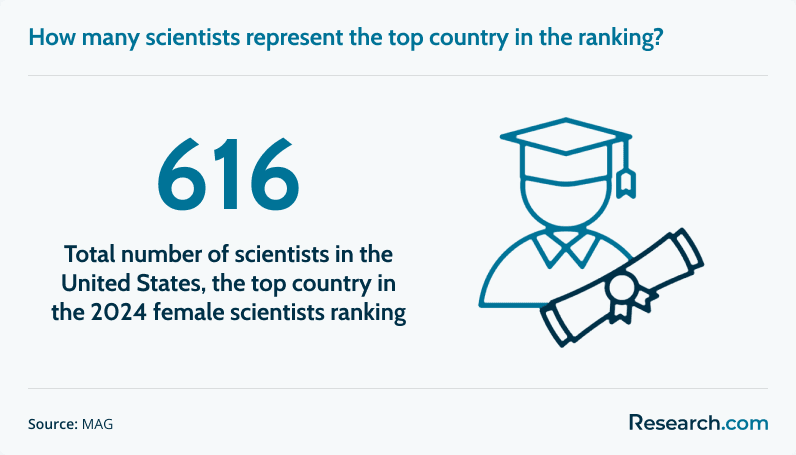
The 2024 Research.com ranking highlights the top 1000 female scientists worldwide based on bibliometric indicators, discipline relevance, awards, and achievements. The United States has the largest representation, with 616 ranked scholars, accounting for 61.6% of the full ranking. Harvard University leads all institutions with 42 affiliated female scientists. Professor JoAnn E. Manson of Harvard Medical School ranks as the best female scientist in the world, recognized for her influential work in epidemiology, endocrinology, and women’s health.
The full ranking is available here: 2024 ranking of the top female scientists in the world.
Key Findings from the 2024 Ranking of Female Scientists
| Finding | What the 2024 data shows | Why it matters |
| Country concentration | The United States accounts for 616 ranked scholars, or 61.6% of the whole ranking. | The ranking reflects the strength of U.S.-based research infrastructure, funding systems, and institutional visibility. |
| Other leading countries | The UK has 92 scientists, or 9.2%, and Germany has 39 scientists, or 3.9%. | These countries remain major contributors to high-impact research by women scientists. |
| Top 1% representation | Eight out of 10 female scientists in the top 1% are from the United States. | The highest-impact segment of the ranking is especially concentrated in U.S.-affiliated institutions. |
| Leading institution | Harvard University has 42 leading female scholars in the ranking. | Institutional resources, research networks, and long-term support can influence scientific visibility. |
| Top-ranked scientist | Professor JoAnn E. Manson from Harvard Medical School ranks first globally. | Her work in epidemiology, endocrinology, and women’s health illustrates the influence of long-term, high-impact medical research. |
| Institutional geography | 9 out of 10 institutions with the highest number of leading female scientists are based in the US; the University of Oxford is the only non-U.S. institution among them. | The institutional distribution shows how concentrated elite research recognition remains. |
| Publication output | The average number of publications for top female scientists is 630.57. | Publication volume is not the only measure of impact, but it is one indicator of sustained research productivity. |
How to Use This Ranking Responsibly
A scientist ranking can be useful, but it should not be read as a complete measure of scientific worth. Bibliometric indicators can identify influential researchers and institutions, yet they may also reflect differences in discipline norms, funding access, team size, publication culture, citation practices, and institutional visibility.
Students can use the ranking to identify role models, research-active universities, and potential graduate study environments. Researchers can use it to understand disciplinary and geographic patterns. University leaders and policymakers can use it to evaluate where support systems appear to be producing visible outcomes—and where gaps remain.
Best uses of the ranking
- Identifying prominent women scientists in specific fields and regions.
- Finding institutions with strong records of supporting high-impact women researchers.
- Understanding where female scientific leadership is most visible.
- Starting conversations about equity, recognition, funding, mentorship, and retention.
Limits readers should keep in mind
- The country assigned to a scientist is based on the affiliated research institution, not necessarily nationality.
- Publication and citation patterns vary by discipline, so comparisons across fields require caution.
- Rankings cannot fully capture mentoring, teaching, public service, community impact, or institutional labor.
- Underrepresentation may reflect structural barriers rather than differences in ability or ambition.
Bias Against Women in Research
Gender bias in research has not disappeared, even as more women enter scientific careers and earn recognition for major discoveries. The problem is not limited to one hiring committee, one grant agency, or one country. It can appear in funding decisions, salary structures, teaching evaluations, promotion practices, authorship norms, family-leave policies, networking access, and informal expectations about who has time to lead major projects.
Karen Schmaling, a psychology professor at Washington State University, Vancouver, has emphasized that diversity is closely connected to creativity and scientific progress. Her point is direct: when gender, race, ethnicity, and nationality are not adequately represented in science, the scientific enterprise itself may be affected.
Evidence on bias is complex. One analysis reviewed 55 studies on grant awards published between 2005 and 2020 and examined data from more than 1.3 million grant applications worldwide, most of them from the US and Europe. The review found that men generally requested more money than women in grant applications. It also found that women still received less funding even when men and women requested similar amounts, suggesting that bias can remain even after request size is considered.
The broader research literature on gender equality in academic science shows a mixed but important pattern. A synthesis of studies from 2000 to 2020 examined tenure-track hiring, grant funding, teaching ratings, journal acceptances, salaries, recommendation letters, and journal productivity. The findings did not support a simple claim that women are disadvantaged in every process at all times. Instead, tenure-track women were found to be at parity with men in grant funding, journal acceptances, and recommendation letters, and advantaged in hiring. At the same time, bias against women remained visible in teaching ratings and salaries; salary gaps were smaller than often claimed, but still meaningful.
The practical lesson is that institutions should avoid both denial and oversimplification. Transparent review criteria, salary audits, equitable funding processes, structured mentorship, childcare support, and inclusive departmental cultures can reduce barriers that accumulate over a career. Recognition rankings matter, but they are only one part of a larger system that determines whether women scientists can enter, stay, lead, and thrive.
Countries with the Best Female Scientists
The 2024 ranking shows large differences in the number of top-ranked female scientists by country. These differences are shaped by research funding, institutional capacity, national policy, cultural expectations, and the availability of career support for women in science.
| Country | Number of ranked female scientists in 2024 | Context from the ranking |
| United States | 616 | The United States increased from 609 scientists in 2023 to 616 in 2024, representing 61.6% of the whole ranking. |
| United Kingdom | 92 | The UK ranks second, with four fewer scientists than the previous year. |
| Germany | 39 | Germany remains third and increased from 37 scientists in 2023 to 39 in 2024. |
| Australia | 33 | Australia’s representation is supported by gender-equity efforts such as the Science in Australia Gender Equity program. |
| Canada | 32 | Canada is tied with France in the number of ranked female scientists. |
| France | 32 | France’s representation reflects continued policy and institutional attention to gender equity in research. |
| Italy | 28 | Italy increased from 26 scientists in 2023 to 28 in 2024, with support from broader European initiatives such as Horizon 2020. |
| Netherlands | 27 | The Netherlands benefits from efforts by the Dutch Research Council to support female researchers. |
| China | 14 | China is making progress through national programs intended to improve gender equity in research. |
| Finland | 12 | Finland joined the top 10 in 2024, replacing Spain. |
The country attached to each scientist in the ranking reflects the affiliated research institution, not the scientist’s nationality. This distinction matters because international mobility is common in academic science, and many leading researchers work outside their country of birth or citizenship.
Business ethics and sustainability professor Ingrid S. Greene of Loyola Marymount University argues that stronger institutional policies are essential for women researchers. She notes, “Unfortunately, the challenges of balancing career and family responsibilities can disproportionately affect women, especially in fields with demanding schedules. This can lead to career interruptions or reduced productivity. In the U.S., there are still inadequate parental leave policies and lack of support for work-life balance that can hinder women’s career progression.”
Greene recommends “more family-friendly policies, including flexible work hours, comprehensive parental leave, and support for childcare.” She also supports “the expansion of mentorship and networking opportunities specifically for women that can help them navigate career challenges and gain essential support.” Her comments point to a central issue: national output is not only about money and laboratories; it is also about whether researchers can build long careers without being forced out by avoidable structural barriers.
Institutions with the Best Female Scientists
Top institutions in the 2024 ranking tend to have large research ecosystems, extensive funding networks, strong graduate and postdoctoral pipelines, and broad international visibility. Harvard University leads the ranking with 42 female scientists in the top 1000, adding two more scientists from the 2023 ranking. The National Institutes of Health follows with 34 scholars, one more than the previous year.
| Institution | Number of ranked female scientists | Ranking context |
| Harvard University | 42 | Ranks first among institutions in the 2024 list. |
| National Institutes of Health | 34 | Ranks second and added one scientist compared with the previous year. |
| Stanford University | 27 | Ranks third, supported by strong research programs and interdisciplinary work. |
| University of California-San Francisco | 24 | Increased from 22 scientists in 2023, with particular strength in medical and biomedical research. |
| University of Pennsylvania | 17 | Ranks fifth and reflects a broad research environment. |
| University of Oxford | 16 | Maintained the sixth spot and is the only non-American institution in the top 10. |
| Columbia University | 16 | Moved from fifth to seventh place. |
| MIT | 16 | Shares the same number of ranked female scientists as the University of Oxford and Columbia University. |
| Yale University | 14 | Ranks ninth in the institutional list. |
| Duke University | 13 | Completes the top ten institutions in the ranking. |
For prospective graduate students and early-career researchers, these institutional counts can be a useful signal—but not the only one. A university with many highly ranked scientists may offer strong networks and research resources, but applicants should also examine lab culture, advisor availability, funding guarantees, family-support policies, publication expectations, and placement outcomes.
Career Sustainability for Women Scientists: Why Lifelong Learning Matters
Scientific careers now demand more than deep expertise in a single topic. Researchers often need skills in data analysis, grant writing, scientific communication, research management, ethics, interdisciplinary collaboration, and leadership. Lifelong learning can help women scientists remain competitive, especially when career interruptions, changing technologies, or institutional barriers affect momentum.
Online, hybrid, and short-format learning can be useful when it is chosen strategically. A researcher might use continuing education to learn advanced analytics, update laboratory methods, prepare for a leadership role, or move into a related sector such as biotechnology, public health, data science, science policy, or consulting. Cost and relevance matter. For example, Research.com’s guide to a low-cost medical billing and coding online program illustrates how short, affordable online options can support career redirection or supplemental skills, though such programs should be evaluated carefully for fit with a scientist’s goals.
Can Certification Programs Improve Career Options for Female Scientists?
Certificate programs can be valuable when they fill a specific skills gap. They are most useful when a scientist can clearly connect the credential to a career outcome: managing clinical research, supervising teams, entering regulatory affairs, learning bioinformatics, improving data analysis, or preparing for industry roles. They are less useful when chosen only because they appear fast or popular.
| Career goal | Useful certificate focus | Decision question |
| Move into industry research | Project management, regulatory affairs, biotechnology operations, data tools | Does the credential match job descriptions in the target industry? |
| Strengthen academic competitiveness | Grant writing, research methods, advanced statistics, leadership training | Will the training improve research output, funding success, or lab leadership? |
| Transition to applied data roles | Programming, analytics, machine learning foundations, visualization | Does the program include hands-on projects that can be shown to employers? |
| Prepare for management | Team leadership, budgeting, communication, research administration | Will the credential help demonstrate readiness for supervisory responsibility? |
Professionals considering shorter training options can review Research.com’s guide to 6-month certificate programs that pay well, but they should compare each program’s curriculum, employer recognition, cost, time commitment, and relevance to their scientific field before enrolling.
Effective Mentorship Strategies for Female Scientists
Mentorship is most effective when it is structured rather than informal and accidental. Women scientists benefit from multiple forms of guidance: research mentorship, sponsorship for visibility, peer support, leadership coaching, grant-writing feedback, and career-transition advice. A single mentor rarely provides all of these forms of support.
Elements of a strong mentorship model
- Clear goals: The mentee and mentor should define what the relationship is meant to improve, such as publication strategy, funding applications, promotion readiness, or leadership development.
- Regular meetings: Scheduled conversations help prevent mentorship from becoming a vague promise rather than an actual support system.
- Feedback loops: Mentors should provide specific, actionable feedback, and mentees should be able to identify what is working and what is missing.
- Sponsorship: Senior researchers can open doors by nominating women for talks, awards, committees, collaborations, and leadership roles.
- Peer networks: Cohorts and writing groups can reduce isolation and help researchers share practical strategies.
Digital learning can also support mentoring capacity. For experienced professionals who want to update their skills or stay engaged in teaching and advising, Research.com’s guide to online degree programs for seniors shows how later-career learners can use flexible education to remain active in evolving academic and professional environments.
High-Paying Career Opportunities Beyond Traditional Academia
Women scientists are increasingly applying research skills outside tenure-track academia. Biotechnology, data science, consulting, public health, healthcare analytics, government research, science policy, product development, and research administration can all value advanced scientific training. These paths may offer different trade-offs: more structured advancement in some cases, less academic freedom in others, and different expectations around speed, teamwork, and deliverables.
Readers exploring compensation-focused options can use Research.com’s guide to high-paying jobs for women as a starting point. For scientists specifically, salary potential should be weighed alongside research autonomy, job stability, work-life fit, publication expectations, and long-term advancement.
Can Alternative Educational Pathways Support Career Progression?
Alternative education models can help researchers upskill without leaving the workforce, but they should be evaluated carefully. Online degrees, executive programs, project-based doctorates, and nontraditional doctoral formats may appeal to working scientists who need flexibility. However, not every pathway carries the same academic weight, employer recognition, or suitability for research-intensive roles.
For some professionals, a nontraditional doctoral format may align with applied leadership goals. Research.com’s guide to the easiest PhD without dissertation can help readers understand how these programs differ from conventional research doctorates. Scientists who plan to pursue faculty roles, grant-funded research, or discipline-specific academic appointments should verify whether a program’s structure meets expectations in their field.
Online Platforms Expanding the Reach of Women Scientists
Online education, webinars, virtual lab tours, open lectures, and digital research communities can make women scientists more visible to students who might not otherwise meet scientific role models. This matters because representation can influence whether students imagine themselves belonging in STEM.
Research on the impact of female instructors shows that including women instructors can meaningfully encourage female students’ interest in STEM disciplines. For schools and universities, this suggests that representation should not be treated as symbolic; it can affect motivation, persistence, and students’ sense of possibility.
Digital platforms also allow students from different regions to connect with leading female scientists through online talks, laboratory demonstrations, mentoring events, and programs hosted by academic institutions or women-focused professional groups. These experiences can help students build confidence, ask practical questions, and develop early professional networks.
Another study on women in STEM education found that, compared with male students, female students spent less time using laboratory equipment and more time recording and taking notes. The study also found that female students were not aware of this behavior. The researchers argued that this lack of awareness may indicate that women are being placed into stereotypically gendered roles in STEM labs. Over time, spending less time on core technical tasks can affect confidence, skill development, and future research roles.
Meredith A. Rausch, an associate professor of education and human development who studies underserved populations, connects this issue to early self-efficacy. She explains, “Early on, we are not including girls in STEM education as much as we could. Girls in elementary school may not be as inclined towards mathematics or the sciences due to a lack of self-efficacy in these areas. While we are creating more opportunities than ever for girls in K-12 (e.g., Girls Who Code), we certainly are not addressing the lack of self-efficacy in statistics, math, and the sciences. By creating confidence early on and addressing the academic hesitancies or hang-ups, we can change the future of research.”
Scientific Disciplines Represented by the Best Female Scientists
Medicine is the most represented field in the 2024 ranking. Among the top-ranked scholars, 468, or 46.8%, publish primarily in medicine. This concentration reflects the scale, funding, citation activity, and global importance of medical and health-related research. Other prominent areas include physics, with 10.5% of ranked scholars; immunology, with 4.2%; and psychology, with 3.4%.
Medicine is even more dominant among the top 1% of female scientists, where seven out of ten scholars focus their work in the field. Psychology and physics are also represented in the top 1%, showing that high-impact female researchers are making major contributions across different scientific areas.
At the same time, women remain underrepresented in several STEM fields. In engineering and architecture, women make up only 16.7% of the workforce. In computer and mathematical occupations, the figure is 26.9%. In chemistry and materials science, women represent 36%. These gaps matter not only for representation but also for earnings: as of 2024, women in STEM careers are paid 87% of the wages of their male counterparts, or 13% less.
The chart below provides additional context on the percentage share of women in selected STEM occupations as of 2023.
H-Index Ranking: Research Impact, Regional Leaders, and Output
The h-index is one measure of research impact. It combines productivity and citation influence, but it is not a perfect measure of scientific contribution. It can be affected by field size, citation norms, coauthorship patterns, and the length of a researcher’s career. Still, it is widely used as one indicator of scholarly influence.
| Region or category | Leading scientist or metric | Ranking detail |
| World and North America | Professor JoAnn E. Manson, Harvard Medical School | Ranks first globally and leads with an h-index of 310. |
| Europe | Professor Kay-Tee Khaw, University of Cambridge | Ranks fourth globally with an h-index of 213. |
| Oceania | Professor Louisa Degenhardt, University of New South Wales | Ranks 123rd in the world ranking. |
| Asia | Professor Jun Yu, Chinese University of Hong Kong | Has an h-index of 115 and ranks number 421 globally. |
| Africa | Professor Linda-Gail Bekker, University of Cape Town | Ranks number 658 in the top 1000 list. |
| South America | Professor Maria-Teresa Dova, National University of La Plata | Ranks number 47 among female scientists globally. |
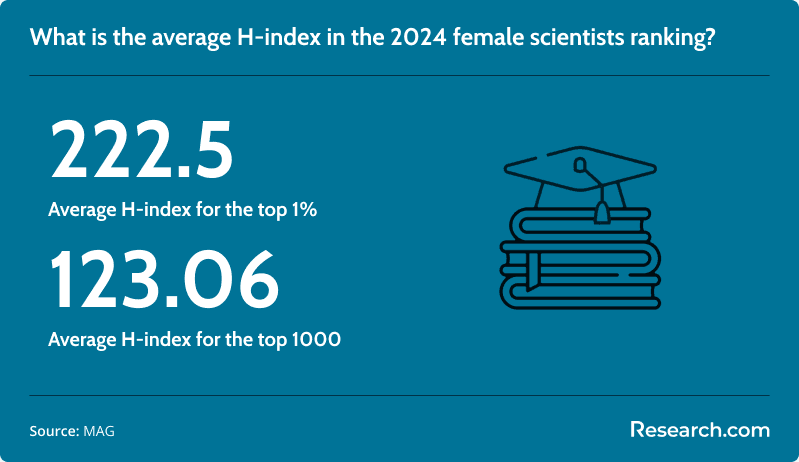
The top 1% of scientists in the ranking have an average h-index of 222.5, compared with 123.06 for the full top 1000 female scientists. The scholar with the lowest index value who made it to the ranking in 2023 has an h-index of 101.
Publication and citation output also show the scale of influence among the highest-ranked scientists. The average number of published articles is 1433.8 for the top 1% and 630.57 for the top 1000 female scholars. The average number of citations is 244,017.7 for the top 1% and 73,007.49 for the top 1000 female scholars. The most frequently cited female scientist is Emelia J. Benjamin from Boston University, with 411,646 citations.
Readers can review the ranking process in more detail on Research.com’s methodology page.
How the 2024 Ranking Was Developed
For the 2024 ranking, Research.com analyzed more than 166,880 scientist profiles across 24 academic disciplines. The analysis drew on bibliometric sources including OpenAlex and CrossRef and considered multiple indicators before determining whether a scientist qualified for inclusion.
The eligibility threshold was applied consistently across scientific fields and commonly fell within the range of 30 to 40. Selection for the ranking considered a scholar’s h-index, the relevance of the scholar’s contributions to the chosen discipline, and awards and accomplishments.
Because rankings depend on available data, they should be read as structured indicators rather than absolute judgments. They are valuable for identifying highly visible and influential researchers, but they cannot fully capture teaching, mentoring, public engagement, institutional service, or the barriers that may have shaped a scientist’s career path.
Institutional Barriers and Retention of Women Researchers
Recognition is important, but the long-term goal is not only to celebrate women who have already overcome barriers. The larger challenge is to reduce the barriers that prevent talented women from advancing in the first place.
Joann Farrell Quinn, a professional development professor from the University of Southern Florida, identifies systemic expectations as a major obstacle: “Women tend to still be the default to pick up the slack in a family, which limits time and attention to professional efforts, regardless if they are in academia or not. I would love to spend more time on my research, but I am not willing to sacrifice myself or my family to do so. While that is my own choice, I find that others may not make the same choices, and more often than not the men put more emphasis on and allocate more time to work.”
Quinn argues that support should be broader than technical training alone. She has designed emotional and social competency-based assessments intended to evaluate individuals on a more level playing field. She explains, “Anything we can do to promote women into fields and programs where they continue to be underrepresented and supported will help move the needle. I think both higher education programs and faculty affairs should be putting into place more holistic support for students and faculty—this includes things related to self-awareness and management skills, leadership training and development, time management, etc. We are holistic beings and should be treated as such- not simply accepted or hired for our cognitive abilities alone, which we know are not enough to succeed. I don’t believe anyone should be accepted into a program or into a role they are not qualified for, or ready for, but quite often what may be needed is support that isn’t readily available.”
Retention is a key issue. Based on a study by Elsevier, 39% of early-career researchers are women. As those cohorts become established in their fields, the share of women falls to 27%. This decline indicates that the pipeline problem is not only about entry into research; it is also about whether women receive enough support to remain and progress.
How Interdisciplinary Collaboration Can Support Innovation and Career Growth
Interdisciplinary work can help women scientists expand their influence beyond a single department or discipline. Collaborations across medicine, engineering, data science, public health, social science, policy, and business can create new funding opportunities, broader publication venues, and more visible leadership roles.
However, collaboration should be managed carefully. Women researchers are often asked to perform service-heavy or coordination-heavy roles that do not always translate into authorship, credit, or promotion. Strong collaborations should include clear agreements about leadership, authorship, data ownership, funding responsibilities, and decision-making.
Flexible educational options can support this kind of cross-disciplinary growth. Readers exploring broader academic pathways can review Research.com’s guide to online degrees that can lead to well-paying careers, while keeping in mind that scientists should choose programs based on research relevance, accreditation, employer recognition, and long-term goals.
Institutional Strategies That Improve Long-Term Success for Female Scientists
Universities, research institutes, funders, and departments can take specific actions to reduce gender-based barriers. The most effective strategies are measurable, transparent, and tied to accountability rather than one-time statements of support.
| Institutional strategy | What it should include | Why it matters |
| Transparent funding review | Clear criteria, reviewer training, and monitoring of award patterns | Reduces the risk that bias affects grant size, approval, or resource distribution. |
| Salary and promotion audits | Regular review of compensation, rank, startup packages, lab space, and leadership assignments | Identifies gaps that may not be visible through individual cases. |
| Family-supportive policies | Comprehensive parental leave, flexible scheduling, childcare support, and fair workload planning | Helps reduce career interruptions and uneven caregiving penalties. |
| Structured mentorship and sponsorship | Formal mentoring, peer cohorts, leadership nominations, and grant-writing support | Improves access to networks and advancement opportunities. |
| Equitable workload allocation | Tracking of teaching, advising, service, committee work, and invisible labor | Prevents women from carrying disproportionate service burdens that slow research output. |
| Continuing education access | Support for leadership training, technical upskilling, and flexible learning | Helps researchers adapt as scientific methods and career expectations evolve. |
Some researchers may also use shorter online programs to broaden their skills, although these should be selected carefully. Research.com’s overview of 6-month online associate degree programs can help readers understand accelerated learning formats, but advanced scientists should verify whether any credential is relevant to their career stage and goals.
Common Mistakes When Interpreting Scientist Rankings
- Assuming rankings measure every form of impact. Citation-based indicators do not fully capture mentoring, teaching, policy influence, community engagement, or institutional leadership.
- Comparing fields without context. Medicine, physics, psychology, and engineering have different publication and citation patterns.
- Equating institutional affiliation with nationality. In this ranking, country assignment is based on the affiliated institution, not personal nationality.
- Using rankings as the only factor in choosing a graduate program. Prospective students should also evaluate advisor fit, funding, lab culture, placement, workload, and support policies.
- Ignoring retention barriers. Entry into STEM is not enough if women leave research at higher rates before reaching senior roles.
- Assuming individual achievement eliminates systemic bias. Exceptional success stories can coexist with structural inequities.
Questions Students and Researchers Should Ask Before Choosing a Research Environment
- Are women represented among senior faculty, lab directors, department chairs, and award nominees?
- How are graduate students, postdoctoral researchers, and early-career faculty mentored?
- Are funding packages, lab resources, authorship expectations, and promotion criteria transparent?
- Does the institution offer parental leave, flexible work options, and childcare support?
- Are salary, promotion, and workload patterns reviewed for equity?
- Do women researchers receive support for grant applications, conference visibility, and leadership opportunities?
- Are interdisciplinary contributions valued in hiring, tenure, and promotion decisions?
- Does the department track retention and advancement by gender?
Female Scientists Leading Significant Advancements
The 2024 edition of the top 1000 female scientists ranking shows that women continue to make major contributions across medicine, physics, immunology, psychology, and many other fields. It also shows that recognition remains unevenly distributed across countries, institutions, and disciplines.
Women scientists often advance in environments shaped by male-dominated traditions, unequal caregiving expectations, and inconsistent institutional support. Yet the scientists recognized in this ranking demonstrate sustained research productivity, high scholarly impact, and long-term commitment to discovery.
There are signs of progress. The percentage of female scientists in biological sciences who experienced successful publishing careers rose from 38.8% in 1991 to 55.7% in 2021. During the same period, the proportion of women who received research doctorates in the physical and earth sciences increased from 19.2% to 35.1%.
Continued progress will require more than annual recognition. It will require stronger retention systems, fairer funding and promotion practices, better early STEM confidence-building, and research environments where women can pursue ambitious scientific work without unnecessary structural penalties.
Key Insights
- The United States dominates the 2024 ranking, with 616 female scientists, or 61.6% of the full list.
- Harvard University leads all institutions with 42 ranked female scientists, and Professor JoAnn E. Manson of Harvard Medical School ranks first globally.
- Medicine is the most represented discipline, accounting for 468 ranked scholars, or 46.8% of the top-ranked female scientists.
- Ranking data is useful for identifying visible research excellence, but it should be interpreted alongside discipline norms, institutional resources, and structural barriers.
- Gender bias in research is not uniform across every process, but evidence shows continuing concerns in areas such as salaries, teaching ratings, funding amounts, and career retention.
- Women remain underrepresented in several STEM occupations, including engineering and architecture, computer and mathematical occupations, and chemistry and materials science.
- Institutions can improve long-term outcomes by auditing salary and promotion practices, supporting caregiving needs, formalizing mentorship, tracking workload equity, and expanding leadership opportunities.
- For students and early-career researchers, the best research environment is not simply the highest-ranked institution; it is the place where mentorship, funding, culture, and career support align with their goals.
About Research.com
All research was coordinated by Imed Bouchrika, Ph.D., a computer scientist with an established record of collaboration on international research projects with academic partners. His role was to help ensure that the data remained unbiased, accurate, and up-to-date.
Research.com is a research portal for science and educational rankings. Its mission is to help professors, research fellows, and students advance their research and identify leading experts across scientific disciplines. Research.com also supports students as they compare colleges, academic opportunities, and career paths. Readers can learn more about the methodology used to create this report here.