
World Ranking of Best Female Scientists in 2026 (5th Edition)

Co-Founder and Chief Data Scientist
On October 8, Research.com released the 5th edition of its annual World Online Ranking of Best Female Scientists. The 2026 ranking features 1,000 female scientists selected across scientific disciplines, highlighting researchers whose work has earned recognition through the ranking's bibliometric assessment.
Women continue to make important contributions across fields ranging from medicine and biology to physics, engineering, and the social sciences. The annual report brings these researchers together in a global ranking, allowing readers to compare leading female scientists across disciplines and countries.
The report also provides a view of the researchers represented in the 2026 ranking, including their institutions, fields of study, and research metrics. By presenting the rankings annually, Research.com tracks leading female scientists and their standing in the global research community.
Key Findings for the 2026 World Ranking of Female Scientists
- Scientists from the United States dominate the ranking with 599 researchers, accounting for nearly 60% of the 1,000 scientists ranked. The United Kingdom follows with 93 scientists, while Germany ranks third with 39. Australia (38) and France (32) complete the top five.
- Harvard University has the highest number of leading female scientists with 39, followed by the National Institutes of Health (33) and Stanford University (23).
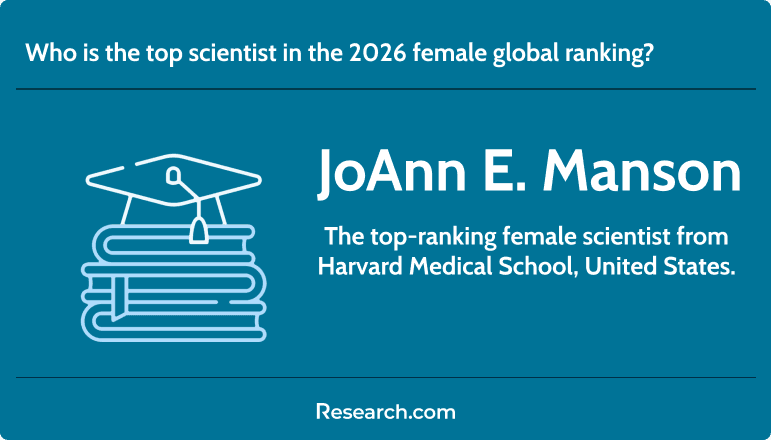
- Professor JoAnn E. Manson of Harvard Medical School in the United States ranks first globally, with a Discipline H-index of 322.
- The average Discipline H-index for the top 1% of scientists is 237.8, compared with 130.27 for all 1,000 scientists in the ranking.
The full ranking for the 2026 list of best female scientists can be found here:
TOP FEMALE SCIENTISTS IN THE WORLD 2026
Women Researchers Are Gaining Ground While Senior Research Roles Lag
Women’s participation in scientific research has expanded in recent years, but progress has not been evenly distributed across disciplines or career stages. More women are entering higher education and research careers, yet their representation often declines as they move into senior research and leadership positions. Looking at both overall researcher participation and authorship roles provides a clearer picture of where progress has been made and where gaps remain.
New findings in 2026 show that women continue to make progress in scientific research, although representation remains uneven across fields and career levels. The latest UNESCO data show that women make up 31.4% of researchers globally, highlighting both women’s growing presence in research and the continued gender gap in scientific careers.
Research published in 2026 also points to persistent differences in scientific leadership. A Nature Index analysis of women's representation in scientific leadership found that women held 29% of first-author positions and 17% of last-author positions in the natural sciences in 2025, with only modest changes over the previous decade. These positions are important indicators of women's participation in leading and supervising research.
Countries with the Highest Number of Leading Female Scientists
The 2026 ranking shows a strong concentration of leading female scientists in a small group of countries. The United States remains the clear leader with 599 scientists, accounting for nearly 60% of the 1,000 scientists ranked. However, this is slightly lower than the 601 scientists recorded in the previous ranking.
The United Kingdom retains second place with 93 female scientists, unchanged from the previous year's count. Germany ranks third with 39, down from 42 previously. Australia moves up to fourth with 38, compared with 35 in the previous ranking.
France ranks fifth with 32 scientists, up from 31, while Canada remains sixth with 31. The Netherlands and Italy each have 27 scientists, although the Netherlands ranks seventh and Italy eighth. China and Spain complete the top 10 with 13 scientists each. China's count is down from 15 in the previous ranking, while Spain remains at 13.
Please note that the country associated with a scientist is based on the affiliated research institution according to MAG, not on their actual nationality.
Institutions with the Highest Number of Leading Scientists
The 2026 ranking places Harvard University first with 39 leading female scientists, followed by the National Institutes of Health with 33 and Stanford University with 23. The University of California, San Francisco, ranks fourth with 20. Harvard's count is down from 39 in the previous ranking, while Stanford declined from 25 and UCSF from 22.
Columbia University, MIT, and the University of Oxford each have 16 scientists. Columbia and Oxford are down from 17 previously, while MIT increased from 15. The University of Pennsylvania remains at 15, while the University of Texas MD Anderson Cancer Center increased from 13 to 14.
Yale University and Mayo Clinic each have 13 scientists, followed by the University of California, Los Angeles, with 12, and the University of Cambridge with 11. Seven institutions have 10 scientists each: Duke University, Brigham and Women's Hospital, the University of Pittsburgh, Icahn School of Medicine at Mount Sinai, the University of Toronto, the University of California, San Diego, and University College London.
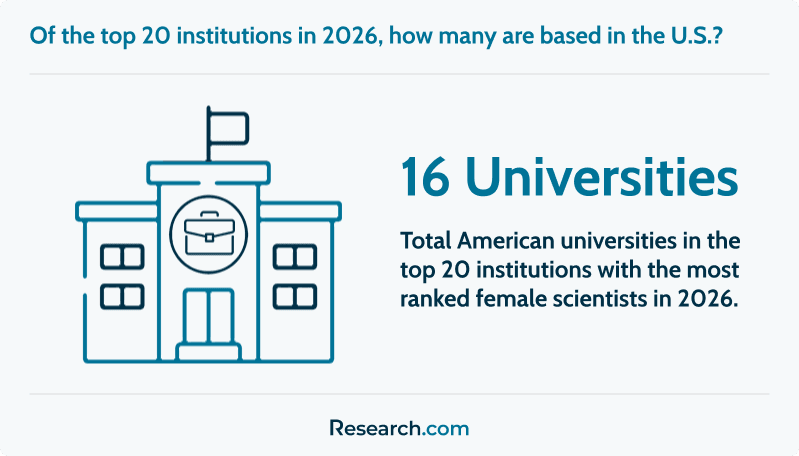
The 2026 top 20 includes institutions from the United States, the United Kingdom, and Canada. U.S. institutions account for 16 of the 20 affiliations, continuing their strong presence among institutions with the highest numbers of leading female scientists.
Online Universities Expand Access to Education for Women in Science
Women are increasingly represented in advanced higher education and online universities, but this progress does not translate evenly into research careers. The OECD 2026 analysis of women in research reported that, in 2023, women accounted for roughly three-fifths of master's graduates and half of doctoral graduates across OECD countries. Yet they are represented by only 35.7% of researchers, a share that remained largely unchanged over the previous decade.
These differences are especially visible in business R&D. Women accounted for only around one-quarter of researchers in business R&D across OECD economies, while their representation in higher education and government research increased more steadily. International mobility also differs. In 2023, women accounted for 45% of internationally mobile doctoral enrolments, up from 42% in 2014.
For online universities, flexible study formats can support women pursuing advanced qualifications while managing other commitments. The OECD data show that women are earning advanced degrees at high rates, even as gaps remain in research participation and career progression.
H-index ranking—leaders, averages, and distribution
Professor JoAnn E. Manson leads North America and the overall ranking, holding the No. 1 world position. She is affiliated with Harvard Medical School in the United States and has an H-index of 322.
With an H-index of 226, Professor Dorret I. Boomsma is the leading female scientist in Europe. She ranks fifth worldwide, with her affiliated institution, Vrije Universiteit Amsterdam, located in the Netherlands.
South America's top-ranked scientist is Professor Maria-Teresa Dova, who holds the No. 41 position globally. She is affiliated with the National University of La Plata in Argentina and has an H-index of 181.
In Africa, Professor R. Cherkaoui El Moursli ranks highest, placing 48th worldwide. She is affiliated with Mohammed V University in Morocco and has an H-index of 177.
The top position in Asia belongs to Professor Yi Xie, who ranks 57th globally. She is affiliated with the University of Science and Technology of China in China and has an H-index of 174.
For Oceania, Professor Louisa Degenhardt ranks first in the region and 90th worldwide. She is affiliated with the University of New South Wales in Australia and has an H-index of 162.
The average Discipline H-index for the top 1% of scientists is 237.8, compared with 130.27 for all 1,000 scientists in the ranking. The top 1% also average 1,268.2 publications, compared with 623.31 publications across the full ranking.
The average number of Discipline Citations for the top 1% is 260,861.8, compared with 78,299.5 for all 1,000 scientists.
You can learn more about the methodology used to create this report here.
About Research.com
All research was coordinated by Imed Bouchrika, Ph.D., a computer scientist with a well-established record of collaboration on a number of international research projects with different partners from the academic community. His role was to make sure all data remained unbiased, accurate, and up-to-date.
Research.com is the number one research portal for science and educational rankings. Our mission is to make it easier for professors, research fellows, and students to progress with their research and find the top experts in a wide range of scientific disciplines. Research.com is also a leading educational platform that helps students find the best colleges, academic opportunities, and career paths.


