World Online Ranking of Best Law Scientists - 2026 Report
Audited and Verified:
Our Editorial and Data Verification Process
Research.com uses government datasets, official education statistics and primary institutional information to support its career and degree guides. Our review process checks factual accuracy, occupational definitions, source dates and the requirements associated with the credentials discussed.
How This Article Was Fact-Checked
Our editorial team verifies salary estimates, employment projections, education requirements and program information against original data providers and official organizations. Salary figures are checked against the relevant occupational definitions and reporting periods. Information about licensure, accreditation and required in-person training is reviewed separately.
Fact-checked and verified on:

Co-Founder and Chief Data Scientist
On April 15, 2026, Research.com released the 5th edition of our annual report on the world's best law scientists. The primary purpose of this report is to shed light on the foremost scholars whose contributions are actively shaping legal theory, jurisprudence, and policy worldwide. This report serves as a vital resource for academic institutions, legal professionals, and students aiming to understand the current landscape of legal research and the experts driving it forward.
For the 2026 edition, our research team examined the profiles of more than 470 prominent scientists. Our analysis incorporates data from OpenAlex, CrossRef, and other bibliometric databases to ensure a thorough and highly accurate evaluation of each scholar's academic impact.
To be considered, scholars specializing in law needed a D-index of at least 40. Our ranking methodology takes into account the D-index score, the proportion of work contributed to the legal field, and notable awards and achievements.
Latest studies in legal research
The landscape of legal research is currently undergoing a monumental transformation driven by artificial intelligence (AI). Recent academic studies highlight both the immense opportunities and the ethical complexities of integrating AI into the legal system. A pivotal March 2025 study in the Colorado Technology Law Journal examined the rapid adoption of AI for tasks such as predictive analytics, document review, and litigation strategy, noting that while efficiency has surged, issues of accuracy—such as AI "hallucinations" in court papers—and data privacy require urgent regulatory attention.
Building on this, a July 2025 study titled "Algorithm Power and Legal Boundaries," published in the Laws, critically analyzed how algorithmic opacity and automated decision-making threaten fundamental rights like due process and equal protection. The researchers emphasized that existing rights-protection paradigms are inadequate for the AI era, advocating for hybrid governance models that balance technological innovation with robust human oversight to preserve fair justice.
The key findings for the 5th edition of the best law scientists ranking
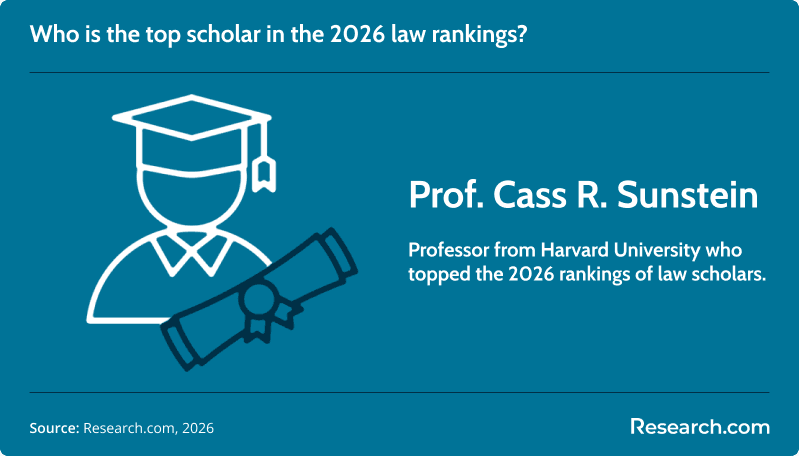
- Cass R. Sunstein from Harvard University holds the number one spot in the ranking with a D-index of 148, up from 138 in the previous year.
- The United States is the leading country in legal research, with 267 scholars represented in the ranking, adding 18 more scientists compared to the 2025 report.
- Australia showed incredible improvement this year, more than doubling its representation from 9 scientists in 2025 to 19 in 2026.
- Harvard University tops the institutional list, boasting 19 affiliated leading law scientists.
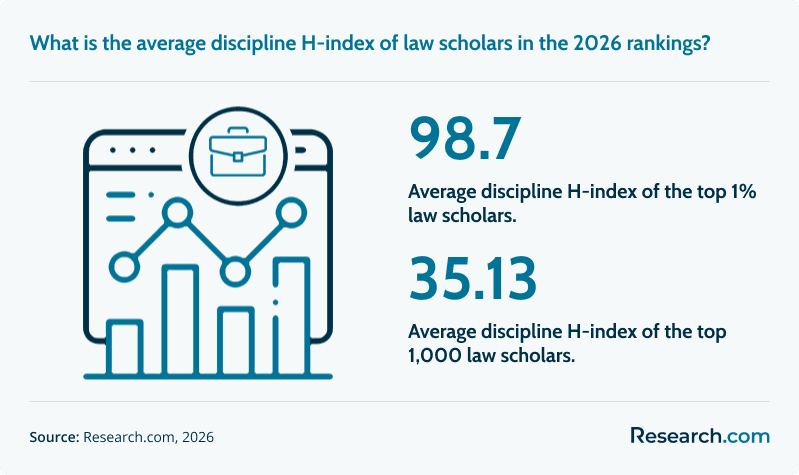
- The average D-index for the top 1% of scientists is 98.7, a noticeable increase from last year's 92.5.
- The overall average D-index for the entire ranking sits at 35.13, with an average of 202.06 publications per scholar.
The full ranking for the 2026 list of the best law scholars can be found here:
WORLD’S BEST LAW SCIENTISTS RANKING
Countries with the highest number of leading law scientists
The United States continues to dominate the landscape of legal scholarship, holding the number one position with 267 scientists in the ranking. This marks an increase of 18 scholars from the 2025 report, emphasizing the US's heavy and continuous investment in academic law. The United Kingdom follows in second place with 50 leading scholars, demonstrating strong growth by adding 10 more scientists to its previous total.
Australia and Canada tie for the third spot, each contributing 19 leading law scientists to the ranking. Notably, Australia showed massive improvement by more than doubling its scholar count from just 9 in the previous year. Other notable countries in the top 10 include the Netherlands (13 scientists) and Germany (12 scientists, which is double their 2025 total).
Please note that the country associated with a scientist is based on the affiliated research institution according to MAG, not on their actual nationality.
Institutions with the highest number of leading scientists
Consistent with previous editions, elite American universities maintain a stronghold at the top of the institutional rankings. Harvard University leads globally with 19 leading law scientists, rebounding nicely from the slight dip it experienced in the 2025 report. Yale University closely follows in second place with 18 scholars, while New York University takes the third spot with 14 scientists.
The University of Chicago and Columbia University round out the top five with 13 and 11 scholars, respectively. Outside of the United States, the University of Oxford remains the highest-ranking institution, tying for 7th place overall with 11 leading scientists. The University of Toronto also maintains a strong presence with 11 affiliated scholars, improving slightly from its 9 scholars in the previous year.
Advancing legal research through online universities
The proliferation of online universities and digital academic platforms is profoundly democratizing the study of law and the dissemination of legal research. As law schools increasingly adopt remote learning models, the geographic barriers to elite legal education and collaborative research are dissolving. Online universities have become vital hubs for hosting digital repositories and facilitating cross-border research networks, allowing scholars to easily share findings on international law, cybercrime, and global governance.
Recent trends indicate that students and researchers at online universities are heavily leveraging AI-driven legal databases and virtual law clinics. By providing flexible, tech-forward environments, these institutions are not only keeping pace with the modernization of legal practice but are actively shaping the future of digital academic research in law.
H-index ranking—leaders, averages, and distribution
For the 5th edition of the ranking, we identified the leading legal scholars across major global regions. In North America, Cass R. Sunstein from Harvard University (United States) holds the top regional and global spot with an outstanding D-index of 148.
In Asia, David Weisburd from the Hebrew University of Jerusalem (Israel) leads the continent, securing the 7th rank globally with a D-index of 86.
In Oceania, the leading scholar is John Braithwaite from the Australian National University (Australia), who ranks 12th in the world with a D-index of 80.
Finally, in Europe, Jonathan Jackson from the London School of Economics and Political Science (United Kingdom) takes the top regional spot, ranking 15th globally with a D-index of 74.
The average D-index for the top 1% of scholars is exceptionally high at 98.7, compared to an average of 35.13 for all scholars included in the ranking.
The average number of publications for the top 1% of scientists stands at 560.1, against an overall average of 202.06 for the entire ranking.
The average number of citations for the top 1% of scholars is an impressive 54,097.7, compared to an average of 8,579.38 for all scholars.
You can learn more about the methodology used to create this report here.
About Research.com
All research was coordinated by Imed Bouchrika, Ph.D., a computer scientist with a well-established record of collaboration on a number of international research projects with different partners from the academic community. His role was to make sure all data remained unbiased, accurate, and up-to-date.
Research.com is the number one research portal for science and educational rankings. Our mission is to make it easier for professors, research fellows, and students to progress with their research and find the top experts in a wide range of scientific disciplines. Research.com is also a leading educational platform that helps students find the best colleges, academic opportunities, and career paths.