
2027 How to Become an Elementary School Teacher in Tennessee: Requirements & Certification

Co-Founder and Chief Data Scientist
Becoming an elementary school teacher in Tennessee is a licensing decision as much as a career decision. You need the right degree, an approved educator preparation program, required exams, a background check, and a plan for maintaining your license after you begin teaching. The path can be straightforward if you start with a Tennessee-approved program, but it can become costly or delayed if you choose a program that does not meet state requirements.
This guide explains how to become an elementary school teacher in Tennessee in 2026, including education requirements, traditional and alternative certification routes, online program rules, expected timelines, program costs, licensure renewal, specializations, and career options. It is designed for first-time college students, career changers, out-of-state candidates, and current educators who want to move into elementary education.
Quick answer: How do you become an elementary school teacher in Tennessee?
To become an elementary school teacher in Tennessee, you generally need to earn a bachelor’s degree in education or a related field, complete a state-approved teacher preparation program with student teaching, pass the required Praxis exams, complete a background check, and apply for a Tennessee teaching license. Candidates should also budget for a non-refundable initial licensure application fee of $50, background check costs that can range from $30 to $50, and Praxis testing costs that may total around $150 to $300 depending on the required exams.
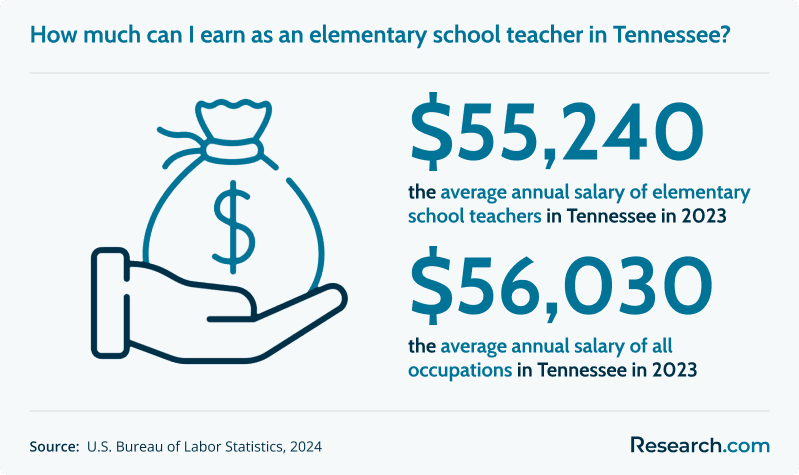
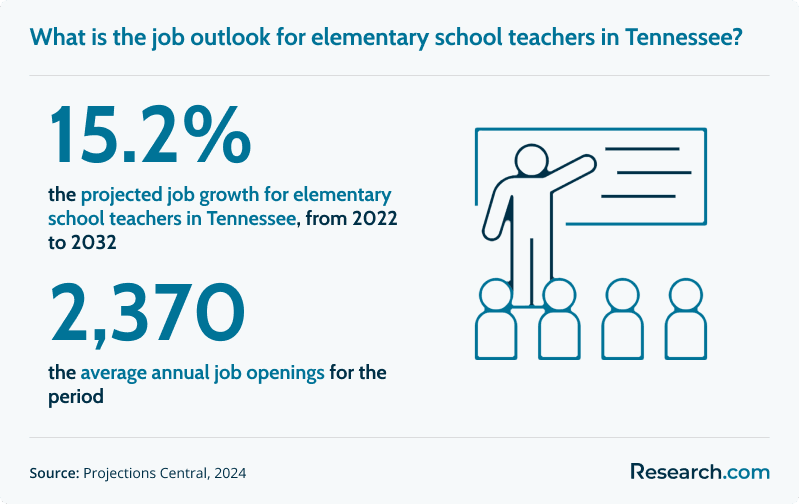
The career outlook is favorable compared with many occupations in the state. Elementary school teachers in Tennessee are projected to see 15.2% growth through 2032, with an estimated 2,370 job openings each year. As of 2023, Tennessee had around 29,520 elementary school teachers, earning an average annual salary of $55,240.
Fast facts for future Tennessee elementary teachers
- Minimum education: A bachelor’s degree in education or a related field is typically required for licensure.
- Teacher preparation: Candidates must complete a state-approved educator preparation program, usually including supervised student teaching.
- Testing: Tennessee requires prospective teachers to pass the Praxis series of exams covering general and subject-specific knowledge.
- Licensure activity: In the 2022-2023 academic year, Tennessee issued over 5,000 new elementary teaching licenses.
- Renewal: Licensed teachers must complete ongoing professional learning, including 60 Professional Development Points (PDPs) every five years.
Guide navigation
- Education requirements for Tennessee elementary teachers
- Licensure application and renewal steps
- Traditional vs. alternative certification routes
- Typical timeline to become licensed
- Online program acceptance for Tennessee licensure
- Online vs. campus elementary education programs
- Average elementary education program costs
- How to choose the right Tennessee program
- Other teaching roles to consider in Tennessee
- Special education pathways for elementary teachers
- Advanced credentials and graduate degree options
- Elementary education specializations
- Career paths after elementary teaching
- Speech therapy skills and classroom teaching
- Moving from preschool to elementary education
- Public and private elementary school differences
- Tennessee elementary teacher job market
- Moving from elementary to high school teaching
- Tennessee teaching certification pathways
- How policy changes affect teacher preparation
- Professional teaching organizations
- Whether an advanced degree is worth it
- Using classroom technology effectively
- Using arts integration in elementary classrooms
What education do Tennessee elementary school teachers need?
Tennessee elementary teachers usually begin with a bachelor’s degree that prepares them to teach young learners across core subjects such as reading, writing, mathematics, science, and social studies. The degree should come from an accredited institution and should connect directly to a state-approved educator preparation program if your goal is public school licensure.
The most important detail is not simply the name of the major. What matters is whether the program satisfies Tennessee licensure standards. A general education degree, child development degree, or unrelated bachelor’s degree may not be enough by itself unless it is paired with an approved teacher preparation pathway.
Core requirements at a glance
| Requirement | What it means | Why it matters |
| Bachelor’s degree | You complete a four-year degree in education or a related field from an accredited institution. | This is the academic foundation required before applying for a teaching license. |
| Approved teacher preparation program | You complete coursework and field experiences aligned with Tennessee educator standards. | The state uses approved programs to verify that candidates are prepared for classroom instruction. |
| Student teaching | You teach under supervision in a real school setting. | This gives you practice with lesson planning, classroom management, assessment, and communication with families. |
| Praxis exams | You pass the required licensure tests for your teaching area. | Praxis scores help demonstrate general and subject-specific readiness. |
| Background check | You complete the required criminal background review. | Schools must verify candidate eligibility to work with children. |
Most elementary education programs include coursework in child development, literacy instruction, classroom assessment, instructional planning, differentiated instruction, classroom management, and teaching methods for multiple subjects. The strongest programs also give candidates early and repeated exposure to classrooms before the full student-teaching semester.
As of 2023, there were around 29,520 elementary school teachers in Tennessee. Their average annual salary was around $55,240, which was slightly below the statewide average annual salary for all occupations of $56,030. Salary varies by district, experience, education level, and school setting, so candidates should review district pay schedules rather than relying only on statewide averages.
How does Tennessee teacher licensure application and renewal work?
After completing your degree, preparation program, testing, and background check, you can apply for an initial Tennessee teaching license. The application is not just a formality; it is the state’s review of whether your education, test scores, preparation program, and background documentation satisfy licensure requirements.
Typical initial licensure steps
- Complete an accredited bachelor’s degree. Your program should align with elementary education requirements or be paired with an approved educator preparation route.
- Finish a state-approved teacher preparation program. This usually includes supervised student teaching and formal evaluation.
- Pass required Praxis exams. Candidates should budget around $150 to $300 for the necessary tests, depending on which exams are required.
- Complete the background check. Background check costs can range from $30 to $50.
- Submit the licensure application. The initial application includes a non-refundable fee of $50.
- Maintain the license after approval. Tennessee educators must complete professional learning to keep their credentials active.
Renewal is an ongoing responsibility. Tennessee requires educators to complete 60 Professional Development Points (PDPs) every five years. PDPs may come from approved professional learning, college coursework, district training, conferences, or other qualifying activities. New teachers should begin tracking PDPs early instead of waiting until the renewal deadline approaches.
Licensure costs candidates should plan for
| Expense | Amount stated | Planning note |
| Initial licensure application | $50 | This fee is non-refundable. |
| Background check | $30 to $50 | Costs can vary by processing requirements. |
| Praxis exams | Around $150 to $300 | Total testing cost depends on the exams required for your licensure area. |
| License renewal professional learning | 60 Professional Development Points every five years | Some PDP activities may be free through districts; others may involve course, workshop, or conference fees. |
Candidates who want a broader view of Tennessee educator pathways can also review Research.com’s guide on how to become a teacher in Tennessee.
Elementary teaching is not the only K-12 option in the state. Among K-12 teachers, high school teachers earn the highest at $59,440.
Should you choose a traditional or alternative teacher certification program in Tennessee?
The best certification route depends on your background. A traditional program is usually the clearest path for first-time college students who know they want to teach. An alternative route may be better for adults who already hold a bachelor’s degree in another field and want to move into teaching without completing a second full undergraduate degree.
Traditional certification route
Traditional teacher preparation is built into an undergraduate or post-baccalaureate education program. It is structured, comprehensive, and usually includes multiple field experiences before student teaching.
- Best for: First-time college students and transfer students who want a direct elementary education pathway.
- Typical requirement: A bachelor’s degree in education or a related field with approved teacher preparation.
- Training focus: Pedagogy, child development, lesson design, classroom management, assessment, and supervised practice.
- Examples of institutions: The University of Tennessee and Middle Tennessee State University offer traditional teacher preparation programs.
Alternative certification route
Alternative certification is designed for candidates who already have a bachelor’s degree but did not complete a traditional teacher education program. These routes often combine targeted coursework, mentoring, and teaching experience.
- Best for: Career changers and degree holders from non-education fields.
- Typical requirement: A bachelor’s degree in any discipline, plus completion of an approved alternative pathway.
- Training focus: Accelerated preparation, mentorship, classroom readiness, and licensure completion.
- Examples of routes: The Tennessee Teacher Training Program and Teach for America are examples of alternative pathways that may place teachers in high-need areas.
| Pathway | When it makes sense | Potential drawback |
| Traditional program | You are starting college or can commit to a full education program with built-in fieldwork. | It may take longer if you already hold a bachelor’s degree. |
| Alternative route | You already have a degree and want a faster transition into teaching. | The pace can be demanding because coursework, testing, and classroom responsibilities may overlap. |
For a deeper comparison of licensure options, review Research.com’s overview of teaching certificate requirements in Tennessee.
How long does it take to become an elementary school teacher in Tennessee?
Most candidates should expect the full process to take approximately five to seven years from the start of a bachelor’s degree to licensure. The timeline can be shorter for candidates who already have a bachelor’s degree and qualify for an alternative certification route, but it can also be longer if you study part time, change majors, need to retake exams, or choose a program that does not align with Tennessee licensure.
| Stage | Typical time involved | What to do during this stage |
| Bachelor’s degree | About four years of full-time study | Choose an accredited institution and confirm that the program prepares candidates for Tennessee elementary licensure. |
| Teacher preparation program | Usually one to two years, often embedded in the degree | Complete methods courses, field placements, and student teaching. |
| Licensure application | Several weeks to a few months | Submit transcripts, test scores, background check documentation, and application materials. |
| Licensure exams | Preparation may take a few months | Schedule required Praxis exams early enough to allow time for retesting if needed. |
If you are still comparing education-related careers, Research.com’s guide to childhood development careers can help you understand adjacent pathways in education and student support.
Can online elementary education programs lead to Tennessee teacher licensure?
Yes. Tennessee can accept online education programs for teacher licensure when the program is properly accredited and satisfies state educator preparation requirements. The format alone is not the deciding factor. The key questions are whether the institution is accredited, whether the educator preparation program is approved for licensure, and whether student teaching can be completed in an acceptable school setting.
What to verify before enrolling online
- Accreditation: Look for institutional accreditation and educator preparation recognition from an appropriate body such as the Council for the Accreditation of Educator Preparation (CAEP) or a similar recognized accreditor.
- Tennessee alignment: Ask whether the program specifically prepares graduates for Tennessee elementary licensure.
- Student teaching placement: Confirm how the school arranges supervised fieldwork if you live in Tennessee but attend an online institution.
- Credit requirements: Many programs require a bachelor’s degree structure of at least 120 credit hours with coursework in child development, instruction, assessment, and classroom management.
- Praxis preparation: Check whether the curriculum includes support for required licensure exams.
- Documentation support: Ask whether the program helps candidates submit transcripts, verification forms, and other documents required by the Tennessee Department of Education.
An online program can be a strong option for working adults, rural students, caregivers, and candidates who need scheduling flexibility. However, it is risky to assume that every online elementary education degree automatically qualifies you for Tennessee licensure. Always request written confirmation from the program before enrolling.
How do online and on-campus elementary education programs in Tennessee compare?
Online and campus programs can both prepare students for teaching if they meet Tennessee licensure requirements. The right choice depends on how you learn best, how much schedule flexibility you need, and how the program handles field placements.
| Factor | Online program | On-campus program |
| Schedule flexibility | Often better for students balancing work, family, or long commutes. | Usually follows a more fixed class schedule. |
| Access | Can be practical for students in rural areas or far from a campus. | Works well for students who live near the institution or want a residential experience. |
| Field experience | May require local placement coordination, which should be confirmed before enrollment. | Often benefits from established relationships with nearby school districts. |
| Peer interaction | May rely on discussion boards, video meetings, and virtual collaboration. | Provides more face-to-face interaction with classmates and faculty. |
| Technology preparation | Often builds comfort with digital learning platforms and online instructional tools. | May offer more in-person workshops, classroom simulations, and campus-based labs. |
| Cost considerations | May reduce commuting or housing costs. | May involve additional transportation, housing, or campus fees. |
According to the Tennessee Higher Education Commission, online tuition rates can be lower than traditional in-state tuition. Still, tuition is only one part of total cost. Compare fees, books, testing, travel for field placements, and the cost of delaying employment if a program takes longer than expected.
What does an elementary education program cost in Tennessee?
The average annual tuition for elementary education programs at four-year nonprofit institutions in Tennessee is approximately $28,334. That number can help with early planning, but your actual cost will depend on the institution, residency status, enrollment load, transfer credits, financial aid, housing, books, and how quickly you complete the program.
Costs to include in your budget
- Tuition: Use the approximately $28,334 average annual tuition figure as a starting point, then compare each school’s published charges.
- Housing and meals: Room and board can vary widely depending on whether you live on campus, commute, rent off campus, or study online.
- Books and materials: Education majors should plan for textbooks, classroom supplies, digital platforms, and assessment materials.
- Testing and licensure: Include Praxis fees of around $150 to $300, the $50 initial application fee, and background check costs that can range from $30 to $50.
- Transportation: Field observations and student teaching may require travel to partner schools.
- Lost income: Student teaching may make full-time work difficult, so plan for that semester carefully.
Students comparing online programs should review Research.com’s list of best value online elementary education programs. If you are considering a different education-adjacent route, you can also compare options such as the best online degrees in library science and best value online library science degrees.
What support do new elementary teachers in Tennessee receive?
New elementary teachers need more than a license. The first years in the classroom require mentorship, lesson-planning support, classroom management coaching, and a reliable network of colleagues. Tennessee teachers may find support through districts, educator preparation programs, professional associations, and online communities.
- District mentorship: Many districts pair beginning teachers with experienced educators who can help with planning, family communication, grading, and classroom routines.
- Professional development: State and district workshops can help teachers build skills while also contributing to PDP renewal requirements.
- Teacher associations: Organizations can provide advocacy, training, peer networks, and updates on policy changes.
- University alumni services: Some Tennessee colleges continue to support graduates through career advising, hiring events, or mentor networks.
- Online educator communities: Digital groups can be useful for sharing lesson ideas, but new teachers should verify advice against district and state policy.
How should you choose the best elementary education program in Tennessee?
The best program is not necessarily the cheapest, closest, or highest-ranked option. It is the program that fits your licensing goal, budget, learning format, timeline, and student-teaching needs. Before applying, evaluate each school through a licensure-first lens.
Program selection checklist
| Question to ask | Why it matters |
| Is the institution accredited? | Accreditation affects licensure eligibility, transfer credits, graduate school options, and financial aid access. |
| Is the educator preparation program approved for Tennessee licensure? | A degree alone may not qualify you for a teaching license if the preparation pathway is not approved. |
| How are field placements and student teaching arranged? | You need a clear path to completing required supervised classroom experience. |
| What Praxis support is available? | Exam preparation can reduce delays between graduation and licensure. |
| Can prior credits transfer? | Transfer policies can change your cost and graduation timeline. |
| What is the total cost, not just tuition? | Fees, books, transportation, testing, and student-teaching expenses can add substantially to the price. |
| Does the program offer relevant specializations? | Endorsements or coursework in special education, ESL, literacy, or STEM can improve fit with district needs. |
| What career support does the school provide? | Strong district relationships can help with student teaching and first-job searches. |
Common mistakes to avoid
- Choosing a program before checking licensure alignment. Always confirm Tennessee approval before enrolling.
- Comparing only tuition. Total cost includes fees, books, testing, transportation, and unpaid or reduced-work student-teaching time.
- Assuming online means easier. Online programs still require fieldwork, exams, and state documentation.
- Waiting too long to prepare for Praxis exams. Testing delays can postpone licensure and employment.
- Ignoring renewal requirements. Track PDPs from the beginning of your career.
- Relying only on rankings. Rankings can be useful, but they do not replace program approval, placement quality, and affordability.
What other teaching opportunities are available in Tennessee?
Elementary teaching is one option within a broader K-12 education system. If you are interested in teaching older students, you may want to explore how to become a middle school math teacher in Tennessee. Middle school math teaching requires stronger subject-specific preparation in mathematics and a different approach to adolescent learning, but it can be a good fit for candidates who enjoy problem-solving and working with grades 6-8.
How can elementary teachers in Tennessee specialize in special education?
Special education is a high-impact specialization for elementary teachers who want to support students with disabilities and diverse learning needs. This path may involve additional coursework, targeted professional development, inclusive teaching strategies, and specialized credentials. Elementary teachers with special education preparation can be valuable in co-teaching classrooms, intervention settings, and schools serving students who need individualized supports.
To compare requirements and training options, review Research.com’s guide on how to become a special education teacher in Tennessee.
What advanced credentials can strengthen an elementary teaching career in Tennessee?
Advanced credentials can help experienced elementary teachers move into leadership, curriculum design, intervention, coaching, and specialized student support roles. Options may include National Board Certification, endorsements in areas such as literacy, STEM, English as a Second Language, or special education, and graduate programs in curriculum, instruction, school counseling, or educational leadership.
Some educators also pursue adjacent training to better support children’s social, emotional, and family needs. For example, professionals interested in clinical support roles may compare online clinical MSW programs, although social work licensure is a separate pathway from teacher licensure.
What elementary education specializations are available in Tennessee?
Specializations allow elementary teachers to build expertise beyond general classroom instruction. The right specialization depends on the students you want to serve, the districts where you hope to work, and your long-term career goals.
| Specialization | What it focuses on | Best fit for teachers who want to... |
| Special education | Instructional supports for students with disabilities and individualized learning needs. | Work in inclusive classrooms, intervention roles, or specialized education settings. |
| English as a Second Language (ESL) | Language development and academic support for non-native English speakers. | Support multilingual learners and culturally responsive instruction. |
| Reading specialist | Literacy development, reading intervention, and assessment of reading challenges. | Focus on early literacy, reading recovery, and schoolwide literacy improvement. |
| STEM education | Science, technology, engineering, and mathematics instruction for young learners. | Build inquiry-based lessons and strengthen problem-solving skills. |
| Gifted education | Advanced learning opportunities for students who need additional academic challenge. | Design enrichment, acceleration, and higher-level learning experiences. |
| Culturally responsive teaching | Instruction that reflects students’ cultural backgrounds and lived experiences. | Create inclusive classrooms and improve engagement for diverse learners. |
In Tennessee, approximately 12% of students receive special education services, which makes preparation in inclusive instruction especially relevant for elementary educators. K-12 teaching jobs are also in high demand in the state, with most having a projected growth rate of 15% or more.
What career paths can elementary school teachers pursue in Tennessee?
An elementary teaching license can lead to classroom teaching, but it can also become the foundation for specialized, leadership, and student support roles. Some paths require additional licensure, graduate study, or clinical credentials.
| Career path | Primary work | Salary or outlook stated |
| Elementary school teacher | Teach foundational subjects to children in grades K-6. | The median salary for elementary school teachers in Tennessee is approximately $48,750. |
| Special education teacher | Support students with disabilities and individualized learning plans. | Projected job opportunity increase of 12.8%. |
| School counselor | Help students with academic, social, and personal development. | Median salary around $46,930, with expected job growth of 11.4%. |
| School librarian | Promote literacy, research skills, and access to learning resources. | Median salary of $51,300 and job growth rate of 10.1%. |
| Speech-language pathologist | Help students with speech, language, and communication needs. | Projected 25.1% increase in opportunities. |
High school students exploring education careers may encounter Tennessee’s Teaching as a Profession pathway, which introduces skills such as lesson planning, classroom management, and educational technology. College students and adult learners can then choose degree programs that match their preferred age group and subject area.
Teachers who enjoy writing, storytelling, and literacy development may also consider graduate-level creative work, such as an affordable online creative writing MFA, though this is not a substitute for teacher licensure.
Can speech therapy skills support elementary teaching in Tennessee?
Speech and language strategies can help elementary teachers support classroom communication, early literacy, pronunciation, vocabulary development, and students who struggle to express themselves. While these skills do not make a teacher a licensed speech-language pathologist, they can improve everyday instruction and collaboration with student support teams.
Teachers interested in a clinical communication pathway can learn more about how to be a speech therapist in Tennessee.
Can preschool experience help when moving into elementary teaching?
Preschool experience can be useful for elementary teaching because it builds understanding of early development, play-based learning, family communication, and classroom routines. Teachers moving from preschool to elementary grades may be especially strong in kindergarten and early literacy settings, where developmental readiness varies widely among students.
If you are comparing early childhood and elementary pathways, review Research.com’s guide on how to become a preschool teacher in Tennessee.
How do public and private elementary schools in Tennessee differ for teachers?
Public and private elementary schools can offer very different working conditions. Public schools generally follow state licensure requirements, district salary schedules, standardized accountability rules, and formal renewal expectations. Private schools may have more flexibility in hiring and curriculum design, but expectations vary by institution, mission, and accreditation status.
| Factor | Public elementary schools | Private elementary schools |
| Licensure expectations | Typically tied closely to Tennessee certification standards. | May vary by school, mission, and accreditation expectations. |
| Curriculum | Often aligned with state standards and district requirements. | May reflect a religious, independent, classical, Montessori, or other educational philosophy. |
| Pay structure | Often based on district salary schedules. | May be negotiated or set by the individual school. |
| Professional development | Usually connected to district and state expectations. | May be school-specific and tied to institutional goals. |
Educators considering independent school settings can review how to become a private school teacher in Tennessee.
What is the job market for elementary school teachers in Tennessee?
The Tennessee job market for elementary teachers is supported by projected growth, replacement needs, and ongoing demand for qualified educators. Elementary school teacher employment in Tennessee is projected to grow 15.2% from 2022 to 2032, with 2,370 job openings per year. Across the United States, approximately 109,000 job openings are expected each year, largely because schools need to replace teachers who retire or move into other careers.
Salary expectations
- Average annual salary in Tennessee: Around $55,240 for elementary school teachers.
- Statewide comparison: This is slightly below the average annual salary for all occupations in Tennessee, which is $56,030.
- Location differences: Nashville and Memphis may offer more competitive opportunities because they are major urban centers with large school systems.
Salary should be evaluated carefully. State averages do not guarantee earnings for any individual teacher. Pay can depend on district salary schedules, years of experience, graduate credits or degrees, shortage-area incentives, and school type.
Current trends affecting Tennessee elementary teachers
- Technology and AI: Teachers are increasingly expected to use digital learning tools, adaptive platforms, and data-informed instruction. AI can help with planning and differentiation, but teachers remain responsible for judgment, student relationships, and ethical use.
- Literacy focus: Early reading instruction remains central in elementary education, making literacy training and reading intervention skills valuable.
- Inclusive classrooms: General education teachers often work with students who have varied learning needs, making special education collaboration and differentiated instruction essential.
- Rural and underserved hiring needs: Demand may be especially important in communities where schools have a harder time recruiting and retaining teachers.
Can elementary teachers transition to high school teaching in Tennessee?
Yes, but moving from elementary to high school teaching typically requires additional subject-specific preparation and the appropriate secondary endorsement or license. A teacher who wants to move into high school math, for example, must demonstrate deeper mathematics content knowledge and meet secondary-level certification requirements.
For a subject-specific example, review Research.com’s guide to high school math teacher qualifications in Tennessee.
What are the main paths to Tennessee teaching certification?
Tennessee candidates usually enter teaching through either a traditional educator preparation program or an alternative certification pathway. Traditional routes work best for students planning their undergraduate education around teaching. Alternative routes are designed for candidates who already hold a bachelor’s degree and need a structured transition into the classroom.
When comparing routes, focus on approval status, cost, length, mentorship, testing requirements, renewal obligations, and whether the pathway leads to the exact endorsement you need. A faster option is not always better if it limits your placement options or leaves you underprepared for classroom realities.
How can Tennessee policy changes affect your teaching pathway?
Teacher preparation and licensure are shaped by state policy. Changes in testing rules, educator preparation standards, funding, accountability, or professional development requirements can affect how long it takes to become licensed and what documentation candidates must submit.
Because requirements can change, candidates should rely on current Tennessee Department of Education information, program advisors, and district human resources offices. Research.com’s guide on how long does it take to become a teacher in Tennessee can help you think through timeline planning.
Why join professional teaching organizations in Tennessee?
Professional organizations can help elementary teachers stay current, build networks, earn professional development credit, and understand policy changes that affect schools. They are especially useful for new teachers who need practical advice beyond what they learned in college.
Benefits of membership
- Professional development: Groups such as the Tennessee Education Association (TEA) and the Tennessee Reading Association (TRA) offer workshops, conferences, and learning opportunities that may support PDP requirements.
- Networking: Members can connect with teachers across districts, grade levels, and specialties.
- Instructional resources: Associations may provide lesson ideas, research updates, classroom tools, and literacy resources.
- Advocacy: Teacher organizations can represent educator concerns related to pay, working conditions, resources, and policy.
- Funding opportunities: Some organizations offer scholarships, grants, or awards for educators and classroom projects.
- Peer support: Teaching can be demanding, and professional communities can reduce isolation during difficult school years.
Should Tennessee elementary teachers pursue an advanced degree?
An advanced degree can be worthwhile if it clearly supports your career goal. A master’s degree may help teachers deepen instructional skill, prepare for leadership roles, qualify for specialized positions, or pursue school-based support work. However, it is important to compare tuition, salary schedule benefits, time commitment, and whether the degree leads to a credential you actually need.
Cost-conscious teachers can compare cheapest masters in education options, but affordability should be weighed alongside accreditation, program quality, licensure relevance, and employer recognition.
How can Tennessee elementary teachers use technology effectively?
Technology is most useful when it improves instruction rather than distracts from it. Elementary teachers can use digital tools for formative assessment, reading practice, math fluency, accessibility, communication with families, and differentiated small-group work. AI tools may help teachers draft lesson ideas or adapt materials, but teachers should check accuracy, protect student privacy, and follow district policy.
If cost is a major concern while entering the profession, Research.com’s guide to the cheapest way to get a teaching credential in Tennessee can help you compare practical options.
How can arts integration improve elementary classrooms in Tennessee?
Arts integration can make elementary lessons more engaging by connecting visual art, music, movement, drama, and creative writing with academic subjects. For example, students might use drawing to explain science concepts, rhythm to reinforce math patterns, or drama to deepen reading comprehension. The goal is not to replace core instruction, but to give students more ways to understand and express learning.
Teachers who want a more formal arts pathway can explore how to become an art teacher in Tennessee.
What do Tennessee elementary teachers say about the career?
- “Teaching elementary students in Tennessee has been deeply meaningful for me because the classroom is where children often discover confidence for the first time. The strongest moments come when a student finally understands a difficult idea and wants to try the next challenge.” Kylie
- “I enjoy that teaching gives me room to be creative while still working toward clear learning goals. Bringing local culture, stories, and community examples into lessons helps my students see that school connects to their own lives.” Terrence
- “The work can be demanding, but the relationships with students, families, and other teachers make it worthwhile. Collaboration with colleagues has helped me improve my instruction and support students academically, socially, and emotionally.” Chandler
Related Articles for Nearby States
- 2027 How to Become an Elementary School Teacher in Kentucky: Requirements & Certification
- 2027 How to Become an Elementary School Teacher in Mississippi: Requirements & Certification
- 2027 How to Become an Elementary School Teacher in Alabama: Requirements & Certification
- 2027 How to Become an Elementary School Teacher in Georgia: Requirements & Certification
- 2027 How to Become an Elementary School Teacher in North Carolina: Requirements & Certification
- 2027 How to Become an Elementary School Teacher in Missouri: Requirements & Certification
- 2027 How to Become an Elementary School Teacher in Arkansas: Requirements & Certifications
- 2027 How to Become an Elementary School Teacher in Virginia: Requirements & Certification
- 2027 How to Become an Elementary School Teacher in Indiana: Requirements & Certification
- 2027 How to Become an Elementary School Teacher in South Carolina: Requirements & Certification
Key insights
- Start with licensure, not just the degree title. The safest route is an accredited program that is approved for Tennessee elementary teacher preparation.
- Plan for both time and cost. The full path often takes approximately five to seven years, and candidates should budget for tuition, testing, background checks, and the $50 initial licensure application fee.
- Online programs can work, but only if they meet state requirements. Confirm accreditation, Tennessee licensure alignment, and student-teaching arrangements before enrolling.
- The job outlook is strong. Tennessee projects 15.2% growth for elementary school teachers through 2032, with 2,370 openings per year.
- Specializations can improve career fit. Special education, ESL, reading, STEM, gifted education, and culturally responsive teaching can help teachers serve specific student needs.
- Renewal starts early. Tennessee teachers must complete 60 Professional Development Points every five years, so tracking professional learning from the start is essential.
- Avoid the biggest mistake: assuming all education programs lead to licensure. Before committing money or time, ask the school to confirm in writing that its program supports Tennessee elementary teacher licensure.
References:
- academics.waldenu.edu (n.d.). State requirements for teacher licensure renewal: Tennessee. academics.waldenu.edu
- tn.gov (16 Aug 2017). Teaching as a profession (TAP). tn.gov
- franklin.edu (n.d.). 2024 Best elementary education & teaching degrees & colleges in Tennessee. franklin.edu
- bls.gov (17 Apr 2024). Kindergarten and elementary school teachers. bls.gov
Other Things You Should Know About Becoming an Elementary School Teacher in Tennessee
To become an elementary school teacher in Tennessee in 2027, start by obtaining a bachelor's degree in education or a related field. Next, complete a state-approved teacher preparation program and pass the required Praxis exams. Finally, apply for a teaching license through the Tennessee Department of Education.
To become an elementary school teacher in Tennessee in 2027, you need a bachelor's degree in elementary education or a related field. Additionally, completion of a teacher preparation program and passing the relevant Praxis exams are required for certification.


