2027 Scientific Literature Mining Capstones: What to Look for in a Data Science Master's

Co-Founder and Chief Data Scientist
A scientific literature mining capstone can show whether a data science master's teaches students to turn research papers into reliable, usable evidence, not just run a text model. If you want to work with scientific or medical research, the deciding factors are access to suitable literature, rigorous evaluation, domain supervision, and permission to share your work.
This guide helps you assess those features before choosing a program or proposing a project.
Key Things You Should Know
- A strong capstone answers a defined research question and evaluates whether its findings remain accurate across papers, publication dates, and scientific terminology.
- Ask programs about literature access, expert supervision, project approval, and rights to publish code or results. A course labeled "NLP" does not establish that support.
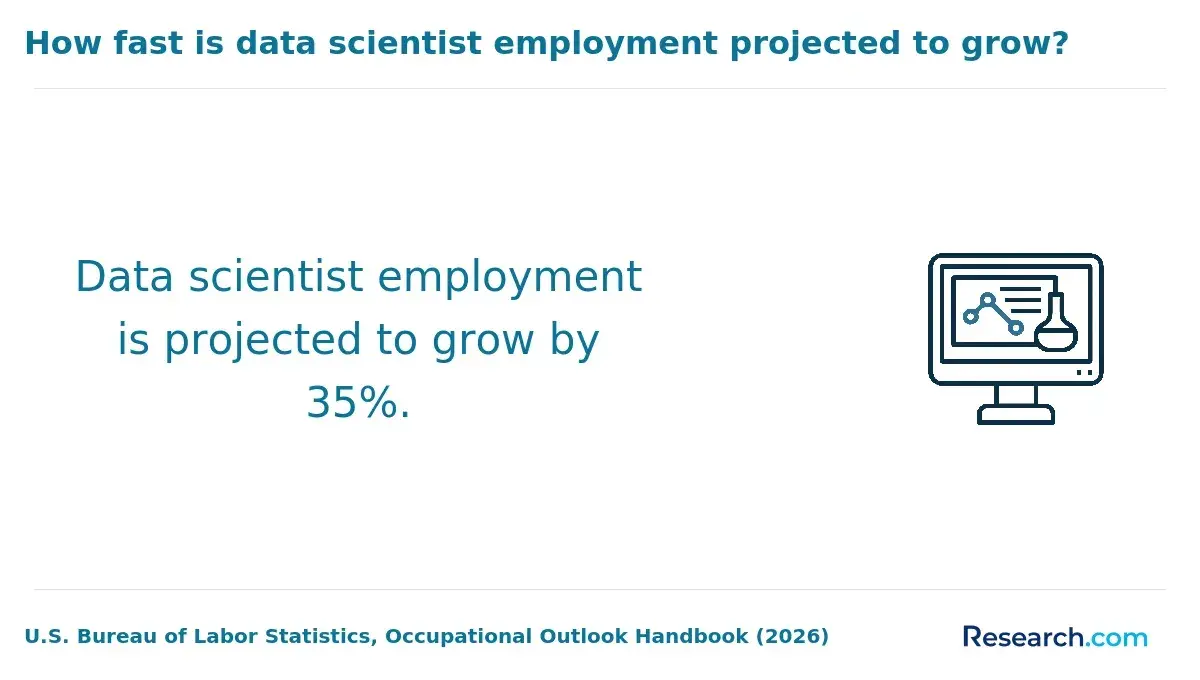
- The U.S. Bureau of Labor Statistics projects 35% growth in data scientist employment from 2025 to 2035, but that occupation-wide forecast does not predict demand for literature mining specialists.
What Is a Scientific Literature Mining Capstone in Data Science?
A scientific literature mining capstone applies data science to a collection of research publications to answer a bounded question. A student might identify which studies report a particular outcome, link substances to reported effects, or track how findings on a topic change over time.
The final product should be more than a searchable collection of papers: it should include a documented dataset, a defensible method, an evaluation, and an explanation of how someone would use or not use the results.
The project scope determines whether it is feasible. Mining abstracts may be manageable when full-text rights are unclear, but abstracts often omit methods and qualifications.
Full-text work can provide richer evidence while adding licensing, extraction, and document-format problems. A promising proposal names the intended literature source, unit of analysis, target output, and end user before selecting a model.
A red flag is when a program showcases polished dashboards without explaining where the papers came from, how findings were checked, or whether students could legally reuse the text.
What Skills Should a Data Science Master's Capstone Demonstrate?
The strongest projects connect research judgment to technical execution. Depending on the question, methods may include retrieval, entity recognition, relation extraction, topic analysis, classification, or retrieval-assisted language-model workflows. Model complexity is less important than whether the output answers the question accurately enough for its intended use.
Look for evidence of a complete workflow, not just a final accuracy score. These components make a capstone easier for an adviser or employer to assess:
- Problem definition: A precise question, intended user, inclusion criteria, and explanation of what a model output means.
- Data handling: Documented search and selection rules, deduplication, metadata, access rights, and treatment of retracted or corrected papers.
- Evaluation: A manually checked sample or other credible reference set, an appropriate baseline, and measures such as precision and recall chosen for the cost of missed or incorrect findings.
- Reproducibility: Versioned code, recorded data and model versions, clear processing steps, and a sharing plan that respects publication licenses.
- Interpretation: Error analysis, uncertainty, and review by someone able to recognize domain-specific mistakes.
A particularly important mistake is evaluating on passages from papers closely related to those used for training. A split by publication or research group, or a test on later publications, may better reveal whether a method generalizes. If a generative AI system is used, the project should also check whether each claimed finding is actually supported by the cited paper.
How Do You Evaluate a Data Science Master's Program's Accreditation?
Start with the institution's accreditation, then assess the degree itself. In the U.S., confirm the school's current institutional accreditation and its status through the accreditor or the U.S. Department of Education's accreditation records.
Do not assume that an accredited institution has a separately accredited data science program, or that separate programmatic accreditation is required for this kind of capstone.
Accreditation establishes an institutional baseline; it does not verify that a program offers literature mining projects, research-data access, or relevant mentors. Ask for the current catalog and capstone rules, then confirm whether students may propose their own topic and work with faculty outside the data science department.
Institutional eligibility can also affect federal financial aid; for the separate financing decision, see funding an online data science master's degree.
Which Courses Prepare Students for Literature Mining Capstone Projects?
A useful course sequence moves from statistics and programming into text analysis, then gives students time to test a research question before the capstone begins. Course titles alone cannot show that sequence: read descriptions, assignments, and project examples to distinguish a brief NLP unit from sustained work with scientific documents.
Prioritize courses in statistical inference and experimental design, databases and data engineering, information retrieval, machine learning, and natural language processing. For a biomedical topic, courses or electives in the relevant science, health informatics, or research methods may help students judge whether extracted claims are meaningful. An advanced NLP elective is valuable when it includes annotation, domain shift, and error analysis rather than only demonstrations of current tools.
If your programming or mathematics background needs strengthening, check whether preparatory classes count toward admission or merely help you succeed after enrollment. AI master's bridge course comparisons can help frame that question, but confirm the requirements of any data science program directly.
What Are the Admission Requirements for a Data Science Master's?
Requirements vary by institution. Applicants should check the program's current policy for prior coursework in programming, calculus, linear algebra, and statistics, as well as its degree, transcript, recommendation, and testing requirements. A background in biology or another research field can strengthen a literature mining proposal, but it does not automatically satisfy quantitative prerequisites.
For this particular goal, an application is stronger when it shows both technical readiness and a plausible research question. A small, documented project that searches papers, labels a sample, and analyzes errors can make that preparation visible.
Before applying, ask whether prerequisite deficiencies can be addressed before enrollment, through approved coursework, or within the degree; self-study may build skill without formally fulfilling a requirement.
How Do Online and Campus-Based Data Science Master's Programs Compare?
Either format can support a literature mining capstone because much of the work is computational. The meaningful difference is whether your schedule and location permit regular access to feedback, licensed resources, collaborators, and an adviser with appropriate domain knowledge.
The comparison below focuses on project conditions rather than assuming one delivery format is stronger.
| Project condition | Online program | Campus-based program |
| Mentor access | May rely on scheduled remote meetings and shared project tools | May offer in-person meetings and nearby research groups |
| Collaboration | Group work may cross time zones | In-person coordination may be easier |
| Literature access | Depends on library permissions and remote authentication | Depends on the same institutional rights, with possible on-site support |
| Schedule | Can suit working students if meetings and deadlines fit | Can suit students able to attend research activities on campus |
Choose by the actual capstone arrangements, not the label "online" or "campus." If you are also considering an AI degree instead of data science, compare its research-methods and evaluation requirements as carefully as its price. A list of low-cost online AI degree programs is a starting point for that distinct comparison, not evidence of literature mining support.
How Long Does a Data Science Master's Take and Cost?
There is no reliable universal time or price for a literature mining capstone. Completion depends on the program's credit requirements, course availability, enrollment pace, and whether the capstone can begin before all other coursework ends. A project involving expert annotation or restricted full-text access may also take longer than an abstract-based project.
For each program, request a current estimate based on your intended pace: tuition, mandatory fees, any additional course or technology charges, and expected costs for travel or campus attendance. Ask whether library access covers the publications you need and whether annotation, computing, or research support has a separate cost.
Compare the resulting total with the time you can realistically commit, not tuition alone. If speed is a priority, data science master's programs with shorter timelines offer a separate starting point, but verify that an accelerated schedule leaves enough time for a rigorous project.
Which Careers Can Scientific Literature Mining Capstones Prepare You For?
A well-documented capstone can provide portfolio evidence for data scientist, NLP-focused data scientist, research analyst, scientific information specialist, or health-technology roles. The best match depends on what the project actually demonstrates: building a reliable text pipeline supports a different application than evaluating research findings for a scientific team.
For health-related work, domain review and careful treatment of uncertainty are especially important. Students considering that direction can compare AI graduate degrees for health technology roles with data science programs on access to health-domain mentors and relevant projects. A capstone can strengthen an application, but employers may also require subject expertise, experience, or skills beyond the project.
What Salary Can Data Science Master's Graduates Expect?
The U.S. Bureau of Labor Statistics reports a median annual wage of $120,230 for data scientists in May 2025. That is an occupation-wide figure, not the expected starting salary for a new master's graduate or a salary specific to literature mining. Pay varies with experience, role, location, employer, and domain expertise.
When assessing a program's salary claims, ask who was surveyed, how many graduates responded, when pay was measured, and whether respondents already worked in data science. A salary level alone cannot show how much the degree changed someone's earnings. Compare the program's full cost against your own plausible career options rather than treating the national median as a return-on-investment estimate.
What Is the Job Outlook for Data Science Master's Graduates?
The Bureau of Labor Statistics projects about 24,800 data scientist openings per year, on average, from 2025 to 2035. Openings include positions created when workers leave the occupation, so they should not be read as openings for new graduates or for scientific literature mining specialists specifically.
Use the forecast as broad context, then examine jobs you might actually pursue. If postings emphasize production systems, look for a capstone with usable code and deployment considerations.
If they emphasize scientific evidence, prioritize transparent search methods, citation-level traceability, and expert review. The more closely your project matches the work of a target role, the more useful it is as evidence of your skills.
Other Things You Should Know About Data Science Programs
Yes, if abstracts contain enough information for the question. State what they omit and avoid making claims that require details found only in full text.
Not automatically. Check each source's license and your institution's guidance before sharing article text. You may be able to share code, document identifiers, permitted metadata, and annotations without redistributing the underlying papers.
Record its status and decide in advance whether to exclude it or flag it in results. A system that silently presents retracted findings as current evidence can mislead users.
A thesis may fit an original research question; a capstone may fit a working tool or applied analysis. Compare the actual supervision, evaluation expectations, and permission to use your preferred literature source rather than choosing by project label.
References
- Opportunities and challenges of text mining in aterials research | nih.gov https://pmc.ncbi.nlm.nih.gov/articles/PMC7905448/
- Copyright and Data Management - Copyright https://guides.lib.usf.edu/copyright/data
- Overview of the Research Process for Capstone Projects | unh.edu https://libraryguides.unh.edu/c.php
- A systematic literature review of capstone courses in software engineering - ScienceDirect https://www.sciencedirect.com/science/article/pii/S0950584923000459
- Capstone Project | University of Chicago https://bmi.bsd.uchicago.edu/capstone/
- Master's in Data Science: Capstone Project | NYU CDS https://cds.nyu.edu/masters-in-data-science-capstone/
- Capstone Projects - UVA School of Data Science https://datascience.virginia.edu/degrees/info/capstone-projects
- Masters Captstone - Columbia DBMI https://www.dbmi.columbia.edu/masters-captstone/