
2027 Online Data Science Master's Cost with Employer Reimbursement: A Break-Even Worksheet

Co-Founder and Chief Data Scientist
An employer's tuition benefit can make an online data science master's affordable - but the advertised tuition and the amount you ultimately pay may be very different. This guide is for working professionals deciding whether to enroll, which offer to choose, and how much career benefit would justify the remaining expense.
You'll build a break-even calculation that accounts for fees, reimbursement timing, repayment obligations, and the possibility that your pay does not change after graduation.
Key Things You Should Know
- Compare each program's complete 2026 cost - not tuition alone - with the expenses your employer will actually reimburse.
- Budget for the period before reimbursement arrives, and treat any stay-with-employer requirement as a potential cost rather than free money.
- Break-even occurs when cumulative, after-tax career gains exceed your unreimbursed costs and any earnings you gave up; the degree itself does not guarantee a raise.
What does an online data science master's degree cost?
There is no reliable single 2026 price for an online data science master's. Schools may charge by credit, course, or term, and an advertised tuition figure may exclude mandatory fees. Without a current, program-specific tuition schedule, a precise total cannot be verified. Request an itemized estimate for the credits you would need, your residency status, and your expected completion pace.
The table separates charges that belong in a comparable program-cost estimate. Use the same categories for every school so a tuition-only quote does not appear cheaper than a more complete estimate.
| Cost category | What it can include | Why the distinction matters |
| Tuition | Required credits or courses at the applicable rate | A rate per credit is not the degree's total price. |
| Mandatory fees | Technology, student services, or graduation charges | These may apply even when instruction is fully online. |
| Situational expenses | Books, software, equipment, travel, or prerequisite courses | They depend on program rules and what you already own or know. |
| Financing and time | Borrowing costs and earnings forgone because of reduced work | Neither is captured by a tuition quote. |
If your goal is specifically AI rather than broader data science, you can also compare affordable online AI programs. Compare their required credits, fees, and employer eligibility on the same basis before treating a lower advertised price as savings.
How does employer tuition reimbursement reduce data science master's expenses?
Reimbursement reduces cost only for charges your employer approves and ultimately pays. A benefit described as "tuition assistance" may exclude fees or materials, require a minimum grade, limit eligible schools or courses, or pay only after you submit proof of completion. Employer policies and the tax treatment of education assistance vary; confirm both with benefits staff and payroll before calculating your net benefit.
Get written answers to the questions that determine whether the benefit works for your program and schedule:
- What is the benefit limit, which charges qualify, and must the degree relate to your current job?
- Must you obtain approval before enrollment, earn a particular grade, or remain employed through the payment date?
- When will reimbursement be paid, and does the benefit reset by calendar year, academic year, or another period?
- If you leave, are laid off, or change roles, must you repay any assistance - and on what terms?
- Will any reimbursement be treated as taxable compensation under the applicable rules?
For a program comparison, count only reimbursement you reasonably expect to receive under those written terms. Keep a separate cash-flow budget: paying a bill now and recovering it after a course ends still requires savings or financing in the meantime. An employer's annual limit can also make a slower course schedule cheaper than finishing as quickly as possible, provided the longer schedule does not create larger fees or lost career opportunities.
How do you calculate the break-even point for a data science master's?
Break-even is the point at which cumulative incremental, after-tax career gains equal the degree's net cost. Use the difference between your expected earnings with and without the degree - not a published data scientist salary. If your employer reimburses courses over time, a year-by-year worksheet is more useful than dividing one headline price by one hoped-for raise.
Complete these steps for each program. Leave uncertain benefits or earnings increases as scenarios rather than treating them as promises:
- Enter required tuition and mandatory fees, then add materials, technology, travel, and prerequisite costs that apply to you. Add financing interest and any wages you expect to forgo; do not add loan principal again if the tuition it pays is already counted.
- Subtract scholarships and reimbursement you expect to receive, adjusting for any applicable taxes. Keep possible repayment to your employer as a separate risk scenario.
- Estimate your annual incremental after-tax gain: expected pay with the degree minus expected pay without it, after taxes and any new work-related costs. Run a no-raise scenario alongside any promotion or job-change scenario.
- Place costs, reimbursements, and gains in the years you expect them to occur. Starting with a negative balance, add each year's net gain; the first year the cumulative balance reaches zero is the break-even point. If it never reaches zero within your chosen planning period, the degree does not break even under those assumptions.
A compact worksheet is: net education cost = all applicable education and financing costs + forgone after-tax earnings − scholarships − after-tax employer support. If gains start only after graduation and remain constant, estimated years after graduation to break even equal net education cost divided by annual incremental after-tax gain. That shortcut is undefined when the gain is zero and can mislead when reimbursement, interest, or pay changes arrive at different times.
Choose a program only if its cost and career case remain acceptable under a conservative scenario. Compare the result with a lower-cost course, certificate, or employer-funded project if those could produce the same skills without a full degree.
What expenses should you include in an online data science master's budget?
Separate total cost from cash needed before reimbursement. Your worksheet should include charges required to graduate, costs tied to your own circumstances, and the time or financing needed to make attendance possible. This distinction matters especially if your employer pays only after grades are posted.
Check the following expense groups against the school's billing schedule and your work arrangements:
- Academic charges: tuition for every required credit, mandatory fees, and any charges for repeating or extending coursework.
- Study costs: required books, software, computing equipment, and prerequisite preparation not included in tuition.
- Format-dependent costs: any required campus visit, proctored assessment, or travel, if the program specifies one.
- Personal and financing costs: interest or fees on borrowing, childcare or schedule changes, and after-tax earnings lost if you reduce paid work.
Do not count an expense merely because another school requires it. Ask each program for its current charges and requirements. Likewise, do not subtract a prospective scholarship until you know its award terms or count the same employer payment as both a tuition reduction and later reimbursement.
How do online and campus-based data science master's programs compare?
The relevant comparison is not simply online tuition versus campus tuition. An online program may let you retain full-time earnings and use an existing employer benefit, while a campus program might offer access to opportunities that better support a specific career move. Either format can have scheduled meetings, team projects, or required in-person activities; confirm the actual requirements.
Compare both options using the same total-cost worksheet and a realistic work schedule. Keeping your job may matter more to break-even than a modest difference in tuition, whereas a campus option may be worth evaluating if its particular coursework or recruiting access addresses a career gap the online option does not.
For schedules and support features that matter while employed, review data science master's choices for full-time employees. Before enrolling, also confirm that the program is available to students in your state and whether your employer's benefit treats online and campus study differently.
What coursework does an online data science master's program include?
Coursework commonly spans statistical reasoning, programming, data management, machine learning, and applied analysis, but each program sets its own requirements. For a break-even decision, the issue is whether the required courses and available projects build skills relevant to the role or promotion behind your earnings scenario. A program with an attractive price but few opportunities to demonstrate the skills you need may be a poor investment.
Read the current catalog for required courses, elective availability, prerequisites, and any capstone or project rules. If you hope to move into healthcare technology and need specialized AI work rather than a general data science curriculum, compare the course and project requirements with AI master's programs for healthcare technology careers. Do not assume that a course title alone establishes the depth or industry relevance you need.
What are the admission requirements for an online data science master's?
Admission requirements vary by institution and program. Check the current application page for degree, transcript, mathematics, programming, test, and work-experience requirements rather than assuming professional experience replaces a stated prerequisite. Also check whether missing preparation requires courses outside the degree: that time and expense belong in your break-even worksheet.
If your previous degree is in another field, ask admissions which evidence of quantitative and programming readiness it accepts and whether preparatory courses can count toward graduation. If you are also considering a more AI-focused path, AI master's degrees for students from other academic fields provide a useful comparison of fit; their admissions policies should not be assumed to apply to a data science program.
How should you verify data science master's accreditation and program quality?
Verify the institution's current accreditation through the institution and its recognized accreditor; do not assume that an online format or a familiar school name settles the question. Then evaluate the specific degree using its official catalog, faculty and student-support information, project requirements, and policies for online students. Institutional accreditation and the strength of an individual curriculum answer different questions.
This check also protects your financial plan. Ask the school to confirm the exact credential awarded, the graduation requirements, whether it can enroll a student residing in your state, and any in-person obligations. Ask your employer whether that institution and degree qualify for its benefit before relying on reimbursement.
What careers and salaries can an online data science master's lead to?
Depending on prior experience and the curriculum, graduates may pursue data scientist, analytics, machine learning, or related roles. The U.S. Bureau of Labor Statistics reports a $120,230 median annual wage for data scientists in May 2025. That is a wage for people working in the occupation, not an expected graduate salary or an estimate of how much a master's will increase your pay.
Build the earnings side of your worksheet around a plausible next role, your current compensation, and evidence from your employer or relevant job postings. Experience, industry, location, and job responsibilities can substantially change the comparison. If you are weighing target employers, data science degree earnings by sector can help frame questions to investigate; do not substitute a sector-wide salary for an offer you have not received.
What is the job outlook for data science graduates in the United States?
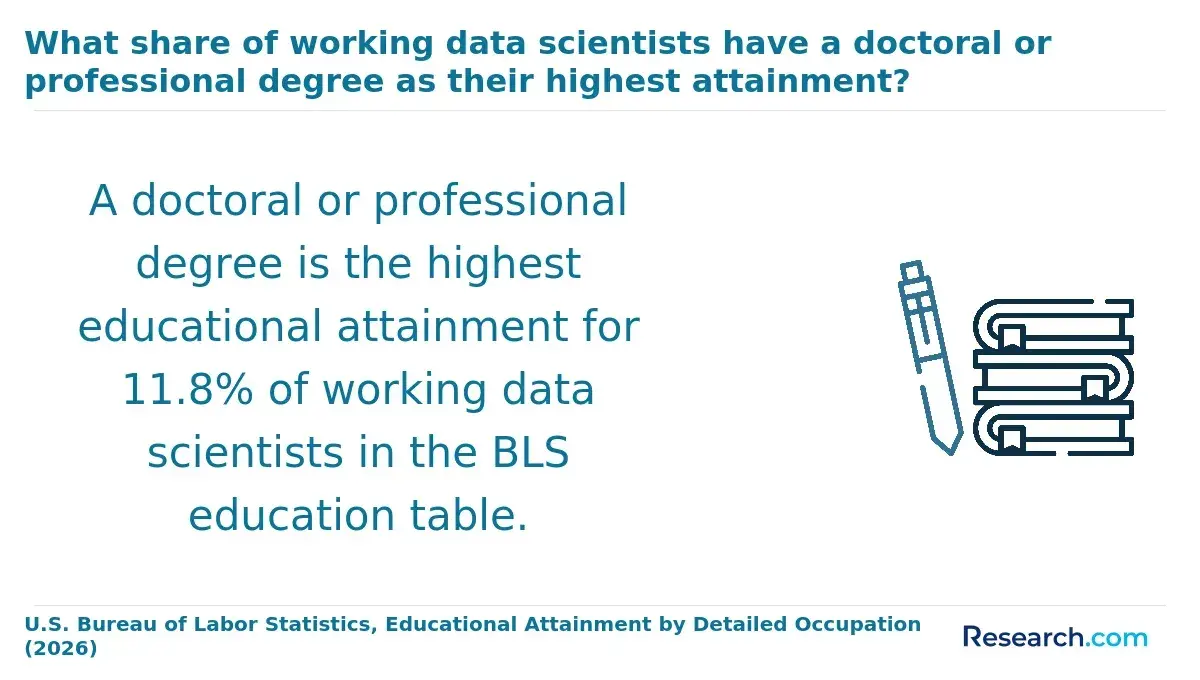
The Bureau of Labor Statistics projects 35% growth in employment of data scientists from 2025 to 2035. This indicates expanding demand for the occupation nationally, but it does not measure demand for holders of any particular master's or guarantee that a career changer will obtain a data scientist job.
Use the outlook as context, not as the return in your break-even formula. A stronger individual forecast comes from checking whether jobs you would pursue ask for skills the program actually teaches, whether your prior experience meets their other requirements, and whether you can complete relevant projects while enrolled. Those findings should determine how conservative your earnings scenarios are.
Other Things You Should Know About Data Science
Potentially, if you meet the loan's eligibility requirements. Confirm the school's payment deadline and your employer's reimbursement date first: borrowing can solve a timing problem but adds financing costs to your worksheet.
Do not assume you can claim a tax benefit for the same expense your employer paid. Eligibility depends on current tax rules and your circumstances; check with a qualified tax professional before including any tax savings in your calculation.
Only if your employer's written policy allows it. Some benefits require advance approval, so obtain confirmation for the course and program before registering.
Some programs permit nondegree enrollment, but admission to a course does not necessarily guarantee later admission or credit toward the master's. Confirm credit applicability and employer-benefit eligibility with both the school and your employer first.
References
- Frequently asked questions about educational assistance programs | Internal Revenue Service https://www.irs.gov/newsroom/frequently-asked-questions-about-educational-assistance-programs
- What Financial Aid Offers Don't Tell You About the Cost of College | U.S. GAO https://www.gao.gov/blog/what-financial-aid-offers-dont-tell-you-about-cost-college
- Cost of Attendance (Budget) | 2025-2026 Federal Student Aid Handbook https://fsapartners.ed.gov/knowledge-center/fsa-handbook/2025-2026/vol3/ch2-cost-attendance-budget
- Employer Tuition Reimbursement: How It Works and How to Pay for College | Winston-Salem State University https://ramsonline.wssu.edu/blog/employer-education-benefits/
- Tuition and Fees - The Hub - Colorado State University https://thehub.colostate.edu/billing/tuition-and-fees/
- Tuition and Fees - UVA School of Data Science https://datascience.virginia.edu/degrees/info/online-msds-tuition-and-fees
- Tuition & Financial Aid | MS in Data Science - Pace Online https://online.pace.edu/graduate-programs/ms-in-data-science/tuition-and-financial-aid/
- 26 U.S. Code § 127 - Educational assistance programs | LII / Legal Information Institute https://www.law.cornell.edu/uscode/text/26/127
- Tuition Information | Office of the Registrar | Illinois https://registrar.illinois.edu/tuition-fees/tuition-info/
- Program Fees | Master of Science in Data Science | University of Connecticut https://masters.datascience.uconn.edu/program-fees/


