2027 Public Health PhD vs Health Services Research PhD

Co-Founder and Chief Data Scientist
Choosing between a Public Health PhD and a Health Services Research PhD means choosing the questions and methods that will shape years of research - not simply choosing a degree title. The distinction matters if you want to study population health but are unsure whether your work belongs in disease prevention, health policy, or the delivery of care. This guide compares doctoral training, supervision, funding, and career paths so research-oriented applicants can identify the program that best supports a feasible dissertation and their intended work afterward.
Key Things You Should Know
- Choose by dissertation question and advisor fit: public health doctorates span population-health fields, while health services research focuses on how care is organized, accessed, financed, delivered, and evaluated.
- Neither degree title determines your methods or career. Compare required courses, available supervisors, data access, and graduates' actual roles before applying.
- Doctoral funding and time to completion vary by program; there is no reliable degree-wide tuition figure or salary that can tell you which option has the better return.
What is the difference between a Public Health PhD and a Health Services Research PhD?
A Public Health PhD trains researchers to investigate population-health problems. Its scope depends heavily on the concentration: epidemiology, biostatistics, environmental health, social and behavioral sciences, and health policy can lead to substantially different dissertations.
A Health Services Research PhD usually centers on the performance and consequences of healthcare systems, including access, quality, costs, insurance, and care delivery. Some schools place health services research within a public health department, so the names are not mutually exclusive descriptions of subject matter.
The comparison below describes typical emphases, not requirements shared by every university. It is most useful when you compare it with faculty work and dissertation examples at schools you are considering.
| Decision point | Public Health PhD | Health Services Research PhD |
| Typical research question | What shapes health or disease patterns across populations, and which approaches could improve them? | How do healthcare organization, payment, policy, and delivery affect access, quality, outcomes, or spending? |
| Possible research settings | Communities, public health agencies, environmental settings, health systems, or population datasets | Health systems, insurers, policy organizations, claims datasets, patient populations, or care-delivery settings |
| Important limitation | The title alone does not identify a methodological specialty. | The title alone does not establish expertise in healthcare management or clinical practice. |
The dividing line is the unit of inquiry, not whether your work benefits public health. A study of neighborhood heat exposure may fit environmental public health; a study of whether a health system reaches patients during heat emergencies may fit health services research. For a broader look at reviewing public health doctoral degree choices, use the same question-first approach rather than treating program labels as interchangeable.
Which PhD is better for your public health career goals?
Choose the Public Health PhD if your intended research concerns disease distribution, exposures, prevention, community interventions, or another population-health question that has strong supervision in a particular public health department.
Choose the Health Services Research PhD if you want to investigate such questions as whether a payment policy changes care access or why an evidence-based service is not delivered consistently. A public health PhD in health policy may be a closer match to the latter goal than an HSR program with no advisor studying your topic.
Test the fit with a provisional dissertation question, a plausible source of data, and the methods needed to answer it. Then look for faculty who actively supervise similar work. If you primarily want to lead programs or improve operations rather than produce original research, a practice-focused DrPH, relevant master's degree, or supervised experience may be more direct.
If you are earlier in your education and still building a population-health foundation, public health undergraduate degree options online address a different decision; they are not substitutes for doctoral research training.
What careers can you pursue with each doctoral degree?
Either doctorate can support research-intensive work in universities, government, health systems, nonprofits, or research organizations. Public health graduates may seek faculty or research roles focused on epidemiology, prevention, environmental health, or population-level policy.
Health services research graduates may pursue faculty, health policy research, care-delivery evaluation, or health-system research roles. Employers hire for demonstrated methods, subject expertise, publications or other research outputs, and relevant experience - not the diploma wording alone.
A PhD does not automatically qualify someone to direct a public health department, manage a hospital, practice clinically, or hold a faculty position. For an applicant who wants to implement programs rather than conduct independent research, compare the doctoral commitment with a master's-level route; public health master's tuition and salary comparisons can help frame that alternative without treating earnings as guaranteed.
Both generally combine advanced coursework, mentored research, doctoral milestones, and a dissertation. Public health coursework varies by concentration: an epidemiology student may develop study-design and causal-inference skills, while an environmental health student may focus on exposure assessment.
Health services research programs commonly draw on health economics, policy analysis, implementation research, outcomes measurement, and quantitative or qualitative evaluation. Check required courses rather than assuming a topic listed as an elective will be available when you need it.
Methodological overlap can be substantial. Either program might teach regression, causal inference, survey research, or mixed methods, but depth depends on prerequisites, course sequences, and supervised application.
Ask whether faculty can guide the analysis your question requires and whether you can obtain appropriately governed data. For applicants who still need undergraduate preparation, public health bachelor's accelerated study schedules concern a prior stage of training; a faster foundation does not replace advanced methods coursework or research experience.
Requirements vary by university and department. Applicants commonly submit academic records, a statement of research interests, recommendations, and evidence of preparation for doctoral-level methods.
Some programs require particular statistics, economics, calculus, or research courses; others assess comparable preparation without prescribing the same courses. Verify current test policies and whether a faculty member must agree to supervise an applicant before admission.
Competitiveness is different from minimum eligibility. A strong application shows how prior research, clinical work, policy analysis, computing, or community-based work informs a specific question.
An MPH, publication, or thesis can help demonstrate readiness but is not a universal prerequisite. Applicants missing foundational graduate preparation can examine MPH admission when some requirements are incomplete; admission to an MPH does not itself establish readiness for a research PhD.
Completion time depends on required coursework, qualifying exams, research approvals, data access, publication or dissertation rules, and whether enrollment is full time. Do not rely on an advertised minimum: request the program's actual time-to-degree information and ask how students with your intended research design progressed.
Restricted healthcare data or partnerships with health systems can add time to an HSR project; community permissions and longitudinal data collection can similarly affect public health research.
Compare net financial exposure, not tuition alone. A written funding offer should clarify tuition coverage, required fees, stipend, health insurance, teaching or research duties, summer support, renewal conditions, and support after the standard funding period.
Also account for lost earnings and any travel or data-related costs. Applicants balancing work or household obligations can use budget and pacing choices for public health students as a starting point, while checking doctoral funding and attendance rules directly with each program.
Some doctoral programs offer online or hybrid coursework, but delivery format does not establish that the entire PhD can be completed remotely. Research meetings, teaching duties, exams, residencies, data access, and dissertation defenses may have separate requirements. Health-system research can also depend on access to collaborators or restricted records that remote enrollment does not provide.
Ask for the current cohort's campus-visit schedule, live-session expectations, supervision arrangements, and rules for research assistants. If an online listing appeals to you, use a public health doctoral program selectivity overview only to identify programs for closer investigation - not as evidence of easy admission, full remote completion, or suitable dissertation supervision.
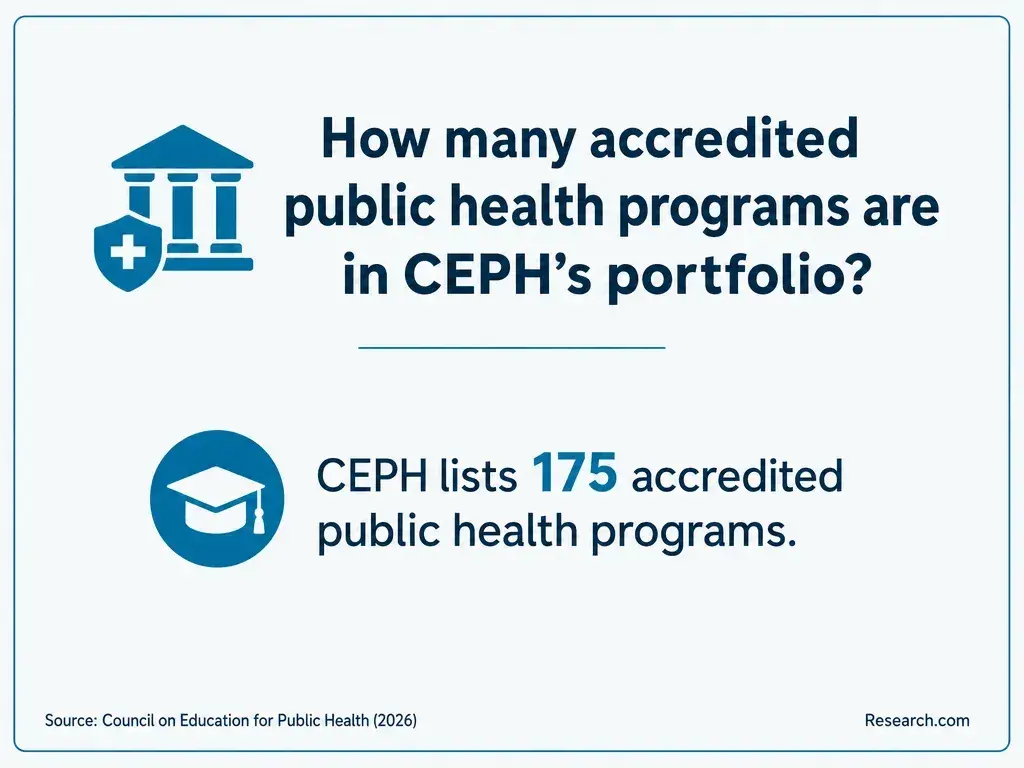
Check that the university has recognized institutional accreditation. Also verify the exact scope of any Council on Education for Public Health (CEPH) accreditation: accreditation of a school or another public health program should not be assumed to cover every doctorate. Ask the institution which unit and degrees are covered if that distinction matters to your goals.
Neither PhD title automatically grants a clinical license or professional certification. A physician, nurse, or other licensed professional must meet the separate rules of the relevant licensing authority. If your goal is professional public health practice rather than doctoral research, consider whether a master's route is more appropriate; online MPH programs with accessible admissions are a separate option, not a shortcut to doctoral credentials or licensure.
There is no authoritative US salary or employment-growth statistic for "Public Health PhD graduates" versus "Health Services Research PhD graduates." The US Bureau of Labor Statistics reports by occupation, not by these degree titles. Its epidemiologist, medical scientist, and other occupational profiles can provide context for a specific target job, but their wages include workers with varied degrees, experience, and employers. Faculty roles and health-system research jobs can follow different hiring and pay structures.
For a useful comparison, identify the roles you would actually seek, check their stated qualifications and posted compensation, and weigh those findings against funding and years out of full-time work. Do not count a higher occupational median as a doctoral earnings premium. If a master's degree could qualify you for the work you want, online MPH cost planning options offer a relevant cost comparison before committing to doctoral study.
How can you choose a reputable doctoral program?
Build a shortlist around your research question, then test whether each program can support the entire project - not just admit you. Faculty fit matters alongside available methods courses, data permissions, funding, and a workable route through doctoral milestones. Published faculty interests are a starting point, not confirmation that someone is accepting students or can provide access to a dataset.
Before accepting an offer, ask the graduate director and potential supervisors for the following information:
- Which faculty are currently available to supervise this question, and what happens if an advisor leaves?
- Which required methods courses, research resources, and committee members would support the proposed design?
- What approvals or data-use agreements would be needed, and who would help secure them?
- What do recent completion times, funding terms, and graduates' placements show about this specific program?
Compare the answers in writing, giving special weight to any dependency you cannot control. If epidemiology-focused research is also under consideration, budgeting for an epidemiology doctorate with aid can prompt further funding questions; confirm every term in the actual offer.
Other Things You Should Know About Public Health
Some universities permit a manuscript-based dissertation, while others require a different format. Check graduate-school and department rules, including coauthorship and contribution requirements, before planning publications as dissertation chapters.
Often, but a change may require a new supervisor, committee approval, revised research permissions, or additional methods training. Ask how the program handles topic changes before assuming funding or timelines will stay the same.
Clinical experience can generate valuable care-delivery questions, but it does not determine the best doctorate. Match the proposed question, methods, and available supervisors; population-level prevention research may fit a public health department better.
Yes. It can examine differences in access, treatment, quality, or outcomes across populations. A strong project defines those measures carefully and considers whether its data and methods can support the conclusions it proposes.
- Health Care Access and Quality - Healthy People 2030 - odphp https://odphp.health.gov/healthypeople/objectives-and-data/browse-objectives/health-care-access-and-quality
- How the health services research workforce supply in... - PMC https://pmc.ncbi.nlm.nih.gov/articles/PMC8928029/
- What Can I Do with My Health Care Management and Policy Major? | Cawley Career Education Center | Georgetown University https://careercenter.georgetown.edu/major-career-guides/what-can-i-do-with-my-major/nursing-and-health/healthcare-management-policy/
- Concentration in Implementation Science | Johns Hopkins https://publichealth.jhu.edu/academics/drph/curriculum/concentration-in-implementation-science
- PhD in Health Services Research | Colorado School of Public Health https://coloradosph.cuanschutz.edu/education/degrees-and-programs/doctor-of-philosophy/phd-in-health-services-research
- Doctoral Studies Funding, Awards, and Grants | NYU Steinhardt https://steinhardt.nyu.edu/current-students/doctoral-studies/doctoral-funding-awards-and-grants
- Implementation Science Concentration | yale.edu https://catalog.yale.edu/ysph/traditional-two-year-mph-program/implementation-science-track/
- REG, Degree Catalog, PhD of Public Health | usuhs.edu https://reg.usuhs.edu/degree-catalog/phd-of-public-health
- Doctor of Philosophy in Public Health (PhD) | Rutgers School of Public Health https://sph.rutgers.edu/academics/degree-programs/doctor-philosophy-public-health-phd
- Information and FAQs on Graduate Aid | virginia.edu https://gradstudies.virginia.edu/funding-and-aid-faqs-graduate-students