2027 Online MS in Psychology - Forensic Psychology for Workforce Development Staff: Choosing a Program Without Leaving Your Job
Audited and Verified:
Our Editorial and Data Verification Process
Research.com uses government datasets, official education statistics and primary institutional information to support its career and degree guides. Our review process checks factual accuracy, occupational definitions, source dates and the requirements associated with the credentials discussed.
How This Article Was Fact-Checked
Our editorial team verifies salary estimates, employment projections, education requirements and program information against original data providers and official organizations. Salary figures are checked against the relevant occupational definitions and reporting periods. Information about licensure, accreditation and required in-person training is reviewed separately.
Fact-checked and verified on:

Co-Founder and Chief Data Scientist
Workforce development staff often help people navigate employment barriers tied to court involvement, trauma, and gaps in community services. An online MS in forensic psychology may deepen that work, but its value depends on what you want to do next - and whether you can complete it alongside your job.
This guide shows how to compare program schedules, applied learning, costs, and career outcomes without mistaking a forensic concentration for a clinical credential. You'll be able to decide whether a master's, a different degree, or targeted training is the better investment.
Key Things You Should Know
- Choose a program around a defined work goal, such as improving justice-involved employment services, not the forensic label alone.
- "Online" does not mean fully asynchronous: confirm live classes, placement hours, campus visits, and whether your employer can approve a workplace project.
- A nonclinical forensic psychology MS does not itself qualify you to practice as a psychologist, diagnose conditions, or conduct forensic evaluations, compare its total cost with the requirements of your target job.
What is an online master's in forensic psychology for workforce development staff?
An online master's in forensic psychology is graduate study of psychological science as it relates to legal and justice settings. Depending on the program, it may emphasize research, behavior, ethics, victim services, corrections, or applied projects. The degree title alone does not tell you how much training it provides in workforce development - or whether it includes clinical preparation.
For a workforce development specialist, the useful intersection is often nonclinical: understanding barriers faced by justice-involved job seekers, evaluating reentry services, coordinating referrals, and communicating evidence to agency partners. If you are comparing distance learning psychology degree options, check the specific master's curriculum rather than assuming every online psychology program serves this purpose.
Can a forensic psychology master's advance a workforce development career?
It can, particularly if you already manage reentry partnerships, supervise employment services, analyze program results, or seek a justice-focused role. Your existing client-service and employer-engagement experience may be more valuable than a degree alone; the master's should fill a demonstrable gap in research, program evaluation, or justice-system knowledge.
The best educational route changes with the work you want to perform. This comparison separates goals that benefit from forensic study from those that require different preparation.
| Career goal | Likely value of a forensic psychology MS | Important limitation or alternative |
| Improve employment services for justice-involved clients | Potentially useful for evidence review, service design, and cross-agency work | Employer training or a focused evaluation course may be enough |
| Lead a workforce or reentry program | May complement management experience | Hiring may weigh budgets, grants, supervision, and outcomes more heavily |
| Provide psychotherapy or forensic assessment | May offer academic background | Requires an appropriate professional education and credential pathway |
Before enrolling, review postings in your agency or target employer and ask which qualifications actually affect hiring or promotion. If you have not finished a bachelor's degree, forensic psychology bachelor's completion planning is the nearer-term decision; a master's cannot replace that admission requirement.
Does an online forensic psychology master's qualify you for licensure?
Usually not by itself. A nonclinical MS with forensic coursework does not authorize independent psychotherapy, diagnosis, restricted psychological testing, forensic evaluation, or use of a protected psychologist title. A course on assessment or psychopathology is academic study, not permission to perform those services.
If your goal is licensed counseling, social work, or psychology practice, identify the occupation and state first. Then ask the relevant licensing board which degree, program features, supervised experience, and examinations it requires. Counseling and social work programs are distinct from most forensic psychology master's programs. Compare their eligibility rules and mental health counseling education costs after aid before choosing a nonclinical MS as a stepping-stone.
Start with institutional accreditation recognized by the U.S. Department of Education or the Council for Higher Education Accreditation, and verify the institution's status directly with the accreditor. Then examine the exact program. Institutional accreditation does not establish that a forensic psychology MS meets a licensing board's requirements; APA accreditation should not be assumed to cover a general or nonclinical master's.
For someone staying employed, scheduling and applied-work policies deserve as much scrutiny as course titles. Request written answers to these questions before paying a deposit:
- Which classes require live attendance, group meetings, exams at fixed times, or campus visits?
- Can enrollment be reduced during a demanding work period, and when are required courses offered again?
- Is a thesis, capstone, or placement required, and may a project at my workplace be proposed for approval?
- Who supervises applied work, and what outcomes does the program report for students pursuing nonclinical careers?
Compare those answers with your work calendar. Intensive online psychology program formats may shorten the calendar while increasing weekly demands; neither "online" nor "accelerated" establishes that a program is compatible with full-time employment.
Course lists vary, but relevant programs may cover research methods, statistics, psychology and law, ethics, social behavior, psychopathology as an academic subject, and justice-system applications. For workforce development, look beyond forensic terminology for instruction in measurement, program evaluation, cultural responsiveness, and clear communication of research findings.
An applied capstone could be valuable if the school permits a feasible employment-services question - for example, examining how an agency measures referral completion. Workplace data are not automatically available for coursework. Employer authorization, confidentiality rules, data-use restrictions, and any required institutional review must be settled before access or publication.
If you actually want to deliver treatment, compare the supervised clinical preparation and clinical counseling master's course sequencing required for that different pathway. A forensic elective cannot substitute for clinical training.
Programs generally require an earned bachelor's degree, but eligible majors and required preparation vary. A workforce development professional with a background in human services, criminal justice, education, or another field should distinguish a formal prerequisite from coursework the school merely recommends. Statistics, introductory psychology, research methods, writing samples, references, and statements of purpose may matter differently at each institution.
Ask admissions to identify missing prerequisites and whether they must be finished before enrollment. In your application, connect concrete duties, such as coordinating employer partnerships or reviewing service outcomes, to the program's research and applied work. Do not present experience providing referrals as clinical training.
If the bachelor's degree remains unfinished, investigate moving existing credits into psychology study first. Only the receiving institution can determine which credits satisfy degree requirements, rather than simply transferring as electives.
Time to completion depends on required credits, course rotation, enrollment pace, and any project or placement. Ask for a term-by-term plan based on the number of courses you can realistically take while working, not the shortest advertised completion time.
Tuition alone understates the decision. The following costs and constraints are worth comparing in each school's current published terms.
| Item to verify | Why it matters while employed |
| Tuition basis and required credits | Shows the core academic expense at your planned pace |
| Technology, course, and graduation fees | May not be included in a tuition quote |
| Campus travel or placement expenses | Can add cost and require leave from work |
| Employer assistance and its conditions | May depend on grades, continued employment, or approved courses |
| Reduced-load and leave policies | Can affect completion time and aid eligibility |
Get an itemized estimate for your intended pace and confirm aid eligibility with the financial aid office before borrowing. If you first need an undergraduate credential, financial aid for substance abuse counseling bachelor's degrees addresses a separate funding decision; undergraduate aid assumptions should not be carried over to a forensic master's.
Potential nonclinical directions include reentry program coordinator, victim-services program staff, corrections education specialist, justice-focused research assistant, and workforce program evaluator. These are examples of functions, not jobs automatically open to every graduate. Employers may require agency experience, data skills, a different degree, or a specific credential.
For an employed reader, the strongest near-term strategy may be internal: seek responsibility for an approved service evaluation, partnership, training initiative, or grant-reporting task while studying. That creates evidence of work you can discuss without disclosing client information. Public-sector hiring rules and pay grades may still limit how quickly new education changes your title.
If your target job involves counseling rather than service coordination, investigate the separate clinical counseling master's time-to-degree and salary outlook. A forensic MS should not be treated as a shortcut into licensed practice.
There is no single "forensic psychology master's salary." Pay follows the occupation, employer, location, experience, and applicable credentials - not the degree label. Workforce specialists, program managers, counselors, and licensed psychologists perform different work and should not be grouped into one earnings estimate.
For a defensible comparison, match your target posting to the closest occupation in the U.S. Bureau of Labor Statistics Occupational Outlook Handbook, then check its stated wage reference year and entry requirements. An occupation-wide median is not a forecast of your salary or a program's graduate outcome. Public agencies may also use fixed pay bands, making an internal promotion policy more informative than a national median.
Weigh a plausible pay change against tuition, fees, and time away from other responsibilities. Planning the cost of a psychology master's can help frame that comparison, but obtain the prospective school's actual charges and your employer's assistance terms before estimating a return.
What job outlook and certifications matter in forensic psychology careers?
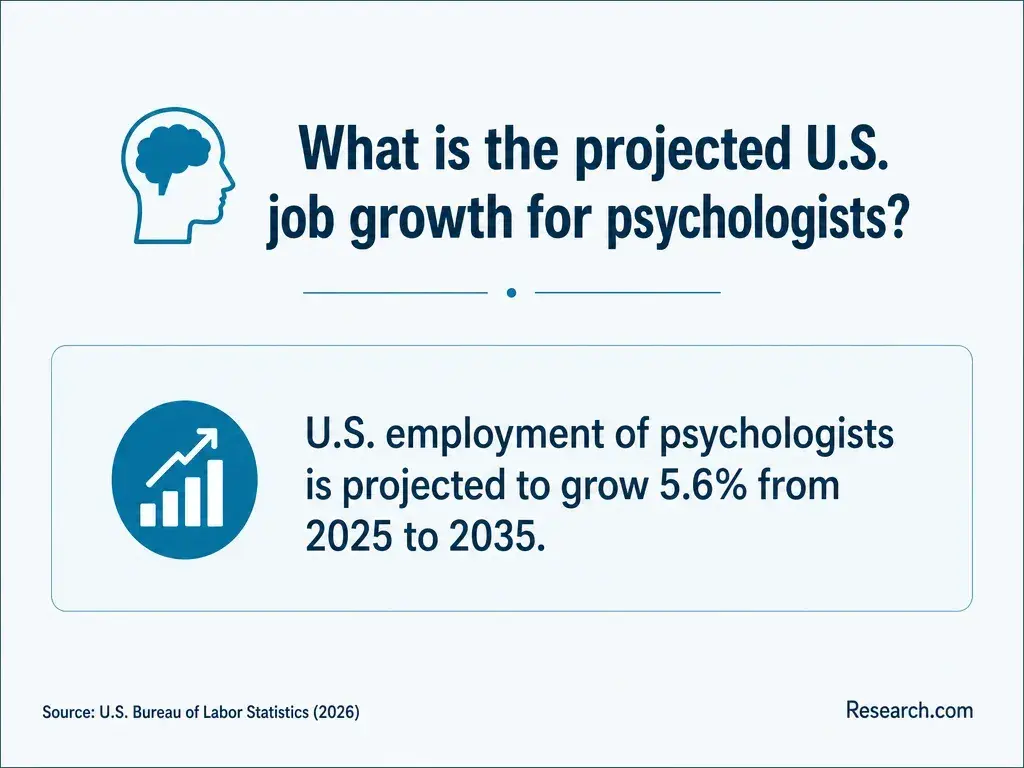
Job outlook is occupation-specific. Use Bureau of Labor Statistics projections for the work you intend to do - such as training, social services management, or counseling - rather than treating projected growth for psychologists as the outlook for nonclinical forensic MS graduates. Local agency budgets and contract funding can matter as much as national projections for a particular opening.
There is no universal certification that turns a forensic psychology MS into a forensic psychologist credential. A job posting may instead call for a state-recognized counseling or peer-support credential, a case-management qualification, data skills, or agency-specific training. Check the issuing body and employer for eligibility, supervision, renewal, and permitted duties before paying for a credential.
If your schedule is the main obstacle, psychology graduate programs with compressed schedules are worth comparing - but faster coursework cannot replace any supervised hours or professional requirements attached to a separate credential. The sound next step is to choose a target role, verify its requirements, and enroll only if the program closes a gap your experience and shorter training cannot.
Other Things You Should Know About Psychology
Yes. Ask whether a suitable supervisor and a narrowly scoped project are possible, while making clear that academic approval and permission to use workplace information must come separately.
Request the written policy and ask your supervisor which duties make the coursework relevant. Confirm reimbursement conditions before assuming the full degree will qualify.
Follow agency policy and course rules. Do not share identifiable or restricted client information; ask the instructor for an approved hypothetical or public-source alternative.
Yes. Ask how often required activities conflicted with work and how advising handled schedule changes. Treat one person's experience as useful context, not a guarantee of current policy.
- Cost of Attendance (Budget) | 2025-2026 Federal Student Aid Handbook https://fsapartners.ed.gov/knowledge-center/fsa-handbook/2025-2026/vol3/ch2-cost-attendance-budget
- Trauma Training for Criminal Justice Professionals | samhsa.gov https://www.samhsa.gov/technical-assistance/gains-center/trauma-training
- The Current Conundrum of State Authorization for Online Education Programs and Clinical Placement - PubMed https://pubmed.ncbi.nlm.nih.gov/26342618/
- Fact Sheet #71: Internship Programs Under The Fair Labor Standards Act | U.S. Department of Labor https://www.dol.gov/agencies/whd/fact-sheets/71-flsa-internships
- Understanding College Costs | studentaid.gov https://studentaid.gov/resources/prepare-for-college/students/choosing-schools/consider-costs
- Training, practice, and career considerations in forensic... - PMC https://pmc.ncbi.nlm.nih.gov/articles/PMC11638730/
- Developing and Supporting Virtual Social Work Practicum Placements: Applied Learning in Social Work Education https://alswe.simmons.edu/article/developing-and-supporting-virtual-social-work-practicum-placements/
- Graduate Cost & Funding | UT San Antonio - Future Roadrunner https://future.utsa.edu/graduate/funding/
- Employment-Based Practicum Placements | charlotte.edu https://socialwork.charlotte.edu/practicum-education/employment-based-practicum-placements/
- A Career in Forensic and Public Service Psychology | apa.org https://www.apa.org/education-career/guide/subfields/forensic/education-training