2027 Online MS in Psychology - Forensic Psychology: Degree Options for Victim Services Evaluation Rather Than Treatment
Audited and Verified:
Our Editorial and Data Verification Process
Research.com uses government datasets, official education statistics and primary institutional information to support its career and degree guides. Our review process checks factual accuracy, occupational definitions, source dates and the requirements associated with the credentials discussed.
How This Article Was Fact-Checked
Our editorial team verifies salary estimates, employment projections, education requirements and program information against original data providers and official organizations. Salary figures are checked against the relevant occupational definitions and reporting periods. Information about licensure, accreditation and required in-person training is reviewed separately.
Fact-checked and verified on:

Co-Founder and Chief Data Scientist
If you work in victim services, justice administration, or a community organization, you may want to know whether an online MS in psychology can help you evaluate services without providing therapy. The distinction matters: evaluating whether people can access timely, useful support requires research skills and agency partnerships, not a clinical license.
This guide explains which degree options build those skills, what nonclinical work graduates may pursue, and what to verify before committing time or money. It also identifies when targeted training or another degree is the more direct route.
Key Things You Should Know
Key Things You Should Know
- For victim services evaluation, prioritize research methods, ethical data access, and an agency-based project over a forensic concentration label alone.
- A nonclinical forensic psychology MS does not authorize therapy, diagnosis, independent psychological assessment, or use of the protected title "psychologist."
- Compare the full cost and schedule of an approved project or placement - not just online tuition - and check the qualifications required by your target employer.
What Is an Online MS in Psychology With a Forensic Psychology Focus?
It is a graduate psychology degree that applies psychological science to legal and justice-related settings. "Forensic" may be an official concentration, a set of electives, or part of the degree's name; those arrangements are not interchangeable. For a victim services evaluator, the useful work is assessing service access, referral processes, client experience, and program outcomes - not examining a person for a court or providing treatment.
A strong fit combines statistics and research design with knowledge of trauma, victimization, and justice systems. Someone entering with a bachelor's degree and little methods training may need foundational coursework first. Affordable bachelor's study in psychology online is one option to compare with individual prerequisite courses; neither is necessary if a prospective MS accepts your existing preparation.
What Careers Support Victim Services Evaluation Without Providing Treatment?
Your current experience matters. A victim advocate may understand referral barriers but need stronger analysis skills; a public-sector analyst may know reporting systems but need preparation in survivor-centered practice. The table separates evaluation responsibilities from related service roles so you can search for jobs by duties rather than by "forensic psychologist."
| Role or function | Typical nonclinical work | What an MS may add |
| Program evaluation assistant or analyst | Define indicators, analyze permitted service data, and explain limitations | Research design, measurement, and reporting skills |
| Victim services coordinator | Manage referrals, document service activity, and coordinate partners | Evidence-informed service improvement; relevant experience may matter more |
| Research associate in a justice or nonprofit setting | Support approved studies, data collection, and findings briefs | Methods training and a supervised research portfolio |
These titles have no universal degree requirement. Review local postings for required experience, software, language skills, and public-sector hiring rules. If pay is central to your decision, exploring better-paid roles related to forensic psychology is always a good idea. A higher-paid role may require management experience or a different credential.
What Education and Licensing Does Forensic Psychology Work Require?
Nonclinical evaluation positions generally depend on an employer's hiring criteria, data permissions, and project supervision rather than a psychology license. A forensic psychology MS alone does not qualify someone to practice as a licensed psychologist, conduct independent clinical or court-ordered psychological evaluations, diagnose conditions, or provide psychotherapy. Those activities fall under distinct professional and jurisdictional requirements.
Decide which side of that boundary your goal occupies. If you want to improve a referral system or assess whether services reach intended communities, seek methods training and authorized agency experience.
If you want to treat survivors, investigate a qualifying counseling or social work pathway and the licensing board's education and supervision rules. Lower-cost accredited counseling degree pathways are a comparison point for that different goal, not a substitute for checking your state's requirements.
Online delivery can make coursework accessible without relocation, but it does not ensure flexible fieldwork, data access, or research mentorship. Compare formats against the actual evaluation project you hope to complete.
| Decision factor | Online program | Campus-based program |
| Class schedule | May be asynchronous or require live meetings | Usually has scheduled in-person classes |
| Agency project | May require you to locate a locally approved site | May offer nearby partners, without guaranteeing a placement |
| Research support | Depends on remote faculty access and project supervision | May offer in-person research teams and meetings |
Ask for the current course schedule, residency requirements, project-approval process, and examples of permitted nonclinical deliverables. If speed matters, online forensic psychology master's options with compressed schedules warrant an extra check: a short calendar may leave less time to secure an agency partner and data permissions.
Course names vary, so judge the skills a program actually teaches. The most relevant preparation covers research design, statistics, qualitative interviewing, program evaluation, psychological measurement, and ethics. Forensic or trauma-focused coursework should add context about justice systems and survivor experiences without being mistaken for therapy training.
Look for a supervised thesis or capstone that can produce a feasible evaluation plan, analysis of authorized data, or findings brief. A useful project might examine whether referral records show delays, but those records cannot be used merely because a student can access them at work. The agency must authorize the use; privacy, safeguarding, and institutional review requirements must be resolved before work begins.
Compare course sequencing as well as titles. Fast-track graduate psychology programs may suit someone with established quantitative skills, but accelerated pacing is a poor trade if it prevents a newcomer from practicing analysis and revising a supervised project.
Programs set their own requirements. Common application materials include a bachelor's transcript, statement of purpose, and recommendations; some also require or recommend introductory psychology, statistics, research methods, or relevant experience. A criminal justice, social work, public health, or other non-psychology major is not automatically disqualifying.
Before applying, ask admissions staff which prerequisites are mandatory, whether equivalent prior coursework counts, and whether missing preparation can be completed before enrollment. Use your statement to connect a specific evaluation goal to your experience - for example, improving how an agency measures referral completion - rather than claiming an interest in clinical forensic practice if that is not your objective.
Applicants still completing shorter routes through forensic psychology bachelor's coursework should confirm when the degree must be conferred and whether their statistics course meets the MS prerequisite.
Completion time depends on required credits, course availability, enrollment pace, and the time needed to arrange an approved project. Published tuition alone is not a total-cost estimate. Request the program's current credit requirements and fee schedule, then calculate required credits multiplied by tuition per credit and add mandatory fees, software, travel, and any project or continuation charges.
Ask whether a slower pace changes aid eligibility or creates extra terms of fees. If you already work at an agency, confirm that the university will approve a workplace-based project before treating it as a cost-saving option. Psychology master's tuition comparisons can narrow a shortlist, but only a program-specific cost estimate captures the schedule and applied-work obligations you would face.
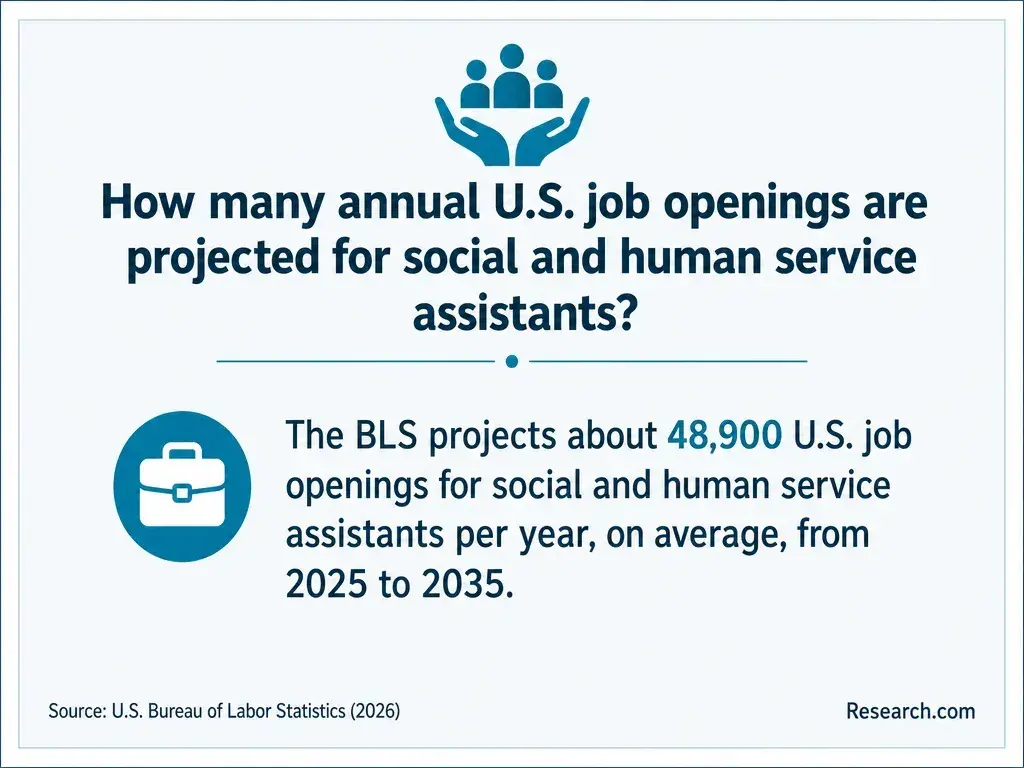
There is no reliable single "forensic psychology MS salary" for this goal. A graduate could work in advocacy, research, program analysis, or management, each with different duties and pay. The U.S. Bureau of Labor Statistics publishes occupation-wide wage data for categories such as social and human service assistants and social and community service managers, but neither category reports earnings specifically for forensic psychology MS graduates.
For a useful comparison, collect salary ranges from postings for the exact evaluation roles and locations you would pursue, then distinguish entry-level positions from jobs requiring management experience. Forensic psychology master's study with faster pacing may reduce time away from other priorities, but finishing sooner does not itself raise the pay attached to a role.
"Victim services evaluator" is not a single occupation with its own federal employment projection. Relevant openings can appear in nonprofits, universities, government agencies, and contracted research organizations, often under analyst, coordinator, or research titles.
Use current Bureau of Labor Statistics projections for the occupation that matches a posting's duties, then check local agency budgets and vacancies; a broad occupational growth rate cannot predict demand at a particular victim services organization.
Expanding the search to treatment roles changes the credential question, not just the outlook. Online study options for addiction counseling may interest someone seeking a separate counseling pathway, but their state-specific credential requirements and job market should not be treated as evidence of demand for nonclinical victim services evaluators.
How Can Students Choose an Accredited Forensic Psychology Program?
First verify the institution's accreditation through its published accreditor and the U.S. Department of Education's accreditation records. Then verify the exact MS title, whether forensic psychology is a formal concentration, and whether the curriculum supports your intended evaluation work. Institutional accreditation does not establish that a nonclinical MS meets psychologist licensure requirements; APA accreditation should not be assumed to cover it.
Request written answers about faculty supervision, local site approval, permissible project data, graduation requirements, and outcomes for graduates in comparable nonclinical roles. Compare that evidence with the full cost and your employer's job requirements.
If you are moving directly from an undergraduate program, remember that guidance on FAFSA for online substance use counseling undergraduates addresses a different degree level; ask each MS financial-aid office what graduate aid is available rather than assuming undergraduate aid terms continue.
Other Things You Should Know About Psychology
Not without explicit organizational authorization and any required privacy, consent, and review procedures. A safer initial project may use approved aggregate service records or a proposed evaluation plan.
No. Details can still identify people, and an agency's data-use rules still apply. Agree on permitted access, storage, and reporting before sharing anything.
Only if that information is necessary, ethically justified, and covered by appropriate approvals and safeguards. Many service questions can be answered without requesting trauma narratives.
With permission, share a redacted methods brief, an empty data-collection template, or a public-facing summary. Do not include identifiable records or imply that a proposed project produced verified results.
- The Professionalization of Victim Services in Canada | justice.gc.ca https://www.justice.gc.ca/eng/rp-pr/jr/jr14/p8.html
- Principles for doing trauma-informed research and program evaluation | Australian Institute of Family Studies https://aifs.gov.au/resources/practice-guides/principles-doing-trauma-informed-research-and-program-evaluation
- Victim Services Careers | fbijobs.gov https://www.fbijobs.gov/victim-services
- Evaluating Technology-Based Services for Victims of Crime | National Institute of Justice https://nij.ojp.gov/topics/articles/evaluating-technology-based-services-victims-crime
- Master's Degree - Forensic Psychology - On Campus | Monroe University https://www.monroeu.edu/academics/king-graduate-school/masters-forensic-psychology
- Tuition and Fees Charts - Student Financial Services https://sfs.gsu.edu/resources/student-acct/tuition-breakdown/
- Careers With a Forensic Psychology Master's Degree | The Chicago School https://www.thechicagoschool.edu/insight/career-development/career-options-masters-degree-forensic-psychology/
- Career Pathways with a Master's in Forensic Psychology | Neumann https://learn.neumann.edu/neuperspectives/careers-with-a-masters-degree-in-forensic-psychology
- Victim Services Specialized Studies Program | fsu.edu https://criminology.fsu.edu/degrees/non-degree-program/victim-services-specialized-studies-program
- An output analysis of a violent crime victim advocacy program | sagepub.com https://journals.sagepub.com/doi/10.1177/02697580261480727