2027 Online BA in Psychology - Mental Health Admissions with a College Gap Longer Than Twenty Years: What to Ask Before Applying
Audited and Verified:
Our Editorial and Data Verification Process
Research.com uses government datasets, official education statistics and primary institutional information to support its career and degree guides. Our review process checks factual accuracy, occupational definitions, source dates and the requirements associated with the credentials discussed.
How This Article Was Fact-Checked
Our editorial team verifies salary estimates, employment projections, education requirements and program information against original data providers and official organizations. Salary figures are checked against the relevant occupational definitions and reporting periods. Information about licensure, accreditation and required in-person training is reviewed separately.
Fact-checked and verified on:

Co-Founder and Chief Data Scientist
A college transcript from more than 20 years ago can still matter - but admission, transfer credit, and progress toward a psychology BA are three different decisions.
If you hope to work in mental health, you also need to know whether the degree supports your target job or merely prepares you for further training. This guide is for returning US students comparing online programs. It explains which records to gather, which offices can answer consequential questions, and how to check your likely time, cost, and career path before applying.
Key Things You Should Know
- A gap of more than 20 years does not automatically prevent admission; ask for a course-by-course evaluation showing which old credits satisfy current degree requirements.
- An online psychology BA can prepare you for some nonclinical support roles, but it does not qualify you to diagnose conditions or provide psychotherapy independently.
- Before committing, obtain a written degree audit and compare remaining credits, course schedules, total charges, and any required in-person experience.
What Is an Online Bachelor's Degree in Psychology for Mental Health Careers?
An online Bachelor of Arts in psychology is an undergraduate degree focused on human behavior and psychological science. A mental health focus may be a formally designated concentration, a set of electives, or simply a theme in a program's description. Ask which it is: the distinction affects what appears on your transcript, but none of these designations is a clinical license.
For a returning student, the useful question is whether the curriculum builds toward a particular next step. Courses on mental disorders, development, research, and service systems may support nonclinical work or a later application to professional school.
If substance-use services are your interest, compare the actual course and experience requirements of undergraduate psychology programs with an addictions focus; a program's name alone does not establish eligibility for an addiction-counselor credential.
Can a Psychology Bachelor's Degree Lead to a Mental Health Career?
Yes, a psychology bachelor's degree can support entry into mental health services, chiefly in nonclinical roles such as program support, intake coordination, advocacy, referrals, or research assistance.
Hiring depends on the employer, your prior experience, and any state-specific credential rules. Experience you gained during your college gap - in customer service, caregiving, administration, education, or community work - may be relevant, but it does not replace a required license or supervised training.
Start with job postings in your area: compare their required degree, duties, hours, and credentials with what the BA actually teaches. If your goal is substance-use counseling rather than support or outreach, examine online study options for addiction counseling alongside your state's credential requirements. A different program or targeted credential may be more direct than a general psychology BA.
What Education and Licensure Are Required for Psychology and Counseling?
Education about mental health is not authorization to treat it. A psychology BA does not by itself permit independent diagnosis, psychotherapy, or use of a protected psychologist title.
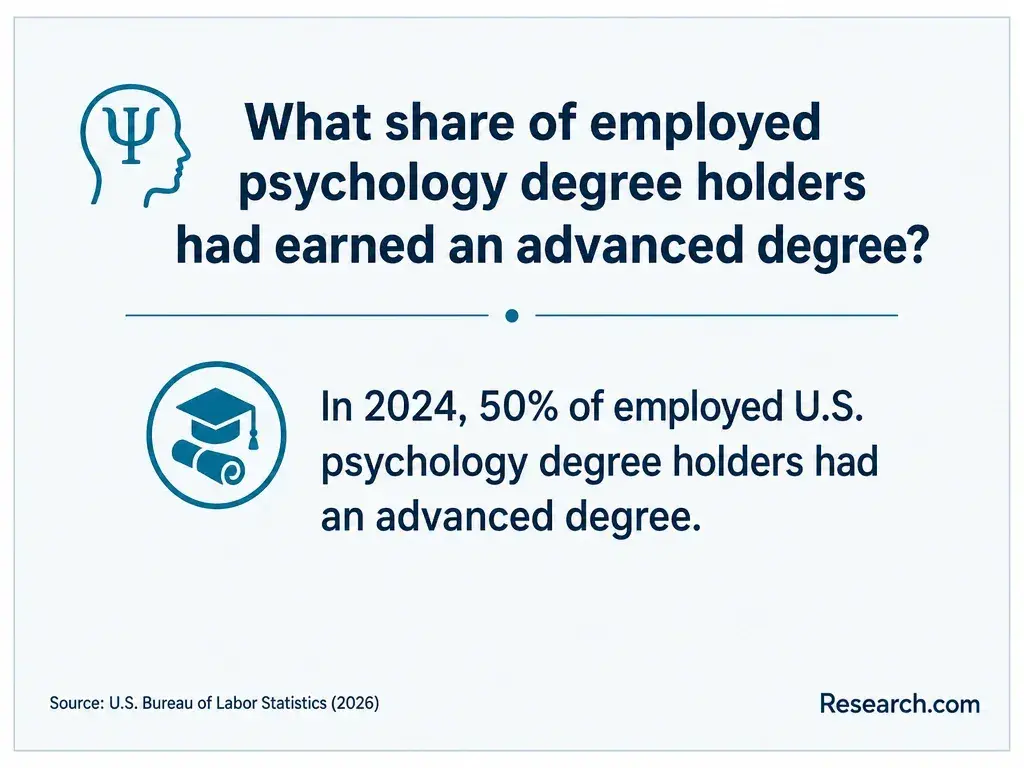
Licensed psychologists generally need doctoral-level professional training and must satisfy state requirements. Licensed professional counselors typically need a qualifying master's degree, supervised experience, and other state-required steps. Social work and marriage and family therapy have distinct educational and licensing routes.
If counseling is your destination, ask prospective graduate programs whether this BA would meet their entry prerequisites - and ask the relevant state board whether the graduate program meets its educational rules. Compare short-duration clinical counseling graduate program options carefully: an advertised short course sequence does not eliminate required supervised experience or guarantee licensure eligibility.
Often, yes. The age of your coursework is not the same as your readiness to study now. Your stronger concern may be whether an institution accepts those credits, applies them to the current major, and offers enough support to rebuild academic habits. Statistics, research methods, and academic writing can be especially demanding if you have not used them recently.
Ask whether you can begin at a manageable course load, access tutoring before the first assignment, and take an introductory or refresher course without delaying a required sequence. An accelerated calendar can reduce elapsed time while increasing weekly demands; compare accelerated BA and BS psychology pathways against your work and caregiving schedule, not just their advertised finish dates.
If you already have substantial professional experience, identify the exact role you want before enrolling. An employer-supported credential, supervised support position, or a few prerequisites might serve that goal at lower cost than another degree. The BA makes more sense when you need a bachelor's credential or its broader academic foundation.
Online and campus programs can teach the same academic subject matter, but they create different scheduling and access problems. An asynchronous lecture may be flexible, while live discussions, group projects, examinations, or a placement may have fixed hours. Campus study can make in-person relationships easier; online study can remove a commute without removing those commitments.
Request a sample course schedule and ask how online students meet faculty, obtain research experience, and arrange any required fieldwork near home. Compare format within the degree you actually need: forensic psychology degree formats and academic requirements, for example, address a different academic interest and should not be mistaken for mental health practitioner training simply because both study behavior.
Psychology BA requirements commonly combine general education with introductory psychology, statistics, research methods, developmental and social psychology, and upper-level electives. Mental health-related options might address psychopathology, health psychology, substance use, or community services. The catalog - not the program label - establishes which courses are required, when they run, and whether older coursework can substitute.
For a returning applicant, sequence matters more than the elective list. If statistics precedes research methods and the latter runs infrequently, one missing prerequisite can extend completion. Ask the department to map your remaining requirements by term. Be wary of transferring a program's advertised speed across specializations: three-year online forensic psychology degree options do not establish how quickly you can finish a mental health-focused BA with your particular credits.
Adult applicants may be asked for an application, official transcripts from every prior college, and evidence that they meet the institution's admission rules. Some schools have separate conditions for transfer admission or declaring the psychology major. A 20-year gap is worth explaining if asked, but do not assume that an old GPA is ignored or that recent work experience automatically overrides it.
Before paying an application fee, request answers from the admissions office and the transfer-credit or registrar's office. The psychology department and an academic adviser must then confirm how accepted courses apply to the major and the graduation plan. Use these questions to distinguish the decisions:
- Will you review unofficial transcripts before I apply, and what decisions remain provisional until official records arrive?
- How will quarter credits, older psychology or statistics courses, and courses from an applied associate degree be evaluated?
- Which accepted credits satisfy general education, psychology prerequisites, major requirements, and the school's residency rule?
- Is there a separate major-admission threshold, and may I appeal an equivalency or request a documented substitution?
- Can I receive a term-by-term degree audit before committing to enroll?
Keep course descriptions or syllabi if you have them; they can help reviewers assess an older course whose title no longer matches. If you eventually plan a master's degree, check its prerequisites separately. Shorter completion routes for psychology master's students do not resolve undergraduate transfer decisions or establish eligibility for a licensed profession.
There is no reliable personal completion estimate until a school determines which requirements remain. Accepted credits can count as electives yet leave a prerequisite, major course, or minimum number of institutional credits unfinished. Course availability and the number of classes you can realistically take each term then determine the schedule.
Compare written estimates using the same inputs: remaining credits multiplied by the applicable tuition rate, plus mandatory fees, materials, technology costs, and any travel or placement expenses. Ask how changing enrollment intensity affects financial-aid eligibility and whether an extra term changes fees.
Comparing affordable psychology colleges online is a starting point, but your best-value option is the one with the lowest credible remaining cost for a degree that meets your goal - not necessarily the lowest advertised rate.
Possible jobs include behavioral-health program assistant, intake coordinator, victim-services advocate, and research assistant. These are examples to investigate, not positions that every psychology graduate qualifies for. Some employers require relevant experience, a different degree, a background check, or a state-recognized credential; duties may also differ substantially under the same job title.
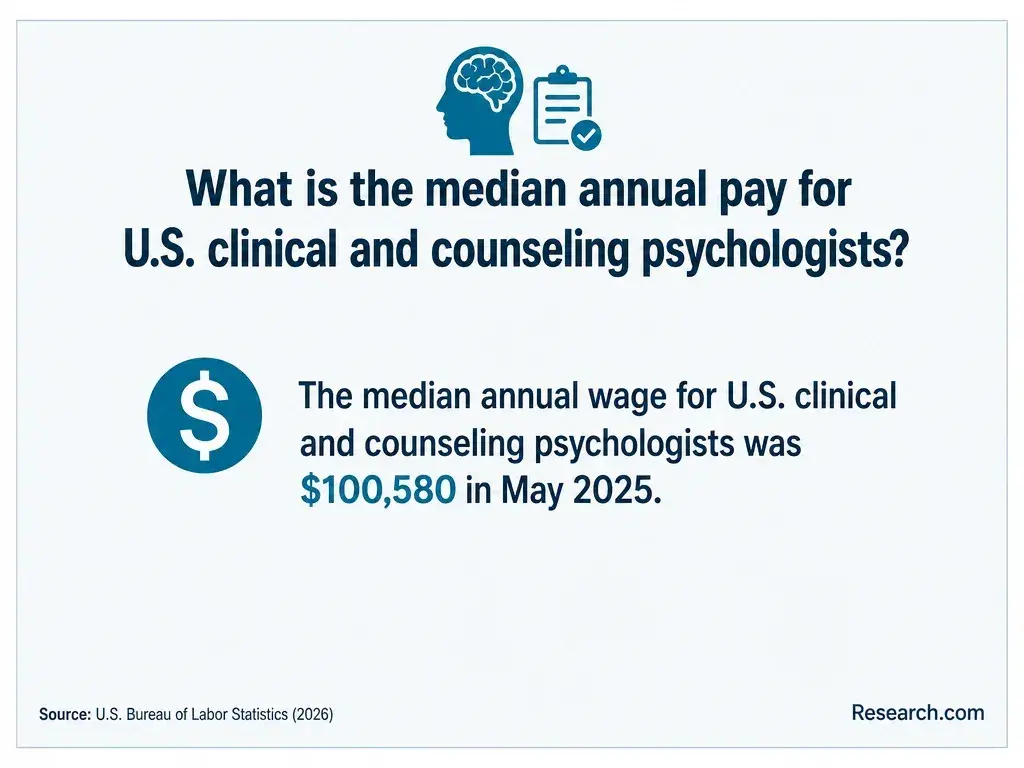
Published US Bureau of Labor Statistics wages and projections describe occupations, not outcomes for online psychology BA graduates. Compare the current occupational entry requirements and national wage and outlook information with local postings for the specific job you want.
If your intended role is licensed counseling, include the additional graduate education and supervised-work period in the decision; planning the time and cost of a counseling master's is more useful than treating a counselor's occupation-wide salary as an expected return on the BA alone.
How Can You Evaluate an Accredited Online Psychology Program?
Verify that the institution holds recognized accreditation and that the exact online BA is offered under its current catalog. Institution-level accreditation does not prove that a mental health concentration exists, that old credits will meet its requirements, or that graduates qualify for licensure.
APA accreditation should not be expected for a general undergraduate psychology BA; professional-program recognition becomes relevant when evaluating a later qualifying degree.
Ask for the catalog applicable to your entry term, a written transfer evaluation, a sample schedule of remaining courses, and the rules for placements, leaves, and graduation. Confirm whether advisers can help online students secure appropriate nonclinical experience.
If a school promotes the BA as preparation for an accelerated counseling degree, make separate accreditation checks for accelerated counseling programs and verify the intended state's licensing rules before relying on that pathway.
The most useful next step is to send the same transcripts and career goal to a short list of schools. Compare their written audits - not verbal estimates - alongside total remaining cost and the weekly schedule you can sustain.
Other Things You Should Know About Psychology
Contact the state higher-education agency or the institution that now holds its records. Ask each prospective school what official transcript or alternative documentation it will accept.
Only if the program requires one. If it accepts professional references, choose someone who can describe your recent work and readiness to study; confirm the school's policy first.
Not automatically. Ask how the school calculates transfer and admission GPAs, whether it recognizes repeated coursework, and whether the proposed class would meet a remaining requirement.
Some institutions offer approved prior-learning assessments, but employment alone does not create credit. Ask what evidence, fees, credit limits, and degree requirements apply before pursuing an assessment.
- College Accreditation | U.S. Department of Education http://www.ed.gov/laws-and-policy/higher-education-laws-and-policy/college-accreditation
- Cost of Attendance (Budget) | 2026-2027 Federal Student Aid Handbook https://fsapartners.ed.gov/knowledge-center/fsa-handbook/2026-2027/vol3/ch2-cost-attendance-budget
- Adult/Returning Students | HESC - NY.gov https://hesc.ny.gov/adultreturning-students
- DAPIP | Homepage - Office of Postsecondary Education (OPE) https://ope.ed.gov/dapip/
- How Does Online Learning Work at CSU? | colostate.edu https://online.colostate.edu/faqs/online-learning.dot
- Out of State Distance Education Students - UA Online https://online.ua.edu/about-us/state-authorization/
- 4.1.21 Instructional Modalities and Distance Education | Illinois State https://policy.illinoisstate.edu/academic/4-1-21
- What Is an Accredited University? Understanding Accreditation | National University https://www.nu.edu/blog/what-is-an-accredited-university/
- How Do Transfer Credits Work When You Go Back to School? | Whitworth Online https://online.whitworth.edu/news-articles/how-do-transfer-credits-work-when-you-go-back-to-school/
- Returning to CSUN: I am a returning undergraduate student https://www.csun.edu/admissions-records/tt-returning-csun-i-am-returning-undergraduate-student