2027 Online MS in Psychology - Forensic Psychology for Domestic Violence Program Evaluation: Which Courses Should You Look For?
Audited and Verified:
Our Editorial and Data Verification Process
Research.com uses government datasets, official education statistics and primary institutional information to support its career and degree guides. Our review process checks factual accuracy, occupational definitions, source dates and the requirements associated with the credentials discussed.
How This Article Was Fact-Checked
Our editorial team verifies salary estimates, employment projections, education requirements and program information against original data providers and official organizations. Salary figures are checked against the relevant occupational definitions and reporting periods. Information about licensure, accreditation and required in-person training is reviewed separately.
Fact-checked and verified on:

Co-Founder and Chief Data Scientist
A forensic psychology master's may sound well suited to evaluating domestic violence services, but a course on crime and behavior alone will not teach you to assess whether a program is reaching survivors or improving access to support. If you work in victim services, a nonprofit, or a justice agency, the useful degree is the one that builds research, evaluation, and ethical data skills around your organization's real constraints. This guide identifies the courses and applied experiences to prioritize, the qualifications the degree does not provide, and the questions to ask before committing to an online program.
Key Things You Should Know
- Prioritize a sequence covering research design, statistics, measurement, and applied program evaluation - not forensic electives alone.
- Look for a supervised project that can use authorized, privacy-protected service data; a placement or capstone is not automatically clinical training.
- Compare the full cost and scheduling of the MS with targeted methods training, especially if you already have a degree and relevant agency experience.
What is an online master's in forensic psychology for domestic violence program evaluation?
It is typically a nonclinical psychology master's with forensic coursework that a student applies to evaluating domestic violence services. The phrase does not necessarily name an official concentration. Confirm the degree title, any formally designated specialization, and the courses actually offered to online students.
Program evaluation asks whether an initiative is implemented as intended, whom it reaches, and what changes can reasonably be associated with its services. For a survivor-support organization, a feasible project might examine referral completion or access barriers. An improvement in referrals would not, by itself, prove that the program reduced violence.
The forensic context adds knowledge of courts, justice systems, victimization, and institutional power. It does not replace survivor-centered practice or authorize clinical assessment. Applicants still building undergraduate psychology foundations can compare psychology degree schools and online formats before assuming a specialized MS is the right starting point.
Which courses should an online forensic psychology program include?
Choose methods depth before specialization breadth. The strongest curriculum connects questions about service access and outcomes to defensible measures, appropriate comparisons, and decisions an agency can act on. Course titles vary, so request syllabi and examples of recent assignments.
This comparison separates essential evaluation preparation from useful context. Check whether the courses are required, consistently available as electives, or merely mentioned in marketing materials.
| Course area | What it should teach for this goal | Priority |
| Research design and statistics | Construct a feasible question; interpret uncertainty, missing data, selection bias, and the limits of causal claims. | Essential |
| Measurement and psychometrics | Define outcomes, assess reliability and validity, and distinguish service indicators from diagnostic instruments. | Essential |
| Program evaluation or applied methods | Build a logic model, select process and outcome measures, plan analysis, and communicate findings to decision-makers. | Essential |
| Qualitative or mixed methods | Study implementation and access barriers while addressing sampling, consent, interpretation, and researcher influence. | Highly useful |
| Forensic, trauma, and victim-services coursework | Understand legal-system interactions, safety, referral boundaries, and the limits of trauma-related measures. | Highly useful |
| Ethics and data governance | Plan confidentiality, data permissions, safeguarding, and any required institutional or research review. | Essential |
An applied capstone is especially valuable if faculty can supervise a realistic agency question. For example, a student could propose an evaluation of whether referrals reach a partner service, using only records the agency permits them to access. The proposal should specify who controls the data, how small groups will be protected from identification, and whether review or consent is required. It is not evidence that the student has permission to use client records.
Do not trade away the methods sequence solely for speed. When considering intensive online graduate psychology study, check whether statistics precedes the evaluation project and whether faculty provide enough feedback to revise a design.
Does a forensic psychology master's qualify you for licensure?
Usually not by itself. A nonclinical MS in forensic psychology can prepare someone to study justice-related behavior or evaluate services, but its name does not confer a psychologist license or authority to diagnose, provide psychotherapy, conduct independent forensic assessments, or offer expert testimony as a licensed practitioner.
If you want to treat clients, identify the specific licensed occupation first, then check that state board's educational, supervised-experience, and examination rules. Counseling, social work, and psychology follow different pathways. Even when comparing clinical counseling master's completion times, verify that the particular program - not just its subject matter - meets the intended state's requirements. For evaluation work, clinical licensure may be unnecessary; methods and agency experience may matter more.
Online delivery can let an agency employee study without relocating, while campus study may offer easier access to faculty projects and local partners. Neither format guarantees a suitable evaluation placement. The important difference is whether you can obtain sustained supervision, useful feedback, and approved access to a feasible project.
Ask whether classes are asynchronous, when live meetings occur, whether group work requires fixed hours, and whether the capstone involves travel or a site agreement. An online project based at your current workplace may be practical, but employment alone does not establish academic approval or permission to use agency data. Compare supervision and on-site obligations as carefully as you would when reviewing accelerated clinical counseling program formats; the placement purposes and licensing implications are different.
Programs set their own requirements. Expect to verify the accepted bachelor's degrees, any minimum academic standards, required psychology or statistics preparation, application materials, and whether relevant employment can strengthen an application. A criminal justice, social work, public health, or other non-psychology background is not automatically disqualifying.
If you lack statistics or research methods, ask admissions whether those courses are formal prerequisites, recommended preparation, or available after admission. Request an evaluation of your transcript before paying for replacements; if undergraduate coursework is needed, comparing affordable psychology colleges online can help you investigate options, but the master's program decides what satisfies its prerequisites.
Time and price depend on required credits, enrollment pace, per-credit tuition, fees, and the availability of courses and project supervision. An advertised accelerated schedule may be unrealistic if a needed methods course is offered infrequently or an agency agreement takes time to approve.
Ask for a term-by-term plan and an itemized estimate covering tuition, mandatory fees, software, possible travel, and any additional terms needed to finish a capstone. Compare that total with a shorter certificate or individual methods courses if your goal is advancement in an existing evaluation role. Guides to faster online forensic psychology master's completion can help you form questions, but obtain the school's current schedule and charges before relying on a projected finish date.
First, confirm that the institution holds accreditation recognized by the U.S. Department of Education and that it covers the institution offering the degree. Then verify the exact program and its delivery format in the current catalog. Institutional accreditation is important, but it does not establish that a forensic psychology MS qualifies graduates for a particular license.
Do not assume American Psychological Association accreditation applies to a general or nonclinical master's; APA's professional accreditation has a different scope. If a school suggests the degree supports licensure, request its written explanation and check it against the relevant state board. This matters particularly when weighing compressed online master's study in forensic psychology: speed, accreditation, course availability, and credential eligibility are separate facts to verify.
Depending on prior experience, graduates may seek evaluation assistant or specialist roles, research coordination, grant reporting, quality improvement, or victim-services program administration. These jobs involve different levels of responsibility; a new graduate is unlikely to enter a management position solely because they hold an MS.
Employers may value a work sample that demonstrates a logic model, defensible measures, a privacy plan, and a concise report for nonresearch colleagues. Survivor advocacy and service coordination may also require site-specific training, background checks, and knowledge of local referral procedures. Work involving co-occurring substance-use needs can intersect with working in substance use recovery support, but evaluating referrals does not qualify someone to provide addiction treatment.
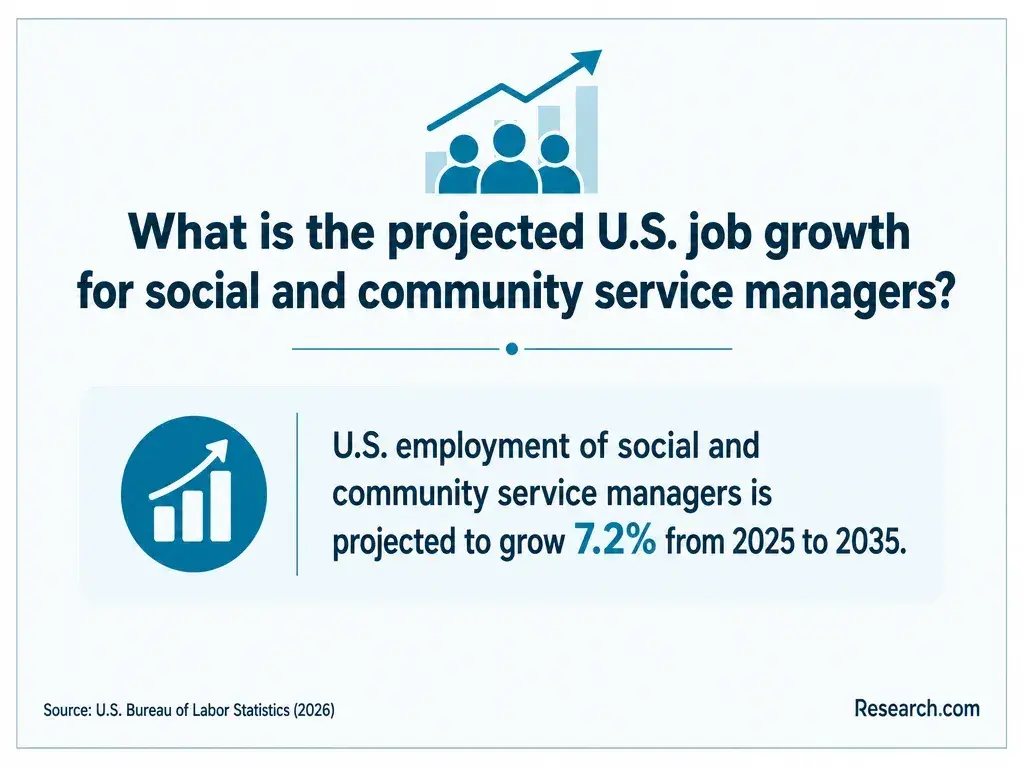
There is no single reliable salary for "forensic psychology program evaluation graduates." Pay depends on the actual job, employer, location, and experience. As one comparison point, the U.S. Bureau of Labor Statistics reported a $78,240 median annual wage in May 2024 for social and community service managers. That occupation typically involves managing programs and staff; its occupation-wide median is not an entry-level evaluation salary or an earnings estimate for this MS.
For a useful return-on-investment comparison, collect salary ranges from the jobs you would realistically qualify for, then weigh any expected change against the program's full cost and time away from paid work. Inexpensive psychology master's degree pathways may lower the education cost, but only a curriculum with the methods and supervised work you need addresses the career goal.
What job outlook and certifications apply to forensic psychology careers?
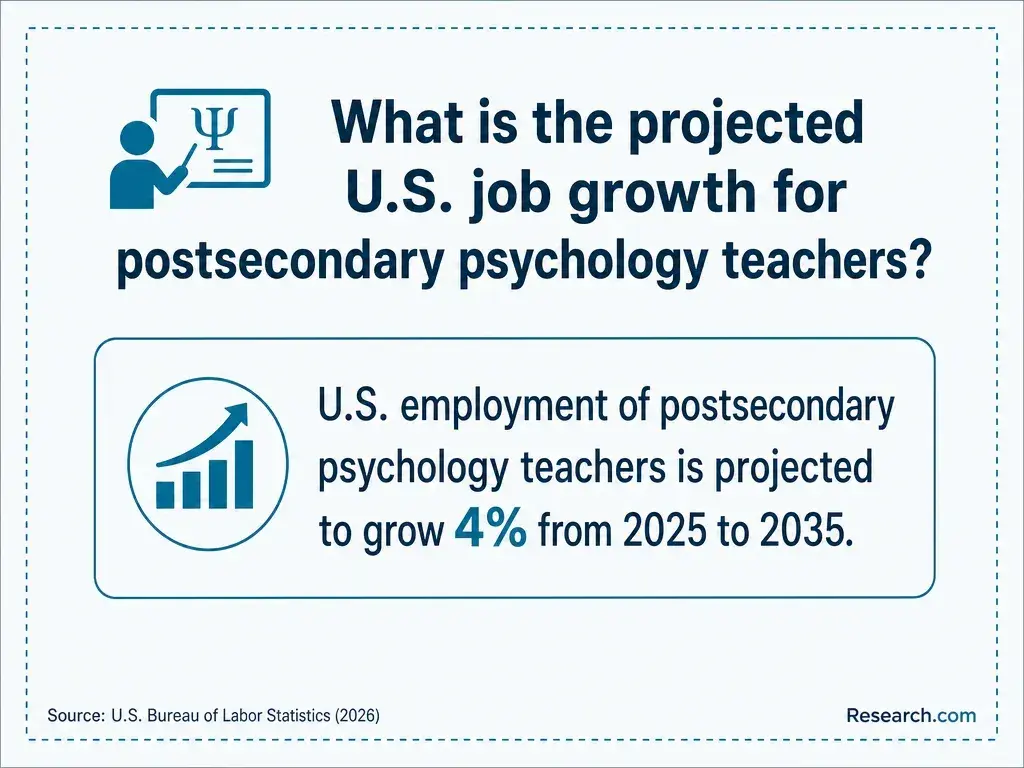
There is no single federal job-growth projection for domestic violence program evaluators. Check outlook data for the occupation matching the duties in a posting, not for "forensic psychologist" simply because the degree uses the word forensic. Local grant funding, agency budgets, and required experience can matter more to a particular opening than a national projection.
General evaluation roles do not have one universal certification requirement. Employers may instead request statistical skills, evaluation experience, or training in confidentiality and trauma-informed services. Direct-service or counseling jobs may have separate state or employer credential rules. If that is your intended work, compare those requirements with the cost of a targeted route, including substance abuse counseling undergraduate education investment where relevant, rather than assuming a forensic psychology MS substitutes for a required credential.
Other Things You Should Know About Psychology
Possibly. Ask the academic coordinator whether your job meets project requirements, and obtain organizational permission before accessing data or representing the work as an approved evaluation.
Focus on feasible process measures, document missing information, and avoid reporting details that could identify individuals. Small samples limit conclusions about outcomes.
No. Existing authorized administrative data, staff workflow information, or a proposal-only project may better fit the question and safety constraints. Any contact with survivors requires appropriate approvals and protections.
Request current syllabi, the course rotation, a sample degree plan, capstone approval rules, and an itemized cost estimate. Confirm that the courses central to your goal will be available during your enrollment.
- How to do trauma-informed research and evaluation | aifs.gov.au https://aifs.gov.au/resources/practice-guides/how-do-trauma-informed-research-and-evaluation
- CDC Approach to Program Evaluation https://www.cdc.gov/evaluation/php/about/index.html
- Accreditation in the U.S. | ed.gov http://www.ed.gov/laws-and-policy/higher-education-laws-and-policy/college-accreditation/accreditation-in-the-us
- OVC Model Standards - Office of Justice Programs https://ovc.ojp.gov/sites/ovc/files/model-standards/6/pfv.html
- Evidence-Based Practice | Child Welfare Information Gateway https://www.childwelfare.gov/topics/casework-practice/evidence-based-practice/
- Why APA Accreditation Matters https://accreditation.apa.org/why-accreditation-matters