2027 Online BA in Psychology - Mental Health for Ethics in Supportive Relationships: Which Courses Should You Look For?

Co-Founder and Chief Data Scientist
Supporting someone through a mental-health difficulty takes more than empathy. It also takes boundaries, respect for privacy, awareness of cultural differences, and the judgment to refer someone to qualified help. If you are considering an online BA in psychology for a support role, the course list matters more than a "mental health" label.
This guide shows which classes and supervised experiences develop ethical relationship skills, how to check what an online program actually offers, and when a different credential would better fit your goal.
Key Things You Should Know
- Prioritize ethics, developmental and social psychology, psychopathology, cultural psychology, and research methods - not just courses with "mental health" in their titles.
- Look for assessed practice in boundaries, confidentiality, referrals, and responding to distress; an online lecture alone cannot demonstrate those skills.
- A bachelor's degree commonly requires about 120 semester credits, but it does not qualify its holder to diagnose conditions, provide psychotherapy, or practice as a licensed psychologist.
What Is an Online BA in Psychology Focused on Mental Health?
It is an undergraduate psychology degree that pairs broad study of behavior and psychological science with coursework about mental health, relationships, or support services. "Mental health" might name an official concentration, a group of electives, or simply the way a school describes its general major. Those arrangements are not interchangeable: check the catalog and degree audit to see what appears on the transcript and what you must complete.
For this goal, supportive relationships means interacting respectfully with people experiencing distress while staying within a defined role. A peer supporter, advocate, or service coordinator may listen, share resources, document an interaction, or arrange a referral. Studying psychological disorders helps them recognize the limits of their knowledge; it does not prepare them to diagnose or treat a person.
When selecting an online psychology bachelor's program, compare published course descriptions and applied-learning requirements rather than relying on the concentration name. If you already work in a community organization, ask whether an approved project can address a real support-process problem without using identifiable client information.
Which Courses Should an Online Psychology BA Include?
The strongest curriculum combines an ethical foundation with evidence literacy and practice applying boundaries. Course titles differ by school, so use syllabi and learning outcomes - not titles alone - to make this comparison. The table separates essential foundations from useful additions.
| Course area | What to look for | Why it matters in supportive relationships |
| Psychology ethics or professional issues | Confidentiality, informed consent, power differences, conflicts of interest, record handling, and scope of practice | Builds judgment about what to share, promise, document, or refer |
| Developmental and social psychology | Lifespan changes, social influence, identity, stigma, and relationships | Helps students avoid one-size-fits-all assumptions about people and families |
| Abnormal psychology or psychopathology | Evidence-based study of conditions, diagnostic concepts, and limitations | Provides context without turning students into diagnosticians |
| Cultural psychology, diversity, or disability studies | Cultural responsiveness, accessibility, structural barriers, and reflective practice | Supports respectful communication and equitable referrals |
| Research methods and statistics | Study design, measurement, uncertainty, and ethical use of data | Helps students assess support claims and avoid treating screening scores as diagnoses |
| Supervised applied elective or internship | Approved tasks, qualified supervision, feedback, and clear referral procedures | Tests whether a student can maintain boundaries outside a textbook example |
Within an ethics course, look specifically for scenarios involving a friend asking for informal counseling, a client disclosing possible harm, pressure to share records, or a supporter becoming the only person someone relies on. A useful assignment asks students to explain their role, identify a privacy or safeguarding obligation, and choose an appropriate supervisor or referral route. Laws and reporting duties depend on the setting and jurisdiction; a course should teach students to check the applicable rules, not memorize a universal script.
If time for electives is limited, choose ethics and a supervised communication or service-learning experience before adding another survey course about disorders. Add addiction or family-focused study when it matches the population you expect to serve. Students aiming specifically for substance-use treatment should also compare online substance use counseling degrees against their state's credential requirements; a psychology elective may not meet them.
Is an Online Psychology Bachelor's Degree Accredited?
Accreditation applies first to the institution: confirm the school's current status with its recognized accreditor and check that the online BA is an authorized offering of that institution. Do not assume a program has separate psychology accreditation. The American Psychological Association does not accredit general psychology bachelor's programs, and institutional accreditation does not certify clinical readiness.
Ask the school for its current catalog, the name of the awarding institution, and written clarification of any claimed program-specific recognition. If your eventual goal is licensed counseling, investigate the intended graduate program and your state board's educational rules separately. Resources on accredited counseling study with accelerated schedules concern a different credential pathway; they are not evidence that an undergraduate psychology concentration qualifies you for counseling licensure.
Online delivery can make lectures and readings easier to fit around work, caregiving, or community-service schedules. It does not guarantee that every activity is asynchronous. Ethics discussions, group exercises, faculty meetings, proctored assessments, and approved placements may have fixed times or local attendance requirements. Campus study may offer more immediate access to research teams and in-person role-play; an online program can be equally useful for this goal if it provides meaningful interaction, feedback, and access to supervised opportunities.
Before enrolling, request a sample course schedule and ask how students practice a difficult conversation, receive feedback, and find approved placements. Check whether a simulated case is discussed privately, whether recordings are required, and how the school protects classmates' disclosures. Compare those obligations alongside fast-paced psychology degree formats: shorter terms may compress weekly work rather than reduce it.
Requirements vary by institution and by whether you apply as a first-year or transfer student. Schools typically evaluate prior education and may request transcripts; some have separate steps for entering the psychology major or an official concentration. Prior work in a nonprofit or support setting can clarify your goals, but it does not automatically replace required psychology, statistics, or research-methods courses.
Transfer applicants should request a written degree audit showing not only which credits are accepted, but which satisfy the major, electives, general education, and residency rules. If you have another long-term specialty in mind, check its later admissions criteria before selecting electives. For example, evaluating forensic psychology degree admissions is a separate task from choosing ethics courses for supportive relationships; a forensic elective neither changes your BA admission status nor establishes a professional qualification.
A full-time student starting without college credit commonly plans around four academic years for a bachelor's degree. The actual timeline depends on accepted transfer credit, required course sequences, term length, enrollment pace, and whether an applied experience is offered when you need it. A school's advertised completion time is not an individual graduation estimate.
Ask an advisor to map the next offerings of statistics, research methods, ethics, and any internship prerequisites against your available hours each term. Include placement travel or unpaid hours if applicable. If the end goal is therapy rather than nonclinical support, compare the full undergraduate-to-licensure timeline with the value of shorter clinical counseling degrees; a shorter graduate schedule does not remove its admission, practicum, or state licensing requirements.
A psychology BA can support applications for nonclinical roles such as community outreach worker, intake coordinator, victim-services assistant, research assistant, or behavioral-health program support worker. Duties vary substantially by employer. A support worker might explain available services, coordinate appointments, maintain records, or escalate a concern under organizational policy - not diagnose a condition or conduct therapy.
For relationship-centered work, employers may value documented experience as much as course titles. Seek a supervised opportunity that lets you demonstrate respectful communication, accurate notes, accessibility practices, and knowing when to consult a supervisor. If recovery services interest you, an addiction recovery employment guide can help you distinguish support jobs from counseling positions; check state-specific peer or addiction credentials before applying.
For someone already employed in a community organization, a full BA may be worthwhile if a degree is needed for advancement or broader academic options. If the immediate goal is to improve referrals and boundaries in an existing job, employer training, supervision, and a targeted ethics course may be more direct.
No. A psychology BA is academic preparation, not a psychologist license. Psychologist licensure generally involves qualifying doctoral education, supervised experience, examination, and approval under the state's rules. Other licensed mental-health professions follow distinct educational and supervision pathways. Neither an undergraduate mental-health focus nor a general psychology master's degree should be assumed to meet those requirements.
If your goal is research or nonclinical advancement, cost-conscious options for a psychology master's may warrant comparison. If your goal is psychotherapy, begin instead with the relevant state licensing board's requirements and identify programs designed for that profession. This distinction can prevent you from paying for a degree that develops useful knowledge but does not advance the credential you need.
There is no single psychology BA salary. Pay depends on the occupation, location, employer, experience, and any required credential. An occupation-wide median from the U.S. Bureau of Labor Statistics describes workers in that occupation, not earnings promised to graduates of a particular major. Counselor or psychologist wage figures are especially poor proxies for bachelor's-entry support jobs because those professions have different qualification requirements.
Compare actual postings for the roles and locations you would pursue, separating starting pay from wages requiring experience or certification. Include tuition, fees, books, lost work hours, and possible unpaid placement time in the decision. The same caution applies to career earnings research for forensic psychology master's students: figures tied to specialized or licensed occupations should not be used to forecast earnings from a mental-health-focused BA.
How Strong Is the Job Outlook for Mental Health Psychology Careers?
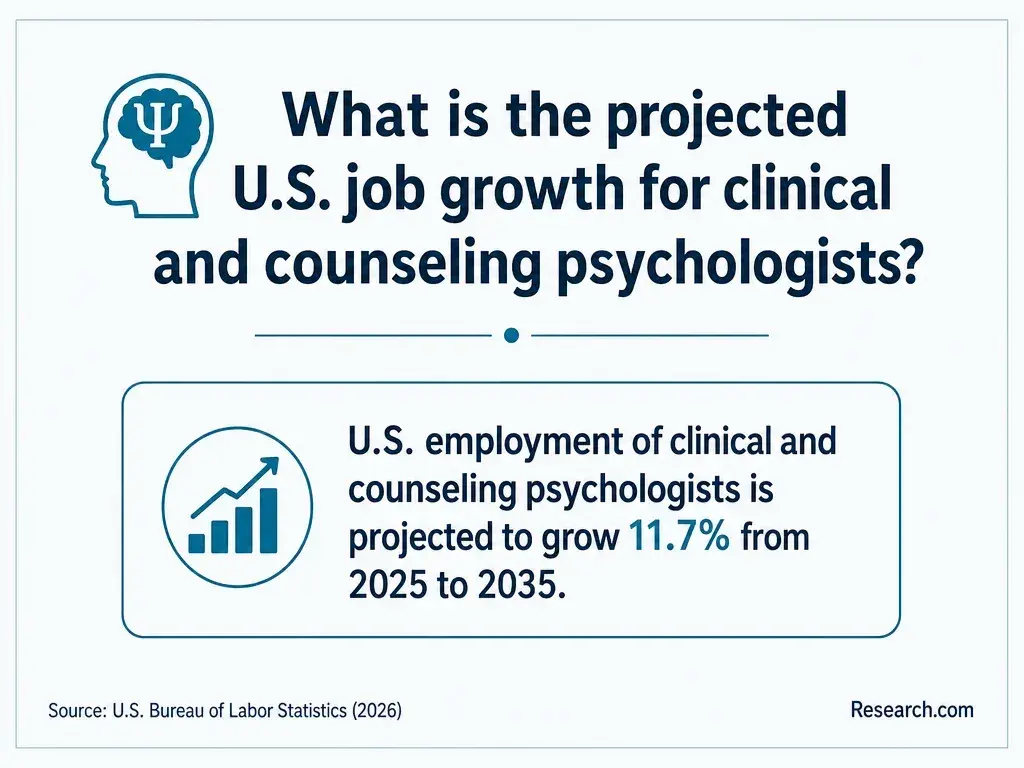
Demand for mental-health services does not translate into one job-growth rate for "psychology careers." The Bureau of Labor Statistics publishes projections for defined occupations, whose entry requirements can differ sharply. A projection for licensed counselors, for example, cannot establish the outlook for an intake coordinator or predict whether a particular BA graduate will find work.
Use the occupation named in a target job posting to find the matching federal outlook, then check local openings and credential rules. For a substance-use role, compare duties and qualifications alongside substance abuse counseling bachelor's fees and career prospects. Before committing to a program, ask its career office for outcomes specific to its psychology graduates - including which respondents entered support work, continued their education, or earned a separate credential.
Other Things You Should Know About Psychology
Not by default. Structured fictional scenarios let students practice responses without pressuring classmates to disclose sensitive experiences. Check the instructor's rules for participation and recordings.
Do not try to become their counselor or promise secrecy. Follow the course's safety procedures and contact the instructor or designated support service, especially if there is an immediate concern.
Follow the organization's communication policy. Personal accounts can blur boundaries and expose private information; approved work channels are generally the safer starting point.
Yes, students can ask the institution's accessibility office about reasonable accommodations. Contact it early so an alternative can preserve the assignment's learning objective without unnecessarily disclosing private information.
- Understanding U.S. Accreditation | EducationUSA https://educationusa.state.gov/understanding-us-accreditation
- Ethical and Legal Issues in Psychotherapy - PMC - NIH https://pmc.ncbi.nlm.nih.gov/articles/PMC9122134/
- Professional Counselors - Applying for a license FAQ's | Texas Behavioral Health Executive Council https://bhec.texas.gov/texas-state-board-of-examiners-of-professional-counselors/faqs-lpc/professional-counselors-applying-for-a-license/
- SAFE-T Suicide Assessment Five Step Evaluation and Triage | samhsa.gov https://library.samhsa.gov/product/safe-t-suicide-assessment-five-step-evaluation-and-triage/pep24-01-036
- Accreditation in the U.S. | ed.gov http://www.ed.gov/laws-and-policy/higher-education-laws-and-policy/college-accreditation/accreditation-in-the-us
- Clinical Mental Health Counseling M.S. | University of Houston-Clear Lake https://www.uhcl.edu/academics/degrees/clinical-mental-health-counseling-ms
- 11.4 Dual Relationships - Ethical Practice in Co-Occurring Substance Use Disorder and Mental Health Counseling https://open.lib.umn.edu/ethicalpractice/chapter/11-4-dual-relationships/
- 4 Research Methods in Psychology | St. Augustine College https://www.staugustine.edu/2022/10/05/main-research-methods-in-psychology/
- Ch 2: Psychological Research Methods | Psychological Science: Understanding Human Behavior https://openbooks.library.baylor.edu/psychscience/chapter/research-methods/
- The Importance of Ethics in Clinical Mental Health Counseling - Concordia University Irvine https://www.cui.edu/the-importance-of-ethics-in-clinical-mental-health-counseling/