2027 Online Ed.D. in Leadership and Learning in Organizations Admissions: Applying with a Competency-Based Master's Transcript
Audited and Verified:
Our Editorial and Data Verification Process
Research.com uses government datasets, official education statistics and primary institutional information to support its career and degree guides. Our review process checks factual accuracy, occupational definitions, source dates and the requirements associated with the credentials discussed.
How This Article Was Fact-Checked
Our editorial team verifies salary estimates, employment projections, education requirements and program information against original data providers and official organizations. Salary figures are checked against the relevant occupational definitions and reporting periods. Information about licensure, accreditation and required in-person training is reviewed separately.
Fact-checked and verified on:

Co-Founder and Chief Data Scientist
A competency-based master's transcript may document completed graduate work without a conventional GPA or familiar course grades. That can complicate an online Ed.D. application even when the master's degree is valid. For professionals considering leadership and learning in organizations, the key is to establish how each doctoral program evaluates the degree, its credits, and evidence of academic readiness.
This guide explains what to request from your master's institution, what to ask admissions before paying an application fee, and how to distinguish admission eligibility from doctoral credit transfer.
Key Things You Should Know
- A completed competency-based master's can meet an Ed.D. degree requirement, but only the receiving program can decide whether its grading and credit documentation satisfy that program's rules.
- Request an official transcript, grading-scale explanation, degree-verification document, and any available credit-equivalency information; ask admissions in writing how it handles a transcript without a GPA.
- Acceptance of a master's for admission does not mean its credits will transfer into the Ed.D. or shorten the program.
What Is an Online Ed.D. in Leadership and Learning in Organizations?
An Ed.D. in leadership and learning in organizations is a practice-oriented doctorate focused on how people learn, lead, and implement change at work. Depending on the program, students may study adult learning, organizational development, evaluation, and applied research in businesses, nonprofits, healthcare organizations, government agencies, or educational institutions. "Online" describes where much instruction occurs; it does not establish that classes are self-paced or that campus visits are unnecessary.
For an applicant with a competency-based master's, the degree's subject matters less than a particular program's eligibility rules and the applicant's ability to connect prior study and professional work to doctoral inquiry. A training manager might propose studying whether a new onboarding approach improves learning transfer, for example. That is a stronger fit argument than claiming that a transcript's unusual format should be overlooked.
What Are the Admission Requirements for an Online Leadership and Learning Ed.D.?
Requirements vary by institution. Programs may ask for a completed master's degree, official transcripts, professional experience, recommendations, a statement of purpose, a résumé, an interview, or a writing sample. Some specify a graduate GPA or minimum grades; others explain how they assess applicants whose institutions do not issue them. Do not infer an exception from a general statement that applicants need a master's degree.
The distinction below helps you identify which questions require an admissions decision rather than an assumption based on another school's policy.
| Admissions issue | What to verify with the Ed.D. program |
| Master's eligibility | Whether the awarding institution and completed degree meet its requirements |
| Missing GPA or letter grades | Whether competency-based grades meet its threshold and what explanatory records it accepts |
| Graduate credits | Whether a minimum number is required for admission and how documented units are counted |
| Professional preparation | What responsibilities or organizational problems demonstrate a suitable practice focus |
| Application timing | Which documents must arrive before review and which may follow an initial application |
If you also hold an education specialist degree, compare the additional eligibility questions involved in online doctoral program choices after an Ed.S. An Ed.S., a completed master's, and credits from an unfinished degree may be treated differently.
How Do You Apply With a Competency-Based Master's Transcript?
A competency-based transcript may record mastery, pass grades, units, or assessments instead of letter grades. Present those records as issued; do not calculate your own GPA or describe a "pass" as an A unless the awarding institution officially defines it that way. Ask the Ed.D. admissions office - not just a general enrollment adviser - how its published rules apply to your specific documents.
Use this sequence before spending time on a full application:
- Obtain an official transcript showing the master's degree was conferred, plus the institution's official grading-scale or transcript-key document.
- Request a registrar's letter if the transcript does not clearly explain credit units, graduate level, academic standing, or why no GPA appears.
- Send the program a concise inquiry naming the degree, awarding institution, grading system, and documented credits; ask whether these meet admission requirements and whether further review is needed.
- Ask separately whether any prior work could qualify for a prerequisite waiver or doctoral transfer review, and who makes each decision.
- Keep the written response, then use your statement and résumé to show leadership responsibilities, research readiness, and a feasible organizational learning problem.
A transcript explanation resolves a documentation question; it does not replace evidence that you can write, interpret evidence, and manage doctoral work. If your history also includes an unfinished doctorate, education doctorate completion after a doctoral study break raises a separate set of credit and progression questions. Disclose that study rather than assuming your completed master's is the only graduate record the program needs.
Check that the institution awarding the doctorate holds recognized institutional accreditation and that the credential on your competency-based master's transcript was issued by the institution you identify in your application. The Ed.D. program can tell you which prior institutions and credentials it accepts. Accreditation alone does not establish that a particular grading system satisfies an admissions GPA rule.
For program quality, review the actual curriculum, faculty guidance, research support, completion requirements, and published online attendance rules. Ask whether the admissions office will provide a written evaluation of your nontraditional transcript and whether the registrar or graduate school makes the final eligibility decision. Favor a documented answer over an informal assurance that "competency-based degrees are usually fine."
Relevant coursework may cover adult learning, organizational change, leadership, research methods, and program evaluation. The precise sequence matters for a competency-based master's graduate: strong workplace experience may support an application, while limited exposure to research design or academic writing may still warrant preparation before enrollment.
Check the final doctoral requirement as carefully as the courses. Programs differ in whether students complete a dissertation, dissertation in practice, capstone, or another approved project. If a conventional dissertation is not the right fit, compare practice-focused Ed.D. final project options, then confirm the specific program's deliverable and approval rules. Prior competency-based projects do not automatically substitute for doctoral research.

Duration and total cost depend on required doctoral credits, enrollment pace, tuition structure, fees, and project completion. A master's accepted for admission may provide no reduction in doctoral coursework. Before estimating savings from transfer, request a written evaluation showing exactly which requirements, if any, prior credits satisfy.
Compare a program's published tuition and fees with required travel, technology, books, and time away from work. If your employer offers education assistance, check coverage limits, reimbursement timing, grade conditions, and repayment obligations. For a model of the questions involved, see budget planning for higher education leadership doctoral study; verify every cost and aid term for the program you actually choose.
Online study may reduce commuting or relocation, but live sessions, group work, and required convenings can still constrain a working professional's schedule. Campus-based study may provide more routine in-person access to faculty and peers while requiring regular travel or a move. Neither format changes the need to resolve a competency-based transcript question before admission.
Ask both programs when classes meet, whether attendance is mandatory, how research advising works, and what happens if a workplace project becomes unavailable. Advertised speed also needs scrutiny: education doctorate duration comparisons are most useful when you check required credits, course sequencing, and realistic project time alongside the stated timeline.
Possible paths include learning and development leadership, organizational development, workforce training, consulting, and education-adjacent administration. The strongest fit usually builds on responsibilities you already hold: designing learning initiatives, leading change, evaluating programs, or making decisions across teams. Employers may value those results more than the doctorate alone.
If your goal is a first move into learning and development, an Ed.D. may be a costly route to experience you could gain through a targeted course, an employer project, or mentorship. If you already lead organizational learning and need deeper applied-research capability, the doctorate may be more relevant. Compare the jobs you want with their stated experience requirements before applying.
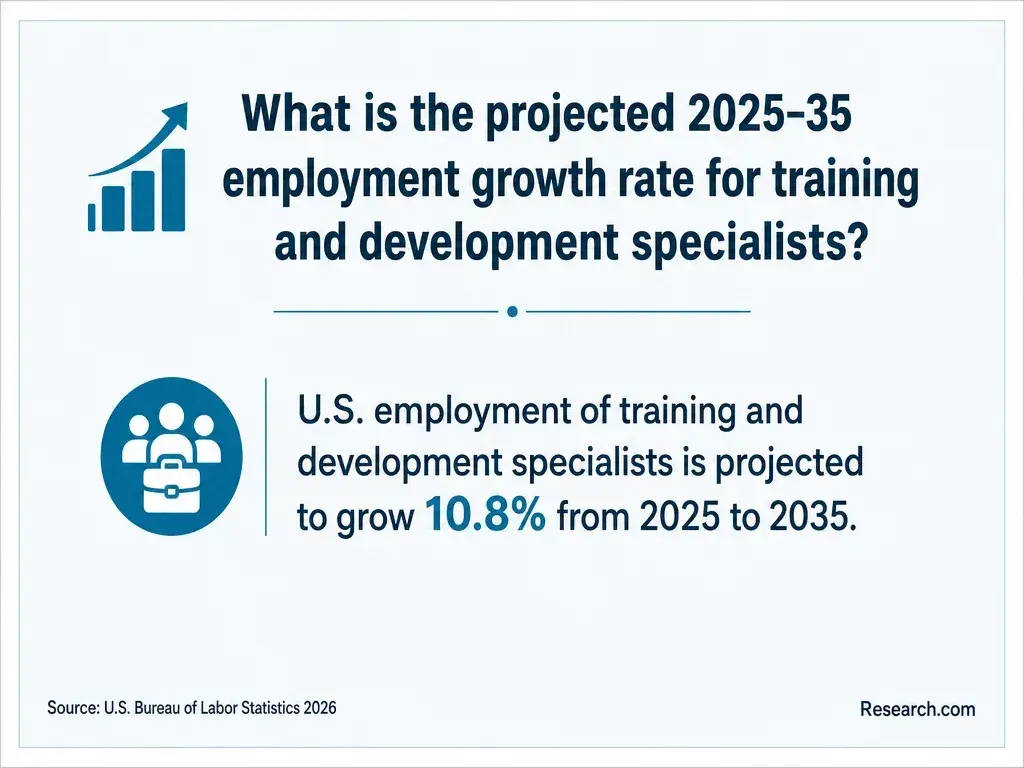
There is no single Ed.D. salary: pay follows the occupation, sector, location, and level of responsibility. The U.S. Bureau of Labor Statistics reports a 2025 median annual salary of $133,000 for training and development managers and projects 6.4% employment growth for that occupation from 2025 to 2035. That median describes workers in the occupation, not graduates of a particular doctorate or applicants newly entering management.
Use occupational data to test whether your target role supports the investment, then review actual job postings and your employer's pay structure. A doctoral credential does not establish eligibility for a management job or guarantee a raise.
Does an Ed.D. Require a Professional License or Certification?
Organizational leadership and learning roles generally do not share a single Ed.D.-specific professional license. An Ed.D. also does not automatically qualify its holder for teacher, principal, superintendent, counseling, or other regulated positions. Those roles may require separate state-approved preparation, experience, examinations, or certification.
If licensure is your goal, ask the program whether its exact degree and track meet the requirements in the state where you plan to practice, then confirm with that state's licensing authority. A transcript accepted for doctoral admission and a doctorate completed successfully are distinct from occupational licensure eligibility.
Other Things You Should Know About EdD Leadership
Yes. A faculty member or supervisor familiar with your work can describe the rigor of your assessments and your writing or analytical skills. Their letter supplements, but does not replace, official academic records.
Not necessarily. If a program requests a writing sample, ask whether a substantial paper or appropriately redacted competency-based project is acceptable.
That depends on the program's deadline for degree completion and final transcripts. Ask whether it reviews applicants with a pending degree and when proof of conferral must arrive.
First ask what specific requirement is unresolved. An additional graded course might demonstrate preparation, but it will not necessarily remedy a rule requiring a calculable master's GPA; obtain the program's guidance before enrolling.
- Direct Assessment (Competency-Based) Programs | ed.gov http://www.ed.gov/laws-and-policy/higher-education-laws-and-policy/higher-education-policy/direct-assessment-competency-based-programs
- Applying for Title IV Eligibility for Direct Assessment (Competency-Based) Programs | Knowledge Center https://fsapartners.ed.gov/knowledge-center/library/dear-colleague-letters/2024-02-14/applying-title-iv-eligibility-direct-assessment-competency-based-programs
- How to Apply to Graduate School: Step-by-Step Application Guide | Ole Miss https://olemiss.edu/the-circle/understanding-graduate-school-application/
- Transfer Credit | CUNY SPS https://sps.cuny.edu/admissions/undergraduate-admission/transfer-credit
- Leadership and Learning in Organizations Online Ed.D. | Peabody College of Education and Human Development https://peabody.vanderbilt.edu/academics/edd-programs/online-leadership-learning-organizations/
- Online Ed.D. in Organizational Leadership | UMass Global https://www.umassglobal.edu/academic-programs/doctor-education-organizational-leadership
- Graduate admissions Steps to apply Prepare required materials | The Ohio State University https://gpadmissions.osu.edu/grad/prepare-required-materials.html
- Application Insights: Tips to Complete and Strengthen Your Application for Admission - Penn Engineering Online https://online.engineering.upenn.edu/admission-advice/application-insights-recap/
- Ed.D. Admissions - Peabody | Vanderbilt University Online https://peabodyonline.vanderbilt.edu/edd-in-organizational-learning/admissions/
- Graduate Credit Transfer Policy - Campus Offices https://campus.collegeforcreativestudies.edu/policy/transfer-credits-graduate/