2027 Online BA in Psychology - Mental Health: How to Compare a Liberal Arts Core Versus a Professional Studies Core
Audited and Verified:
Our Editorial and Data Verification Process
Research.com uses government datasets, official education statistics and primary institutional information to support its career and degree guides. Our review process checks factual accuracy, occupational definitions, source dates and the requirements associated with the credentials discussed.
How This Article Was Fact-Checked
Our editorial team verifies salary estimates, employment projections, education requirements and program information against original data providers and official organizations. Salary figures are checked against the relevant occupational definitions and reporting periods. Information about licensure, accreditation and required in-person training is reviewed separately.
Fact-checked and verified on:

Co-Founder and Chief Data Scientist
Two online psychology BAs can share a mental health focus yet prepare students differently. One may emphasize psychological science, statistics, and broad electives; another may devote more space to human services and workplace applications.
That distinction matters if you want to enter support work, prepare for graduate study, or finish a degree efficiently with transfer credits. This guide shows how to compare the cores, check what each program actually requires, and avoid mistaking mental health coursework for a clinical qualification.
Key Things You Should Know
- A liberal arts core generally offers more disciplinary breadth; a professional studies core generally emphasizes applied work. Compare required courses and experiences, not the BA label.
- Neither core makes a psychology BA a therapy license. Check the educational rules for your intended profession before choosing electives or a graduate pathway.
- Many bachelor's degrees require around 120 semester credits, but your remaining time and cost depend on how a school applies transfer work to its actual requirements.
What Is an Online Bachelor's Degree in Psychology With a Mental Health Focus?
It is an undergraduate psychology degree that adds coursework on subjects such as psychological disorders, health behavior, prevention, or mental health service systems. "Mental health focus" may mean an officially recorded concentration, a set of electives, or simply a program's description. Ask whether the focus appears on the transcript and which courses are guaranteed to be available online.
The degree remains a psychology BA, not a counseling degree. If your primary interest is substance use and recovery, bachelor's study in addiction psychology online may offer a more targeted comparison. In either case, examine the actual curriculum before assuming that the program prepares you for a state-regulated role.
How Do Liberal Arts and Professional Studies Cores Differ?
The "core" is the required coursework and learning experience around the psychology major. These labels describe tendencies, not standardized degree categories: an excellent applied program can teach rigorous research methods, while a liberal arts program can include substantial community work.
The comparison below identifies where to look for meaningful differences in two programs' catalogs.
| Decision factor | Liberal arts-oriented core | Professional studies-oriented core |
| Typical emphasis | Psychological theory, research, writing, and broad inquiry across disciplines | Applied communication, service systems, organizational practice, and work-based problems |
| Mental health learning | Often examines disorders and treatment evidence as academic subjects | May emphasize outreach, referrals, documentation, and nonclinical service delivery |
| Experience to verify | Faculty research, independent study, or a research capstone | Agency project, internship, or applied capstone with an approved supervisor |
| Potential limitation | May require you to seek practical experience independently | May leave fewer electives for advanced statistics or graduate prerequisites |
A liberal arts core can be the stronger choice if you are exploring research or graduate programs with substantial methods expectations. A professional studies core can fit someone pursuing community-service or program-support work, particularly if it includes a credible supervised project. Neither advantage follows from the name alone: compare required statistics, research methods, electives, and access to supervisors.
If your next step may be a nonclinical psychology MS, check its prerequisites before prioritizing speed. A guide to choosing a fast-track psychology master's program can help frame that later decision, but an accelerated MS is not a substitute for missing undergraduate preparation or a qualifying clinical degree.
Does an Online Psychology Bachelor's Degree Qualify You for Mental Health Licensure?
No. A psychology BA, regardless of its core or mental health concentration, does not by itself authorize psychotherapy, diagnosis, independent psychological assessment, or use of a protected clinical title. Those activities require the credential specified by the relevant state and profession, usually involving further education, supervised experience, and examination.
If your goal is licensed counseling, compare the target state's board requirements with a specific qualifying graduate program's curriculum and placements. Accredited mental health counseling education by program pace is a separate comparison from choosing a psychology BA; faster coursework does not eliminate required professional training. Social work, school psychology, addiction counseling, and psychologist licensure follow different rules.
Look first for the sequence rather than the course titles. Introductory psychology should lead into statistics and research methods, followed by upper-level work in areas such as development, social psychology, biological bases of behavior, and psychopathology. A mental health focus may add community mental health, health psychology, substance use, or ethics and cultural responsiveness. Availability and requirements vary by school.
For a research-oriented next degree, ask whether you can take advanced methods, analyze data, and complete a supervised project. For nonclinical service work, look for instruction in evidence-informed communication, confidentiality, referral boundaries, and evaluation of services. A course about counseling techniques or assessment teaches subject matter; it does not grant permission to treat clients or administer restricted tests.
If substance-use counseling is the specific goal, compare the state's credential rules with inexpensive undergraduate substance use counseling degree choices. A lower-cost curriculum is useful only if its courses and any required supervised experience serve the credential you intend to pursue.
Online delivery changes access and scheduling, not the academic or professional status of the degree by itself. An asynchronous lecture may fit around work, while a live statistics lab, group project, research meeting, or local internship may still require fixed hours. Campus programs may make in-person research teams and agency contacts easier to access; online programs should explain how remote students obtain comparable mentoring and approved experiences.
Ask for a sample term schedule and the requirements for every internship, residency, or campus visit. This is especially important when comparing advertised completion speed: faster online forensic psychology degree completion, for example, says little about whether a student can secure a suitable placement or finish required courses in the needed order. The same caution applies to mental health concentrations.
Requirements differ for first-year, transfer, and degree-completion applicants. Schools commonly request prior transcripts and evidence of secondary-school completion or previous college study; some have separate standards for admission to the major. Ask whether statistics or other prerequisites must be finished before upper-level psychology courses.
For returning students, admission and accepted credits are not the same as progress toward graduation. Request a written degree audit showing how previous classes apply to general education, the major, the mental health focus, and any in-residence requirement. Psychology degree completion with transfer coursework is worth exploring, but only the receiving institution can approve equivalencies and confirm your remaining requirements.
A bachelor's degree commonly totals around 120 semester credits. Your time to completion depends on accepted credits that actually satisfy requirements, course sequencing, term length, and how many courses you can manage alongside other obligations. A short advertised timeline may assume a heavy course load or substantial prior credit.
Compare the full remaining cost, not a tuition rate alone. Ask each school for a personalized estimate covering remaining credits, mandatory fees, textbooks or software, and any travel or unpaid placement expenses. An online psychology tuition comparison guide can identify schools to investigate, but your approved degree audit and aid offer determine the more relevant comparison. If licensed counseling is your eventual goal, budget separately for qualifying graduate education and supervised training.
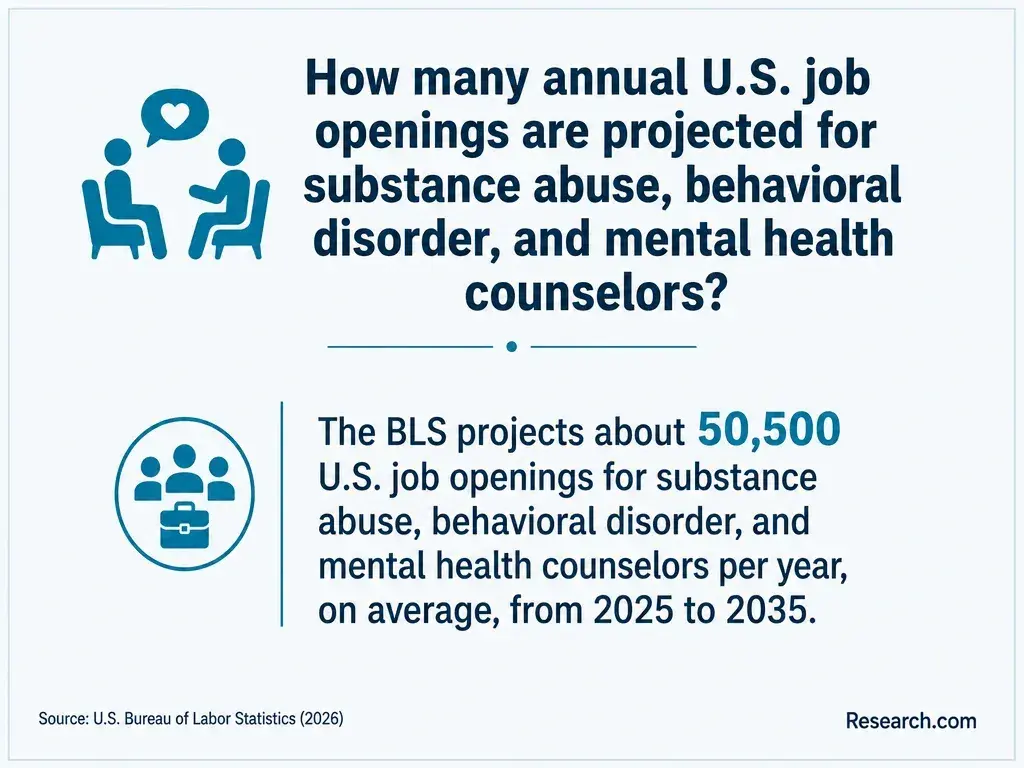
Potential nonclinical roles include behavioral-health support, intake or referral coordination, community outreach, victim advocacy, and human-services program assistance. Duties may involve communicating with clients, maintaining records, connecting people to services, and supporting a supervised team - not providing independent treatment. Employers may require relevant experience, background checks, additional training, or a specific credential.
A professional studies core with an approved agency project may help you show evidence of those tasks. A liberal arts core can be equally useful if you build experience through supervised work, volunteering, or research. For someone drawn to recovery services, recovery support career planning can help distinguish support jobs from credential-regulated counseling. If your target employer hires primarily for a specific support credential, that training and experience may be more direct than another degree.
There is no single salary or growth rate for graduates of a mental health-focused psychology BA. Pay and demand attach to occupations, locations, employers, and credentials - not to the degree's core. For a realistic comparison, identify job titles in your intended area, read their entry requirements, and consult the corresponding US Bureau of Labor Statistics occupational data. An occupation-wide median includes workers with different experience and education; it is not a starting offer.
Be especially careful with titles that sound specialized. Understanding pay and entry requirements in forensic psychology careers can illustrate why a justice-support job and a licensed forensic psychologist should not be grouped into one earnings expectation. Apply the same discipline when comparing mental health support work with licensed counseling or psychology practice.
How Can You Choose an Accredited Online Psychology Program?
Start by confirming the institution's accreditation and that it applies to the institution offering your degree. Then verify the exact BA title, whether the mental health focus is formal, and which requirements apply to your entry term. Do not assume the American Psychological Association accredits undergraduate psychology majors; institutional accreditation also does not establish eligibility for a clinical license.
Before accepting an offer, ask an advisor to confirm the following points in writing. The answers turn a broad core comparison into a workable degree plan.
- Which statistics, research, mental health, and applied courses are required, and how often are they offered online?
- How will each transfer course satisfy a specific degree requirement, and what credits must be completed at this school?
- What supervision, site approval, fixed meeting times, or travel does any project or internship require?
- What is the estimated cost and completion schedule based on my approved remaining courses?
If your ultimate target is counselor licensure, evaluate graduate options against the licensing board's rules rather than treating BA accreditation as the final check. Affordable accredited mental health counseling study options can inform a later cost comparison, provided you verify the particular program's accreditation scope and state eligibility.
Other Things You Should Know About Psychology
Possibly. Ask the registrar or advisor for a revised degree audit first; changing programs can alter which completed courses count and delay graduation.
Not necessarily. A transcript, project, internship, and description of your skills usually communicate more than the core's label.
Only if the program approves the site, duties, learning goals, and supervision. Existing employment does not automatically meet an internship requirement.
Not automatically. Check whether you can actually take those electives and whether they leave room for the methods courses, experience, or prerequisites your next step requires.
- Cost of Attendance (Budget) | 2025-2026 Federal Student Aid Handbook https://fsapartners.ed.gov/knowledge-center/fsa-handbook/2025-2026/vol3/ch2-cost-attendance-budget
- Accreditation in the U.S. | ed.gov http://www.ed.gov/laws-and-policy/higher-education-laws-and-policy/college-accreditation/accreditation-in-the-us
- NYS Mental Health Counseling: License Requirements | nysed.gov https://www.op.nysed.gov/professions/mental-health-counselors/license-requirements
- GAC - Chapter 135-5 REQUIREMENTS FOR LICENSURE https://rules.sos.ga.gov/gac/135-5
- Mental Health Counselor - Licensing Requirements | Washington State Department of Health https://doh.wa.gov/licenses-permits-and-certificates/professions-new-renew-or-update/mental-health-counselor/licensing-requirements
- Transfer Credit Policy | Point University Catalog https://catalog.point.edu/policy/standinghonors/creditforpriorlearning
- Online Mental Health Concentration | SNHU https://www.snhu.edu/online-degrees/bachelors/ba-in-psychology/mental-health
- Preparing to Use Your Bachelor's Degree in Psychology | apa.org https://www.apa.org/education-career/guide/bachelors
- Program: Psychology: Mental Health Concentration, B.A. | avila.edu https://catalog.avila.edu/preview_program.php
- How Do Transfer Credits Work When You Go Back to School? | Whitworth Online https://online.whitworth.edu/news-articles/how-do-transfer-credits-work-when-you-go-back-to-school/