2027 Online BA in Psychology - Mental Health for Psychology of Health Behavior: Which Courses Should You Look For?
Audited and Verified:
Our Editorial and Data Verification Process
Research.com uses government datasets, official education statistics and primary institutional information to support its career and degree guides. Our review process checks factual accuracy, occupational definitions, source dates and the requirements associated with the credentials discussed.
How This Article Was Fact-Checked
Our editorial team verifies salary estimates, employment projections, education requirements and program information against original data providers and official organizations. Salary figures are checked against the relevant occupational definitions and reporting periods. Information about licensure, accreditation and required in-person training is reviewed separately.
Fact-checked and verified on:

Co-Founder and Chief Data Scientist
A program can advertise a mental health focus yet offer little coursework on why people adopt - or struggle to sustain - health-related behaviors. That difference matters if you want to evaluate prevention programs, support community services, or prepare for further study.
This guide is for prospective online psychology students comparing course catalogs, not just degree titles. You'll learn which foundations, electives, and applied experiences build useful health-behavior skills, how to sequence them, and what a bachelor's degree does - and does not - prepare you to do.
Key Things You Should Know
- Prioritize statistics and research methods, then look for health psychology or behavior-change coursework; a mental health course alone does not teach you to evaluate health interventions.
- Check whether relevant courses are required, reliably offered electives, or merely listed as possible options - and whether supervised projects can be completed online or locally.
- A psychology BA commonly takes about four years of full-time study, but its courses do not independently qualify graduates to diagnose conditions or provide psychotherapy.
What Is an Online BA in Psychology Focused on Mental Health and Health Behavior?
It is an undergraduate psychology degree that combines the study of thoughts, emotions, and behavior with topics such as mental health, prevention, and everyday health decisions. Health behavior means actions that affect health - such as sleep, physical activity, medication adherence, or help-seeking - and the personal and social conditions that shape those actions. Health psychology studies these relationships; it is not a license to deliver healthcare.
The focus may be an officially named concentration, an elective cluster, or simply a theme in a general BA. Read the degree audit rather than assuming the label guarantees particular courses. If your interest centers specifically on substance use and recovery systems, compare distance learning bachelor's degrees in addiction psychology against broader health-behavior options; addiction coursework is not automatically counselor training.
Which Courses Should You Look for in a Mental Health Psychology Program?
Start with the evidence-building courses: introductory psychology, statistics, research methods, and scientific writing. These teach you to distinguish a proposed explanation from a measured result. For health behavior, that matters when evaluating whether an outreach effort changed behavior or merely reached people who were already motivated.
The following course groups serve different purposes. Compare actual syllabi and prerequisites, because similar course titles can cover very different material.
| Course area | What it adds to health-behavior study | What to check |
| Health psychology or behavioral medicine | Connections among stress, coping, health decisions, and physical health | Coverage of evidence-based behavior-change theories, not only disease descriptions |
| Abnormal psychology or psychopathology | Academic understanding of mental disorders and their effects on functioning | Attention to diagnostic limitations and the difference between learning about disorders and diagnosing them |
| Social and developmental psychology | How relationships, social norms, age, and life circumstances affect behavior | Applications across populations rather than a one-size-fits-all model |
| Biological psychology | Foundations for understanding stress, sleep, reward, and behavior | Science prerequisites and whether the course fits your preparation |
| Measurement or program evaluation | Ways to assess behavior and judge whether a program met its goals | Practice interpreting measures, bias, uncertainty, and privacy obligations |
For a feasible sequence, take statistics before advanced methods, then use health psychology and social or developmental psychology to frame a focused question. A later supervised research project or community-program evaluation can help you apply those skills without treating client support as clinical practice. If your intended role is substance-use counseling rather than health-behavior research or outreach, examine online addiction counseling coursework and admissions and check your state's credential rules before choosing electives.
Is an Online Psychology Bachelor's Degree Accredited and Professionally Recognized?
Check the institution's accreditation and confirm that it covers the university offering the online BA. Institutional accreditation helps establish academic legitimacy, but it does not verify that a particular health psychology elective is offered regularly or that a graduate qualifies for a licensed role. The American Psychological Association does not accredit general psychology bachelor's degrees.
Professional recognition depends on the next credential you seek. For example, a student planning to become a licensed counselor should assess the requirements of an appropriate graduate program and state board; the BA's mental health focus is academic preparation, not a substitute. Comparisons of accredited counseling study with accelerated schedules concern a different degree level, where applicable program recognition and supervised training require separate scrutiny.
The degree format matters less than whether you can access the courses and experiences needed for your goal. Online students may have more geographic choice, while campus students may find it easier to join laboratories or attend agency events. Neither format automatically provides a supervised project, and an asynchronous lecture does not mean group work or internships happen on your schedule.
Compare the formats on actual obligations: live class meetings, faculty research access, local site approval, required campus visits, and the availability of upper-level health-behavior electives. Ask how remote students receive feedback on research proposals and find supervisors. If scheduling is your chief constraint, psychology degree completion through accelerated study is another format to investigate - but shorter terms can intensify weekly work, particularly in statistics and methods.
Schools commonly request prior academic records and have different processes for first-year and transfer applicants. Admission to the university does not necessarily mean admission to every major course or concentration. Check whether statistics, research methods, or upper-level electives have prerequisites that could delay your planned sequence.
Transfer students should request a written degree audit showing not just accepted credits, but which credits satisfy the psychology major and which remain as electives. This is especially important when comparing using previous coursework toward a psychology degree: a transferred statistics class may be accepted by the university without satisfying the major's methods prerequisite. The receiving institution makes the final equivalency decision.
A conventional full-time bachelor's path is about four years; transfer credits, part-time enrollment, prerequisite sequencing, and course availability can change the timeline. For cost, request a term-by-term estimate covering tuition, mandatory fees, materials, and any travel or unpaid time required for an applied experience. Compare remaining cost to graduate, not advertised tuition alone.
Do not compare an accelerated bachelor's estimate directly with accelerated forensic psychology master's costs and outcomes. Graduate study begins after undergraduate preparation and serves different goals; a short advertised duration does not make it a cheaper substitute for completing a BA. Ask each bachelor's program how often the courses you need are offered before assuming a faster schedule will save money.
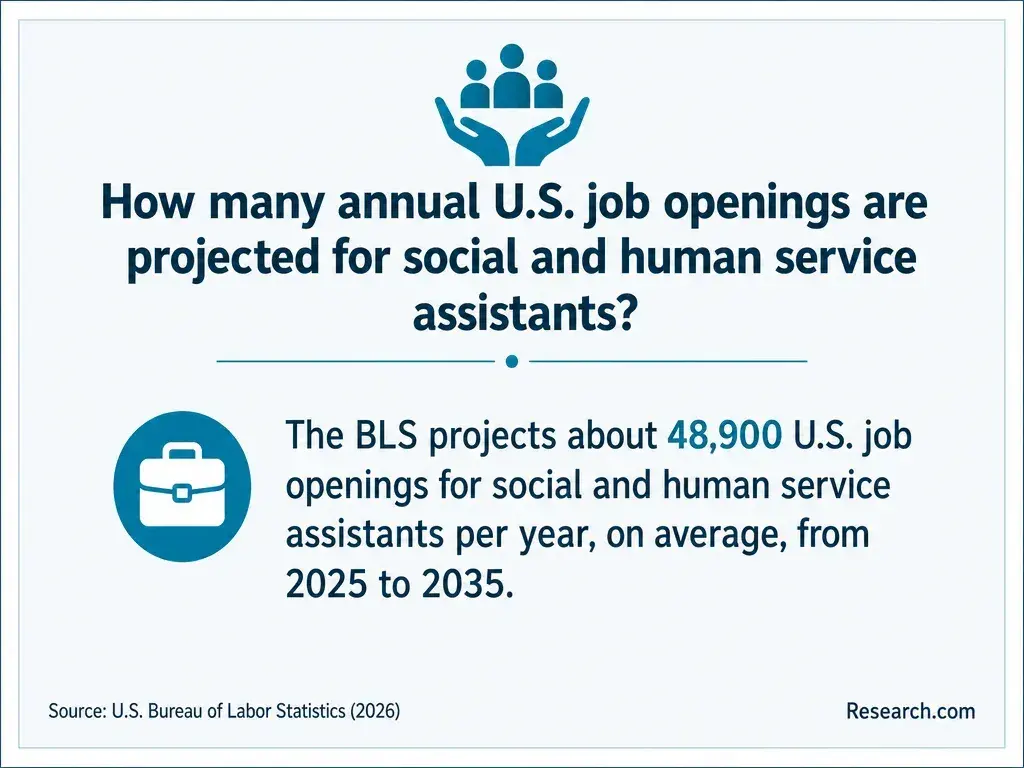
Relevant nonclinical possibilities include human-services assistant, community outreach worker, program assistant, research assistant, and intake or referral support worker. Duties may involve explaining services, coordinating appointments, maintaining records, gathering program data, or supporting outreach. Employers may also require experience, training, or a different field-specific credential.
For health-behavior work, a methods project, accessible public-facing writing sample, or approved community placement can demonstrate more than a concentration name alone. If you are considering justice-related work instead, compare the actual duties and qualifications behind earning potential after a master's in forensic psychology; that graduate pathway is not an outcome of this BA, and neither degree title grants forensic or clinical authority.
The U.S. Bureau of Labor Statistics reported a May 2024 median annual wage of $45,120 for social and human service assistants. This is an occupation-wide figure, not the expected pay of psychology BA graduates. Location, employer, responsibilities, and experience can matter more than whether a transcript lists a mental health elective.
Use job postings for your target role and region to assess hiring prospects rather than treating a broad occupational projection as a personal job guarantee. If your plan requires later clinical training, compare the additional expense and likely work against mental health counseling graduate study costs versus earnings; bachelor's-level and licensed-counselor wages describe different occupations.
No. A psychology BA, including one focused on mental health, does not by itself authorize psychotherapy, diagnosis, independent psychological assessment, or use of a protected clinical title. Learning about treatment or screening in class is different from qualifying to deliver those services.
If counseling is your goal, investigate a graduate program designed around your state's educational and supervised-practice requirements. Faster-paced online mental health counseling master's study may appeal to students planning ahead, but verify its applicable recognition, in-person placement obligations, and state eligibility rather than relying on speed or a program title. If you instead want prevention outreach or program evaluation, nonclinical experience may be more directly relevant than immediately pursuing a clinical degree.
How Should You Choose a Reputable Online Psychology Program?
Build a short course map for each program: required foundations, the next available statistics and methods classes, health-behavior electives, and a realistic project option. Then ask an advisor to confirm which courses you can actually take in your expected terms and whether remote students receive faculty supervision. A concentration with appealing titles is a weak fit if its key electives are unavailable before you graduate.
Match that map to your next step. A prospective research applicant should prioritize methods, writing, and opportunities for faculty feedback; a community-service applicant may value evaluation work and approved local experience. If a later nonclinical graduate degree is essential to your plan, assess its entry requirements and total cost separately; lower-tuition psychology master's options are a subsequent comparison, not evidence that a particular BA provides the preparation you need.
Other Things You Should Know About Psychology
Sometimes. A school may allow them as major electives, general education, or only free electives. Get written approval before counting on a course to satisfy a requirement.
No. Build broad developmental and research foundations first. Choose population-specific electives once you know which settings and questions interest you.
Only with the required employer and faculty permissions. Client or patient information may carry additional privacy and review obligations; use public or appropriately authorized data when possible.
No. Programs set their own requirements, which may include particular statistics, methods, science, or research experience. Compare your planned courses with the requirements of programs you might apply to.
- Biological, Behavioral, and Social Factors Affecting Health | nih.gov https://www.ncbi.nlm.nih.gov/books/NBK43745/
- Advocating for Behavior Change With Education - PMC - NIH https://pmc.ncbi.nlm.nih.gov/articles/PMC6124997/
- Mental Health Education | Adolescent and School Health https://www.cdc.gov/healthy-youth/mental-health/mental-health-education.html
- Evidence-Based Practices Resource Center | samhsa.gov https://www.samhsa.gov/libraries/evidence-based-practices-resource-center
- Mental health | who.int https://www.who.int/news-room/fact-sheets/detail/mental-health-strengthening-our-response
- Course Descriptions | Applied Behavior Analysis | SUNY Downstate https://www.downstate.edu/education-training/school-of-health-professions/programs/applied-behavior-analysis/curriculum/course-descriptions.html
- B.S. Applied Behavior Analysis Degree Program | Nazareth University https://www2.naz.edu/academics/applied-behavior-analysis/
- PhD in Clinical Psychology versus Health Psychology | ucla.edu https://health.psych.ucla.edu/phd-in-clinical-psychology-versus-health-psychology/
- Bachelor of Arts in Psychology - Texas State's online programs https://online.txst.edu/degrees/undergraduate/ba-psychology/
- Cultural Humility in Behavioral Health Care | Harborview Behavioral Health Institute https://bhinstitute.uw.edu/training-workforce-policy/training/on-demand-training/cultural-humility-in-behavioral-health-care/