2027 Choosing an Online BA in Psychology - Mental Health for a Future Applied Psychology Graduate Application: Prerequisites to Compare

Co-Founder and Chief Data Scientist
An online psychology BA with a mental health focus may look like a direct route to an applied psychology master's program. The risk is choosing engaging mental health electives while missing statistics, research methods, or experience that a target graduate program expects.
This guide is for prospective and returning undergraduates planning that next step. It explains which prerequisites to compare, how online study affects research and applied learning, and when a different undergraduate course plan would leave you better prepared.
Key Things You Should Know
- Compare the BA against actual graduate admissions pages: statistics, research methods, relevant psychology coursework, and research experience matter more than a concentration's name.
- A typical bachelor's degree requires about 120 credits, but transfer evaluations and course sequencing - not the advertised format - determine your remaining time and cost.
- A mental health focus can support nonclinical work and graduate applications; it does not qualify you to diagnose, provide therapy, or hold a protected clinical title.
What Is an Online BA in Psychology With a Mental Health Focus?
It is a bachelor of arts in psychology delivered partly or entirely online, with coursework emphasizing subjects such as psychological disorders, development, health behavior, addiction, or mental health service systems. At one school, "mental health" may be an officially recorded concentration; at another, it may describe a selection of electives. Confirm what will appear on your transcript and which courses are actually offered to online students.
The BA should still teach psychology as a science. A course about depression or counseling theories is useful academic preparation, but it cannot replace training in research design or confer clinical authority. If you are comparing the breadth of available undergraduate formats, start with psychology degree options for distance learners, then inspect each institution's current catalog rather than relying on a program label.
Does an Online Psychology Bachelor's Degree Prepare You for Graduate School?
Yes, it can - if its coursework and opportunities match the graduate programs you intend to pursue. Admissions committees generally evaluate the institution, transcript, preparation, recommendations, experience, and fit with the program. Online delivery is not itself a substitute for, or a barrier equivalent to, those requirements. A rigorous methods course and substantive faculty-supervised project are stronger evidence of readiness than a mental health concentration alone.
First identify the next degree's purpose. An applied or research-oriented psychology MS may emphasize program evaluation, behavioral research, or organizational and community applications. A clinical mental health counseling degree is a distinct professional pathway with its own educational and supervised-practice requirements. Neither a BA nor a general applied psychology MS automatically qualifies someone for licensure. If timing matters, graduate psychology degrees with accelerated schedules can help you identify formats to investigate, but an accelerated calendar does not waive admissions prerequisites.
For research-oriented applications, seek opportunities to explain a research question, choose suitable measures, analyze evidence, and discuss limitations. Ask online faculty whether students can join supervised projects remotely and whether those projects allow enough interaction for a meaningful recommendation letter.
What Prerequisites Should You Compare for Applied Psychology Graduate Programs?
Build the undergraduate plan backward from several graduate programs you could realistically apply to. Separate required courses from recommended preparation and from evidence that makes an application more competitive. Requirements differ even among programs with similar names: an applied program focused on community evaluation may value different preparation from one centered on organizational behavior or experimental research.
The comparison below shows what to check in each graduate program's current admissions requirements and what evidence an online BA should let you produce.
| Area to compare | Graduate-program question | Useful BA evidence |
| Psychology foundation | Which introductory or upper-level psychology courses are required? | Transcript showing the specified courses or approved equivalents |
| Statistics | Is a statistics course required, and must it cover particular methods? | Course description or syllabus establishing content and level |
| Research methods | Is experimental design or a laboratory component required? | Methods syllabus, research paper, or supervised project |
| Specialized study | Are developmental, social, abnormal, or other subjects required or recommended? | Relevant upper-level coursework chosen for the target field |
| Application evidence | Are research experience, writing samples, or particular references expected? | Faculty-supervised work and recommenders who know your contributions |
"Applied psychology" does not establish a uniform prerequisite list. Even adjacent specialties differ; forensic psychology degree formats and academic requirements are worth comparing only if legal-system research or related nonclinical work is a genuine target.
To turn this comparison into an enrollment decision, take these steps:
- Save the current admissions and prerequisite pages for three target graduate programs, including their rules for transfer or substitute courses.
- Map each requirement to a specific BA course and term; flag anything that cannot be completed before applications are due.
- Email graduate admissions about unclear equivalencies, then obtain an undergraduate degree audit showing how required courses fit into your remaining credits.
If all three targets require a course your preferred BA does not offer, a different BA or an approved supplemental course may be a better choice than the more appealing concentration title.
Neither format is automatically better. Online study can reduce commuting and allow employed students to keep working, while campus study may make laboratories, faculty contact, and local placements easier to access. Compare the actual opportunities: an online program with active remote research mentorship may fit a future applied psychology applicant better than a campus program where undergraduates rarely join projects.
Ask whether classes are asynchronous, whether research meetings occur live, and whether an internship requires a locally approved site and supervisor. Those obligations can matter more than the word "online" on a program page. If the eventual goal is licensed counseling rather than nonclinical applied psychology, compare the distinct graduate route through comparing fast-track mental health counseling master's formats; graduate clinical training and placements should not be inferred from undergraduate delivery.
Prioritize statistics and research methods early enough to qualify for an upper-level project, capstone, or research assistantship. Developmental and social psychology can help explain how context and life stage affect behavior; abnormal psychology provides an academic introduction to disorders and diagnostic frameworks. Depending on your target MS, health psychology, community psychology, program evaluation, measurement, or advanced data analysis may be more valuable than another survey of treatment approaches.
Review course descriptions rather than titles alone. A graduate program may expect experimental design, while a BA's general research course covers only how to read studies. Similarly, an assessment elective may teach the limits of measures without qualifying students to administer restricted clinical tests. If your longer-term plan is counseling, clinical mental health counseling course pace and accreditation concerns a different, professional graduate curriculum; choosing counseling-related BA electives does not complete that curriculum in advance.
Requirements vary by institution and by whether you apply as a first-year or transfer student. Schools commonly request prior transcripts and evidence that you meet their general undergraduate admission rules. Some separately require admission to the psychology major or completion of introductory courses before upper-level enrollment. An admitted transfer student still needs an official evaluation to learn which credits satisfy general education, major, and residency requirements.
If you are returning with credits, request a written degree audit before committing. In particular, ask whether previous statistics and research courses meet the BA's requirements and whether planned courses will be available online in the needed terms. Aid is a separate eligibility decision, not an admissions guarantee. Students also weighing an addiction-support undergraduate route can use online substance use counseling bachelor's aid resources to identify questions for each school's financial aid office.
A bachelor's degree commonly comprises about 120 credits, but that figure is not a completion estimate. Remaining credits, accepted transfer work, course prerequisites, enrollment pace, and how often required classes run determine the timeline. Ask for a term-by-term plan that includes statistics, methods, and any project needed for graduate applications - not merely the earliest possible graduation date.
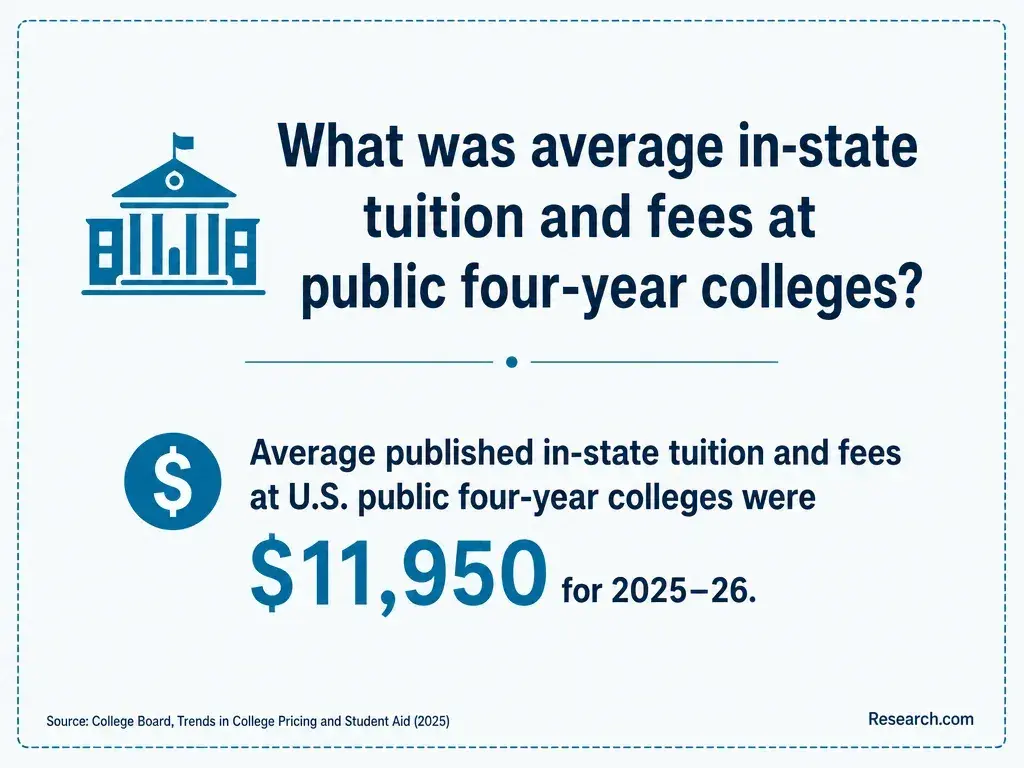
For cost, request the institution's current per-credit tuition and mandatory fees, then calculate them against the credits in your approved degree audit. Include books or software, possible travel for a placement, and any difference in aid eligibility at your intended course load. A faster schedule may reduce elapsed time without reducing the number of credits billed. If you are comparing the eventual expense of a licensure-oriented alternative, comparing tuition assistance for mental health counseling study addresses a later and distinct financial decision.
Check the institution's accreditation with its recognized institutional accreditor and confirm that it applies to the school awarding the BA. Do not look for APA accreditation as a general quality stamp for an undergraduate psychology major: APA program accreditation covers specified professional psychology training, not ordinary psychology BAs. Likewise, institutional accreditation alone does not prove that a particular graduate program will accept every course or that a degree meets a state's clinical licensing rules.
Next, inspect the current catalog and ask the psychology department for evidence relevant to your goal: online availability of statistics and methods, access to research supervision, capstone options, faculty expertise, and procedures for arranging any nonclinical placement. Compare graduate options separately; even lists of affordable online psychology master's programs need to be checked against your intended specialty, course prerequisites, and research goals. Written answers about course availability and approvals are more useful than broad claims about flexibility.
Depending on prior experience and local hiring rules, graduates may compete for nonclinical roles in human services, community outreach, program support, research assistance, or behavioral-health service coordination. Duties might include documenting services, helping people navigate referrals, supporting outreach, or assisting with data collection under an organization's procedures. Employers may require relevant experience, background checks, or additional training; the BA alone is not a job qualification for every opening.
For a student planning an applied psychology MS, the most useful undergraduate role is often one that develops supervised research, ethical data handling, or program-evaluation skills. A role involving client contact offers different evidence and must stay within its authorized scope. Forensic interests illustrate why titles need scrutiny: accelerated forensic psychology master's costs and outcomes concern specialized graduate study, not automatic eligibility to conduct forensic evaluations. Diagnosis, psychotherapy, and independent psychological assessment require the appropriate professional qualifications.
What Are the Salary and Job Outlook for Mental Health Psychology Careers?
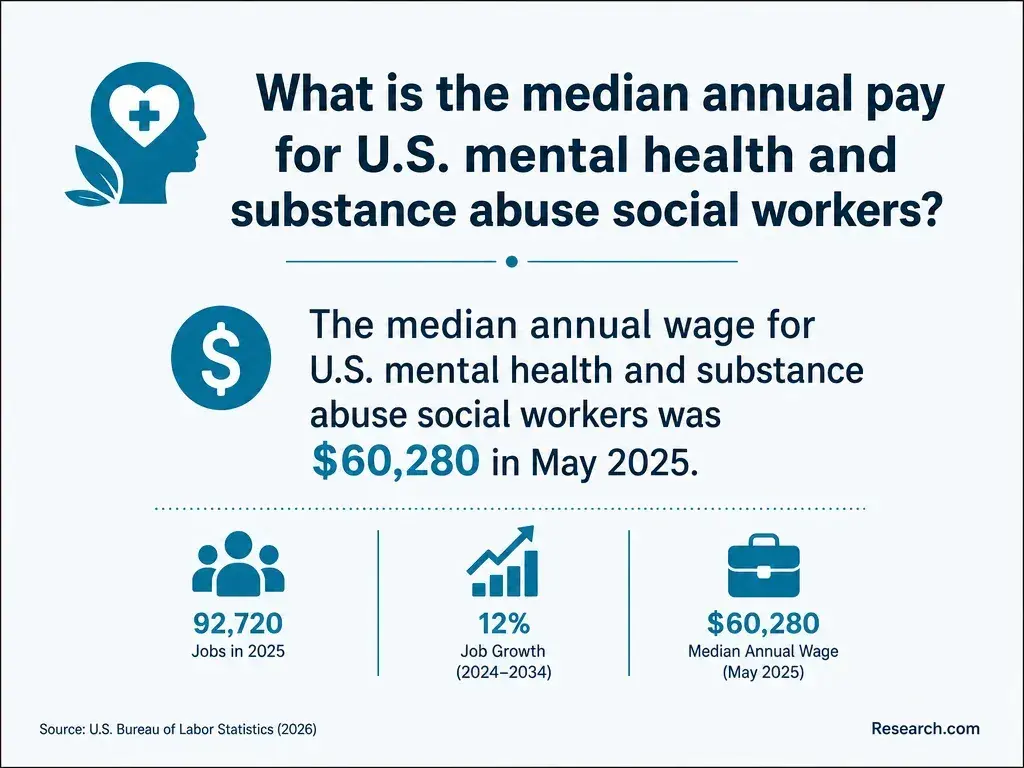
There is no single "mental health psychology BA" salary. Pay depends on the occupation, employer, location, experience, and required credential. The U.S. Bureau of Labor Statistics reported a May 2024 median annual wage of $59,190 for substance abuse, behavioral disorder, and mental health counselors, with employment projected to grow 17% from 2024 to 2034. That occupation generally requires a master's degree, and licensure rules vary by state; its median is not an expected wage or job-growth forecast for BA graduates.
For a useful comparison, select job titles you would actually qualify to pursue and check their current BLS occupational data alongside local postings. Then compare the added education and supervised experience required for your longer-term goal. Short-duration counseling master's return on investment is relevant only if licensed counseling - not a nonclinical applied psychology MS - is the outcome you want. Recheck wage and projection releases before making a financial commitment.
Other Things You Should Know About Psychology
Many programs consider applicants in their final undergraduate year, but admission may depend on completing the degree and any outstanding prerequisites before enrollment. Check each program's deadline and conditions.
Policies differ. Ask the target program whether a letter grade is required and provide the syllabus if it needs to assess course content.
Not universally. Check each program's current test policy, including any waiver conditions, before scheduling an exam.
Choose faculty or supervisors who can describe specific academic, research, or professional work. Early participation in discussions, office hours, and supervised projects gives them stronger evidence than a course grade alone.
- DAPIP | Homepage - Office of Postsecondary Education (OPE) https://ope.ed.gov/dapip/
- Cost of Attendance (Budget) | 2025-2026 Federal Student Aid Handbook https://fsapartners.ed.gov/knowledge-center/fsa-handbook/2025-2026/vol3/ch2-cost-attendance-budget
- The Moderating Effect of Faculty Mentorship on... - PMC https://pmc.ncbi.nlm.nih.gov/articles/PMC8693936/
- Accreditation in the U.S. | ed.gov http://www.ed.gov/laws-and-policy/higher-education-laws-and-policy/college-accreditation/accreditation-in-the-us
- Do I Need a Degree in Psychology to Apply to Graduate School? | William James College https://www.williamjames.edu/news/do-i-need-a-degree-in-psychology-to-apply.html
- Online Psychology B.A. or B.S. Degree Completion Program | gsu.edu https://online.gsu.edu/program/psychology-ba-or-bs-completion-program/
- 4 Types of Psychology Degrees: Picking the Right Program | Bouvé College of Health Sciences https://bouve.northeastern.edu/news/4-types-of-psychology-degrees-picking-the-right-program/
- Academic Affairs Graduate Program Admissions Policy | Ferris State University https://www.ferris.edu/policies/academic-affairs-graduate-program-admissions-policy.htm
- Admission Requirements https://graduate.appstate.edu/graduate-admissions/apply-graduate-school/application-requirements
- Human Services | Human Development and Family Sciences https://www.hdfs.udel.edu/human-services/