2027 Online BA in Psychology - Mental Health for Client Engagement in Nonclinical Services: Which Courses Should You Look For?
Audited and Verified:
Our Editorial and Data Verification Process
Research.com uses government datasets, official education statistics and primary institutional information to support its career and degree guides. Our review process checks factual accuracy, occupational definitions, source dates and the requirements associated with the credentials discussed.
How This Article Was Fact-Checked
Our editorial team verifies salary estimates, employment projections, education requirements and program information against original data providers and official organizations. Salary figures are checked against the relevant occupational definitions and reporting periods. Information about licensure, accreditation and required in-person training is reviewed separately.
Fact-checked and verified on:

Co-Founder and Chief Data Scientist
If you want to help people connect with mental health services, course titles alone will not tell you whether an online psychology BA prepares you for the work. Client engagement can involve listening, explaining options, coordinating referrals, and documenting contacts - without diagnosing or providing therapy. This guide is for prospective students and community-service workers comparing programs. It identifies the courses and supervised experiences worth prioritizing, the boundaries of nonclinical work, and the questions to ask before paying for a degree.
Key Things You Should Know
- Prioritize developmental and social psychology, mental health and service-systems coursework, research methods, and supervised practice in communication, referrals, and documentation.
- A psychology BA can support applications for nonclinical service roles, but no BA alone authorizes psychotherapy, diagnosis, or independent psychological assessment.
- Compare programs by applied opportunities and actual scheduling requirements - not a mental health label alone - and obtain a written estimate of remaining credits and total charges.
What Is an Online BA in Psychology for Nonclinical Mental Health Services?
It is a bachelor of arts degree in psychological science that a student applies to work such as outreach, service navigation, intake support, or program coordination. Nonclinical means the worker does not independently diagnose conditions or deliver treatment. The degree may be a general psychology BA with relevant electives; a concentration in mental health is a separate, school-defined curriculum feature, not an automatic part of every BA.
For client engagement, the useful outcome is not simply knowing the names of disorders. It is being able to communicate respectfully, recognize when a concern needs escalation, explain referral options within agency policy, and handle information responsibly. Students comparing online psychology programs and academic pathways should look past concentration labels to the required courses and approved experiential options.
Can an Online Psychology Bachelor's Degree Lead to Mental Health Careers?
Yes, but it is preparation for applying, not a job credential with a guaranteed outcome. A graduate might seek a nonclinical support position at a community organization, behavioral-health provider, or social-service agency. Hiring depends on the employer's duties, the applicant's experience, and any state or agency requirements for working with particular populations.
Start with your existing experience and a target job posting. Someone already coordinating nonprofit services may need stronger knowledge of development, research evidence, and confidentiality rather than another introductory communication course. Someone entering the field may need supervised contact with clients and familiarity with local referral systems. If the goal is psychotherapy, compare qualifying professional graduate pathways instead; faster-paced online mental health counseling master's study is a different educational decision, with its own fieldwork and state-licensure checks.
Is an Online Psychology Bachelor's Degree Accredited and Licensure-Eligible?
Check whether the institution holds recognized institutional accreditation, then confirm that the advertised BA is the degree the institution awards. Institutional accreditation matters for academic oversight and can affect aid and credit-transfer decisions; it does not certify that graduates qualify for a mental health license. The American Psychological Association does not accredit general psychology bachelor's programs.
A BA or mental health concentration alone does not qualify someone to practice as a licensed psychologist or counselor. If licensure is your eventual goal, work backward from the applicable state board's educational and supervised-practice rules. For example, accredited mental health counseling education by program pace raises questions about graduate program recognition and required placements that a psychology BA cannot settle.
Choose a coherent sequence, not the largest collection of mental health electives. First build a foundation in development, social behavior, and research literacy. Then add coursework on mental health, culture, ethics, and service delivery. Finally, seek approved practice applying those ideas under supervision.
The comparison below connects course areas to nonclinical tasks. Course names and availability vary, so compare catalog descriptions and assignments rather than assuming similarly named classes teach the same skills.
| Course area | Relevance to client engagement | Important limit |
| Developmental and social psychology | Supports age-appropriate communication and awareness of social context, stigma, and group influences. | Does not establish expertise with every client population. |
| Psychopathology or abnormal psychology | Introduces mental health terminology and the effects of distress on daily functioning. | Studying disorders is not training to diagnose them. |
| Multicultural psychology, disability studies, or community psychology | Helps students examine accessibility, trust, and barriers to using services. | Competence also requires listening to clients and learning local agency practices. |
| Research methods and statistics | Builds skill in judging evidence behind outreach approaches and interpreting program data. | Coursework does not authorize access to confidential records. |
| Ethics, helping skills, or human-services practice | Can develop communication, boundaries, referral, and documentation skills. | Practice exercises are not a clinical practicum. |
If available, an approved internship or community-based project can bring the sequence together. Look for supervised opportunities to practice explaining services, documenting contacts, and routing concerns according to a written escalation protocol. Confirm the site, duties, supervisor, privacy training, and scheduling requirements before treating an elective or current job as placement credit.
Substance-use services illustrate why course selection must follow the target role: an addictions elective can improve referral literacy, while counseling positions may require a separate state-recognized credential. Compare choosing an addiction counseling degree route only if that is the work you intend to pursue.
The academically important difference is often access to practice, not whether lectures are delivered on a screen. An online course can support discussion, role-play, and feedback, but a client-facing placement may still require travel, set shifts, live meetings, and site approval. A campus program may make local partnerships easier to find, although its timetable may be less workable for an employed student.
Ask each school how students obtain placement supervision and whether required courses run asynchronously, at fixed times, or only in certain terms. Online delivery does not guarantee control over group assignments or agency hours. The same distinction matters if you later consider intensive online graduate psychology study: a shorter academic schedule does not remove applied-work obligations or turn a nonclinical degree into a license.
Requirements vary by school and by whether you apply as a first-year or transfer student. Institutions commonly review prior academic records, while some have separate rules for entry to the psychology major. Admission, acceptance of transfer credits, and satisfaction of specific degree requirements are different decisions.
If you already have college credit, request a degree audit showing where psychology, statistics, research methods, general-education, and remaining residency requirements will fall. A previously completed statistics course, for example, might transfer as credit without replacing the major's required course. Students considering accelerated bachelor's program choices in forensic psychology should apply the same scrutiny to course equivalencies and sequencing; a shorter advertised timeline does not establish their personal graduation date.
Time depends chiefly on credits that apply to requirements, course availability, enrollment pace, and any approved placement. A student bringing substantial applicable transfer credit may finish sooner than a first-time student, but a prerequisite offered infrequently can delay either one. Ask for a term-by-term plan rather than relying on a program's fastest advertised completion time.
For cost, compare the price of all remaining credits plus mandatory fees, materials, technology, and any travel or reduced work hours associated with applied experience. Obtain the school's written estimate and ask how a change in enrollment pace would affect aid. If your target is substance-use support, bachelor's-level substance use counseling tuition and career value may provide a more relevant comparison than the sticker price of a general psychology BA. Check any required credential separately before treating the degree as sufficient.
Potential roles include intake or referral coordinator, community outreach worker, human-services assistant, program assistant, and some behavioral-health support positions. A victim-services organization may also hire advocates for nonclinical support and resource navigation. Titles are not standardized: read the duties, supervision arrangements, population served, and required credentials in each posting.
For example, an intake coordinator may explain available services, collect information permitted by agency policy, schedule appointments, and pass clinical concerns to qualified staff. That differs from evaluating symptoms to make a diagnosis. If your interest is victim services or justice settings, shorter master's study plans in forensic psychology may be worth comparing for later specialization, but a forensic degree title itself grants neither investigative authority nor clinical practice rights.
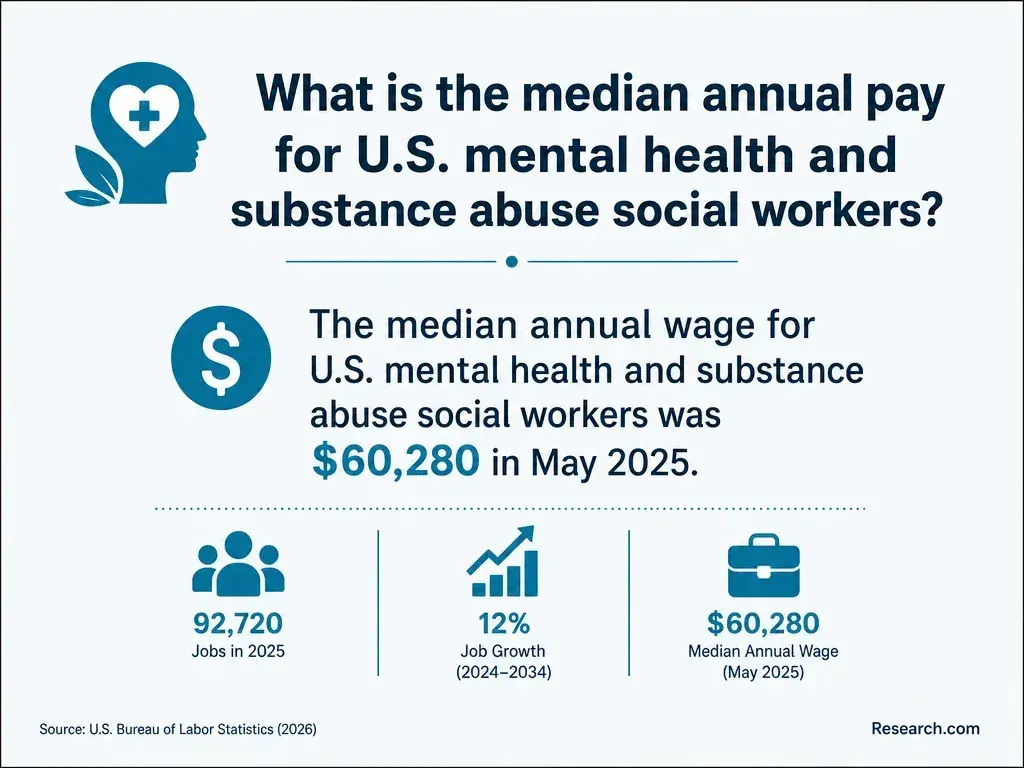
There is no single salary or growth rate for "psychology BA graduates." The U.S. Bureau of Labor Statistics reports occupation-wide wages and projections, not earnings caused by a particular major. Its Occupational Outlook Handbook category for social and human service assistants can offer context for some support jobs, but intake coordinators and outreach workers may be classified differently. Location, employer, experience, and required credentials also affect pay.
Compare the current BLS entry for the occupation that best matches a specific posting, then compare local advertised pay with your remaining education cost. Do not use wages for licensed counselors or psychologists as a return estimate for a BA. Likewise, economical routes to graduate psychology study matter financially only if additional study serves a defined job or academic goal; a general psychology master's is not automatically a counseling qualification.
How Can You Choose a Reputable Online Psychology Bachelor's Program?
Begin with the duties in several jobs you would actually apply for. Then compare programs against the courses and supervised evidence those duties require. A strong match makes its requirements, delivery schedule, placement approval process, and total charges clear before enrollment - not just its mental health branding.
Ask admissions and psychology faculty for the current catalog and written answers to the points most likely to change your decision:
- Which courses teach research literacy, cultural responsiveness, communication, ethics, and service referral, and how are those skills assessed?
- What supervised nonclinical experiences are available, who finds the site, and are live meetings, travel, or fixed shifts required?
- Which of my prior credits satisfy degree requirements, what remains to graduate, and what will those remaining requirements cost?
- What evidence does the school provide about completion and career support, and which graduates and time periods do its outcomes describe?
If graduate study is a possibility, check the intended program's prerequisites rather than assuming any BA concentration covers them. This is especially important when evaluating forensic psychology degree admissions, where academic specialization and professional authority are easily confused. If your present goal is a narrow support task and you already hold a relevant degree, employer training, a targeted course, or supervised experience may be more efficient than another bachelor's degree.
Other Things You Should Know About Psychology
Usually only with your organization's permission. Describe your role and use an approved, non-identifying sample or hypothetical template; do not share client records, quotations, or contact details.
No. Language access can be valuable, but accurate communication also requires role-specific training, cultural responsiveness, and the agency's rules for interpretation and confidentiality.
Possibly. Requirements depend on the site, duties, and population served. Ask the program and prospective site early, particularly if the work involves minors or other protected populations.
Not by itself. Lived experience may be relevant, but employers and states can require defined training, certification, supervision, or other qualifications for peer-support roles.
- The social determinants of mental health and disorder - PMC https://pmc.ncbi.nlm.nih.gov/articles/PMC10786006/
- About Mental Health | cdc.gov https://www.cdc.gov/mental-health/about/index.html
- Frequently Asked Questions - California Board of Psychology https://www.psychology.ca.gov/licensees/faq.shtml
- Choosing a Program - APA Accreditation https://accreditation.apa.org/choosing-a-program
- How to assess and intervene with patients at risk of suicide | apa.org https://www.apa.org/monitor/2022/06/continuing-education-intervene-suicide
- Psychology (PSY) - Courses - UO Catalog - University of Oregon https://catalog.uoregon.edu/courses/crs-psy/
- Types of Mental Health Professionals | nami.org https://www.nami.org/treatments-and-approaches/types-of-mental-health-professionals/
- Understanding Motivational Interviewing https://motivationalinterviewing.org/understanding-motivational-interviewing