2027 Online BA in Psychology - General Psychology: Psychology Electives to Compare for Public Service Careers
Audited and Verified:
Our Editorial and Data Verification Process
Research.com uses government datasets, official education statistics and primary institutional information to support its career and degree guides. Our review process checks factual accuracy, occupational definitions, source dates and the requirements associated with the credentials discussed.
How This Article Was Fact-Checked
Our editorial team verifies salary estimates, employment projections, education requirements and program information against original data providers and official organizations. Salary figures are checked against the relevant occupational definitions and reporting periods. Information about licensure, accreditation and required in-person training is reviewed separately.
Fact-checked and verified on:

Co-Founder and Chief Data Scientist
An online BA in general psychology offers room to choose electives, but public service jobs call for different kinds of preparation. A future victim advocate, program evaluator, and school support worker should not build identical course schedules.
This guide is for students and working public service professionals who want to connect psychology coursework to a specific nonclinical role. It compares useful electives, explains where supervised experience matters more than another class, and shows how to check whether an online program can support the work you hope to do.
Key Things You Should Know
- Choose electives by job tasks: developmental psychology supports work with families and young people; community or health psychology supports outreach; statistics and research methods support program evaluation. Pair relevant coursework with supervised, nonclinical experience.
- A forensic, addiction, or abnormal psychology elective does not grant investigative authority or permission to diagnose or treat people.
- A U.S. bachelor's degree commonly requires about 120 semester credits, but the credits and costs remaining depend on the school's degree audit - not simply how many transfer credits it accepts.
What is an online BA in general psychology for public service careers?
It is a broad undergraduate psychology degree delivered primarily online, with electives students can align to government, school, justice-system, or community-service work. "General psychology" describes curricular breadth, not a public service credential or a promise that every relevant elective will be available online.
The strongest use of that flexibility is to work backward from a position description. A person already coordinating community referrals may need research methods and program evaluation more than another survey course. Someone moving into victim services may benefit from trauma-informed service concepts, development, and justice-system context - but will still need agency-specific training and clear boundaries around counseling and legal advice.
A dedicated concentration is worth considering when its required courses and experiences match a defined goal. Compare its actual requirements with a flexible BA rather than relying on its name; a forensic psychology program review before enrollment is particularly useful if justice-system work is the goal. Neither route, by itself, qualifies someone to conduct forensic evaluations.
Which psychology electives best prepare students for public service jobs?
The best combination covers the population served, the service setting, and a skill the employer can observe. Course titles vary by school, so compare syllabi and prerequisites rather than assuming similarly named electives teach the same material.
The table shows how common electives connect to nonclinical public service tasks. It describes academic relevance, not a qualification to perform every task independently.
| Elective area | Relevant setting or task | Important limit |
| Developmental psychology | Age-appropriate communication in youth, family, or older-adult services | Does not qualify a graduate as a school psychologist |
| Social, cultural, or community psychology | Outreach, community partnerships, and understanding barriers to service | Local knowledge and community input remain essential |
| Health or addiction psychology | Prevention education, recovery-service coordination, and referrals | Treatment and counseling may require separate credentials |
| Forensic psychology | Understanding behavior and research in legal or corrections settings | Does not confer investigative or forensic-assessment authority |
| Advanced statistics or program evaluation | Interpreting agency reports and assessing service outcomes | Data access, privacy, and causal claims require care |
For most students, a methods-oriented course plus one population-focused and one setting-focused elective is a more defensible combination than three courses with overlapping subject matter. Confirm which courses fulfill major requirements and whether a required sequence leaves room for all three. If justice-system study is becoming the main academic goal, compare the elective route with intensive online forensic psychology bachelor's study; faster scheduling is useful only if it still permits relevant experience and manageable coursework.
What public service careers can you pursue with a psychology bachelor's degree?
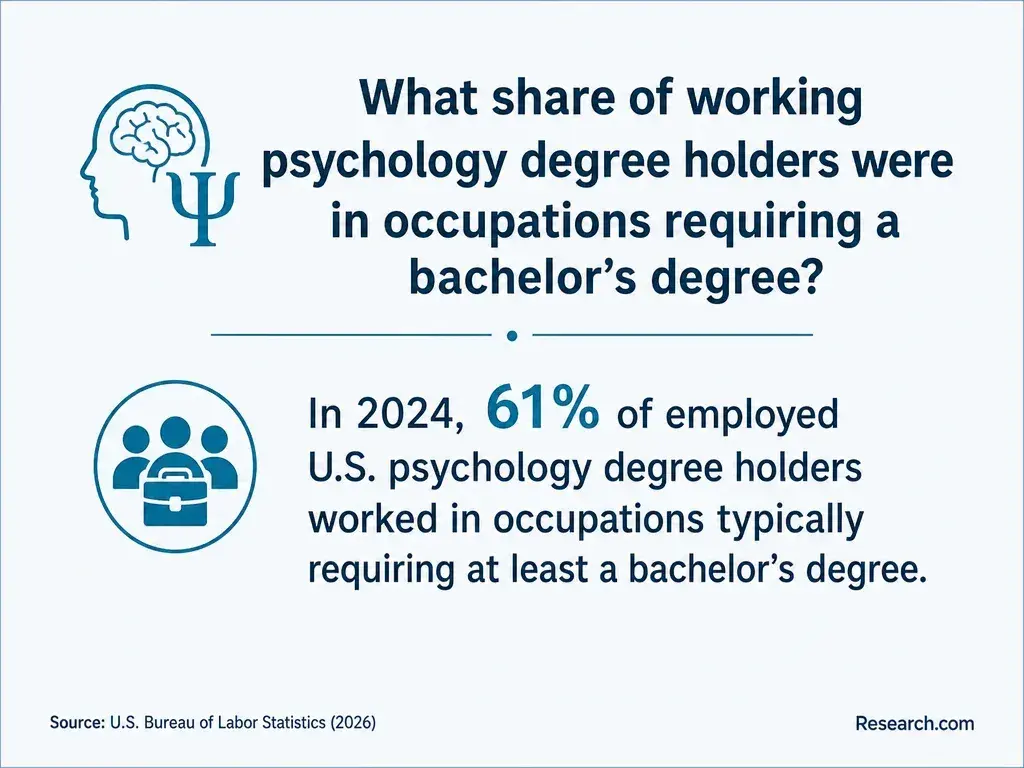
A psychology BA can support applications for nonclinical roles such as human-services assistant, program assistant, victim-services advocate, intake coordinator, and research or evaluation assistant. Eligibility depends on the employer, jurisdiction, experience, and duties. Government classifications may specify a degree field, examination, background check, or prior service experience.
These examples distinguish the work an applicant might pursue from the additional preparation that can make an application credible.
| Target role | Typical nonclinical work | Evidence beyond coursework |
| Human-services or case-coordination assistant | Document contacts, explain services, and coordinate referrals | Supervised client-facing experience and accurate documentation |
| Victim-services advocate | Explain resources, support referrals, and coordinate with agencies | Confidentiality, safety training, and knowledge of local procedures |
| Program or evaluation assistant | Maintain records, summarize findings, and support reporting | Spreadsheet skills and a carefully scoped analysis sample |
| Recovery-support worker | Offer permitted support and connect people with services | Any state- or employer-required peer credential and supervision |
Students with existing public sector or nonprofit experience should first look for internal roles that combine that experience with new analytical or service skills. Those new to the field can seek approved volunteer work, a nonclinical placement, or an entry-level agency position. For recovery-related work, compare local job requirements with an addiction recovery employment guide rather than treating addiction coursework as a counseling credential.
Online and campus programs can teach the same disciplinary material, but access to people and experiences may differ. An asynchronous lecture can fit shift work; a live research meeting, group project, or local internship may not. Campus study can make informal faculty contact and nearby placements easier, while an online program may let a working student remain connected to an existing agency.
Before choosing a format, ask who arranges nonclinical placements, whether research assistantships accept remote students, when required meetings occur, and whether any campus visits are mandatory. A student planning future graduate study should also ask how online students obtain substantive faculty feedback and recommendation letters. Even shorter master's study plans in forensic psychology need separate scrutiny later; an online BA's flexibility says nothing about a graduate program's scheduling or research requirements.
General psychology majors commonly combine introductory psychology, statistics, research methods, and study across areas such as development, social behavior, cognition, and biological or abnormal psychology. General education and electives complete the degree. The exact mix - and whether methods must precede advanced electives - belongs to the institution's current catalog.
For public service preparation, methods courses deserve particular attention. They help students distinguish a community need from a measured outcome, recognize weak comparisons, and explain uncertainty in reports. A capstone or supervised project may offer a chance to demonstrate those skills, but permission to use agency records and any required institutional review must be established before work begins. Students considering advanced forensic study can use forensic psychology master's accelerated curriculum planning to see why undergraduate methods preparation matters; a rapid graduate schedule may leave little room to repair foundational gaps.
First-year applicants generally submit prior education records under the university's undergraduate admission rules. Transfer applicants usually submit transcripts from every college attended. Some institutions admit students to the university before they can declare the psychology major; prerequisites, minimum grades, or capacity rules may then apply separately.
If future counseling practice is the goal, undergraduate admission is only the first checkpoint. Compare prospective graduate programs' prerequisites and professional-training requirements before using all available electives. A general psychology BA may provide preparation, while a qualifying counseling program follows a distinct path; shorter routes through mental health counseling graduate study should be assessed against the intended state's rules, not speed alone.
Time depends on remaining requirements, course availability, enrollment pace, and any approved transfer work. A bachelor's degree commonly totals about 120 semester credits, but accepted credits do not necessarily satisfy psychology, general education, or residency requirements. Request a written degree audit and a term-by-term course plan before estimating a finish date.
For cost, compare the price of the credits you still need - not just advertised per-credit tuition. Include mandatory online fees, books or software, possible travel, and the financial effect of reducing work hours for a placement. Ask financial aid staff how a proposed enrollment pace affects eligibility. If graduate study is likely, assess that as a separate investment: psychology master's fees and total study costs should not be assumed to match undergraduate charges.
No general psychology BA, online or on campus, independently licenses someone to practice as a psychologist, diagnose conditions, provide psychotherapy, or conduct independent clinical assessment. Those functions require the applicable professional education, supervised training, examinations, and state authorization. An elective about counseling, addiction, or psychological testing does not change that boundary.
Some nonclinical jobs also require a state-recognized certification, agency training, or supervision; rules differ for peer support and substance-use services. Check the exact job title with the employer and responsible state authority. If the intended endpoint is licensed counseling, compare qualifying program requirements and the full financial commitment, including mental health counseling tuition and funding options, before treating the BA as the entire education plan.
There is no single salary or employment outlook for "public service psychology graduates." The relevant comparison is the specific occupation and hiring agency. The U.S. Bureau of Labor Statistics Occupational Outlook Handbook reports occupation-wide pay and projections for roles such as social and human service assistants; those figures are not starting salaries for BA graduates or pay scales for a particular government employer.
For a realistic estimate, match the duties in a current posting to the closest occupational category, then check the agency's posted grade, location, benefits, and advancement rules. Compare that compensation with the cost of the remaining degree requirements and any unpaid experience. Students weighing addiction-service training should also distinguish aid that reduces cost from debt that must be repaid; grants versus loans for substance abuse counseling bachelor's students illustrates that distinction, although aid eligibility must be checked for the actual program.
How do you choose an accredited online psychology bachelor's program?
Confirm that the institution holds recognized institutional accreditation, then inspect the psychology curriculum rather than assuming accreditation verifies a particular elective, placement, or career outcome. APA accreditation is not the standard for a general undergraduate psychology BA. The best-fit program is one that lets you complete relevant courses and demonstrate job-related skills at a sustainable cost.
Use the same questions with each school so the answers can be compared directly:
- Which target-role electives are scheduled online during my likely enrollment terms, and what prerequisites control access?
- Can online students obtain supervised nonclinical experience or research mentorship, and who approves the site and duties?
- What does my written degree audit show for major, general education, and residency requirements?
- What will required courses, fees, scheduling constraints, and any travel cost at my planned pace?
For transfer students, the distinction between accepted credits and requirements satisfied is especially important. Get the school's evaluation of your remaining coursework after transferring into psychology before comparing completion time or total price. If your target agency values a specific credential or experience more than another degree, ask whether employer training, an approved placement, or a targeted course would meet the need more directly.
Other Things You Should Know About Psychology
Consider one if its required courses fill a clear gap in your target role and fit your graduation plan. A minor is less valuable if it delays completion without adding skills requested in relevant job postings.
It can be valuable where agencies serve multilingual communities. Coursework alone may not meet an employer's required proficiency standard; ask how language ability is assessed and avoid presenting classroom study as professional interpreting qualification.
Only with the agency's permission. Remove confidential information, respect data-use rules, and describe your own contribution accurately. A public-data project may be simpler to share.
Some do, depending on the jurisdiction and position. Read the specific posting for examinations, application lists, background checks, and deadlines; a psychology degree does not waive those hiring steps.
- Overview: Texas Transfer Initiatives https://reportcenter.highered.texas.gov/agency-publication/miscellaneous/overview-texas-transfer-initiatives/
- Employment Outcomes of Bachelor's Degree Holders - COE https://nces.ed.gov/programs/coe/indicator/sbc/bachelor-degree-holder-outcomes
- Plan for Program Evaluation from the Start | National Institute of Justice https://nij.ojp.gov/topics/articles/plan-program-evaluation-start
- Frequently Asked Questions - California Board of Psychology https://www.psychology.ca.gov/licensees/faq.shtml
- Online Psychology B.A. or B.S. Degree Completion Program | gsu.edu https://online.gsu.edu/program/psychology-ba-or-bs-completion-program/
- 4.1.18 Credit Earned through Transfer, Examination, and Prior Learning | Illinois State https://policy.illinoisstate.edu/academic/4-1-18/
- Internships, Co-ops, and Jobs - USF Career Services https://careers.usf.edu/channels/search-for-a-job-internship/
- Psychology careers guide | apa.org https://www.apa.org/education-career/guide/careers