2027 Online BA in Psychology - Mental Health After an AA in Liberal Arts: Compare Transfer Credit and Remaining Coursework
Audited and Verified:
Our Editorial and Data Verification Process
Research.com uses government datasets, official education statistics and primary institutional information to support its career and degree guides. Our review process checks factual accuracy, occupational definitions, source dates and the requirements associated with the credentials discussed.
How This Article Was Fact-Checked
Our editorial team verifies salary estimates, employment projections, education requirements and program information against original data providers and official organizations. Salary figures are checked against the relevant occupational definitions and reporting periods. Information about licensure, accreditation and required in-person training is reviewed separately.
Fact-checked and verified on:

Co-Founder and Chief Data Scientist
An AA in liberal arts can put an online psychology bachelor's within reach, but an accepted credit is not always a completed psychology requirement. That distinction affects how many courses, terms, and tuition charges remain. If you want to study mental health or enter support work, this guide shows how to compare transfer evaluations, identify likely coursework gaps, and check whether a program fits your schedule and career goal. You will leave with a clearer way to request and compare degree audits before enrolling.
Key Things You Should Know
- An illustrative 60-credit AA applied to a 120-credit BA leaves 60 credits by subtraction - not necessarily just 60 credits of coursework you can take in any order.
- Compare credits that satisfy general education, psychology prerequisites, major courses, and graduation residency separately; the receiving university's approved degree audit controls.
- A mental-health focus can prepare you for supervised, nonclinical support roles, but a psychology BA alone does not qualify you to diagnose conditions or provide psychotherapy.
What can you do with an online BA in psychology after an AA in liberal arts?
Your AA may supply writing, communication, social-science, and quantitative foundations. The BA adds psychology theory and research skills; mental-health electives can help you understand disorders, prevention, and service systems. Together, they may support applications for nonclinical positions in community organizations, behavioral-health programs, or research teams. The degree does not replace role-specific training or experience.
Start with the work you want to do. If it involves outreach, intake support, referrals, or recovery services, compare the BA's applied opportunities with local employers' requirements and any state credential rules. An approved internship or supervised project may provide more relevant evidence of readiness than the concentration label alone. For a closer look at support roles and credentials, see education routes for recovery-related careers.
How many transfer credits can an AA in liberal arts apply toward an online psychology degree?
There is no universal number. An AA commonly represents about 60 semester credits, while a bachelor's commonly requires about 120, but each institution sets its own transfer maximum, course-equivalency rules, major requirements, and minimum credits completed there. A transfer agreement may protect a general-education block without satisfying psychology prerequisites.
Use this distinction when reading an evaluation: accepted credit counts toward the degree's total, while applied credit also fulfills a named requirement. The categories below show where liberal-arts courses might land; only the receiving school can confirm the result.
| Prior coursework | Possible application | Question for the evaluator |
| Writing, humanities, and general social science | General education or electives | Does the AA complete a general-education block? |
| Introductory psychology | Psychology prerequisite or elective | Is this the major's required introductory course? |
| Statistics | Major requirement, quantitative requirement, or elective | Does it meet the psychology department's statistics standard? |
| Other liberal-arts courses | Electives, subject to limits | Will they apply toward graduation after all other requirements are met? |
Request an official evaluation using your transcripts and, where equivalence is unclear, course descriptions or syllabi. Compare the resulting audits - not advertised transfer maximums - when evaluating psychology degree programs for online learning. Ask about quarter-to-semester conversion, repeat-course rules, transfer appeals, and the deadline for obtaining a written substitution.
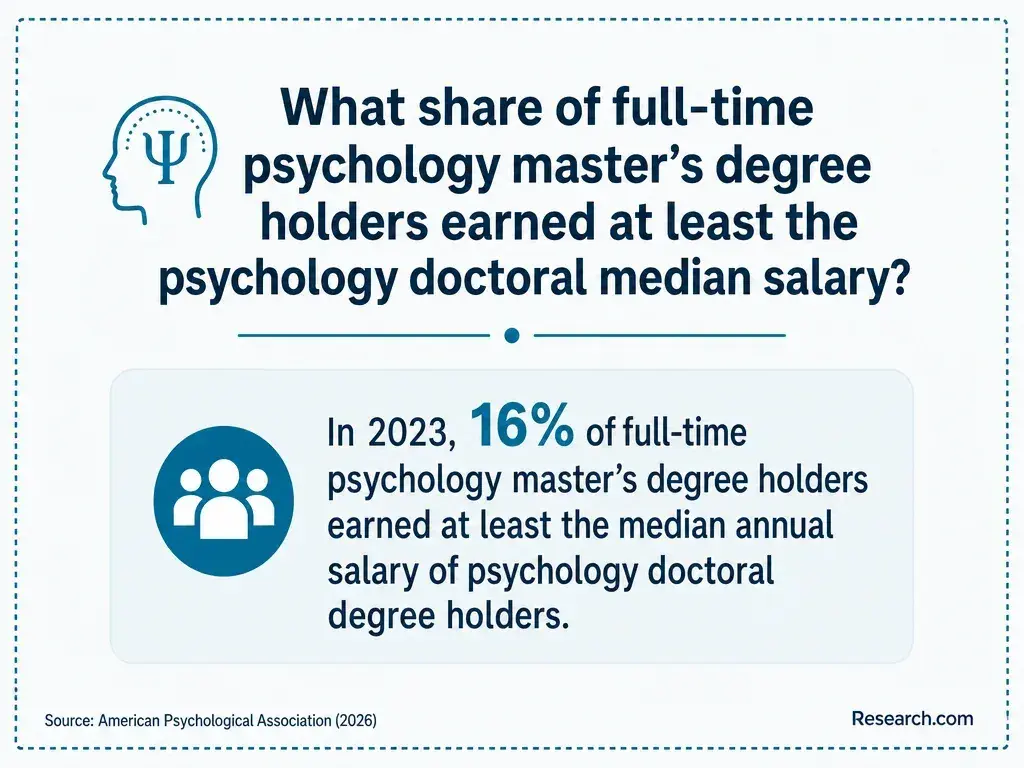
How much psychology coursework remains after transferring an AA degree?
Usually, more than the credit subtraction suggests. In an illustrative 120-credit BA that accepts all 60 credits from an AA, the student has 60 credits left toward the total. If the AA contained little psychology, however, most upper-level major courses could still be outstanding. Required courses and prerequisites - not just the credit balance - determine the actual path.
Ask the psychology department for a term-by-term audit showing introductory psychology, statistics, research methods, required breadth courses, mental-health electives, any capstone, and the institution's residency requirement. Check whether a transferred statistics course is approved for the major, not merely for general education. If you are considering a specialized future degree, compare its prerequisites before choosing electives; one-year online forensic psychology master's options, for example, should not be assumed to accept every undergraduate course combination.
A useful comparison is the number of remaining required courses in the longest prerequisite sequence. Two schools can award the same total transfer credits yet require different graduation dates if one accepts your methods prerequisite and the other does not.
Programs typically combine psychology foundations with statistics, research methods, and upper-level study of areas such as development, social behavior, cognition, and biological or cultural influences on behavior. A mental-health focus may add psychopathology, health psychology, substance use, or community mental-health courses. Check whether that focus is an official concentration recorded by the school or simply a set of electives.
Course titles alone do not show depth. Compare prerequisites, the number of upper-level psychology courses, research assignments, and whether an internship or capstone is required, optional, or unavailable online. Students interested specifically in substance-use counseling should compare the BA curriculum against choosing an addiction counseling degree route; a general mental-health elective may not meet a state's counselor-credential coursework rules.
Online delivery also varies by course. An asynchronous lecture may still include scheduled exams, group research meetings, or a locally arranged placement. Obtain the actual course rotation and participation expectations before relying on a proposed schedule.
Check that the institution holds recognized accreditation and that the accreditation covers the institution awarding the online degree. This matters for transfer review, federal aid eligibility, and many later admissions decisions. Confirm the status through the institution's stated accreditor and the U.S. Department of Education's accreditation database; do not rely solely on a program advertisement.
Do not look for APA accreditation as a requirement for a general psychology BA: APA accreditation applies to specified professional psychology training programs, not ordinary undergraduate psychology majors. If your eventual goal is licensed counseling, evaluate the later qualifying graduate program under the rules that apply to that profession and state. Guidance on accreditation checks for accelerated counseling programs concerns that separate pathway, not accreditation of your BA.
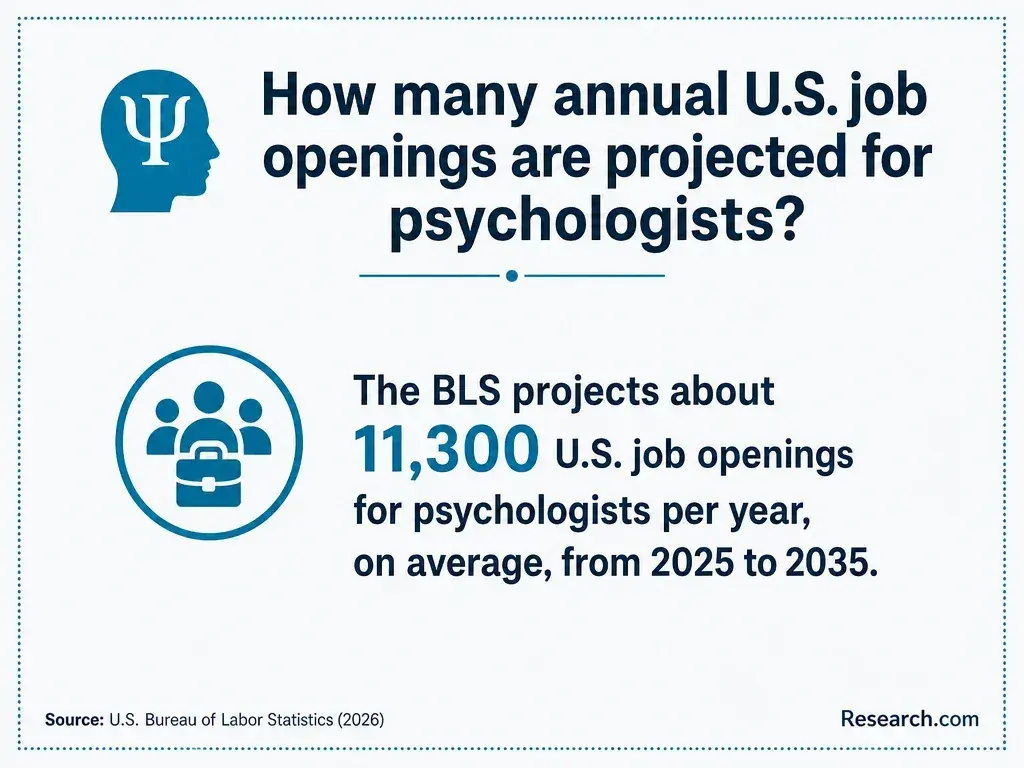
The projected annual job openings for psychologists in the United States.
Schools may review your completed college credits, GPA, official transcripts, and eligibility to enter the psychology major separately from admission to the university. Some require particular introductory or quantitative courses before upper-level psychology study; others allow you to complete them after transfer. An AA is not, by itself, proof that you have met major-entry requirements.
Send transcripts from every college attended and ask admissions and the psychology department which requirements must be complete before enrollment. Include syllabi for courses you want reconsidered as equivalents, and request written decisions on any substitution. If you are comparing a psychology BA with a more occupation-specific undergraduate program, forensic psychology study choices and employment preparation illustrates why admission rules and career aims should be checked together rather than inferred from a degree title.
Completion time depends on the approved audit, course availability, prerequisites, and how many courses you can manage each term. Finishing an AA does not automatically mean two years remain. A missing statistics or methods prerequisite can delay later courses even when the school accepts most of your credits.
Request a projected schedule for both your preferred pace and a slower pace you could sustain if work or caregiving changes. Verify whether required courses run every term, whether summer study is available, and whether internships, live sessions, or campus visits affect the plan. Advertised accelerated options - including accelerated undergraduate forensic psychology study - are comparisons to investigate, not a completion-time promise for your transfer record.
Calculate cost from credits still required at the receiving institution, not credits accepted from your AA. Add mandatory online or course fees, books and software, and any travel or unpaid placement costs. Compare each school's current charges using its written audit and proposed enrollment schedule; a lower price per credit can lose its advantage if more credits or terms are required.
Ask the financial-aid office how your intended course load affects aid eligibility and whether all planned courses count toward your degree. Check satisfactory academic progress rules and obtain any employer tuition-benefit terms in writing. If substance-use services are your specific goal, comparing undergraduate substance use counseling costs and outcomes may reveal a more direct route - but verify the credential implications before treating a lower advertised price as better value.
Depending on the employer and jurisdiction, a graduate may apply for nonclinical work such as behavioral-health program support, intake coordination, community outreach, case-assistance, victim advocacy, or research support. Duties can include scheduling, documentation, connecting people with services, and assisting a supervised team. Job titles are unreliable shortcuts: read each posting for required experience, credentials, permitted duties, and work with protected client information.
Relevant experience can matter as much as the concentration. Look for an approved internship, research project, or supervised community role that develops communication, accurate records, appropriate referrals, and confidentiality practices. A psychology BA may also support later study; finding a lower-cost psychology master's degree is worth considering only if a specific target role values that additional nonclinical training. A general psychology master's is not a substitute for a qualifying clinical degree.
Does a psychology bachelor's qualify you for counseling or psychology licensure?
No. Studying mental health in a BA does not authorize independent diagnosis, psychotherapy, psychological assessment, or use of a protected licensed title. Counseling and psychologist pathways generally require further education and other jurisdiction-specific steps; addiction and peer-support credentials have their own state rules. Check the responsible licensing board or certifying body for the exact occupation and state before selecting courses.
If your goal is licensed therapy, work backward from that credential's educational requirements rather than assuming the BA concentration will meet them. Compare qualifying graduate programs, supervised-practice obligations, and total cost; counseling degree affordability and accreditation addresses a different decision from completing a psychology BA. If you want nonclinical support work instead, a targeted credential or supervised experience may be more direct than additional graduate study.
Other Things You Should Know About Psychology
Possibly. The receiving school decides whether to accept them and whether they can satisfy a graded prerequisite or major requirement. Ask for a course-specific ruling.
Often, with advance approval. Confirm the exact equivalent and whether transfer limits or residency rules permit it before registering.
Only if the program approves the site, duties, supervision, and learning objectives. Existing employment alone does not establish internship credit.
Not necessarily. For nonclinical jobs or future applications, relevant courses and demonstrated experience may matter more. Check whether a target employer or graduate program specifies particular coursework.
- LCDC New License Registration | texas.gov https://www.hhs.texas.gov/business/licensing-credentialing-regulation/professional-licensing-certification-compliance/licensed-chemical-dependency-counselor-program/lcdc-new-license-registration
- .08 Number of Credits Accepted for Transfer. | Library of Maryland Regulations https://regs.maryland.gov/us/md/exec/comar/13B.06.02.08
- Texas Core Curriculum Application Guide https://reportcenter.highered.texas.gov/agency-publication/miscellaneous/waar-faq-texas-core-curriculum/
- What Degree Do I Need to Become a Counselor or Therapist? | Palo Alto University https://paloaltou.edu/resources/blog/what-degree-do-i-need-become-counselor-or-therapist
- Institutions - Associate Degree Types https://adhe.edu/institutions/associate-degree-types
- Psychology (Liberal Arts) AA - Fully Online | Hudson County Community College https://www.hccc.edu/programs-courses/academic-pathways/social-science/psychology-aa-online.html
- BA in Psychology | Cal State LA https://www.calstatela.edu/nss/psychology/ba-psychology
- About Associate Degrees | Curriculum https://curriculum.santarosa.edu/about-associate-degrees
- Different Types of Psychology Degrees and Jobs | snhu.edu https://www.snhu.edu/about-us/newsroom/social-sciences/what-jobs-can-you-get-with-a-psychology-degree
- Prerequisites & Requirements | roguecc.edu https://www.roguecc.edu/degrees-and-programs/degrees-and-certificates/social-and-behavioral-science-education-pathway/psychology-interest-associate-of-arts-oregon-transfer/prerequisites-and-requirements.php