2027 Online BA in Psychology - Addictions for Behavioral Health Technicians: Choosing a Program Without Leaving Your Job
Audited and Verified:
Our Editorial and Data Verification Process
Research.com uses government datasets, official education statistics and primary institutional information to support its career and degree guides. Our review process checks factual accuracy, occupational definitions, source dates and the requirements associated with the credentials discussed.
How This Article Was Fact-Checked
Our editorial team verifies salary estimates, employment projections, education requirements and program information against original data providers and official organizations. Salary figures are checked against the relevant occupational definitions and reporting periods. Information about licensure, accreditation and required in-person training is reviewed separately.
Fact-checked and verified on:

Co-Founder and Chief Data Scientist
Behavioral health technicians often learn about addiction and recovery at work, but fitting a bachelor's degree around shifts is a different challenge. An online psychology-addictions BA may strengthen your knowledge and open some career options, yet its value depends on what you already do, what you want to do next, and whether the program can accommodate your schedule.
This guide shows you how to compare coursework, applied requirements, costs, and credentials without assuming that an online degree is automatically flexible - or that a psychology concentration qualifies you to provide treatment.
Key Things You Should Know
- A typical bachelor's degree requires about 120 semester credits, but your remaining credits - and time to graduation - depend on an approved degree audit.
- Choose a program around your actual shifts: check live classes, placement hours, course rotations, and leave policies before relying on an "online" label.
- A psychology-addictions BA can support technician and recovery-service work; it does not, by itself, authorize addiction counseling, diagnosis, or psychotherapy.
What Is an Online Bachelor's Degree in Psychology-Addictions for Behavioral Health Technicians?
An online bachelor of arts in psychology with an addictions focus is an undergraduate psychology degree that adds study of substance use, recovery, and behavioral-health services. Schools may offer addictions as a formal concentration, a minor, or simply a selection of electives. Those distinctions matter: ask what will appear on your transcript and which courses are guaranteed to be available online.
For a working technician, the degree is most useful when it connects scientific understanding with existing responsibilities - not when it repeats introductory training you already receive from your employer. Compare programs using a written degree plan, rather than a concentration name alone. A broader guide to selecting an online psychology bachelor's program can help you identify candidates, but your work schedule and target job should determine the final choice.
Can an Online Psychology-Addictions Degree Prepare You for Behavioral Health Technician Work?
Yes, an online psychology-addictions degree can improve preparation for behavioral health technician work, particularly in observation, documentation, communication, and understanding substance use in context. It cannot replace employer training, supervised practice, or a credential required for particular duties.
Start with your job description. A technician might monitor safety, record observations, support daily activities, communicate concerns to a supervisor, or assist with referrals. Look for courses and supervised assignments that help you explain behavior accurately, write objective notes, respect confidentiality, and recognize when to escalate a concern. Your employer - not a classroom exercise - sets the procedures for emergencies and client care.
If your goal is working in substance use recovery support, compare the degree with a shorter, employer-recognized training or credential route. Ask your supervisor which qualification affects hiring or advancement. If the answer is a specific certification plus experience, a full BA may be worthwhile for longer-term mobility but unnecessary for the immediate step.
What Accreditation Should You Look for in an Online Psychology-Addictions Program?
First, verify the university's institutional accreditation through the institution and its recognized accreditor. This is the relevant starting point for evaluating an online psychology BA; accreditation also matters when you later seek transfer credit or apply to graduate school, although another school decides what it will accept.
Do not reject a psychology bachelor's program because it lacks American Psychological Association program accreditation: APA accreditation is not the standard for general undergraduate psychology majors. Likewise, institutional accreditation does not establish eligibility for an addiction counselor license. If counseling is your eventual goal, compare the requirements of the relevant state board and qualifying graduate programs separately. Even online clinical counseling graduate completion options require scrutiny of their professional preparation, supervised experience, and state eligibility; an undergraduate addictions focus is not a substitute.
Expect psychology foundations such as development, learning, social behavior, and biological influences, alongside statistics and research methods. An addictions focus may add courses on substance use, prevention, co-occurring conditions, recovery systems, and ethics. Catalogs vary, so distinguish required courses from electives that may not run every term.
For a technician, research methods and statistics are practical, not just academic: they help you assess claims about interventions without mistaking an association for proof that a service caused an outcome. Addiction coursework should also teach respectful language, cultural responsiveness, privacy, and the limits of screening tools. Learning about counseling approaches does not permit you to deliver counseling.
Check whether the curriculum leaves room for your next goal. For example, shorter routes through forensic psychology bachelor's coursework may appeal to someone moving toward justice-system support, but forensic electives offer less direct preparation for addiction-service work than a well-chosen recovery or public-health course. Choose electives for the duties you want, not the appeal of a specialization label.
Online delivery removes a commute to class; it does not necessarily remove scheduled attendance or local fieldwork. The comparison below identifies obligations most likely to collide with technician shifts. Policies differ by course and entry term.
| Feature | Online program | Campus-based program | Why it matters while employed |
| Class meetings | May be asynchronous or require live sessions | Usually meets at set times | Either format can conflict with rotating shifts |
| Applied learning | May require an approved local site | May use local partners or campus resources | Site hours may occur during your paid workday |
| Peer and faculty contact | Often arranged remotely | Often available in person | Both require time for collaboration and feedback |
Request sample syllabi and ask whether exams are proctored at fixed times, group projects require meetings, or courses include campus visits. An accelerated calendar is not automatically easier to combine with full-time work. That warning applies beyond the BA: even under-two-year forensic psychology graduate program options should be assessed for weekly workload and scheduled commitments rather than speed alone.
Online BA applicants commonly submit prior transcripts and satisfy the institution's undergraduate admission rules. Transfer applicants should also ask how previous courses apply to general education, the psychology major, statistics, and any addictions concentration. Being admitted and having credits accepted are not the same as having those credits satisfy graduation requirements.
Before applying, send each school your transcripts and request a program-specific transfer evaluation or degree audit. Ask which remaining courses have prerequisites, how often they run online, and how many credits must be completed at that institution. An associate degree or prior technician training may help, but neither establishes a completion date until the school evaluates it.
Admission standards are only one comparison point. When reviewing affordable online psychology degree programs, compare the cost of the remaining required courses, not just an advertised tuition rate. A school that applies more of your existing credits to requirements may offer the better path even if its per-credit price is higher.
A bachelor's degree commonly totals about 120 semester credits, but a working student's timeline depends on credits still needed, prerequisite order, course availability, and a sustainable term-by-term load. Ask for a degree audit and map the remaining courses against your shift pattern. If an applied course requires daytime site hours, include those hours in the plan rather than treating it as an ordinary online class.
For cost, calculate remaining tuition plus mandatory fees, books or software, travel or placement expenses, and any income you would lose by reducing shifts. Check financial-aid eligibility at your intended enrollment level and ask whether your employer offers tuition assistance, including any grade, service, or repayment conditions. Resources on comparing grants for undergraduate addiction counseling study can prompt useful funding questions, but aid available to you depends on your school and circumstances.
A manageable pace can be financially wiser than an ambitious schedule that forces unpaid leave or repeated courses. Obtain a written estimate for your own degree plan before committing.
With relevant experience, a psychology-addictions BA may support applications for behavioral health technician, intake, recovery-support, outreach, or service-coordination roles. Employers differ on whether they require a degree, a specific credential, experience, or a combination. Review postings in your area for the duties you actually want rather than treating "behavioral health" as one occupation.
If you want to move from direct support into coordination, look for opportunities to demonstrate accurate documentation, referral follow-through, respectful communication, and supervised teamwork. Ask whether an approved workplace-based project can meet an academic requirement; your existing job does not automatically count as a placement, and client records cannot be repurposed for coursework without authorization.
A graduate degree is not the automatic next step. Consider the return on additional study only after identifying the target role. Discussions of forensic psychology master's degree career return considerations, for instance, address a different specialization and should not be read as earnings evidence for an addictions BA or a technician job.
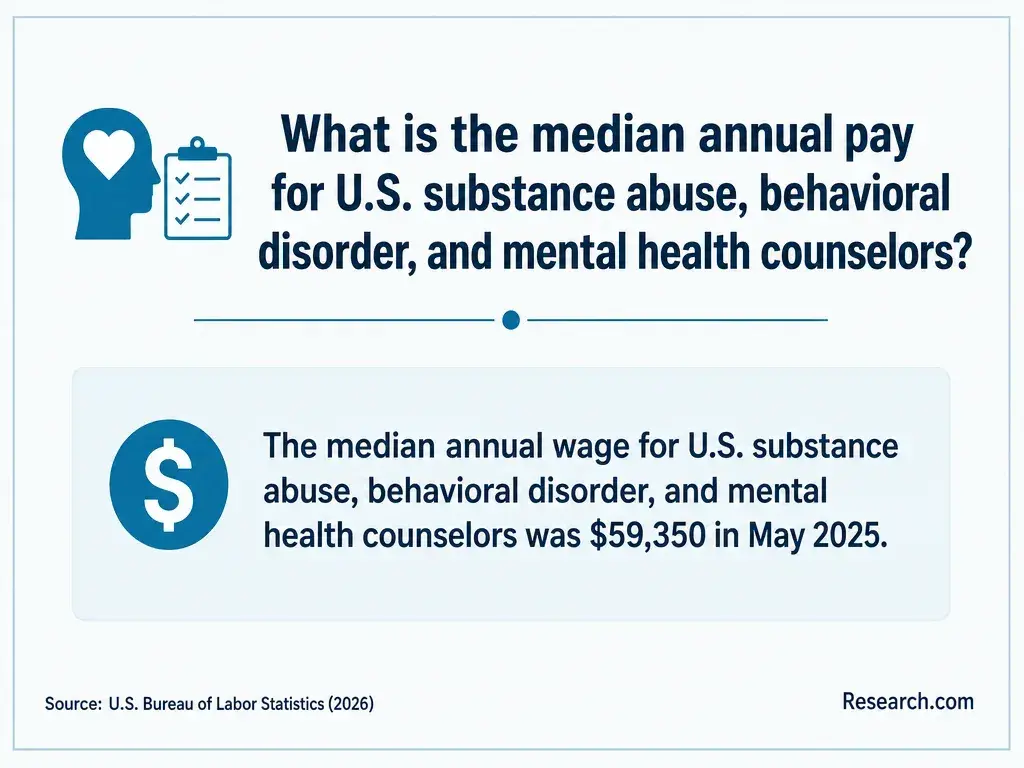
"Behavioral health technician" spans different settings and duties, so it has no single reliable wage figure that applies to every posting. The closest federal labor-market category for some jobs is psychiatric technicians and aides in the U.S. Bureau of Labor Statistics Occupational Outlook Handbook. Other addiction-service jobs may be classified differently. Use the current occupation-specific median wage and employment projection as context, then check local postings for the exact title, shift, setting, and credential requirements.
An occupation-wide median is not a starting salary or the expected earnings of psychology BA graduates. Shift differentials, experience, employer type, and local demand can change an offer. If pay is your reason for enrolling, compare the likely change in responsibilities and compensation with your remaining education cost; undergraduate substance use counseling study on a budget is another comparison, but its degree and career assumptions must match the job you intend to pursue.
What Certifications or Licenses Do Behavioral Health Technicians Need?
There is no universal credential attached to every behavioral health technician job. Requirements depend on the state, employer, setting, and tasks. An employer may require its own safety training, while a position involving peer support or substance-use-disorder counseling may have separate state-recognized certification, supervision, or licensing rules.
Before choosing a degree, take a target job posting to the employer or relevant state credentialing authority. Confirm the exact credential name, qualifying education, supervised hours, examination requirements if applicable, and which duties are permitted before certification. Keep technician support, peer services, and counseling distinct: a psychology BA with addiction courses does not independently authorize diagnosis or therapy.
If you later consider graduate education, apply the same test to it. Online psychology master's completion planning can help frame the time commitment, but a general psychology master's is not automatically a license-qualifying counseling degree. Verify the educational pathway against the state and occupation you have chosen.
Other Things You Should Know About Psychology
Usually only in a way your employer and course policies permit. Do not share identifiable client details, records, or images; ask how to use a hypothetical example instead.
Ask an advisor about course withdrawal deadlines, part-time enrollment, and leave policies before the change occurs. Also check how a lighter course load would affect your aid and graduation plan.
Some institutions evaluate documented workplace or prior learning, but credit is not automatic. Ask the receiving school what evidence it accepts and whether any award would satisfy a degree requirement.
Tell the university before moving. Confirm it can enroll you in the new state and whether relocation changes placement options, tuition, or the credential rules relevant to your career goal.
- Types of Financial Aid: Grants, Work-Study, and Loans | studentaid.gov https://studentaid.gov/understand-aid/types
- Military Training Evaluation Program (MTEP) | dantes.mil https://www.dantes.mil/credit4training/
- Substance Use Disorder Counseling Certificate | UC San Diego Division of Extended Studies https://extendedstudies.ucsd.edu/certificates/alcohol-and-drug-abuse-counseling
- Behavioral Health Support | Ozarks Tech (OTC) https://ozarkstech.edu/programs/human-services/behavioral-health-support/
- B.S. in Psychology - Behavioral Health Degree Online https://online.ecok.edu/online-degrees/bs-bachelors-psychology-behavioral-health/
- Applied Psychology: Addictions Studies, B.S. - CPS, CPSO | University of New Hampshire https://www.unh.edu/program/bachelor-science/applied-psychology-addictions-studies
- Practicums, Internships and Projects What's the Difference? | Oregon State University https://health.oregonstate.edu/internships/types-of-experiential-learning
- Employer Tuition Reimbursement: How It Works and How to Pay for College | Winston-Salem State University https://ramsonline.wssu.edu/blog/employer-education-benefits/
- Online Bachelor's Degree in Psychology in Addictions | Purdue Global https://www.purdueglobal.edu/degree-programs/psychology/bachelor-psychology-addictions/
- Transfer Credit Policy - Hunter College - CUNY https://www.hunter.cuny.edu/students/admissions/undergraduate/apply/transfer/transfer-credit-policy/