2027 MSL in Financial Services vs. a Finance Master's: Choosing Legal or Analytical Depth

Co-Founder and Chief Data Scientist
If your work involves both financial decisions and financial regulations, the choice between a Master of Studies in Law (MSL) in financial services and a finance master's can be difficult. One builds legal and regulatory fluency; the other develops financial analysis. That distinction matters for professionals considering compliance, risk, investment, or banking roles.
This guide compares what each degree teaches, where each may help, and what to verify about cost and career outcomes before you enroll.
Key Things You Should Know
- Choose a financial-services MSL for deeper regulatory interpretation and compliance work; choose a finance master's for valuation, modeling, and investment analysis.
- Neither degree is a standard requirement for compliance work, and an MSL does not qualify its holder to practice law.
- Compliance officers had median annual pay of $80,730 in May 2025, with 4% projected job growth for 2025-2035, according to the Bureau of Labor Statistics (BLS); those occupation-wide figures are not graduate salary outcomes.
What is the difference between an MSL in financial services and a finance master's?
An MSL is a non-Juris Doctor (non-JD) graduate law degree intended primarily for people who need legal knowledge without becoming attorneys. Schools may use names such as Master of Legal Studies (MLS) for a similar degree. A finance master's is a graduate business or quantitative degree centered on financial decisions and markets.
The comparison below identifies the difference most likely to affect your work: whether you need to interpret rules or analyze financial results:
| Decision factor | Financial services MSL | Finance master's |
| Primary depth | Legal reasoning, regulatory frameworks, and compliance | Financial modeling, valuation, markets, and investment decisions |
| Typical work product | Regulatory analysis, policy interpretation, or compliance advice within a nonlawyer role | Models, forecasts, valuations, or investment analysis |
| Main limitation | Does not confer a license to practice law | May offer limited instruction in interpreting financial services law |
The degree title alone cannot establish depth. Check whether "financial services" is a formal concentration with required courses, a set of electives, or simply a topic mentioned in a program description.
Which degree is better for financial compliance, risk, and regulatory careers?
For a role focused on interpreting banking, securities, or consumer-finance requirements and translating them into internal controls, an MSL is usually the closer curricular match. For a role focused on credit analysis, market exposure, stress testing, or financial models, a finance master's may be more useful. Risk jobs can require both skill sets, so the job description matters more than the word "risk" in its title.
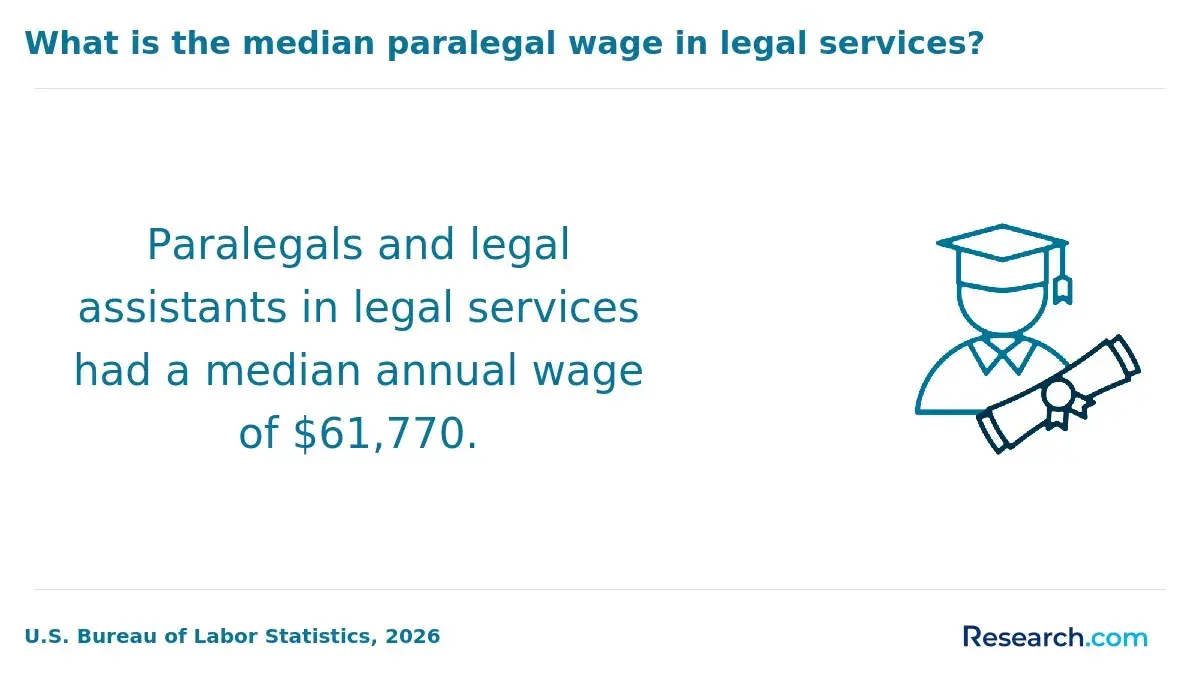
Neither degree is a universal hiring requirement. Relevant experience, employer training, and role-specific credentials may be a less costly route, particularly if you already have the missing skills. If your goal is legal-support work rather than a graduate-level regulatory role, start by choosing an associate degree in paralegal studies and comparing the duties employers actually advertise. Paralegal education is distinct from an MSL and does not authorize independent legal practice.
Does an MSL in financial services qualify graduates to practice law?
No. An MSL is not a JD, and completing one does not by itself make a graduate eligible to practice law or represent clients. Attorney admission requirements vary by jurisdiction and generally involve a qualifying legal education and additional licensing steps.
An MSL graduate may apply legal knowledge in an authorized nonlawyer job, such as helping a compliance team understand a rule and implement a policy. The boundary is important: an employer's need for regulatory expertise does not turn a nonlawyer into its attorney. If your goal is to give legal advice as a licensed lawyer, investigate the JD and the requirements of the jurisdiction where you intend to practice instead.
What do students learn in financial services MSL and finance master's programs?
Financial-services MSL coursework may address legal research, contracts, administrative and business law, financial regulation, and compliance processes. The practical payoff is learning to identify legal issues, read governing materials, and work effectively with counsel. A finance master's typically emphasizes accounting and financial statements, corporate finance, valuation, investment analysis, and quantitative methods. Its payoff is stronger analysis of financial choices and their consequences.
Course titles do not prove that students complete hands-on regulatory projects or use particular modeling tools. Compare required assignments and electives with work you expect to do. If legal study must fit around a job, planning business law degree study around employment can help frame questions about workload and course sequencing.
What are the admission requirements for each degree?
Both routes generally seek applicants with a bachelor's degree, but each school sets its own rules for grades, recommendations, work history, and standardized tests. An MSL may welcome applicants without legal training; that does not mean every program waives prerequisites or assumes no financial-services experience. Finance programs vary in how much accounting, economics, mathematics, or statistics they expect on entry.
Check the published requirements for your intended intake rather than assuming a test is required or waived. If your background is strong in compliance but light in quantitative work, ask whether the finance program requires preparatory courses. If you work in finance but have not studied law, ask how the MSL introduces legal research and writing. Any prerequisite adds time and potentially cost to the comparison.
How long do these master's programs take and how much do they cost?
Completion time depends on required credits, course availability, enrollment pace, and whether a program has a fixed cohort schedule. Either route may be offered for full-time or part-time study; neither should be assumed to be the faster option from its degree name alone.
Compare each school's current tuition and mandatory fees using the same unit—ideally the estimated cost of completing the required curriculum, not one program's per-credit rate against another's advertised total. Include books, technology, possible campus travel, and prerequisite courses. Ask about program-specific financial aid eligibility and employer assistance rather than assuming either will cover the bill. For a broader cost comparison, review affordable graduate legal studies and salary considerations, then confirm figures with the school.
The opportunity cost matters too: a lower-tuition program can still be expensive if its schedule reduces your working hours, while a broader degree may not be worth its added coursework if employer training addresses your specific gap.
Are online financial services MSL and finance master's programs reputable?
Online delivery alone does not determine quality. Confirm the institution's current accreditation through its recognized accreditor, then examine the actual degree curriculum, faculty, assessment methods, and student support. Institutional accreditation is separate from American Bar Association approval of qualifying paralegal education programs; ABA paralegal-program approval is not an accreditation test for an MSL or finance master's.
"Online" also does not necessarily mean self-paced. Ask whether classes meet live, exams have fixed windows, or campus visits are required. Accelerated calendars can compress the same work into a less flexible schedule; our list of fast-track online business law master's programs offers a starting point for examining that trade-off, not a substitute for checking current scheduling rules.
What careers can graduates pursue with each degree?
An MSL may complement experience in compliance, regulatory affairs, policy, internal controls, or financial services operations. A finance master's may fit financial analysis, investment research, corporate finance, or quantitatively focused risk work. Employers determine qualifications for particular jobs, and advancement may depend more on relevant experience than on either degree alone.
For a career changer, test the intended move against entry-level postings before buying graduate-level depth. Someone seeking paralegal or legal-assistant work should compare that occupation's education expectations separately; online paralegal bachelor's programs that accept transfer credits address a different educational path from either master's degree. Prior banking or analytical experience may transfer to a compliance team, but you may still need to learn its specific regulations and reporting processes.
What salaries and job outlooks can graduates expect?
BLS reports median annual pay of $80,730 in May 2025 for compliance officers and projects 4% job growth for 2025-2035, with about 32,700 openings per year. This is a useful benchmark if compliance is your target, but it covers an occupation across industries and experience levels—not financial-services MSL graduates or new hires specifically.
There is no single comparable salary for "finance master's graduates" because financial analysts, investment professionals, and risk specialists perform different jobs. Compare pay data for the precise occupation and location you want, then weigh it against your current earnings, likely entry point, and total program cost. Neither degree guarantees a raise or promotion.
How can you choose an accredited program that fits your career goals?
Start with the work you want to perform, then check whether required courses—not merely electives—build the skills that work demands. The following sequence helps prevent an expensive mismatch:
- Collect job descriptions for your target role and mark the recurring legal, quantitative, and experience requirements.
- Compare required courses and sample assignments in each program against those requirements; verify whether a named concentration appears on the transcript.
- Confirm institutional accreditation, admissions prerequisites, online meeting times, completion rules, and the current total cost directly with each school.
- Ask employers or practitioners whether the degree, a narrower credential, or supervised experience would best close your particular skills gap.
Favor the MSL when regulatory interpretation is the central gap and you do not need attorney licensure. Favor the finance master's when the gap is modeling or financial decision-making. If neither curriculum matches a specific job requirement, postpone the degree decision until you have tested a smaller training option or gained relevant experience.
Other Things You Should Know About Law & Paralegal
Relevant coursework may help you study, but a degree does not automatically award a separate designation. Check the issuing organization's current examination, experience, and eligibility rules for the credential you want.
Do not assume they will. A JD program decides whether prior graduate coursework can count toward its requirements, subject to its own policies. Get an answer from the prospective law school before enrolling in an MSL for that purpose.
Requirements vary. A program may use a thesis, capstone, project, or coursework-only format. Check the catalog for the exact degree and concentration.
Possibly. Employer tuition-assistance policies may restrict eligible schools, grades, reimbursement amounts, or continued employment. Obtain the policy and approval terms before committing to a program.
References
- Typical Law School Requirements & Prerequisites | Ohio Northern University https://law.onu.edu/news/law-school-admissions-101-typical-law-school-requirements-prerequisites
- Online Master's Degrees | NYU SPS https://www.sps.nyu.edu/explore/degrees-and-programs/landing-pages/online-masters-degrees.html
- Finance Law | William & Mary Law School https://online.law.wm.edu/master-of-legal-studies/concentrations/finance-legal-studies
- Exploring Career Opportunities with a Master's in Finance | umn.edu https://carlsonschool.umn.edu/graduate/resources/masters-in-finance-career-opportunities
- Finance Master's Degree - Daniels College of Business https://daniels.du.edu/finance/masters/
- Master's in Finance vs. MBA: Which Should You Choose? | NU https://www.nu.edu/blog/masters-degree-finance-vs-mba/
- Choosing Between an MBA and Master's in Finance | Pace University New York https://www.pace.edu/news/choosing-between-mba-and-masters-finance-6-factors-consider
- Financial Services Law Track - Online MLS | Wake Forest https://mls.law.wfu.edu/curriculum/financial-services/
- Is an MLS Worth It? ROI and Career Outcomes for Non-Lawyers | Drexel University Kline School of Law https://drexel.edu/law/news/legal-studies-blog/is-an-mls-worth-it-roi-and-career-outcomes-for-non-lawyers/
- Institute for Financial Market Regulation | Albany Law School https://www.albanylaw.edu/institute-financial-market-regulation