2027 Most Affordable Online Master's Degrees for Career Mobility

Co-Founder and Chief Data Scientist
An online master's degree can open a path to specialization or a career change, but the cheapest advertised tuition may not produce the lowest bill - or the best return. The U.S. Bureau of Labor Statistics (BLS) reported a 2024 median annual wage of $124,910 for information security analysts, illustrating the appeal of growing technical fields; that figure describes an occupation, not what a degree will earn you. This guide compares master's degree fields by potential cost and career fit, then shows working adults how to check total price, requirements, and likely value before enrolling.
Key Things You Should Know
- Required credits, fees, residency charges, prerequisites, and unpaid placements can change which online master's option is cheapest.
- An MBA or technical MS may support advancement, while counseling, teaching, and advanced nursing roles can require separate state approval, supervised practice, or licensure.
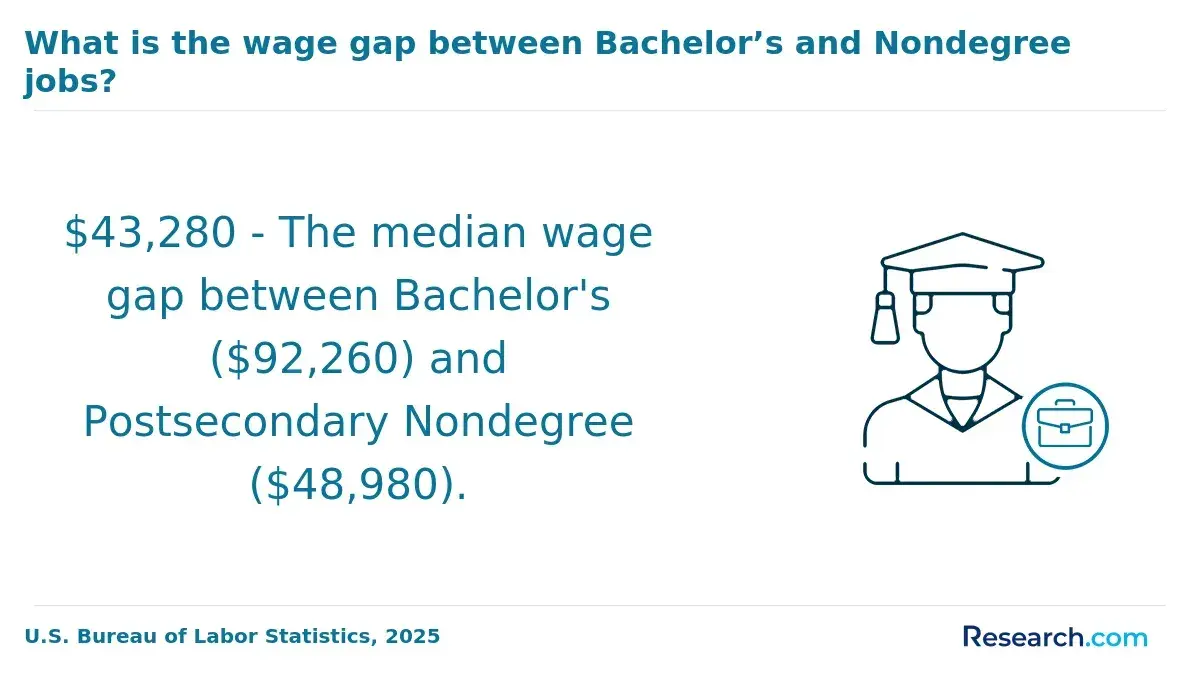
- BLS reported 2024 median weekly earnings of $1,840 for workers with a master's degree and $1,543 for those with a bachelor's; the difference does not establish what an individual program will add to your income.
Top 10 Most Affordable Online Master's Degrees for Career Mobility - Affordable Online Master's Degrees
Business / MBA Programs
An online Master of Business Administration (MBA) can suit professionals moving toward general management, operations, or a new industry. Compare its full credit load and business-school fees with a narrower MS in management or accounting; a less expensive specialized degree may be better if your target role is clear.
Some MBAs require foundation courses or substantial group work despite online delivery. Management jobs typically also depend on experience, so ask employers whether the credential changes your eligibility for a specific role.
Healthcare Administration & Management Programs
A Master of Healthcare Administration (MHA) or healthcare-focused MBA can prepare experienced staff for budgeting, operations, and quality-improvement work. An online Master of Public Health (MPH) is a different fit when population health or policy is the goal.
Compare required credits, project work, and any internship or residency expenses. A low-cost MHA does not itself qualify someone for clinical practice or a management job; healthcare employers often value relevant experience alongside graduate study.
Information Technology Programs
An MS in information technology often covers systems, cloud infrastructure, and IT leadership. It may offer a practical route for experienced support, networking, or systems professionals seeking broader responsibility.
Compare bridge-course costs if your bachelor's degree is unrelated, and check whether an online laboratory can be completed remotely. If your aim is one vendor-specific role, an employer-funded certification may cost less than a master's. Supervisory positions generally require demonstrated technical and people-management experience.
Computer Science Programs
An MS in computer science can deepen software, algorithms, or artificial-intelligence expertise. It is most cost-effective when its coursework serves a role you cannot readily reach through experience alone.
Career changers should price prerequisite programming and mathematics courses separately; these may extend study without counting toward the degree. Compare a research thesis with a project-based track, and confirm whether required computing resources or examinations add costs. Many software jobs do not require a master's.
Cybersecurity Programs
An MS in cybersecurity can build expertise in security engineering, risk, or governance, but programs vary sharply in technical depth. Compare the price of required labs, certifications, and prerequisite networking courses - not just graduate tuition.
For a working IT professional, an employer-supported certification may be a cheaper first step. For someone targeting specialized security work, a well-matched MS may offer broader preparation. A degree alone does not replace hands-on experience or qualify someone for every security role.
Data Science / Analytics Programs
An MS in data science typically emphasizes statistics, programming, and machine learning; an MS in business analytics may focus more on organizational decisions. Compare prerequisite mathematics, software access, and capstone requirements when estimating cost.
Applicants without quantitative preparation may need extra coursework. Choose the technical path when your target jobs require substantial modeling; choose analytics when you need to apply data within an existing business function. A portfolio and relevant experience can matter alongside either credential.
Education / Educational Leadership Programs
A Master of Education (MEd) may support curriculum or instructional roles, while an educational leadership degree may be designed for aspiring administrators. Public-school salary schedules and state credential rules strongly affect value: check whether the degree qualifies for a pay lane or intended license before comparing tuition.
Leadership tracks may require teaching experience and a supervised internship. A lower-priced program outside your state may be expensive in practice if it does not meet local credential requirements.
Counseling / Psychology Programs
An online MA or MS in counseling may lead toward professional counseling licensure, but the degree is only part of that pathway. Budget for required clinical placements, supervision, background checks, and possible travel; placements are generally in person.
Confirm that the curriculum and any relevant programmatic accreditation meet the rules of the state where you intend to practice. A general psychology master's may serve research or other goals but is not interchangeable with a licensure-track counseling degree.
Nursing Programs
A Master of Science in Nursing (MSN) can support nursing leadership, education, or advanced practice, depending on its track. Applicants generally need the nursing preparation and active license specified by the program. Advanced-practice tracks can carry substantial clinical-placement and compliance costs even when courses are online.
Verify state authorization, placement support, programmatic accreditation, and eligibility for any intended certification before comparing prices. An MSN does not independently confer an advanced-practice license.
Engineering Management Programs
An MS in engineering management combines technical project work with finance, operations, and leadership. It may be a better value than a general MBA for engineers who want to manage technical teams, particularly when an employer reimburses tuition.
Check whether admission requires an engineering or quantitative background and whether projects demand scheduled collaboration. The degree can strengthen management preparation, but employers commonly expect engineering experience before assigning senior responsibility.
What Are the Most Affordable Online Master's Degree Programs?
The most affordable online master's degree is the accredited, career-relevant option with the lowest complete cost for your circumstances - not necessarily a particular field. Published tuition varies by school, residency, and program, so these degree families cannot be defensibly ranked by price without comparing actual offers.
The table identifies cost variables and career trade-offs to investigate first.
| Degree family | Cost variable to investigate | Potential mobility and limitation |
| MBA or management MS | Required credits, differential tuition, foundation courses | Broad business mobility; advancement often depends on experience |
| IT, cybersecurity, or computer science MS | Technical prerequisites, labs, software, certification charges | Specialization or a technical career change; some roles have cheaper certification routes |
| Data science or analytics MS | Mathematics prerequisites and project resources | Analytical specialization; employers may also expect a portfolio |
| MHA or healthcare management degree | Internships, residency requirements, program fees | Healthcare operations preparation; clinical licensure is separate |
| MEd, counseling MA/MS, or MSN | Placements, supervision, and state-specific requirements | Possible credential or practice pathway; an unsuitable program can be costly to correct |
| Engineering management MS | Entry prerequisites and project requirements | Technical leadership preparation; usually builds on work experience |
Shortlist programs only after identifying the job or credential you want. For licensure-oriented fields, eligibility in your state is a threshold requirement, not a feature to trade away for lower tuition.
How Much Do Affordable Online Master's Degrees Cost?
Calculate an online master's degree's price as tuition for all required graduate credits plus mandatory fees and required expenses, then subtract aid you do not have to repay. A per-credit quote is a sticker price, not the total program cost; your net price depends on scholarships, employer assistance, and other aid. Published prices also change, so request an estimate for your intended start term and enrollment pace.
The largest differences commonly come from program-specific tuition, in-state versus out-of-state rates, technology or course fees, prerequisites, books and software, and travel for residencies or placements.
Part-time enrollment can preserve wages but may spread fees over more terms; an intensive schedule can reduce elapsed time while limiting work hours. Request a written estimate that separates required degree credits from noncredit or prerequisite coursework.
Eligible students can compare institutional scholarships, employer tuition assistance, payment plans, and federal graduate aid. Graduate borrowing is not a price reduction: compare expected borrowing and repayment with a realistic career plan.
If financial aid is central to your choice, guidance on what online college gives the most financial aid can help frame questions, but confirm graduate-level eligibility and award amounts directly with each school.
Are Online Master's Degrees Accredited and Respected by Employers?
Online study does not prevent a master's degree from being accredited or respected. The first check is whether the institution holds recognized institutional accreditation. Then determine whether your intended profession requires, prefers, or benefits from additional programmatic accreditation. Employer acceptance is role-specific; relevant skills, experience, and any required license still matter.
Programmatic checks are especially important for regulated pathways. For example, compare counseling programs with state board requirements and relevant counseling accreditation; check nursing programs against applicable nursing accreditation and state authorization.
Teacher and administrator candidates should confirm state credential eligibility. Business accreditation may matter to some employers, but it should not substitute for comparing cost and curriculum.
Do not infer that "online" means no in-person obligations. A credible program can include scheduled classes, local clinical work, practicums, residencies, or proctored assessments. Verify these details in the catalog and with the program before paying a deposit.
Which Online Master's Degrees Offer the Best Career Mobility?
Career mobility can mean moving into a new field, gaining a specialization, qualifying for a regulated profession, or becoming competitive for advancement. The strongest choice is the least costly credential that clears the specific barrier between your current experience and target role.
Technical MS degrees may help applicants build specialized skills, but the incremental value is smaller if their employers already accept demonstrated experience or certifications.
An MBA, MHA, or engineering management MS may broaden advancement options for experienced professionals; none substitutes for a record of leading projects. Counseling, education, and nursing degrees can have clearer credential purposes, but state requirements and placement costs make a poor program match particularly expensive.
Before applying, inspect job postings for your target role. Note whether a master's is required, preferred, or absent, and whether employers ask instead for a license, certification, portfolio, or years of experience. If the degree is merely preferred, compare its full cost with a graduate certificate, employer-funded training, or another route.
What Do You Learn in an Online Master's Degree Program?
Most career-oriented online master's programs combine core courses, electives or a concentration, and an applied final requirement such as a capstone, portfolio, or project. Research-focused programs may offer a thesis. Clinical and licensure-oriented degrees add supervised experiences that cannot necessarily be completed from home.
The content should match the credential's purpose: an MBA emphasizes organizational decisions; an MS in computer science or data science emphasizes technical methods; an MEd, MSN, or counseling degree may connect coursework to professional practice. Compare syllabi and final requirements rather than assuming similar degree names teach the same skills.
A thesis can make sense for research preparation, while a practical capstone may better serve a defined workplace problem.
If doctoral study is your longer-term goal, examine whether a prospective doctorate accepts your master's preparation; discussions of the easiest PhD without dissertation are not a substitute for checking the doctorate's actual research and completion requirements.
What Are the Admission Requirements for Online Master's Programs?
Standard master's admission requires a completed bachelor's degree. Programs commonly request transcripts and may assess grades, relevant coursework, a statement of purpose, recommendations, a résumé, or an interview. GRE or GMAT policies vary by program; a school-wide admissions page may not describe the rules for a selective graduate track.
Preparation differs by field. Computer science and data science programs may require programming or mathematics; an MSN generally requires specified nursing credentials; educational leadership may require teaching experience.
Some programs offer foundation courses or conditional admission, but ask whether those courses count toward the degree and what they cost.
If you have not completed a bachelor's degree, start with that requirement rather than assuming prior college attendance qualifies you for graduate admission. Exploring easy bachelor degrees online can help you consider undergraduate paths, but choose one that also supplies the prerequisites for your intended master's.
How Long Does It Take to Complete an Online Master's Degree?
Completion time depends on required graduate credits, course availability, enrollment intensity, prerequisites, and the final project or placement. A short class term is not a short degree. Full-time study can shorten elapsed time but may increase financial pressure; part-time study can protect earnings while extending the schedule.
Ask for a term-by-term plan based on the hours you can actually study. Check whether required courses run every term, whether synchronous meetings conflict with work, and whether a clinical placement or internship has fixed daytime hours.
Those constraints can matter more than the label "fully online," particularly for readers balancing caregiving; resources on degrees for stay at home moms can help surface scheduling questions to raise with an advisor.
Previous graduate coursework or a stackable graduate certificate may reduce remaining credits only if the school evaluates and applies them to this degree.
Ask about course equivalency, grade and age limits, maximum transfer credit, and credits that must be earned at the institution. Undergraduate prerequisites normally do not become transferable master's credits simply because you have completed them.
What Careers and Salaries Can Online Master's Graduates Expect?
Occupational wages provide context for a career decision, not a forecast of what a particular master's graduate will earn. The BLS 2024 U.S. median annual wages below cover workers across experience levels and education backgrounds; these occupations do not uniformly require a master's degree.
| Occupation | 2024 U.S. median annual wage | Master's-degree relevance |
| Information security analyst | $124,910 | A cybersecurity MS may deepen expertise; relevant technical experience remains important |
| Data scientist | $112,590 | An analytical MS may build specialization; qualifications vary by employer |
| Medical and health services manager | $117,960 | An MHA or related degree may support advancement; healthcare experience commonly matters |
| Software developer | $133,080 | A computer science MS may support specialization; many positions do not require graduate study |
BLS projections indicate strong demand in some data and security occupations, but demand does not make every degree a good investment. Compare the cost of your specific program with the qualifications in local job postings, your current earnings, and the experience you can gain while studying. For licensed careers, include the time and expense of post-degree requirements.
How Do You Choose a Reputable Online Master's Program?
Start with a target occupation, then compare programs against the requirements of that occupation. This sequence helps prevent the common mistake of choosing the cheapest degree before discovering that it lacks a required course or does not support licensure.
Use this short verification process before applying or accepting an offer:
- Confirm institutional accreditation and, where relevant, state authorization, programmatic accreditation, and eligibility for your intended license or certification.
- Request the current catalog, required-credit total, complete tuition and fee schedule, and a written explanation of prerequisites and in-person obligations.
- Ask for a term-by-term completion plan and a graduate transfer-credit evaluation if you have potentially eligible prior coursework.
- Compare the resulting total cost, expected borrowing, scheduling fit, and curriculum with a cheaper certificate, professional certification, or continued work experience.
Be wary of an advertised completion time based on full-time enrollment you cannot manage, an "online" program that leaves placement arrangements entirely to students, or a salary claim that treats occupational medians as graduate outcomes.
Ask for documented program outcomes where available, and treat missing information as a reason to investigate - not as proof of a favorable answer.
Other Things You Should Know About
There is no universally cheapest field. Compare accredited programs by all required credits, tuition, fees, prerequisites, and in-person costs; the lowest per-credit rate may not produce the lowest total bill.
It can, if its curriculum and entry requirements match the new role. Check whether employers also require experience, a portfolio, certification, or licensure before paying for the degree.
Sometimes. Counseling, nursing, and some education programs commonly require local placements, while other programs may require scheduled sessions, examinations, or campus visits. Check the specific program's requirements.
No. Occupational wages and education-level averages do not predict an individual outcome. Estimate the degree's value using your target job's requirements, your likely total cost, and realistic advancement opportunities.
References
- Field of degree: Occupational Outlook Handbook | bls.gov https://www.bls.gov/ooh/field-of-degree/
- Types of Financial Aid: Grants, Work-Study, and Loans | studentaid.gov https://studentaid.gov/understand-aid/types
- Estimate your college cost | USAGov https://www.usa.gov/estimate-college-cost
- Are Prerequisite Courses Barriers to Pharmacy Admission or the Keys to Student Success? - PMC https://pmc.ncbi.nlm.nih.gov/articles/PMC10159397/
- School-Determined Requirements | 2024-2025 Federal Student Aid Handbook https://fsapartners.ed.gov/knowledge-center/fsa-handbook/2024-2025/vol1/ch1-school-determined-requirements
- The Value of Industry Recognized Certifications | St. Kate's https://continuinged.stkate.edu/industry-recognized-certifications-value/
- Undergraduate and Graduate Tuition and Fees | Purdue Global https://www.purdueglobal.edu/tuition-financial-aid/undergraduate-graduate-tuition-and-fees/
- Types of Financial Aid | Roosevelt University https://www.roosevelt.edu/tuition-aid/types-of-financial-aid
- Other Forms of Financial Assistance | Office of Scholarships & Financial Aid | Nebraska https://financialaid.unl.edu/types-funding/other-financial-assistance/
- Return to School | Employer Tuition Assistance Programs | UMass Global https://www.umassglobal.edu/blog-news/get-your-employer-pay-college-tuition-assistance-programs