2027 MLIS Programs for School Library District Technology Planning

Co-Founder and Chief Data Scientist
Choosing an MLIS for districtwide school library technology work means checking more than a program's technology electives: school librarian credentials, applied planning experience, and cost can all affect whether the degree fits your goal.
The U.S. Bureau of Labor Statistics projects 2.6% employment growth for librarians and media collections specialists from 2025 to 2035, making preparation for specialized responsibilities worth examining carefully. This guide helps prospective students and working educators identify the right credential, compare programs, and build skills they can use across a school district.
Key Things You Should Know
- Look for an MLIS with school library preparation and opportunities to plan, evaluate, and support technology across multiple schools; a relevant elective alone is not a district-planning specialization.
- Check state school librarian credential rules separately from ALA program accreditation. An online degree does not automatically qualify graduates for certification or endorsement.
- The May 2025 median pay for the broad U.S. category of librarians and media collections specialists was $68,270; it is not a salary estimate for district technology planning jobs.
What are MLIS programs for school library district technology planning?
These are library and information science master's programs that can help a student prepare to coordinate school library technology beyond a single building. The work may involve evaluating catalog and discovery systems, improving access to digital resources, supporting staff training, and helping schools align purchases with instruction, accessibility, privacy, and district priorities.
"District technology planning" is usually a career goal, not the name of a formal MLIS concentration. A suitable program may combine school librarianship courses with electives in information technology, management, and assessment. Before treating a program as specialized, distinguish its published track from individual electives and from an applied project you would have to arrange yourself.
The scope of the intended job matters. A school librarian might lead library-system decisions and teach information literacy; a district library coordinator might set shared practices across campuses; a district technology director may have broader infrastructure and staffing responsibilities for which an MLIS is only one possible background. Compare actual job descriptions in your target district before choosing a degree.
Which accreditation should school library technology planners look for?
Check whether the specific master's program appears in the current American Library Association (ALA) directory of accredited programs. A university's institutional accreditation is important but does not establish that its MLIS, MLS, Master of Science in Library Science, or differently titled LIS master's program has ALA accreditation. The degree name alone does not settle the question.
Then verify school librarian preparation separately. State education authorities set certification or endorsement rules, which may include approved coursework, prior teaching credentials, field experience, or assessments. ALA accreditation does not replace those requirements or confirm that a program offers the courses you need. For a broader accreditation comparison, see this guide to best online librarian degree accreditation.
Ask the program to identify its current accreditation status and explain, in writing, which state school library credentials its published pathway is designed to support. Confirm the answer with the education authority in the state where you plan to work, especially if you will study across state lines.
What education and licensing requirements apply to school library technology careers?
Requirements depend on the position. A school librarian or library media specialist in a public school generally needs to meet the relevant state's school librarian certification or endorsement rules. A district library coordinator may also be expected to bring school library experience, while a district technology position may accept education, information technology, or administrative backgrounds instead of an MLIS. Employer requirements are not interchangeable with state licensing rules.
Start with the role you want, then compare its posting with the state education authority's requirements. Check whether the proposed MLIS includes an approved school library pathway, whether previous teaching credentials are needed, and how any supervised school experience can be completed. If you already hold a teaching license, ask the state and university whether an endorsement pathway would meet your goal without another full degree.
What degree pathways prepare professionals for school library technology planning?
The strongest pathway depends on both your current credentials and whether you want to practice as a school librarian. The comparison below separates the credential needed for a role from the additional preparation that may make a candidate useful in districtwide planning.
| Pathway | Potential fit | Key limitation to check |
| MLIS or equivalent LIS master's with school library preparation | Applicants seeking school librarian roles and a foundation for later district responsibilities | Whether the pathway meets the intended state's credential rules |
| School library endorsement or certificate | Educators who already meet prerequisites and need a specific state credential | Whether it provides enough planning and technology coursework for the desired job |
| Educational technology or school leadership degree | Applicants targeting broader district systems, instruction, or administration | Whether the job also requires a school librarian credential |
For someone without school library experience, an MLIS with supervised practice can provide a foundation before moving into district coordination. An experienced educator whose target role centers on infrastructure or instructional technology may get a better fit from another graduate pathway. This overview of the library science education pathway can help you place an MLIS alongside other degree options.
How do online and campus-based MLIS programs compare?
Delivery format affects access to courses, but it does not change state credential requirements. This comparison highlights the scheduling and fieldwork questions most likely to matter for a working educator.
| Format | Potential advantage | Verify before enrolling |
| Online | Can allow study while remaining employed in a district | Live-session times, elective rotation, campus visits, and approval of a local school placement |
| Campus-based | Can offer regular in-person contact with faculty and nearby placement partners | Course times, commuting costs, and whether a placement can be arranged in your intended district |
Neither "online" nor "accelerated" guarantees that school library courses or practica will be available when you need them. Request a term-by-term schedule that includes credential coursework, not just the general MLIS core. If completion speed is a priority, compare documented sequencing as well as advertised timelines in guides to fast online library science masters.
What coursework covers school library technology, leadership, and district planning?
Look for a combination of school library instruction, digital resource management, technology evaluation, leadership, and assessment. Catalog descriptions can indicate relevant content, but they do not show whether an elective is required, offered regularly, or open to students in the school library pathway.
A useful curriculum should let you connect classroom needs to district decisions. For example, a project could assess how well a shared discovery tool helps students find age-appropriate resources across campuses, then propose improvements using usage evidence, staff feedback, accessibility checks, and a realistic implementation plan. Courses in information organization, collection development, instructional collaboration, and management can each contribute to that work.
Ask whether a practicum, capstone, or independent study can involve a district library office rather than only one school. An applied plan with a budget rationale, staff-training outline, and evaluation measures is more persuasive evidence of planning skill than a technology course title by itself. Confirm that the placement and project can actually be approved before relying on them.
What are the admission requirements for MLIS programs?
MLIS applicants generally need a bachelor's degree and must follow each university's published graduate admission process. Programs may request transcripts, a statement of purpose, recommendations, a résumé, or other materials; policies and deadlines differ. Prior library employment is not a universal admission requirement, and an applicant should not assume teaching experience substitutes for any stated academic prerequisite.
Use the statement of purpose to explain why district library planning interests you and what experience you bring from teaching, libraries, technology support, or school administration. If you need a school librarian credential, contact the program before applying to ask whether admission to the MLIS also grants entry to its school library pathway, or whether that pathway has separate requirements.
How long do MLIS programs take and what do they cost?
Completion time depends on required credits, enrollment pace, course sequencing, and any school library fieldwork. An accelerated timetable is meaningful only if the credential courses and an approved placement fit within it. Ask for a sample plan based on your intended pace and state requirements rather than assuming the general MLIS timeline applies.
For an accurate cost comparison, calculate required credits multiplied by the tuition rate that applies to you, then add mandatory fees and likely materials, travel, and fieldwork expenses. Published tuition is not the full cost of attendance; a longer schedule can also add living expenses or delay a career move. Check whether an employer offers reimbursement and whether you qualify for institutional scholarships before estimating your personal out-of-pocket cost. Options for library science tuition assistance are worth exploring, but awards are not automatic.
If borrowing is necessary, ask the financial aid office about eligibility and loan terms for your enrollment period. Compare the amount you would finance with realistic job opportunities in your district; the broad librarian salary median is not a reliable basis for a personal payback calculation.
What careers and salaries can MLIS graduates pursue in school library technology?
Potential roles include school librarian or library media specialist, district library coordinator, and library systems or digital resources specialist. Duties vary: one employer may expect instructional leadership and staff development, while another emphasizes vendor coordination, access to digital collections, or support for a shared library system. Technology departments may also hire for adjacent roles that do not require an MLIS.
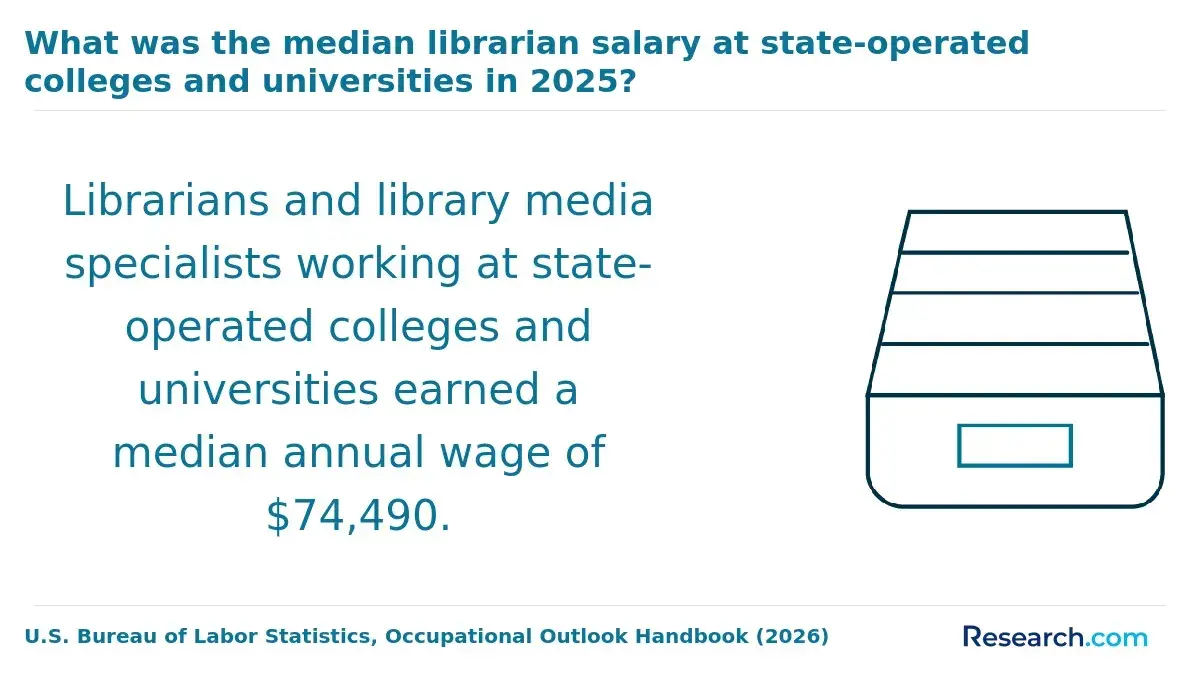
The BLS reported a May 2025 median annual wage of $68,270 for U.S. librarians and media collections specialists. That occupation covers settings beyond schools and does not isolate district technology planners. Use local postings, salary schedules, and required experience - not the national median alone - to assess a target job.
Districtwide roles may favor candidates who have supported more than one campus, trained colleagues, evaluated resources, or managed a system change. If you are considering an entry role as a route to coordination, compare the experience sought in postings with guidance on library science experience requirements. An MLIS can support advancement, but it does not replace demonstrated work with schools and staff.
What is the job outlook for school library technology professionals?
The BLS projects 2.6% U.S. employment growth for librarians and media collections specialists from 2025 to 2035. This is a broad occupational projection, not a forecast of district planning vacancies. Openings for a particular role will depend on district staffing, budgets, and whether technology responsibilities sit in a library office, an instructional team, or a central IT department.
Digital access, accessibility, student privacy, and responsible use of AI tools make technology evaluation relevant to school libraries, but they do not guarantee new positions. Before enrolling, review current postings in the districts where you could work. If they consistently require a school librarian credential, prioritize an eligible pathway; if they emphasize infrastructure leadership instead, compare educational technology and administration programs on equal terms.
Other Things You Should Know About Library Science
Approval may involve library leadership, IT, procurement, finance, and school administrators. Ask a prospective employer where the library's recommendation ends and formal purchasing authority begins.
Define the instructional need, run a limited pilot if district policy allows, and gather feedback from students and staff. Include accessibility, support needs, and ongoing costs in the evaluation.
Ask what data the tool collects, who can access it, how long it is retained, and how deletion works. Route the answers through the district's privacy and procurement review rather than assuming a vendor's general assurances are sufficient.
Include them only where there is a defined educational use. Evaluate accuracy, student privacy, accessibility, and district policy before recommending a tool for discovery or instruction.
References
- Washington Librarian Certification FAQ | wa.gov https://www.sos.wa.gov/library/resources-you/librarian-certification/washington-librarian-certification-faq
- Library Media - Oklahoma.gov https://oklahoma.gov/education/services/standards-learning/library-media0.html
- Chapter 7: Technology Integration, Technology in Schools | ed.gov https://nces.ed.gov/pubs2003/tech_schools/chapter7.asp
- MLIS Master of Library and Information Studies - UA Online https://online.ua.edu/degrees/mlis-master-of-library-and-information-studies/
- School Library Media Endorsement - UW Information School https://ischool.uw.edu/programs/non-degree/school-library-media-endorsement
- Library and Information Science, MLIS (Online) | Southern Connecticut State University https://www.southernct.edu/academics/programs/library-and-information-science-mlis
- School Librarianship | ou.edu http://www.ou.edu/cas/slis/academics/graduate/mlis/school-librarianship.html
- MLIS Online - School Librarianship - ODUGlobal https://online.odu.edu/academics/programs/library-information-studies-school-librarian
- Master's in Library and Information Science | UNC Greensboro https://www.uncg.edu/degrees/library-and-information-science-m-l-i-s-instructional-technology-concentration/
- Accredited Programs | ALA https://www.ala.org/educationcareers/accreditedprograms