2027 MLIS Programs for Archival Description and Finding Aid Work

Co-Founder and Chief Data Scientist
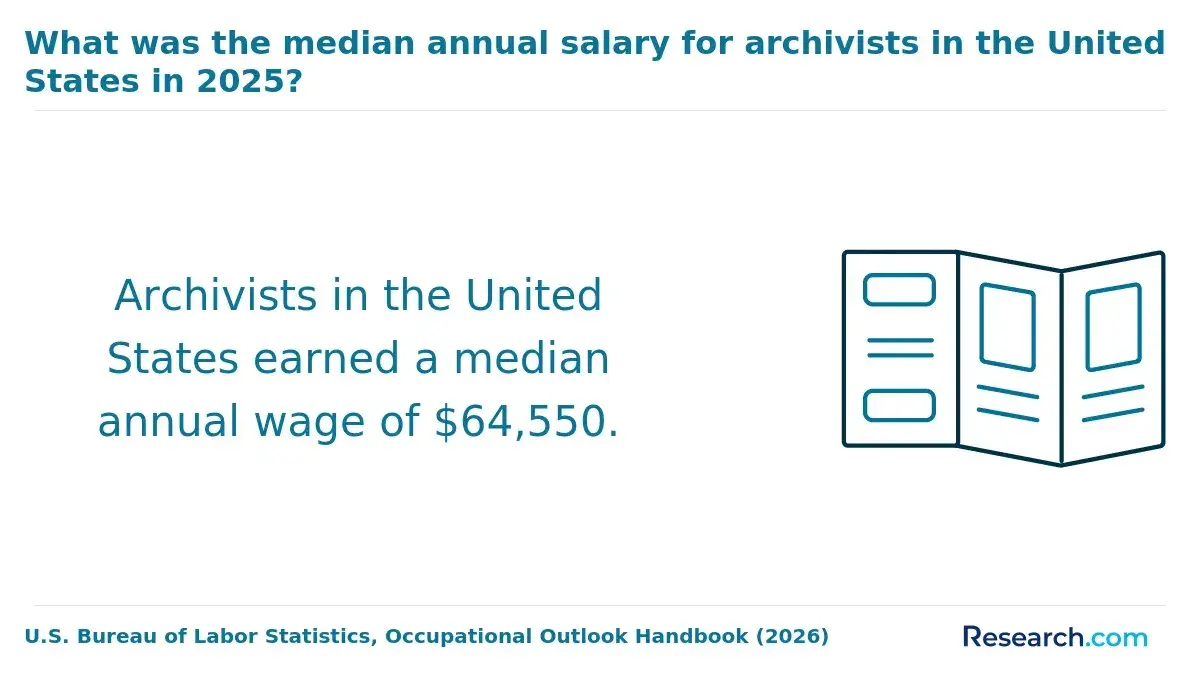
Choosing an MLIS for archival work takes more than finding a program that lists an archives elective. You need opportunities to arrange collections, write usable finding aids, and work with archival description standards - and you need to know whether those opportunities will be available while you are enrolled. The U.S. Bureau of Labor Statistics reports a May 2025 median annual salary of $64,550 for archivists, making the cost of preparation worth examining carefully. This guide helps prospective students compare curricula, practical experience, study formats, and career fit before committing to a program.
Key Things You Should Know
- Look for documented archival description coursework and a supervised collection-processing project; a course title alone does not establish hands-on preparation.
- Check the specific master's program's ALA accreditation status separately from the university's institutional accreditation, then confirm when relevant electives will run.
- Archivist employment is projected to grow 3.4% from 2025 to 2035, but that occupation-wide projection does not predict openings or outcomes for any particular MLIS program.
What are MLIS programs for archival description and finding aid work?
These are library and information science master's programs that let students prepare for a specific archival task: describing collections so people can discover, understand, and request them. A finding aid is a guide to an archival collection. It commonly explains who created the materials, their dates and scope, how they are arranged, and any access restrictions.
Archival description is not the same as cataloging every document separately. Archivists often describe materials at the collection, series, and folder levels while preserving information about their creator and original context. That work combines research, arrangement, clear writing, access decisions, and metadata that can be published in a discovery system.
An MLIS, MLS, Master of Science in Library Science, or Master of Information may provide a route into this work; the degree name alone does not establish its archival curriculum. Likewise, an archives course is relevant coursework, not proof of a formal concentration. Students should distinguish a university-documented track from electives they assemble themselves and from an applied project they must arrange independently.
What education and accreditation do archivists need in the United States?
Archivist positions commonly call for graduate education, but requirements vary by employer and job. An MLIS with archival coursework is one route; a history or public history master's degree with substantial archives experience may suit other positions. Some entry-level archives assistant and processing positions have different requirements and may provide a way to test the field before graduate study.
For an LIS degree, check whether the specific master's program appears in the current American Library Association directory of accredited programs. Institutional accreditation applies to the university and is not a substitute for ALA program accreditation. ALA accreditation also does not verify that a particular archives elective, internship, or online format is available.
ALA accreditation can matter when employers specify an ALA-accredited LIS degree, but it is not a universal legal requirement for archivists. Read postings from the types of archives where you hope to work, noting both required qualifications and preferred experience. If school librarianship is also part of your plan, check the relevant state education authority's licensure requirements separately; an archival MLIS pathway does not automatically meet them.
Which MLIS programs offer archival description and finding aid coursework?
A defensible shortlist starts with current university catalogs and course schedules, not a concentration label alone. Without confirming individual programs' current offerings and schedules, naming schools as dependable sources of finding aid training would overstate what a catalog listing proves. Use the evidence levels below to compare programs on the same terms.
This table separates the claims a program can substantiate from the questions that remain important to a prospective student.
| Evidence level | What it establishes | What to confirm |
| Formal specialization | The university documents an archives concentration or track. | Which description courses are required, and which are electives? |
| Relevant coursework | Published courses address archival arrangement, description, or metadata. | When will they run, and can students in your format enroll? |
| Experiential preparation | A documented practicum, internship, or project allows applied work. | Who secures the placement, and what deliverable can you produce? |
| General alignment | Broad LIS study may support archival interests. | How will you obtain direct finding aid experience? |
Ask a program adviser for a recent syllabus and the next planned offering of each relevant elective. Request examples of permitted practicum work - such as processing a collection and drafting its finding aid - while respecting donor restrictions and privacy rules. If geography and budget shape your shortlist, a guide to Southern library masters affordability can help identify programs to investigate; verify archival coursework and total costs directly before treating a lower-priced option as a good fit.
How do online and campus-based archival MLIS programs compare?
Both formats can teach description principles. The more consequential difference is how you will access collections, supervision, and courses when you need them. Online delivery does not mean every class is asynchronous or every archival practicum can be completed remotely.
The comparison highlights logistical questions that can change whether a format is workable for archival training.
| Format | Potential advantage | Constraint to verify |
| Online | May let students study while working or living near a local archives placement. | Live meeting times, elective access, placement rules, and any required travel. |
| Campus-based | May offer easier access to nearby collections and on-site project supervision. | Whether relevant placements and electives fit the student's schedule. |
| Hybrid | Can combine remote coursework with in-person collection work. | Frequency and cost of required visits, including practicum attendance. |
If you already work at an archive, ask whether a supervised project there can satisfy program requirements; do not assume your regular duties will count. If speed is a priority, compare published sequencing with one year accelerated library programs, then check whether the archival electives and applied work you want fit the faster schedule.
What do students learn in archival description and finding aid courses?
Strong preparation follows a collection from initial assessment to a description that researchers can use. Students may practice appraisal, arrangement, writing collection- and series-level descriptions, documenting access conditions, and revising language for clarity and accessibility. For digital or mixed-format collections, they may also encounter metadata and preservation workflows.
Courses may teach Describing Archives: A Content Standard (DACS), which guides archival description, and Encoded Archival Description (EAD), a structured way to represent finding aid information. A standard's appearance in a catalog description does not show how much practice students get using it.
For portfolio value, look for an assignment that results in a reviewed finding aid or a substantial description sample. Ask whether students receive feedback from a practicing archivist, document arrangement decisions, and explain how they handled ambiguous dates, names, or restrictions. If a project uses real collections, confirm what work may be shared publicly: donor agreements and privacy concerns can limit portfolio publication.
What are the admission requirements for archival MLIS programs?
Applicants should expect a bachelor's degree and a school-specific graduate application. Programs may request transcripts, a statement of purpose, recommendations, a résumé, or writing samples; test policies and minimum academic requirements vary. An undergraduate history or library science major should not be assumed necessary unless a program says so.
Use the statement of purpose to connect your interests to the work: describe relevant experience with collections, research, records, metadata, or public access, and identify the skills you want to build. Applicants without archives experience can discuss transferable work while seeking volunteer, paid, or project-based exposure before enrollment.
Compare each school's current requirements rather than relying on a general overview of online library science programs tuition admissions. In particular, ask whether admission to the degree also provides access to archival electives or whether a track, placement, or independent project has a separate approval process.
How long do archival MLIS programs take and what do they cost?
Time to completion depends on required credits, course load, elective scheduling, and any practicum. A short advertised completion time may not apply if the description course you need is offered later in the sequence or a collection placement requires an additional term.
For a comparable tuition estimate, multiply required credits by the tuition rate that applies to you, then add mandatory fees. The resulting figure is still not a full attendance budget: account for books, technology, travel, and any unpaid practicum hours. Ask whether online students receive a distinct rate rather than assuming they qualify for in-state tuition.
Separate gross program cost from what you would pay out of pocket after confirmed funding, and from any amount you plan to borrow. Scholarships, assistantships, employer support, and federal aid have distinct eligibility rules; confirm current terms for your enrollment period with the school's financial aid office. A guide to library information science financial aid can help you identify funding questions, but do not count an award or reimbursement until you have its conditions in writing.
Before enrolling, compare that budget with jobs you could realistically pursue and your existing earnings. If you chiefly want to learn archival description for a current role, a focused course, certificate, or supervised project may cost less than a full master's degree.
What archival careers can an MLIS degree prepare you for?
Finding aid skills apply to processing archivist, collections archivist, digital archivist, and special collections positions at universities, museums, historical organizations, government archives, and other collecting institutions. Duties differ: one position may emphasize physical arrangement and researcher access, while another centers on digital collections or managing description projects.
An MLIS can also support adjacent work in records management or metadata, but those jobs do not uniformly require an LIS degree. Employers may value a different graduate degree, technical skills, or substantial experience. When assessing barriers to library science employment, compare the qualifications in actual archival postings with those for adjacent roles rather than assuming one credential opens every path.
For a first archives position, a credible portfolio might contain a permission-cleared finding aid excerpt, a collection-level description, and a brief explanation of your arrangement decisions. Pairing that work with supervised experience can demonstrate what you did - not merely which standards appeared on a syllabus. Archives assistant roles can be useful entry points, though their responsibilities and advancement prospects differ from professional archivist positions.
How much do archivists and archival description specialists earn?
The U.S. Bureau of Labor Statistics reports a $64,550 median annual salary for archivists in May 2025. That occupation-wide median is a useful comparison point, not an expected starting salary or an outcome attributable to an MLIS. Pay for a description-focused position depends on its classification, employer, location, duties, and the candidate's experience.
"Archival description specialist" is not necessarily a distinct BLS occupation. A job with that title could be classified differently depending on its work. Compare actual postings for roles you would accept, including whether they are temporary, part-time, or grant-funded, before using salary figures to judge the cost of a degree.
What certifications and professional standards support archival careers?
DACS provides a framework for describing archival materials, while EAD supports structured finding aid data. Learning to apply standards consistently - and to explain decisions when collections do not fit neatly into a template - is more useful than simply listing acronyms on a résumé.
The Academy of Certified Archivists offers a professional certification pathway, but certification is not a universal legal requirement to work as an archivist. Check its current eligibility rules and compare them with postings in your intended employment setting before deciding whether to pursue it. During an MLIS, prioritize supervised work and strong description samples if those are the qualifications employers request most often.
Other Things You Should Know About Library Science
Yes. A finding aid can identify restricted material while stating the applicable access conditions. The amount of detail published should follow the repository's policies and relevant donor, privacy, and legal obligations.
No. EAD is one way to structure finding aid information. A repository's publishing system and local practices determine the format it uses.
Possessing or digitizing an item does not necessarily transfer its copyright to the archive. Rights depend on the item and applicable agreements or law; consult the repository's rights information before reusing an image.
AI tools may help draft or search text, but their output can misidentify people, dates, relationships, or sensitive information. A responsible workflow requires human verification against the collection and the repository's description and privacy policies.
References
- Fall 2024 Voluntary Internship Opportunities | National Archives https://www.archives.gov/careers/internships/vip-opportunities-fall-2024
- Library Science, Archives and Records Management Concentration, MLS | North Carolina Central University https://www.nccu.edu/academics/graduate-programs/library-science-archives-and-records-management-concentration-mls
- Chapter 5, Description in ArchivesSpace | si.edu https://www.aaa.si.edu/documentation/processing-collections-with-audiovisual-material-chapter-5-description-ead-using
- Finding Aids | The New School Archives & Special Collections https://findingaids.archives.newschool.edu/
- Library and Information Science: Archives Concentration, Online - School of Information Studies | Academic Affairs https://uwm.edu/informationstudies/academics/library-and-information-science-archives-concentration-online/
- How to Become an Archivist - Arizona Online https://online.arizona.edu/news/how-become-archivist-step-step-guide-launching-your-career
- Archival Processing Internship Program | University of Michigan Library https://www.lib.umich.edu/about-us/work-us/jobs-students/archival-processing-internship-program/
- Archival Studies (MLIS) | missouri.edu https://cehd.missouri.edu/degree/archival-studies-mlis/
- MLIS - Archival Studies Online - The University of Alabama https://online.ua.edu/degrees/mlis-master-of-library-and-information-studies-concentration-in-archival-studies/
- Contents - Describing Archives https://saa-ts-dacs.github.io/dacs/dacs.html