2027 Is ANCC PMHNP-BC Worth Pursuing? Employer Recognition, Costs, and Career Goals
Audited and Verified:
Our Editorial and Data Verification Process
Research.com uses government datasets, official education statistics and primary institutional information to support its career and degree guides. Our review process checks factual accuracy, occupational definitions, source dates and the requirements associated with the credentials discussed.
How This Article Was Fact-Checked
Our editorial team verifies salary estimates, employment projections, education requirements and program information against original data providers and official organizations. Salary figures are checked against the relevant occupational definitions and reporting periods. Information about licensure, accreditation and required in-person training is reviewed separately.
Fact-checked and verified on:

Co-Founder and Chief Data Scientist
For an RN considering psychiatric advanced practice - or an APRN changing specialties - PMHNP-BC is a consequential credential, not an optional résumé upgrade. Earning it requires qualifying psychiatric-mental health nurse practitioner education and an ANCC examination; practicing as a PMHNP also depends on state authorization.
This guide separates the value of certification from the much larger investment in graduate training. It will help you judge employer recognition, costs, clinical preparation, and whether the PMHNP role actually matches the patients and work you want.
Key Things You Should Know
- Best fit: PMHNP-BC is worth pursuing when you want psychiatric-mental health NP practice and your state or target employers require or recognize national certification. It does not itself grant an APRN license or guarantee a pay increase.
- Eligibility is the main investment: ANCC requires qualifying graduate-level PMHNP preparation, including at least 500 faculty-supervised clinical hours in the population focus; an RN's psychiatric work experience alone does not replace that education.
- Budget beyond the exam: ANCC has listed a standard initial examination fee of $395, subject to change. Tuition, required clinical travel, reduced work hours, state licensing, and ongoing certification costs can matter much more.
Is the ANCC PMHNP-BC certification worth pursuing for your career goals?
Usually yes - if your goal is to practice as a psychiatric-mental health nurse practitioner. PMHNP-BC establishes that you met ANCC's eligibility standards and passed its specialty examination. For an eligible graduate, the certification cost is generally small compared with the cost of qualifying education. Its value is strongest where national certification is needed for state APRN authorization, employer hiring, or credentialing.
The harder decision is whether to enter a PMHNP program. This role involves psychiatric assessment, diagnosis, treatment planning, medication management where authorized, psychotherapy-related competencies, and ongoing care across the lifespan. An experienced psychiatric RN brings valuable clinical judgment, but RN practice and NP practice have different educational and regulatory requirements. If you prefer inpatient RN care, counseling in another licensed profession, or a different NP population focus, PMHNP education may be an expensive mismatch. For example, one-year family nurse practitioner pathways address a different population focus and should not be chosen as a shortcut to psychiatric NP certification.
Compare actual PMHNP job postings in your intended location before enrolling. Look for the required certification, state license, patient age range, prescribing responsibilities, supervision or collaboration rules, and expected experience. If you already have qualifying PMHNP education, ask your state board and prospective employers which credentialing steps remain; if you do not, evaluate the full education-and-licensure investment rather than the exam fee alone.
What is the ANCC PMHNP-BC certification, and who recognizes it?
The American Nurses Credentialing Center (ANCC) awards Psychiatric-Mental Health Nurse Practitioner-Board Certified (PMHNP-BC) after an eligible applicant passes its certification exam. It is a national professional certification - not a school-issued certificate, an RN license, or permission by itself to practice as an APRN. ANCC certification is recognized by employers and is used in state APRN credentialing, but the relevant state board decides the requirements for practice in its jurisdiction.
Recognition is specific to the role and population focus. PMHNP-BC does not certify someone as a family NP, and a family NP qualification does not substitute for PMHNP preparation. Likewise, accelerated postgraduate family NP certificates serve a different specialty goal. Before relying on any job advertisement, confirm whether it accepts PMHNP-BC, which state APRN license it requires, and whether the employer has separate credentialing or onboarding standards.
What are the education and licensing requirements for PMHNP-BC certification?
ANCC's PMHNP-BC pathway requires an active RN license and an accredited graduate-level PMHNP program that meets its current eligibility criteria. Required preparation includes advanced pathophysiology, advanced health assessment, advanced pharmacology, and psychiatric-mental health NP content across the lifespan, plus at least 500 faculty-supervised clinical hours in the population focus. Check ANCC's current eligibility guide before applying: the school must document that its particular track meets the requirements, not merely award an MSN or DNP.
After program completion, candidates apply to ANCC, establish examination eligibility, and pass the exam. They must separately satisfy the board of nursing's requirements for APRN licensure or recognition in each jurisdiction where they intend to practice. The sequence matters: a degree does not confer certification, and certification does not replace state practice authorization. An RN considering RN-to-BSN programs with no clinicals should also distinguish BSN completion from the supervised graduate PMHNP clinical education required for this credential.
The appropriate route depends on your current RN license, graduate education, and population-focus preparation. The comparison below shows what each route can contribute; only a qualifying PMHNP track, not the degree label alone, supports exam eligibility.
| Starting point and route | Potential fit | Critical check |
| RN with a BSN: PMHNP MSN | Graduate preparation directed toward psychiatric NP practice | Confirm accreditation, ANCC eligibility, clinical placements, and state APRN requirements. |
| RN pursuing a PMHNP DNP | PMHNP preparation combined with doctoral-level practice study | Confirm that the DNP includes the PMHNP track; a leadership-only DNP does not qualify. |
| Already-prepared APRN or graduate nurse: post-graduate PMHNP certificate | Potentially avoids repeating some graduate study | The school must assess prior coursework and supervised hours and prescribe any gaps. |
| RN without a BSN: eligible bridge pathway | May combine degree progression with graduate study | Verify when PMHNP coursework begins and which awards and clinical requirements the route includes. |
When comparing affordable online BSN-to-MSN bridge programs, do not assume a bridge includes psychiatric NP preparation; many lead to non-APRN specialties. A nurse with a non-nursing bachelor's degree should ask whether the specific school admits licensed RNs through its graduate or bridge route and how prior credits apply. Existing APRNs should request a formal gap analysis rather than assuming another population focus's clinical hours transfer.
Online coursework can reduce commuting, but online does not mean clinically remote or self-paced. Both online and campus-based PMHNP tracks require approved supervised clinical learning. Programs can also require live classes, simulations, intensives, or campus visits. For a working RN, placement timing and preceptor availability may be more important than where lectures occur.
Compare the formats using the same questions: who secures and approves clinical sites, which states the school can serve, where in-person sessions occur, and whether required hours fit your work schedule. Campus programs may offer more face-to-face access but still require students to travel to clinical sites. If considering shorter psychiatric-mental health nursing master's pathways, request a term-by-term schedule that includes clinical hours. A compressed course sequence is not necessarily a feasible schedule alongside full-time employment.
PMHNP preparation builds on the advanced assessment, pathophysiology, and pharmacology required for NP education. Specialty study typically addresses psychiatric assessment and diagnosis, psychopharmacology, therapeutic approaches, substance use, care across the lifespan, and ethical and legal issues. Faculty-supervised clinical experiences let students apply those concepts with appropriate patients and preceptors; classroom study or RN employment alone does not validate NP-level clinical competence.
Ask each program how it documents direct patient-care hours, evaluates clinical performance, and ensures exposure to the age groups and conditions required by its curriculum. For an APRN changing specialties, this is especially important: prior advanced practice experience is useful, but the receiving program determines which competencies and hours satisfy its PMHNP track. Shorter doctoral nursing study options may suit another academic goal, but a DNP without qualifying psychiatric NP coursework and supervised care is not a PMHNP-BC route.
Programs commonly review an active RN license, prior nursing education, transcripts, academic performance, recommendations, and a statement of professional goals. Some consider RN experience, interviews, prerequisite coursework, or clinical-placement eligibility. Requirements differ by degree level and school; admission to a university does not necessarily mean admission to its PMHNP track.
Before applying, ask whether your degree and license meet the track's entry requirements, whether it accepts applicants in your state, and when clinical-site documentation is due. An RN who first needs initial nursing preparation faces a different admissions decision; resources for planning applications to accessible nursing schools do not establish eligibility for a graduate PMHNP track. Applicants with previous graduate nursing study should provide syllabi and clinical records for an individualized review rather than expecting automatic credit.
There is no single defensible duration or total price for PMHNP education. An MSN, a PMHNP DNP, and a post-graduate certificate have different credit and clinical requirements; enrollment pace, accepted prior study, course sequencing, and placement availability change the completion date. Request each school's written plan for your starting credentials, not just its advertised shortest timeline.
Compare costs on a consistent basis: total tuition and mandatory fees through completion, clinical and campus travel, books and technology, background or health-clearance expenses, the ANCC exam, state applications, and income lost if you reduce work hours. ANCC has listed a $395 standard initial exam fee, with membership-based discounts; verify the fee and eligibility for any discount when you apply. Certification renewal also has ongoing requirements and costs. A search for cost-focused nurse practitioner study options should filter specifically for PMHNP tracks and compare total, not per-credit, expense.
With the required state authorization and employer credentialing, a PMHNP may work in outpatient psychiatry, integrated primary care, community mental health, hospitals, or other behavioral health services. Duties, patient populations, prescribing authority, and required collaboration vary by job and state. Graduation and certification are milestones, not substitutes for an active APRN license or an employer's assessment of readiness.
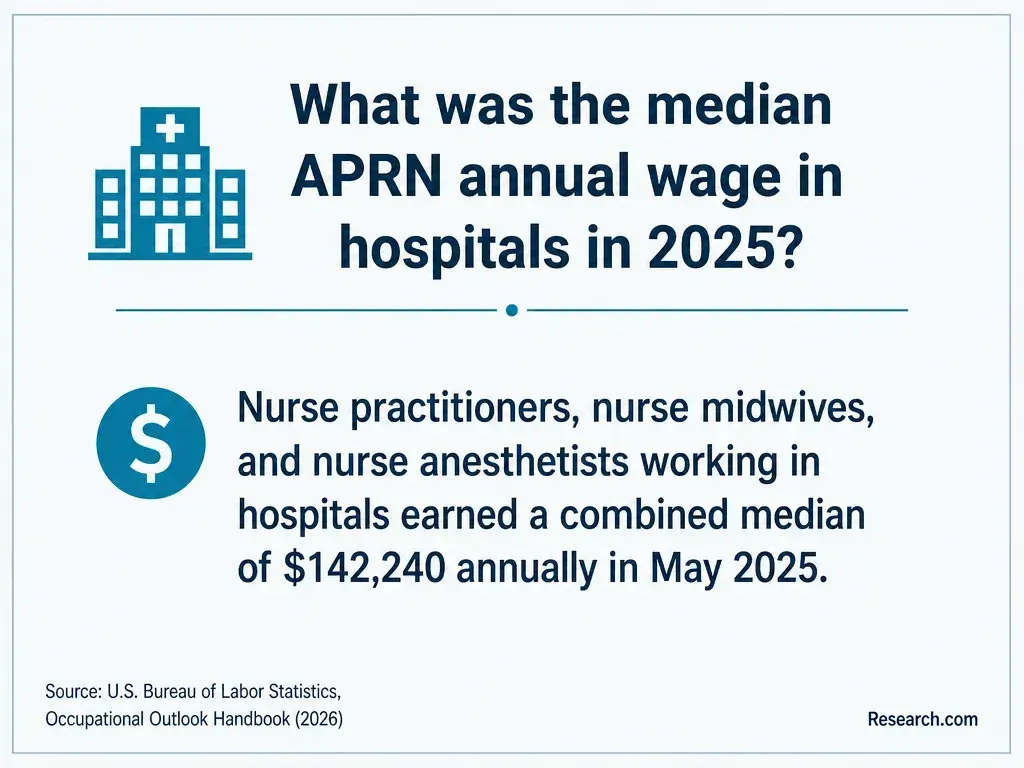
The U.S. Bureau of Labor Statistics reports wages for nurse practitioners, not a separate national PMHNP wage. Its May 2024 median annual wage for nurse practitioners was $129,210. That occupation-wide midpoint is useful for context, but it is not a starting offer or a forecast for a psychiatric specialty, location, schedule, or practice setting. Compare actual local postings and compensation terms - including benefits, call, patient volume, and productivity expectations - before estimating a return on education.
For someone changing careers without an RN license, the pathway starts earlier: compare nursing degrees for non-nursing graduates that genuinely prepare students for initial RN licensure. A previous non-nursing degree may help with admission or prerequisites, but it does not authorize RN or PMHNP practice.
What job outlook and employer standards apply to PMHNP-BC nurses?
BLS projects 40% employment growth for nurse practitioners from 2024 to 2034. That is a projection for the broader NP occupation, not a PMHNP-specific hiring rate or a promise of openings in a particular community. Use it alongside local vacancy listings, employer requirements, and the availability of suitable clinical placements rather than as a reason to enroll by itself.
Employers may check state APRN authorization, national certification, prescribing credentials where applicable, relevant patient-population experience, references, and demonstrated clinical skills. Some positions are designed for newly certified NPs with structured support; others expect independent experience with particular settings or acuity. Ask about orientation, consultation access, caseload, and escalation procedures as carefully as you ask about salary. If a job requires PMHNP preparation, exploring less competitive DNP admissions will only help if the specific program also provides an eligible PMHNP track; an unrelated doctorate is not an employer or licensing substitute.
Other Things You Should Know About Nursing
You may use the credential after ANCC awards it, subject to its rules. Do not present yourself as authorized to practice as an APRN until the applicable state has granted that authority.
Yes. ANCC certification has a five-year renewal cycle with continuing-competence requirements. Check ANCC's current renewal criteria early enough to document qualifying activities.
Certification alone does not authorize cross-state practice. Check the requirements of the state where the patient is located, along with applicable prescribing, employer, and telehealth rules.
Review ANCC's current retesting policy, fees, and waiting period. Use your score report and the current exam content outline to target weak areas; program completion alone does not confer the credential.
- Earnings, job satisfaction, and turnover of nurse practitioners across employment settings | nih.gov https://pmc.ncbi.nlm.nih.gov/articles/PMC10986281/
- ANCC vs. AANPCB: Your Guide to NP Certification Boards | The University of Tulsa https://online.utulsa.edu/blog/ancc-vs-aanpcb/
- What is PMHNP Certification? | Oakstone https://oakstone.com/blog-and-more/pmhnp-certification/
- Certification Discounts | APNA https://www.apna.org/ancc-certification-discounts/
- APRN License Requirements by State 2026 | NursingLicensure.org https://www.nursinglicensure.org/np-state/
- ANCC Certification FAQs | ANA https://www.nursingworld.org/certification/faqs/
- ANCC NP Certification Exam: Format, Eligibility & Prep | RegisteredNursing.org https://www.registerednursing.org/articles/ancc-np-certification-exam-what-to-expect-how-to-prepare/
- 5 Steps to Achieve Success with Your Psychiatric Nurse Practitioner Certification! | npexamcoach.com https://npexamcoach.com/psychiatric-nurse-practitioner-certification-pmhnp-bc-eligibility-and-exam-guide/
- How to Become a Psychiatric Nurse Practitioner (PMHNP) | Nursing License Map https://nursinglicensemap.com/advanced-practice-nursing/nurse-practitioner/psychiatric-and-mental-health-nurse-practitioner-pmhnp/
- What Is a PMHNP? How to Become a Psychiatric Mental Health Nurse Practitioner - NP Programs https://npprograms.org/psychiatric-nurse-practitioner/