2027 Is an Online Ed.D. in Leadership and Learning in Organizations a Good Fit for University Enrollment Managers?
Audited and Verified:
Our Editorial and Data Verification Process
Research.com uses government datasets, official education statistics and primary institutional information to support its career and degree guides. Our review process checks factual accuracy, occupational definitions, source dates and the requirements associated with the credentials discussed.
How This Article Was Fact-Checked
Our editorial team verifies salary estimates, employment projections, education requirements and program information against original data providers and official organizations. Salary figures are checked against the relevant occupational definitions and reporting periods. Information about licensure, accreditation and required in-person training is reviewed separately.
Fact-checked and verified on:

Co-Founder and Chief Data Scientist
University enrollment managers already make consequential decisions about recruitment, access, student success, and institutional resources. An online Ed.D. in Leadership and Learning in Organizations may strengthen their ability to lead change and evaluate what works - but it is a substantial commitment, not a prerequisite for every promotion.
This guide examines where the degree fits enrollment management, what it may leave out, and how to weigh its academic demands and cost against more direct ways to advance.
Key Things You Should Know
- Best fit: Experienced enrollment managers who want to lead cross-campus change, develop staff, and investigate persistent problems in recruitment or student progression.
- Not a promotion guarantee: The U.S. Bureau of Labor Statistics reports a $104,590 median annual salary for postsecondary education administrators in May 2025; that occupation-wide figure is not an Ed.D. graduate salary.
- Before enrolling: Confirm the program's enrollment-relevant coursework, live-session and project requirements, total cost, and whether a shorter credential or larger leadership assignment would better meet your goal.
Is an online Ed.D. in Leadership and Learning in Organizations right for university enrollment managers?
It can be a good fit if your next role requires you to change how people and departments work together - not simply become more proficient at enrollment operations. A leadership-and-learning Ed.D. is a practice-oriented doctorate concerned with organizational improvement, adult learning, and the use of evidence in professional decisions. For an enrollment manager, its strongest application may be leading coordinated work among admissions, financial aid, advising, academic departments, and institutional research.
Consider the problem you are positioned to address. If you can influence staff development, redesign a handoff between offices, or evaluate an enrollment initiative, doctoral study may give you a useful framework and an applied setting. If you primarily need deeper expertise in financial aid rules, customer relationship management systems, predictive modeling, or recruitment operations, targeted training and supervised responsibility may be faster and less costly.
The comparison below links each pathway to a different enrollment-management goal. Program curricula and hiring preferences vary, so treat these as decision criteria rather than promised outcomes.
| Pathway | Potentially strongest fit | Important limitation |
| Leadership-and-learning Ed.D. | Leading organizational change and evaluating improvements in practice | May offer limited depth in specialized enrollment technology or policy |
| Relevant master's study or focused certificate | Building a specific analytics, finance, policy, or management skill | May not provide sustained doctoral-level applied inquiry |
| Research-oriented PhD | Preparing for a career centered on original scholarship | May be less aligned with a manager's immediate operational problems |
| Expanded leadership assignment or employer development | Demonstrating readiness for broader institutional responsibility | Depends on access to mentorship, authority, and meaningful projects |
A doctorate makes the most sense when you want both the learning and the extended opportunity to apply it. Ask whether the roles you actually want prefer doctoral preparation, or instead emphasize budgets, enrollment results, supervisory experience, and institutional fit.
What does an Ed.D. in Leadership and Learning in Organizations prepare graduates to do?
Relevant programs can help managers diagnose organizational problems, lead adult learning, plan change, and evaluate whether an intervention is useful. In enrollment management, that might mean examining why admitted students encounter confusing transitions between offices, then testing a better process with the people who operate it. It does not mean assuming that staff training will fix a problem caused by policy, staffing, or incentives.
Applied inquiry is especially valuable when decisions have multiple stakeholders. A manager might combine process records, staff perspectives, and appropriately authorized student data to distinguish a service bottleneck from a communication problem. Course projects and final doctoral requirements differ: some programs use a dissertation in practice, while others specify a different research or capstone format. Compare online Ed.D. final project format comparisons, then confirm the actual requirement with each program.
Workplace access is not academic approval. Before proposing a project involving student records or employee feedback, establish who can authorize access, what confidentiality and FERPA obligations apply, and whether institutional research review is required. A useful final product could be an evaluation or implementation plan even when restricted data cannot be shared publicly.
How can this Ed.D. advance a career in university enrollment management?
The degree may help an experienced manager compete for responsibilities that extend beyond a single recruitment channel: developing teams, coordinating enrollment strategy across units, evaluating initiatives, or advising senior leaders. Its value is strongest when you can pair the credential with evidence of decisions you owned, people you led, and changes you helped implement. A title alone does not establish that record.
Build a professional portfolio around the work you can discuss responsibly: the problem, your authority, the stakeholders involved, your method, and what the evidence did or did not show. Redact confidential student and institutional information. If you have already completed substantial doctoral study elsewhere, an ABD-to-Ed.D. program comparison guide may help you identify questions about an alternative route; only a receiving institution can determine eligibility and credit applicability.
For advancement within your current institution, seek a cross-functional assignment and candid feedback from the hiring authority before committing to tuition. If the next job chiefly requires a larger budget, direct supervision, or demonstrated enrollment performance, gaining that experience may matter more immediately than starting a doctorate.
Course titles differ, but a well-matched curriculum should develop organizational leadership, adult learning, change implementation, and applied research. For an enrollment manager, the test is whether those subjects can be connected to decisions made across a university - not whether the catalog repeatedly uses the word "leadership."
Look for preparation to diagnose an organizational problem before choosing an intervention; design staff learning that transfers into practice; and assess a program using appropriate qualitative or quantitative evidence. Courses in ethics and governance also matter when decisions affect students and involve restricted records. Some programs offer higher-education or analytics electives, but do not infer a formal concentration or advanced technical training from a single course.
Compare the required sequence with your existing skills. A manager experienced in recruitment but new to evaluation may benefit most from research methods and measurement. One already skilled in analytics may gain more from organizational change and stakeholder engagement. Ask for syllabi and recent project descriptions to see how deeply the program teaches each area.
An online format can let an enrollment manager remain employed and apply coursework at their institution. It does not necessarily make the degree self-paced. Live classes, cohort projects, faculty meetings, and possible campus convenings can conflict with recruitment travel, application deadlines, and the start of an academic term.
Campus-based study may make informal faculty contact and local networking easier, but commuting or relocating can be impractical. Online study shifts more responsibility to the student to schedule collaboration and sustain contact with faculty. Neither format is inherently better for applied work; the decisive questions are whether you can attend required activities and receive useful guidance on a feasible project.
Request the actual meeting schedule, attendance policy, campus-visit requirements, group-work expectations, and options if your employer or job changes. Compare those obligations with your busiest enrollment cycles - not just an average workweek.
Requirements are program-specific. An institution may ask for a completed graduate degree, transcripts, professional experience, recommendations, a statement of purpose, or an interview; it determines which credentials and experience qualify. An education master's is not a universal requirement. Applicants should distinguish meeting an admissions threshold from receiving transfer credit toward doctoral coursework.
As an enrollment manager, describe your actual decision-making scope rather than relying on your job title. A strong application can explain an organizational problem you have encountered, the stakeholders affected, what you have already tried to learn, and why doctoral study is appropriate. Do not claim access to student data or authority to conduct a workplace project unless it has been granted.
If you hold an education specialist degree, online Ed.S.-to-Ed.D. study pathways offer a useful comparison point. Ask each admissions office separately whether the credential supports eligibility, whether any coursework is transferable, and whether an approved evaluation would change your completion plan.
There is no reliable universal completion time or price for online leadership Ed.D. programs. Required credits, course sequencing, enrollment pace, the final project, and any campus visits determine the time commitment. Tuition may be charged by credit or by term, and extending enrollment can add expense even after coursework is finished.
For online Doctor of Education tuition planning, compare written estimates for required tuition and fees alongside travel, lodging, books or technology, and any continuing-enrollment charges. Then account for time away from work and any employer assistance. Reimbursement is not the same as prepaid tuition: check annual limits, grade requirements, covered fees, and repayment obligations if you leave your job.
Ask the program for its current degree requirements and a sample schedule at your intended pace. Calculate the cost of that schedule and a slower one before deciding that the degree is financially workable. Do not base the decision on an assumed promotion or salary increase.
An experienced enrollment manager might pursue broader admissions or enrollment leadership, student-success administration, institutional planning, or a role coordinating change across university offices. The Ed.D. may also support work in professional development or organizational consulting when paired with the relevant functional experience. These are possible paths, not positions conferred by the degree.
The transition depends on what you have already done. A move from managing a recruitment team to overseeing multiple enrollment functions calls for budget, policy, and supervisory experience. A move into student-success leadership also requires familiarity with advising and retention work. Consulting requires a credible record of diagnosing problems and delivering usable recommendations, not just a doctoral project.
Review postings for your target role at comparable institutions. Separate required qualifications from preferred doctorates, then identify the experience you still need. A broadly focused organizational Ed.D. should not be mistaken for a state-approved educator licensure program.
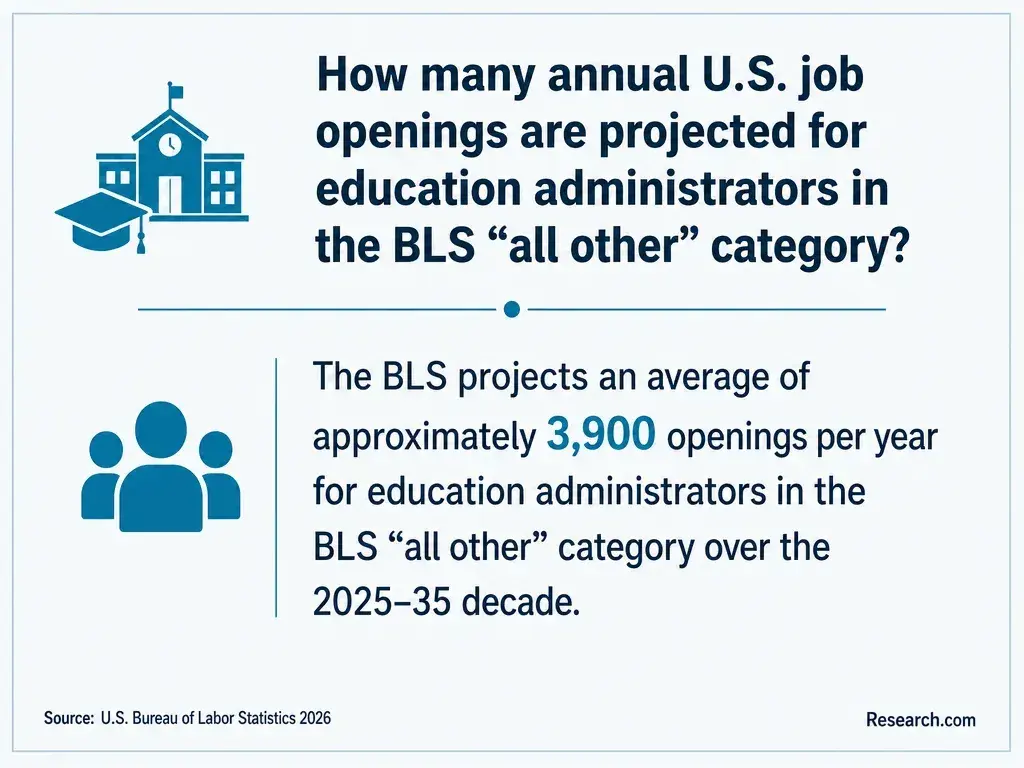
The closest broad federal occupation is postsecondary education administrators, which includes roles beyond enrollment management. The U.S. Bureau of Labor Statistics reports a May 2025 median annual salary of $104,590 and projects 1.8% employment growth from 2025 to 2035. That modest growth suggests applicants should assess specific openings and institutional conditions rather than assume that a doctorate creates demand for senior enrollment leaders.
Neither figure predicts pay for an enrollment manager or measures an Ed.D. salary premium. Compensation depends on the position, institution, location, scope of responsibility, and prior experience. For a practical financial decision, compare compensation for roles you could plausibly seek with and without the degree, and weigh any difference against the full cost of study.
How can prospective students evaluate an accredited online Ed.D. program?
Start by verifying the institution's accreditation with its recognized accreditor and confirming the exact degree awarded. Accreditation is essential to check, but it does not establish that a program has an enrollment-management concentration, qualifies graduates for licensure, or produces a particular career result.
Next, compare published requirements with your intended work: required courses, faculty expertise, live attendance, campus convenings, final-project format, advising, and access to research support. Ask whether a project at your university is permitted, who approves an external or workplace site, and what happens if access changes. Request outcomes information with its cohort size and definition rather than relying on selected alumni stories.
Finally, compare written cost estimates. Resources on organizational leadership doctoral fees and total costs can help frame the questions, but the program must confirm charges for your entry term. Choose the program whose obligations and learning opportunities fit your leadership goal - not simply the one with the most convenient description of "online."
Other Things You Should Know About EdD Leadership
Only if your institution's data and AI policies, the program's rules, and any required approvals permit that use. Do not enter identifiable student records into an unapproved tool.
It is a doctoral degree, but a university decides which credentials meet the requirements of a particular faculty or administrative position. It does not by itself establish eligibility for a tenure-track appointment.
Do not assume so. If international recruitment is your goal, check the curriculum and obtain role-specific training in applicable institutional procedures and immigration compliance.
Possibly, but eligibility depends on factors including the employer, loan type, repayment plan, and qualifying payments - not possession of an Ed.D. Confirm the current federal rules before including forgiveness in a financing plan.
- Accreditation in the U.S. | ed.gov http://www.ed.gov/laws-and-policy/higher-education-laws-and-policy/college-accreditation/accreditation-in-the-us
- Cost of Attendance (Budget) | 2025-2026 Federal Student Aid Handbook https://fsapartners.ed.gov/knowledge-center/fsa-handbook/2025-2026/vol3/ch2-cost-attendance-budget
- Qualified Ed expenses | Internal Revenue Service https://www.irs.gov/credits-deductions/individuals/qualified-ed-expenses
- Maximizing the Impact and ROI of Leadership Development | nih.gov https://pmc.ncbi.nlm.nih.gov/articles/PMC11505461/
- Admissions Requirements - Educational Leadership https://edld.charlotte.edu/admissions/
- The Graduate Field Program and Capstone Evaluation Project | Applied Learning in Social Work Education Journal https://alswe.simmons.edu/article/the-graduate-field-program-and-capstone-evaluation-project/
- Doctor of Education in Educational Leadership - USC Online https://online.usc.edu/programs/educational-leadership/
- Higher Education / Enrollment Management | EPS | SEHD | UM https://eps.edu.miami.edu/graduate/masters/hea-msed/heaem-track/index.html
- Balancing Work, Life, and an EdD: What to Expect in an Educational Leadership Doctorate | Fairfield University https://www.fairfield.edu/news/insights/education-human-development/what-to-expect-in-an-educational-leadership-doctorate.html
- Online EdD Higher Education | Saint Leo University https://onlinedegrees.saintleo.edu/programs/online-edd-higher-education